Tencent Video Integrates with HarmonyOS Device-Side A2A
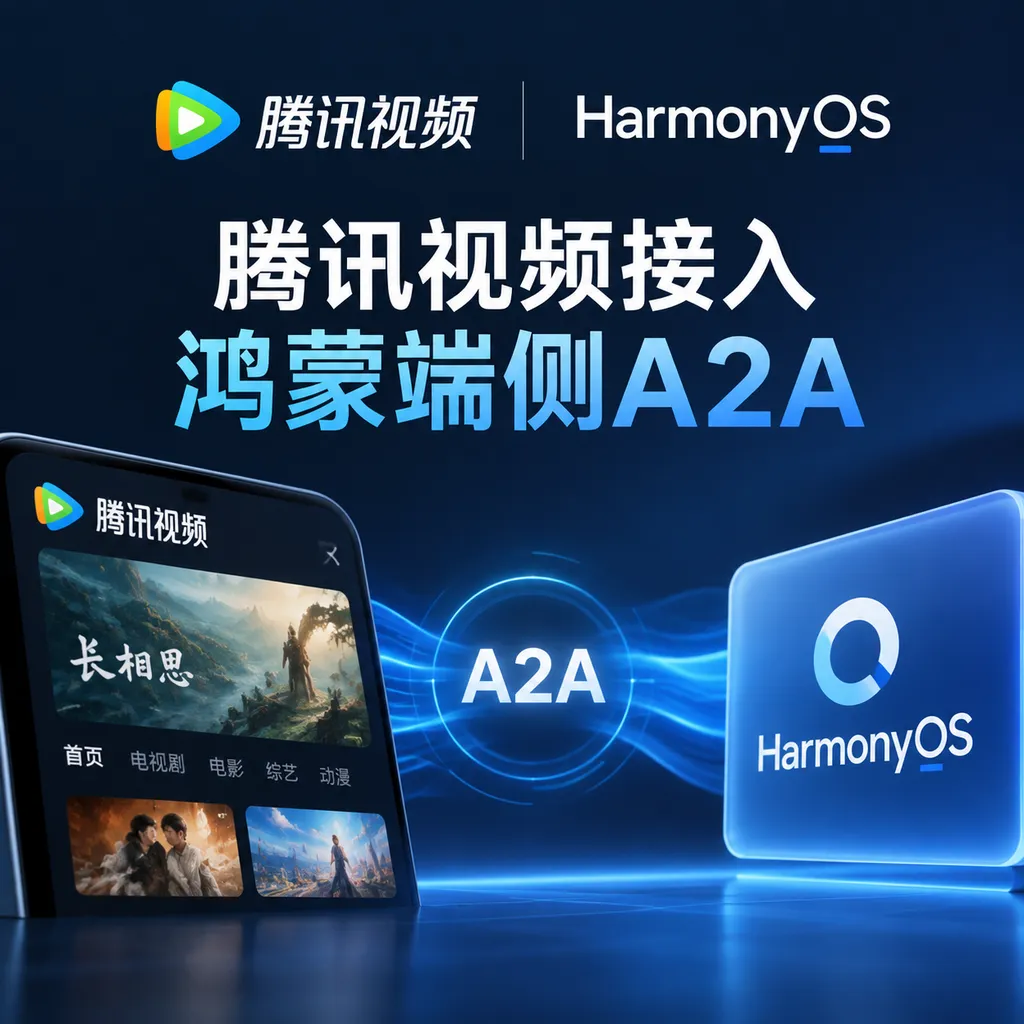
The HarmonyOS version of Tencent Video is the first to integrate openJiuwen A2A. Xiaoyi can call Tencent Video’s AI assistant directly from the playback page, enabling show searches, recommendations, and plot-related Q&A. The real change is not merely the addition of another entry point, but that App Agents are beginning to become system-level AI capabilities that can be discovered and orchestrated.
Tencent Video Integrates HarmonyOS On-Device A2A, Letting Xiaoyi Directly Call an App Agent
The HarmonyOS version of Tencent Video is turning “watching videos” into a task that can be handed directly to the system AI for collaborative completion. On September 11, the Huawei HarmonyOS Developer Technology public account revealed that the HarmonyOS version of Tencent Video has taken the lead in experimenting with on-device agent collaboration based on openJiuwen A2A: users can wake Xiaoyi and have it call Tencent Video’s AI Assistant to select content, make recommendations, and answer questions about the plot within the current playback context.
The key point is not that Tencent Video has added another chatbot, but that Xiaoyi and the Agent within the App finally have a relatively standardized “way of communicating.” In the past, when the system assistant wanted to call an App’s capabilities, it often had to adapt to each interface separately. Now, Xiaoyi is more like a unified task-dispatching hub: it only needs to know “which Agent can do what,” and then pass the user’s intent to the appropriate Agent.
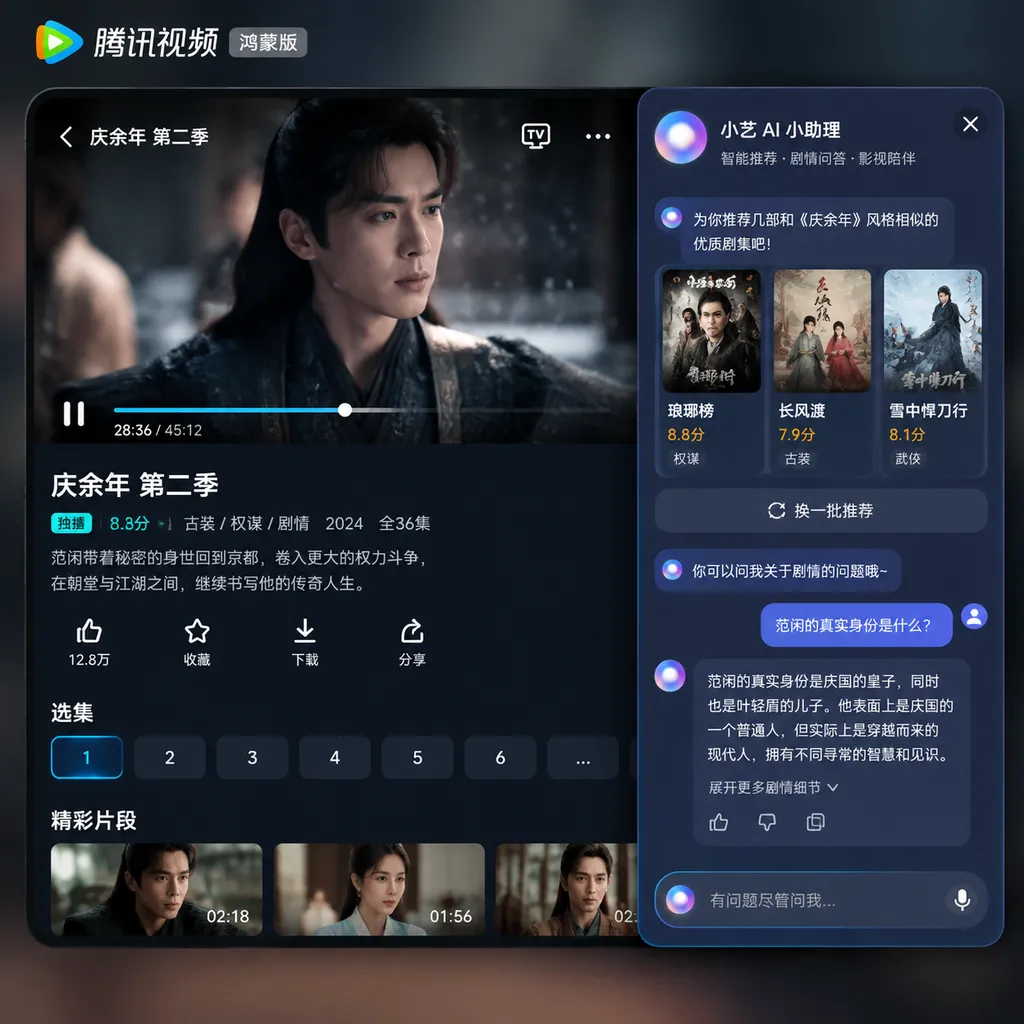
Users Can Ask About the Plot and Find Content Without Leaving the Player
The scenarios publicly demonstrated so far are specific and closely aligned with everyday use. A user can say to Xiaoyi, “Recommend some good movies on Tencent Video,” and Xiaoyi can access Tencent Video’s content library to generate a list of films. After the user taps a card, they are taken directly to the corresponding content page.
If the user is currently using Tencent Video, the system can also use OnApp Chips’ foreground-awareness capabilities to identify the current App and usage context, automatically providing suggestions such as “currently popular TV series,” “new movies of the year,” and “recommended variety shows to watch while eating.” The recommendations are not a block of text detached from the App, but clickable content cards that can start playback when tapped.
Another scenario that better demonstrates the value of A2A is plot Q&A during playback. When watching ensemble dramas, mystery series, or political dramas, users often encounter problems such as confusing character relationships, unexplained foreshadowing, or forgotten details from the previous episode. At this point, waking Xiaoyi sends the question directly to Tencent Video’s AI Assistant for processing. Users do not need to leave the player, copy the title, switch pages, and ask again.
From a product-experience perspective, this goes a step beyond “putting an AI chat box inside the App.” The latter requires users to actively find the entry point; the former allows the system assistant to understand the current context and route the task to the App Agent that best understands the content. Xiaoyi is responsible for understanding and dispatching, while Tencent Video’s AI Assistant handles content retrieval and answers. Each side does what it does best.
What Exactly Does A2A Change?
A2A, or Agent-to-Agent, literally refers to communication and collaboration between intelligent agents. The traditional way of using AI is usually “user—system assistant—tool”: the user makes a request, and the assistant calls a fixed tool. A2A expands the chain to “user—system-level Agent—application Agent—specific capability,” allowing different Agents to collaborate according to their respective roles.
It can be understood in terms of a company’s receptionist, project manager, and specialist departments: Xiaoyi is like a receptionist combined with a project manager. It first determines what problem the user wants to solve and then finds the appropriate application Agent. Tencent Video’s AI Assistant is like the content department, with command of the content library, episode information, and plot-understanding capabilities. Xiaoyi does not need to know what retrieval system or model Tencent Video uses internally; it only needs to know that the Agent can “recommend movies” and “answer questions about the plot.”
The value of openJiuwen A2A lies in defining the interaction model between Xiaoyi and Agents inside applications. Applications register their Agents and available capabilities through standardized interfaces, while the system handles discovery, understanding, routing, and orchestration. For developers, this approach could theoretically reduce a great deal of individually customized interface work.
It addresses a longstanding problem in ecosystem collaboration: every App has its own functions, but the system AI cannot write a dedicated adaptation layer for every App. If integrating a new application requires redeveloping, testing, and maintaining a new batch of interfaces, integration costs rise as the ecosystem grows. If what is integrated instead consists of capability descriptions and standardized task protocols, the system can more easily bring different applications into the same capability network.
Direct On-Device Connections: Response Speed and Privacy Are Key Selling Points
This integration is being emphasized as on-device A2A. According to publicly available information, the agent in the HarmonyOS version of Tencent Video can reuse system channels, shortening the processing path between Xiaoyi and the App and allowing some interaction data to circulate in a closed loop on the device as much as possible.
This does not mean that every answer is generated entirely without going through the cloud, nor does it mean that on-device capabilities are inherently free of privacy risks. However, it does provide a more reasonable technical direction: context recognition, task forwarding, and interface launching that can be completed locally do not need to upload data to remote services at every step. The user’s foreground App, viewing history, and preference information have fewer opportunities to leave the device, and latency may also be lower.
For video scenarios, local awareness is particularly important. The system needs to know what the user is watching, which page they are on, and whether playback is in progress, rather than requiring the user to describe the context again every time. An on-device channel can turn “the content currently playing” into context that the system can understand, after which the Tencent Video Agent can handle more specialized content-related questions.
However, one boundary still requires continued observation: when plot analysis needs to call a cloud-based large model, when user history needs to be synchronized across devices, or when recommendation services involve a more comprehensive user profile, it remains necessary to clarify where data is processed, how long it is stored, and who authorizes it, along with clear permission mechanisms and visible status indicators. The technical selling point of on-device A2A is “fewer detours.” Whether it can truly build trust will depend on whether permissions, logs, and revocation mechanisms keep pace.
A Consistent Experience Inside and Outside the App Is More Useful Than Another Chat Box
A common problem with many system-level AIs is that they can answer questions but may not take users to the correct operating interface. For example, the system assistant may tell you the name of a movie, but you still have to open the video App yourself, search for it, confirm the version, and start playback.
This solution uses card capabilities, allowing Xiaoyi to launch the polished native interface already provided by Tencent Video. The recommendation results retain the App’s own content presentation and operating flow, and users can continue to play the content by tapping a card. For users, system AI and the App are no longer two disconnected experiences. For developers, existing UI capabilities can be reused, eliminating the need to build a separate simplified page for the system assistant.
This is also one of the differences between A2A and ordinary “AI plugins”: a plugin often provides only a passive function that can be called, whereas A2A places greater emphasis on an Agent’s task capabilities, context negotiation, and result presentation. A request may not simply return a string; it may return a set of content cards, an action that can continue to be executed, or even a next step requiring user confirmation.
From an engineering perspective, developers must handle more than model calls. They must also deal with capability descriptions, parameter validation, identity authentication, error fallback, user confirmation, and UI rendering. If an Agent recommends a movie, the system needs to know whether the card can start playback directly. If the user is asking about the current series rather than the entire content library, the call chain must carry the correct context. If the service is unavailable, Xiaoyi must provide an understandable failure message instead of silently timing out.
For the HarmonyOS Ecosystem, the Real Test Is “What Happens After Integration”
Tencent Video is a representative launch partner, but whether A2A can become an ecosystem capability cannot be judged solely by whether a single demo runs smoothly. The key questions are how many applications will subsequently be willing to integrate it and whether they can maintain their integrations over time.
For large Apps, integrating with a system-level Agent may create a new distribution entry point, but it also raises questions about control: after users initiate requests through Xiaoyi, can the App still fully control the recommendation, conversion, and service processes? How should the system Agent handle advertising, memberships, content permissions, and child modes? There must also be clear product boundaries regarding which capabilities an application opens up and which require secondary confirmation.
For small and medium-sized developers, standardized interfaces are good news, but “standardization” should not stop at the documentation level. What developers really care about is whether registration and review are simple, whether debugging tools are complete, whether Agent capabilities have unified authentication and billing methods, who is responsible for troubleshooting when online calls fail, and whether a single integration can cover different devices such as phones, tablets, cars, and computers.
If these issues can be resolved, HarmonyOS’s system AI may have the opportunity to move beyond “helping users open an App” and directly call an App’s professional capabilities. Video Apps can provide content understanding, e-commerce Apps can provide shopping lists, travel Apps can provide routes and orders, and office Apps can provide file processing. Users will not need to remember which App contains a service; they can simply express their intent.
This logic can be summarized as “intent as a service”: the user states what they want to accomplish, the system understands the intent, and then matches it with an Agent or Skill capable of completing the task, skipping the traditional path of “open App—find function—fill in parameters.”
A2A Is Not Universal Glue; Models and Permissions Still Matter
A dose of caution is needed here: A2A solves the problem of “how Agents communicate” with one another, but it does not automatically solve the problem of “whether that communication is accurate.” Xiaoyi may misunderstand the user’s intent, while the Tencent Video Agent may provide an incorrect result because its content library, copyright information, or context is incomplete. A protocol can define the message format, but it cannot guarantee that recommendations and plot answers will always be correct.
In addition, collaboration between intelligent agents is more likely than a single Q&A interaction to produce cascading errors. If one Agent misidentifies the task, subsequent routing, retrieval, and execution may all be based on an incorrect premise. The system therefore needs to let users know which Agent is currently being called, which step is being executed, and which results come from internal application services. When necessary, it should also require confirmation before actions such as playing content, making a purchase, or placing an order.
Supplementary materials indicate that HarmonyOS is making “transparent tool calls and visible, controllable execution processes” part of the agent experience. This is the right direction. A truly mature Agent ecosystem should not merely make AI more like a black-box butler; it should give users the ability to interrupt, inspect, and revoke actions at any time.
For developers, future competition will also shift from “whether an App has AI” to “whether its Agent can be called reliably.” A good application Agent should at least have clearly defined capability boundaries, stable structured outputs, traceable execution logs, and explicit failure handling. Otherwise, integrating with system-level AI will only amplify the application’s existing problems.
Assessment: A Step for HarmonyOS’s AI Ecosystem From Entry Point to Hub
The significance of Tencent Video’s integration of on-device A2A lies not in users having to tap fewer times, but in the changing relationship between system AI and application AI. In the past, system assistants mainly served as entry points and shortcuts. Now, they are beginning to act as discoverers, routers, and collaboration orchestrators for application Agents.
For users, the first thing they will notice is the convenience of watching series: find a show with one sentence, tap a card to start playback, and directly ask about anything they do not understand, without switching back and forth between the player, search box, and chat window. For developers, the more important question is whether a single integration can bring system-level distribution, and whether standard protocols can expose their specialized capabilities to more scenarios.
This is still an early-stage implementation. Public information is not yet sufficient to prove that a large-scale ecosystem has formed, and on-device A2A should not simply be equated with fully localized AI. But the direction is clear: as App Agents begin to be discovered and dispatched uniformly by system AI, competition among mobile operating systems will no longer be only about the number of applications and interface efficiency. It will also be about whether they can organize a usable, trustworthy, and controllable network of intelligent agents.
Tencent Video is the first typical example in this network. What remains to be seen is whether more applications can integrate in the same way, and whether Xiaoyi can turn “knowing that this Agent exists” into “accurately handing the task over to it.” If the answer is yes, the AI experience on HarmonyOS will have moved from a showcase feature into the infrastructure stage.
References
- ITHome: HarmonyOS Version of Tencent Video Launches On-Device A2A Capabilities—Introduces the functions and technical highlights of Tencent Video and Xiaoyi collaborating through openJiuwen A2A.
- HarmonyOS Developer Technology Public Account Information—ITHome’s compilation of the officially disclosed information, covering OnApp Chips, application Agent integration, and on-device collaboration.
This article was compiled based on publicly available information. Some technical judgments are based on disclosed product mechanisms; actual functionality and data-processing methods are subject to the official version and privacy statements.