Tesla Teases FSD v15 Active Collision Avoidance Upgrade
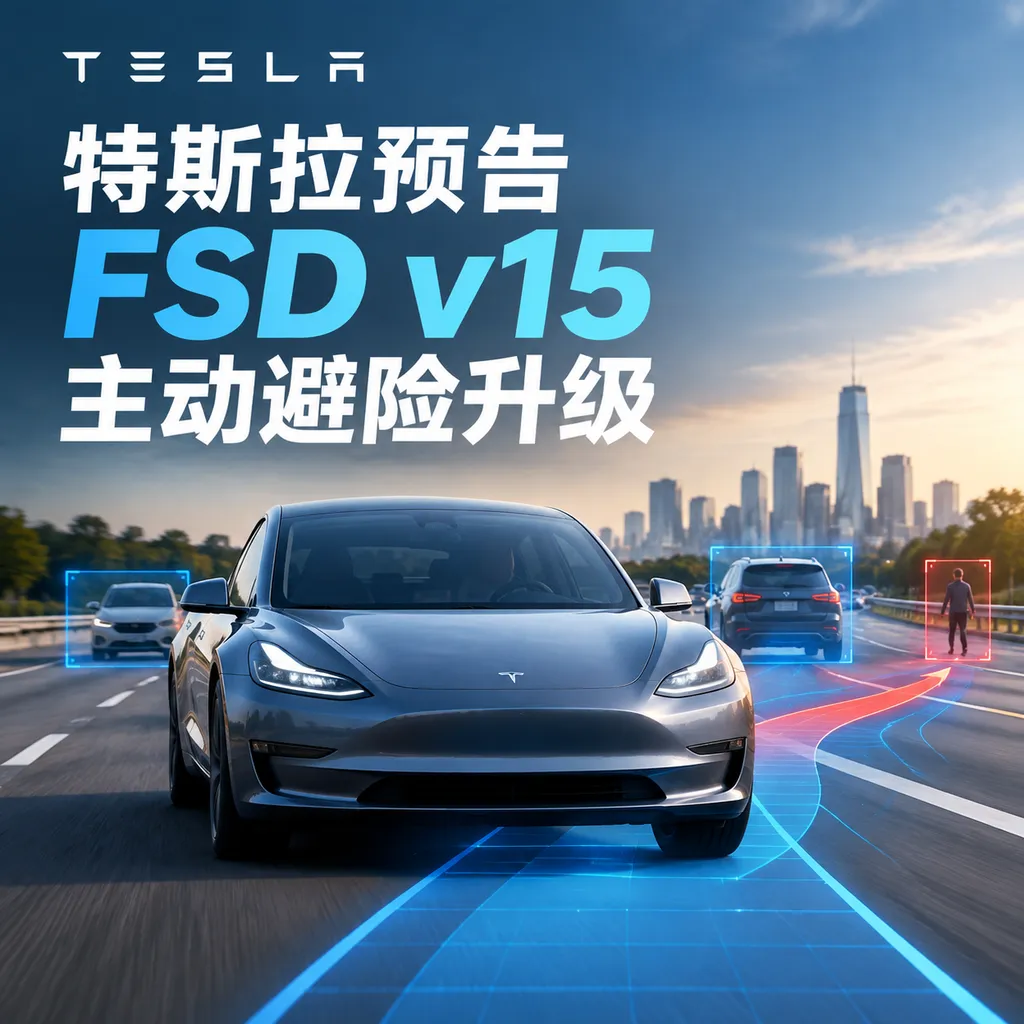
Tesla’s head of AI revealed that FSD v15 will focus on improving its ability to proactively avoid danger, enabling it to predict hazards earlier and react more quickly, while also strengthening the coordination between prediction and control. Early versions have already been tested on some Robotaxi vehicles, but the promise of being “ten times better than humans” still requires validation with real-world driving data.
Tesla Is Focusing FSD v15 on “Act First, Explain Later”
Tesla is preparing a substantial upgrade for FSD v15. On September 12, Tesla AI chief Ashok Elluswamy revealed, in connection with a near-collision incident, that the new version will focus on strengthening active collision avoidance: detecting danger earlier, responding faster, and further improving overall safety and collision-avoidance capabilities.
This is not an ordinary feature update. Internally, Tesla views v15 as an architecture-level upgrade. The neural network will grow significantly, and the connections between the vehicle’s environmental prediction, decision-making, and control will become tighter. In other words, FSD v15 is not merely trying to “see more clearly”; it aims to shorten the entire chain from recognizing a risk to actually turning the steering wheel and applying the brakes.
For autonomous-driving systems, active collision avoidance often creates a greater distinction than “driving like a human on normal roads.” Mainstream driver-assistance systems can already follow vehicles and stay in lanes with considerable stability. What truly tests a system is when the vehicle ahead suddenly changes lanes, a vehicle emerges from behind an obstruction, an unexpected road user crosses an intersection, or the system must immediately choose a lower-risk action while a human driver is still hesitating.
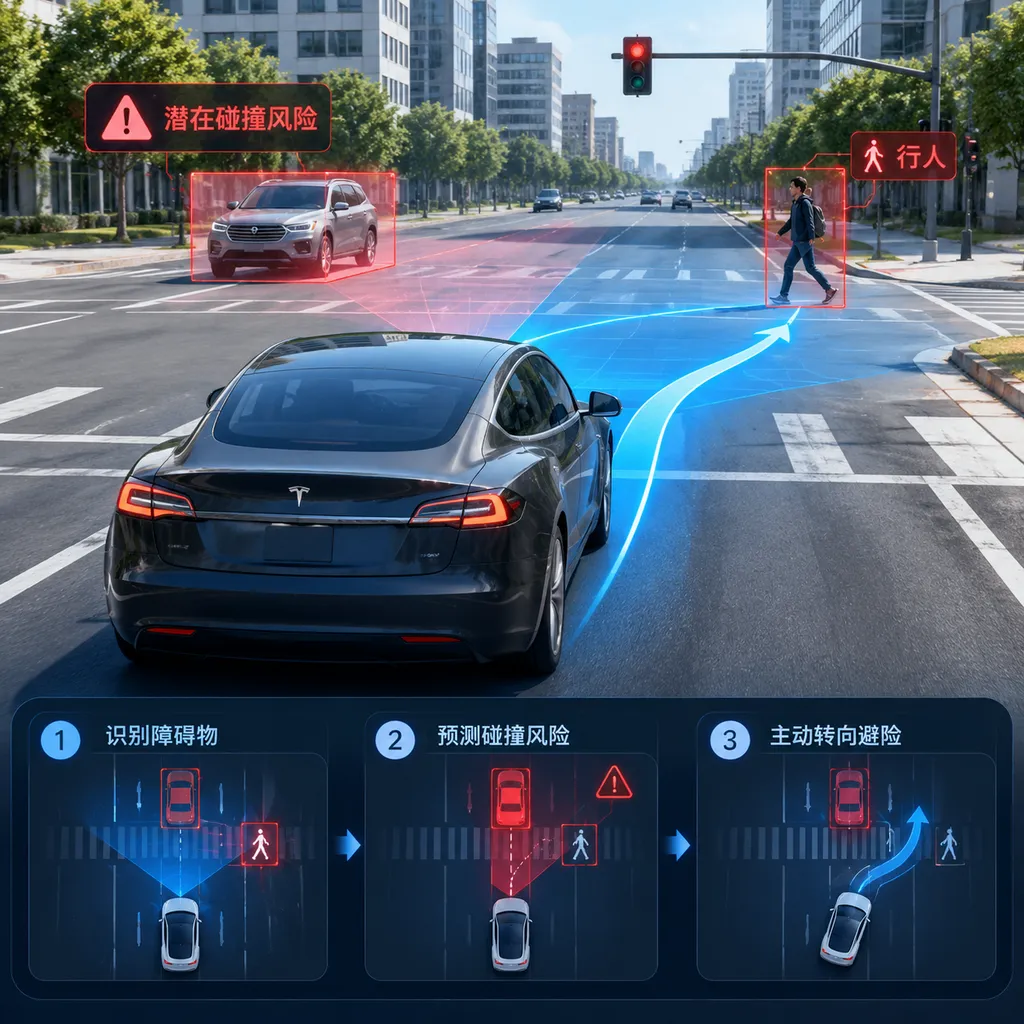
One Near-Miss Reveals the Most Difficult Few Hundred Milliseconds in Autonomous Driving
In the incident mentioned by Elluswamy, a Tesla actively steered to avoid another vehicle leaving a parking lot, ultimately preventing a potential collision. He said on social media that he was grateful the owner was safe, and stated that FSD v15 would deliver earlier hazard prediction, faster reaction times, and a significant overall improvement in safety and collision avoidance.
From the user’s perspective, this may have looked like the vehicle “suddenly turning the wheel.” From the system’s perspective, however, the vehicle had to complete a series of judgments in a very short time:
- Determine whether the object leaving the parking lot would enter the vehicle’s path;
- Estimate the other vehicle’s speed, direction, and next move;
- Distinguish between the other vehicle merely nosing out and being about to enter the roadway;
- Calculate whether braking, slowing down, changing lanes, or going around the obstacle would pose the lowest risk;
- Confirm that the evasive maneuver would not take the vehicle into an adjacent lane, the curb, or another obstacle.
Human drivers make similar judgments, but these processes are compressed into intuition. An autonomous-driving system, by contrast, must use cameras, neural networks, prediction models, and vehicle controllers to complete the same work within a few hundred milliseconds or less. If any link in the chain is delayed, the system may shift from “avoiding the danger in advance” to “braking after the collision.”
That is why Tesla’s emphasis on “earlier prediction” and “faster response” actually addresses two different problems. The former determines whether the system has enough time to make a decision; the latter determines whether it can rapidly turn its judgment into vehicle motion after detecting danger. Improving perception accuracy alone without optimizing control may leave the vehicle able to see a risk but unable to avoid it in time. Improving execution speed without reliable prediction, meanwhile, can lead to excessive braking or unnecessary steering.
The Key to v15 Is Not Simply Larger Parameters
Available information indicates that FSD v15 will expand the neural network and establish a closer relationship between the prediction and control modules. One claim circulating externally is that Tesla may increase the model’s parameter count from approximately 1 billion to 10 billion. If that figure is ultimately verified, it would mean the model has grown by roughly an order of magnitude.
However, larger parameter counts do not mean that autonomous-driving capability will inevitably improve tenfold. Parameters are more like a model’s “capacity”: they allow the system to remember and express more complex patterns, but they cannot by themselves guarantee that these capabilities will perform reliably on real roads. What truly matters is whether data quality, training objectives, inference latency, onboard computing power, and safety-validation methods can all keep pace.
Tesla’s technical approach has always been distinctive. Compared with solutions that rely on high-definition maps, lidar, or large numbers of manually defined rules, Tesla places greater emphasis on vision-based, neural-network-driven end-to-end driving. The vehicle must not merely identify “a car here and a lane there”; it must understand the movement trends of road users from continuous video and then directly generate driving actions.
The advantage of this approach is that the system can use enormous amounts of real-world road data to continuously learn from long-tail scenarios. The problem is that its internal decision-making process is more difficult to explain and validate. A rule-based system can explicitly state, “Apply the brakes when the distance is less than a certain number of meters.” An end-to-end model may decide to steer based on the combined influence of multiple visual cues. It may be closer to the flexibility of human driving, but it also requires large-scale testing and strict safety boundaries.
If v15 really does integrate prediction and control more closely, it could mean that the system will no longer divide the driving process neatly into several mutually independent modules—“perception, prediction, planning, and control”—but instead allow those modules to share more contextual information. The goal would be to reduce information loss and delay as data moves between modules.
As a simple example, a traditional system might first determine that “there is a pedestrian ahead,” then have the prediction module calculate the pedestrian’s trajectory, after which the planning module chooses between braking and going around the pedestrian. A more tightly integrated architecture might directly understand that “this pedestrian is looking toward the road, their feet are pointed toward the lane, and they are very likely to enter the vehicle’s path in the next second,” thereby releasing the accelerator early and preparing to brake. For safe driving, this advance margin is often more important than hard braking at the last moment.
Automatic Collision Avoidance Is Becoming a Safety Foundation Rather Than an Assistive Feature
At the same time, Tesla has begun rolling out Automatic Collision Evasion to some existing customer vehicles. Notably, this capability does not depend entirely on whether the driver has enabled FSD. Even when the vehicle is being driven manually, the system can intervene when necessary if it determines that a collision is imminent.
This represents an important direction: the value of driver-assistance systems is no longer limited to handling cruising, following, and lane changes for the driver. It also includes serving as the last line of defense when the driver makes a mistake or has no time to react. The vehicle can perform emergency braking or limited steering corrections when the driver is distracted, misjudges a situation, or brakes too late.
But “active intervention” is also a double-edged sword. The system must determine in an extremely short time whether it should take control. It must neither suddenly steer when there is no genuine risk nor miss a real collision window out of fear of false activation. Especially on highways, through construction zones, and in mixed-traffic environments, one incorrect evasive maneuver could create a new danger.
Therefore, the most important metrics for automatic collision avoidance should not simply be how many obstacles it successfully avoided in demonstration videos. They should include:
- Under how many different road, weather, and lighting conditions it is effective;
- Whether it remains stable when facing motorcycles, pedestrians, bicycles, and unconventional vehicles;
- Whether the system adequately considers adjacent lanes and blind spots when it steers actively;
- Who has ultimate control when the driver and system operate the vehicle simultaneously;
- Whether the vehicle can keep the risk within an acceptable range after making an incorrect judgment.
These questions determine whether it is truly a reliable safety foundation or merely a “second driver” that requires constant vigilance from the human driver.
The Robotaxi Fleet Has Become v15’s First Real-World Testing Ground
Tesla has begun testing early versions of v15 in some Robotaxi fleet vehicles. During the company’s second-quarter earnings call in July this year, Tesla disclosed that modified Model Ys providing autonomous-driving services within the Robotaxi network were already equipped with an early test version of FSD v15.
Having the Robotaxi fleet test the system first offers clear engineering value. Ordinary users’ daily routes, weather conditions, and operating habits vary widely, making data collection inconsistent. Fleet vehicles, by contrast, can run continuously within fixed areas, making it easier to collect consecutive samples from the same locations and the same types of road conditions. When the system encounters danger, requires human intervention, or performs an abnormal maneuver, Tesla can also more easily reconstruct the entire process.
However, Robotaxi testing cannot be equated directly with readiness for large-scale use in privately owned vehicles. Fleet vehicles are often concentrated in selected cities and on selected routes, and their vehicle condition, remote support, and operating rules may also differ from those of ordinary owners. A system that performs well within a limited area is not necessarily ready to face nationwide construction changes, severe weather, temporary traffic controls, and every possible driving style.
A more realistic pace may be for the Robotaxi fleet to encounter a large number of boundary cases first, after which Tesla gradually delivers vetted capabilities to consumer vehicles, and only later discusses broader operation without human supervision. For v15, what truly matters is not the four words “when it will launch,” but whether it can turn dangerous scenarios discovered by the test fleet into verifiable and reproducible safety improvements.
“Ten Times Safer Than Humans” Remains a Goal That Requires Qualification
Musk has repeatedly set ambitious goals for FSD v15. In April this year, he claimed that FSD v15 would be far safer than humans, even in fully unsupervised and complex scenarios. Earlier, in August 2025, he also stated that the driving performance of FSD v14 would surpass that of human drivers and that v15 could reach ten times the safety level of human driving.
These statements are attention-grabbing, but developers and vehicle owners cannot look only at the promotional language. First, “ten times safer than humans” requires a clearly defined denominator and statistical methodology. Does it mean the number of collisions per million miles, or the number of times a driver must take over per million miles? Does it include all accidents, or only rear-end collisions the system could have avoided? Different statistical methods can produce completely different conclusions.
Second, human driving is not a fixed benchmark. Risk varies greatly among novice drivers, fatigued drivers, professional drivers, and cautious drivers. If an autonomous-driving system wants to claim that it surpasses humans, it must at least undergo long-term comparisons on the same roads, in the same weather, during the same periods, and under similar traffic density—not compare a small number of successful cases with overall human accident data.
Third, average system performance and performance in extreme scenarios may be entirely different. An autonomous-driving system may operate steadily in 99.9% of ordinary conditions, while the remaining 0.1% of long-tail scenarios may determine the severity of an accident. True safety is not about making the vehicle behave like an experienced driver most of the time; it is about having the vehicle recognize when it is uncertain and take a conservative action.
Therefore, v15’s safety promises should be understood as engineering goals rather than completed conclusions. Tesla’s optimistic predictions for multiple previous FSD versions have not always been fulfilled as promised. v15 may indeed bring an architectural and capability leap, but before a broad rollout, it will still need independent data, regulatory approval, and long-term on-road performance to prove itself.
Parameter Expansion May Also Serve Personalized Driving
In addition to active collision avoidance, Tesla is also believed to be adding stronger personalization capabilities to FSD. According to related information, personalization features may arrive with v15 this winter or early next year. With a larger representation space, a large model could theoretically retain general driving capabilities while also accommodating the preferences of specific owners.
In the past, FSD was more like a driver with “uniform standards”: regardless of who owned the vehicle, the system followed the same following distances, lane-changing rhythm, and route choices. After personalization, the system might gradually learn a driver’s preferred style—for example, changing lanes earlier, maintaining a greater following distance, avoiding complex intersections, or choosing parking positions that better match the driver’s habits on familiar routes.
This change could improve the FSD user experience. Many users do not believe that the system is completely incapable of driving; rather, they feel that it does not drive “like them”: it follows too conservatively, hesitates too much when changing lanes, or takes unexpected routes through parking lots. As long as the safety boundaries remain unchanged, allowing the system to adapt to users within those boundaries could naturally increase willingness to subscribe to and use the service.
Tesla has already been building the relevant data loop. After a driver takes control of the vehicle, the system can ask the user to select a reason for the intervention, helping distinguish whether the route was unreasonable, the maneuver was too aggressive, the response was too slow, or the driver simply changed the destination temporarily. The vehicle’s cameras can also provide information about attention and control inputs, helping the system determine whether a takeover resulted from a genuine driving preference or a moment of nervousness.
An ideal feedback loop would look roughly like this: the driver takes over in a certain type of scenario; the system records the scenario and feedback; the next time it encounters a similar situation, it adjusts its strategy; and then it observes whether the driver takes over again. After repeated iterations, FSD gradually develops a driving model for that individual.
However, personalization cannot alter the safety baseline. A vehicle owner’s preference for more aggressive lane changes does not mean the system should reduce the safety distance. A driver’s habit of moving quickly through intersections does not mean the vehicle can lower its vigilance toward pedestrians and non-motorized road users. Truly viable personalization should mean “adapting to preferences within safety constraints,” not allowing the model to learn the driver’s bad habits as well.
Tesla’s Real Competitive Advantage Is the Data Loop, Not a Slogan
Whether v15 succeeds will ultimately depend on whether Tesla can do several things at once: build a larger model, maintain sufficiently low onboard latency, collect continuous video data, perform stable over-the-air updates, and rapidly correct failures.
Tesla’s greatest advantage remains the size of its fleet and its data loop. Every vehicle can serve as a mobile data-collection terminal. Vehicles operating in different cities, weather conditions, and driving styles can continuously generate training samples. As long as the company can effectively filter for high-value scenarios, it has an opportunity to incorporate dangerous cases that are extremely difficult to construct manually into training.
But more data does not automatically mean greater safety. Whether data collection covers critical long-tail scenarios, whether labeling and replay are accurate, and whether model updates undergo sufficient validation are equally important. The faster an autonomous-driving system iterates, the more it needs strict version management and rollback mechanisms. Otherwise, an update that appears to improve average performance could introduce new risks in a small number of critical scenarios.
From this perspective, the significance of v15 is not merely that “the parameter count has increased from 1 billion to 10 billion.” It is whether Tesla is transforming FSD from a driver-assistance feature into a continuously learning and continuously validated intelligent system running in the vehicle. The former looks more like a software upgrade; the latter is closer to infrastructure construction.
What Should Developers and Vehicle Owners Watch Now?
For ordinary vehicle owners, after v15 is released, the most important thing to observe is not whether the vehicle occasionally performs a more aggressive evasive maneuver, but whether the system remains consistent during continuous use:
- Whether it can slow down earlier when vehicles and pedestrians suddenly emerge from behind obstructions;
- Whether it reduces last-second hard braking and sharp turns at complex intersections;
- Whether the vehicle remains predictable after automatic collision avoidance intervenes;
- Whether its capabilities decline significantly in construction zones, at night, and in rain or snow;
- Whether the driver takeover rate and takeover reasons continue to improve after system updates.
For developers and industry observers, the harder metrics to watch include end-to-end inference latency, hazard-prediction lead time, takeover rate, false-trigger rate, accident rate per million miles, and whether system capabilities remain consistent across different hardware configurations. Only when more of this data is gradually disclosed can the outside world determine whether v15 represents a genuine architectural upgrade or merely a more grandly packaged version iteration.
If Tesla opens up more driving-event data in the future, autonomous-driving developers will also gain new research samples. For teams working on simulation, data loops, risk assessment, and onboard inference optimization, FSD v15 may encourage the industry to shift its attention away from simple object recognition toward questions such as “How will the danger evolve over the next few seconds?” and “How should the vehicle act under uncertainty?”
Conclusion: Build the “Lead Time” First, Then Talk About Unsupervised Driving
The most commendable aspect of FSD v15’s current direction is that it places active collision avoidance at the center of the product upgrade. The value of autonomous driving has never been limited to taking over cruising; it also lies in making an early judgment while danger has not yet fully emerged and preserving sufficient room to act. Earlier prediction is generally more valuable than perfect recognition that comes too late, while faster control must likewise be built on the premise that it does not create new risks.
Tesla has already placed early v15 versions into some Robotaxi fleets and begun rolling out collision-avoidance capabilities to consumer vehicles. This shows that v15 is not remaining at the concept stage of a presentation but is entering real-world validation. However, the distance between “successfully avoiding danger in some scenarios” and “consistently achieving safety far beyond human levels in complex environments” still involves extensive testing, regulation, and questions of responsibility.
For vehicle owners, the right expectation is not to treat v15 as a driver to which they can completely hand over control, but as a safety system that intervenes earlier and faster. For Tesla, the real challenge is not to announce another goal of being “ten times safer than humans,” but to use repeatable data to prove that the system truly detects risks earlier, performs fewer dangerous maneuvers, and chooses conservative actions when it is uncertain.
If these goals are ultimately fulfilled, FSD v15 will represent an important step for Tesla from competing over the “driver-assistance experience” to competing over “machine safety judgment.” If they are not, it will once again remind the industry that the hardest part of autonomous driving has never been getting a vehicle to drive in a demonstration, but enabling it to consistently take the right action before unexpected events occur in the real world.
Sources
- ITHome: Tesla FSD v15 Will Improve Active Collision Avoidance: Covers Tesla’s AI chief’s disclosures regarding earlier hazard prediction, faster reactions, and automatic collision-avoidance capabilities.
- ITHome: Musk Says Tesla FSD v15 Safety Will Far Exceed Human Levels: Summarizes Musk’s previous statements regarding FSD v15’s safety goals and progress on related versions.
Note: This article was written based on public reports and public statements by Tesla management. The final features, rollout scope, performance metrics, and regulatory status of FSD v15 are subject to Tesla’s official announcements.