LightNav-0 Enables Robots to Zero-Shot Change Bodies
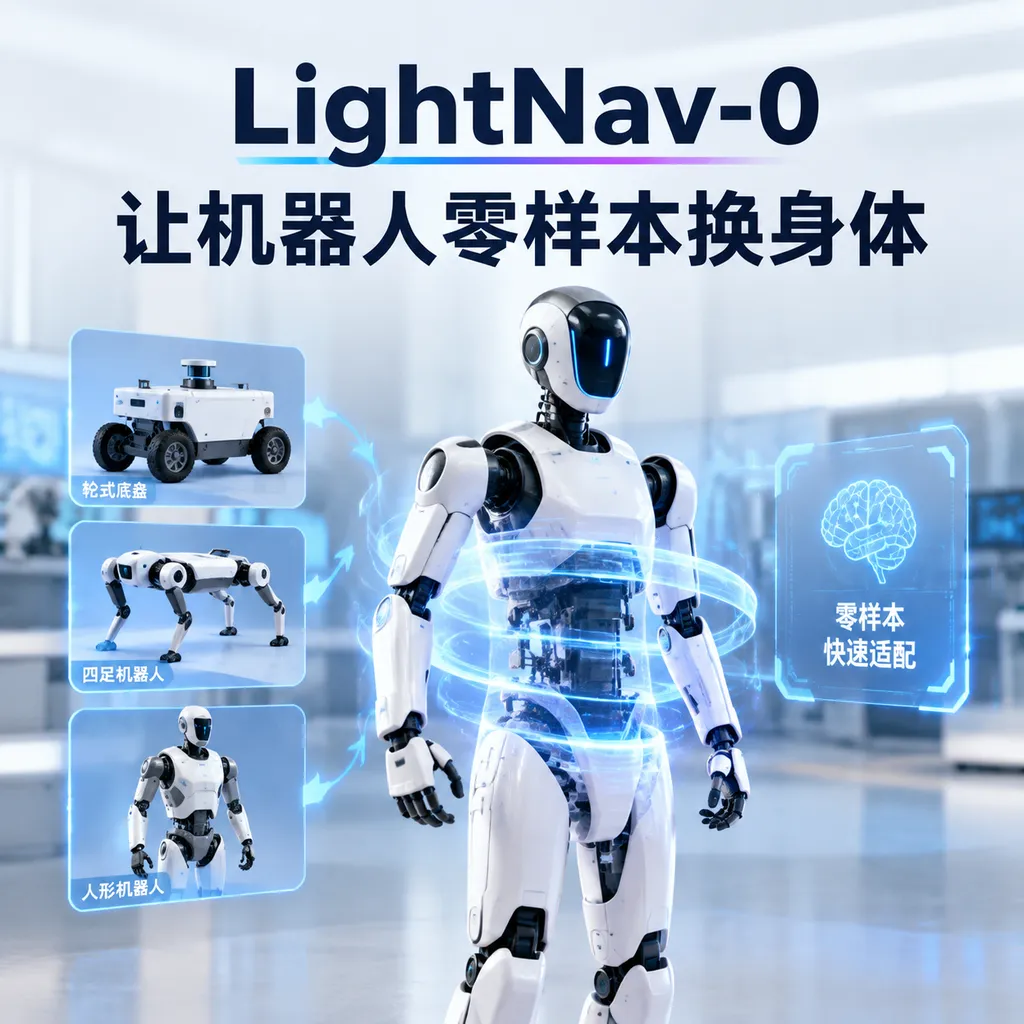
Liangyuan Xinchuang’s open-source navigation model LightNav-0 uses the Real2Sim2Real data engine to convert more than 2,000 real-world scenes into simulation worlds for repeated training, achieving zero-shot navigation generalization across four robot embodiments without fine-tuning for the target robot, scene, or task.
LightNav-0 Lets Robots Zero-Shot Switch Bodies
LightNav-0, a general-purpose navigation model recently open-sourced by Liangyuan Xinchang, is shifting the competition in embodied intelligence from “whether robots can walk” to “whether the same model can continue walking after switching to another body.”
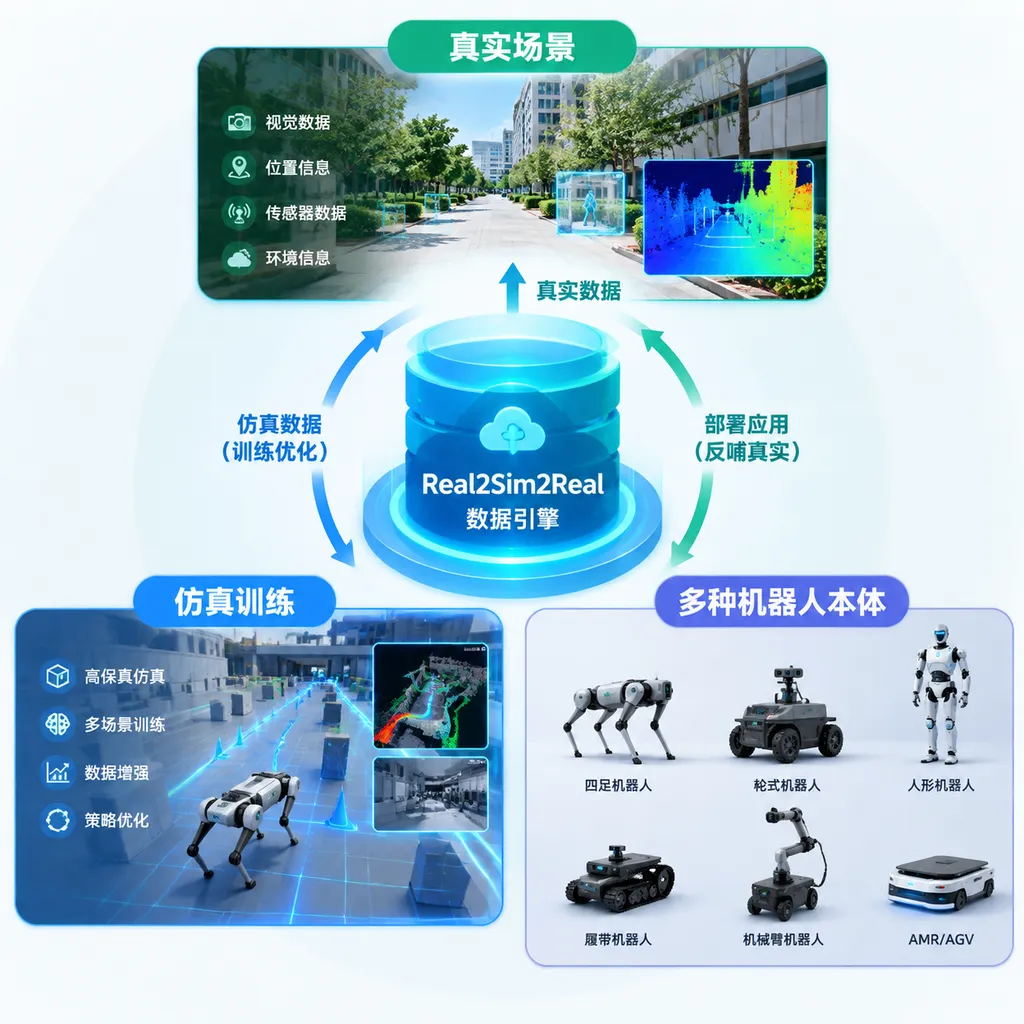
According to publicly available information, LightNav-0 is built on a Real2Sim2Real data engine that converts more than 2,000 real-world scenes sourced from the internet into reusable simulation environments and generates over 4,000 hours of visual, language, and action post-training data. More importantly, it claims to achieve zero-shot real-robot generalization across embodiments, tasks, and scenarios without using training data from the target robot, target environment, or specific target task, and without additional fine-tuning.
The value of this development lies not in adding yet another VLN (Vision-and-Language Navigation) model, but in Liangyuan Xinchang’s attempt to solve one of the most practical barriers to deploying embodied intelligence: can the capabilities learned by a model be separated from the robot it was trained on?
The Challenge in Robot Navigation Is Not “Understanding the Map”
Traditional robot navigation already has a relatively mature engineering workflow. A map is first built using LiDAR or cameras, then the robot is localized, and finally a planner calculates an obstacle-avoiding route. For products such as warehouse robots and robot vacuum cleaners, whose environments have clear boundaries and relatively fixed tasks, this approach remains effective.
But the foundation-model approach aims to do something different. It hopes that a robot can act in an open environment without a prebuilt map using only cameras, language instructions, and its own historical state. When a user says, “Go next to the sofa in the living room,” “Go around the obstacle ahead,” or “Find somewhere to sit,” the robot must not only recognize objects, but also understand spatial relationships, determine its own position, and convert the language goal into continuous actions.
The challenge therefore shifts from simple path planning to a long-horizon decision-making problem:
- Which information in the current view is relevant to the task;
- Whether the direction the robot sees is actually the direction in which its body can move;
- Whether a road that appears passable is truly wide enough for the robot to get through;
- When the target is temporarily out of sight, whether it should continue exploring, take a detour, or return to the previous decision point;
- After switching to another type of robot, whether an action that was previously effective will still work.
Here, a “navigation model” is more like a space-aware action hub than a map module in the traditional sense. It needs to incorporate vision, language, historical trajectories, and the robot’s movement capabilities into a single decision-making process.
Four Robot Embodiments Test Transferability
The differences between robots are far greater than simply changing a camera. Wheeled platforms typically move forward, backward, and turn on a plane; quadruped robots can cross obstacles and navigate slopes, but their cameras continuously change as their bodies pitch and roll; bipedal robots offer a viewpoint closer to that of humans, while having to manage balance and gait; robotic arms or mobile manipulation platforms may be constrained by coordination between the base and the actuators.
The same instruction to “move forward” corresponds to entirely different action spaces on different embodiments. For a wheeled robot, it may mean linear and angular velocity; for a quadruped, it also involves gait, footholds, and body posture; for a biped, whether the action is stable may matter more than the distance to the target.
If a model merely memorizes the actions and visual frames in its training data, its policy will quickly fail when transferred to another embodiment. Genuine zero-shot cross-embodiment generalization means that the model must learn more abstract spatial patterns: where obstacles are, in what direction the target lies relative to the robot, whether a passage is wide enough, and whether the robot is currently capable of executing a particular movement.
This is also what makes LightNav-0 especially worth watching. Rather than training four separate navigators for four types of robots, it attempts to use one unified model to process perception and action outputs across different embodiments. Here, “zero-shot” does not mean that robots require no engineering adaptation whatsoever. Instead, it means that when deploying the model on a new robot, in a new scenario, or for a new task, it does not depend on large-scale, targeted data collection or additional fine-tuning.
In other words, what the model transfers is navigation capability, not the muscle memory of a particular machine.
Real2Sim2Real: Bringing the Real World into the Training Ground First
Data has always been the biggest bottleneck for embodied models. Language models can obtain massive amounts of text from the internet, and vision models also have large-scale image and video datasets, but robot action data is much harder to acquire. Repeatedly letting a real robot experiment in shopping malls, residential buildings, industrial parks, and complex indoor environments is costly, slow, and potentially unsafe.
Even more troublesome is that every fall and collision can cause hardware damage. Covering enough combinations of floor materials, lighting conditions, furniture layouts, and obstacles is nearly impossible to scale through real-robot data collection alone.
The Real2Sim2Real approach used by LightNav-0 can be summarized in three steps:
- Real2Sim: Reconstruct simulation environments from real-world images, videos, or scene assets;
- Simulation training: Generate large-scale visual, language, and action trajectories in simulated environments, allowing the model to repeatedly experience different navigation tasks;
- Sim2Real: Transfer policies learned in simulation to real robots and execute them through a perception-action loop in the real world.
Public information indicates that Liangyuan Xinchang has converted more than 2,000 real-world scenes into reusable simulation environments and generated more than 4,000 hours of post-training data in total. This figure alone does not mean that the model is necessarily stronger, but it does show that the team is building not a one-off dataset, but a pipeline capable of continuously producing training experience.
The key advantage of this approach is that it makes failure inexpensive. Robots can crash into walls, get lost, and enter dead ends in simulation. The system can also repeatedly generate extreme viewpoints and difficult paths for a particular embodiment. As long as the simulation environment is sufficiently close to the real world, the model can encounter more long-tail situations before deployment.
Of course, simulation is not inherently reliable. Real-world conditions include reflective materials, dirty lenses, exposure changes, dynamic pedestrians, differences in ground friction, and sensor latency. All of these can cause a strategy that works in simulation to fail on a real robot. Therefore, the challenge of Real2Sim2Real has never been simply “turning a scene into a 3D model.” It is about preserving the visual and physical factors that truly matter for decision-making while allowing irrelevant details to vary sufficiently at random.
“Seeing Ahead” Does Not Mean “Knowing How to Get There”
Cross-embodiment navigation is particularly vulnerable to one problem: the world seen by the camera is not the same as the world the robot’s body can act in.
Take a quadruped robot as an example. Its camera may be mounted on its chest or head. When the robot lifts a leg, crouches, or moves up and down a slope, its viewpoint changes with its posture. The “front” in the image is not always stable in world coordinates. An object that appears close at hand may actually require a complicated detour, while a path that looks flat may exceed the robot’s current ability to step over obstacles.
The model must therefore process three types of information simultaneously:
- External environment: Obstacles, passages, doors, stairs, target objects, and so on;
- Task semantics: Where the user wants to go or what action the user wants the robot to perform;
- Embodiment state: Its own posture, speed, available actions, and movement feedback from the recent past.
The significance of LightNav-0 lies precisely in putting this information into a unified navigation policy, rather than having the vision model, localization module, and action planner work independently. For developers, this architecture is closer to “one embodied foundation model handles understanding and decision-making, while a low-level controller handles stable execution” than to using an end-to-end model to replace every engineering module.
Leading on VLN Benchmarks Is Not the Same as Real-World Deployment
Public information indicates that LightNav-0 has achieved leading results across visual-language navigation benchmarks. However, for models of this kind, benchmark performance should be viewed as a starting point rather than a conclusion.
VLN benchmarks generally provide relatively clear task definitions, environmental boundaries, and evaluation methods, making it possible to effectively compare models’ abilities to understand language and plan paths. In real-world deployment, however, robots encounter longer task chains, more ambiguous instructions, and more uncontrollable factors. For example, when a user says, “Put the package by the door,” the robot must first determine which package and which door. If someone blocks the way halfway through, it must also decide whether to wait, detour, or replan.
A genuinely valuable evaluation should answer at least several questions:
- In a new scenario, can the model recognize layouts that did not appear in the training data;
- On a new embodiment, can it still maintain low collision and failure-to-localize rates;
- After prolonged operation, do errors accumulate to the point where recovery is impossible;
- When confronted with dynamic obstacles and sensor anomalies, does the model continue executing, or does it know when it is uncertain;
- When the instruction itself is ambiguous, will the robot stop and proactively ask for clarification?
If a model excels only at static, short-distance, single-target tasks, it is more like an excellent navigation policy. Only a model capable of handling constantly changing environments and long-horizon tasks comes closer to being a reusable navigation foundation model.
How Is It Better Than Traditional Solutions?
LightNav-0 will not immediately replace SLAM, path planning, or robot operating systems. Traditional modules still offer clear advantages in interpretability, determinism, and real-time performance. In structured environments such as factories and warehouses in particular, map-based solutions are often cheaper and easier to validate.
Its advantages are mainly apparent in three types of scenarios.
The first is open environments. When environments change frequently, or when it is simply impossible to build a map in advance, the model can make immediate decisions based on vision and language.
The second is task variation. Traditional navigators generally solve the problem of “reaching a particular coordinate,” whereas a vision-language model can convert natural-language goals such as “go to the window,” “find a chair,” or “go around the standing water and reach the door ahead” into action plans.
The third is embodiment reuse. If the same model can serve wheeled, quadruped, and bipedal robots, companies will not need to build data and policy systems from scratch for every piece of hardware. This is especially important for robotics companies: they can devote more effort to hardware differences and low-level control instead of retraining the navigation brain every time they switch platforms.
But the costs are equally clear: end-to-end models are harder to explain, more sensitive to data distributions, and usually more computationally expensive at inference time than traditional planners. A more realistic engineering path is not for “the model to rule everything,” but for the model to handle high-level semantics and policy selection, while deterministic low-level modules take responsibility for specific obstacle avoidance, velocity control, and safety boundaries.
Liangyuan Xinchang’s Approach Goes Beyond a Single Navigation Model
Viewed alongside LightParkour and Light REACT, which Liangyuan Xinchang released consecutively over the past month or so, LightNav-0 makes the team’s direction clearer.
LightParkour focuses on perception-driven whole-body movement, unified multi-skill policies, and real-robot transfer; LightNav-0 addresses how robots understand environments, goals, and paths; Light REACT targets whole-body resilience control under abnormal conditions such as external disturbances, falls, and hardware damage.
On the surface, these three technologies correspond to movement, navigation, and control respectively. In reality, they point to the same Physical AI infrastructure:
- Use large-scale simulation and real-world data to produce training experience;
- Use unified models to support multiple tasks and skills;
- Use real-robot feedback to handle uncertainty in the environment and hardware;
- Use preference or post-training mechanisms to teach the model to choose the more reasonable option among multiple feasible actions.
This is more worth watching than simply releasing a model that scores highly on a benchmark. Embodied intelligence will ultimately not be a competition over isolated capabilities. It is not enough for a robot to jump, navigate, or recover its posture. The key is whether these capabilities can be orchestrated in a unified way and remain usable when the body is damaged, the environment changes, or the task switches.
The experience of Light REACT also illustrates this point: “how many skills a model has” and “which skill it should call and when” are two different things. A robot may still be able to stand but immediately choose to crawl on the ground. It may complete the task according to the reward function, but to a human this is obviously not reasonable behavior. The same applies to a navigation model: reaching the target does not mean the route choice was correct, and arriving at the destination does not mean the actions were safe enough.
After Open-Sourcing, the Real Test Begins
Open-sourcing LightNav-0 will lower the barrier for developers to try a general-purpose navigation model, but it will not automatically solve deployment problems. Different teams may use different camera positions, image resolutions, control frequencies, and action interfaces. Even if the model supports zero-shot inference, engineering work is still required for input-output adaptation, latency control, and safety policies.
For developers, the most important question is not “Can the model be installed directly on a robot?” but whether the following interfaces are open:
- Is a clear input format and action-space definition provided?
- Does it support custom cameras, language instructions, and embodiment states?
- Is it possible to replay failed trajectories and perform SFT, LoRA, or difficult-sample retraining?
- Are simulation environments, evaluation scripts, and real-robot deployment examples available?
- Are the model’s limitations regarding dynamic obstacles, long-horizon tasks, and safety boundaries clearly specified?
If this infrastructure is complete, LightNav-0’s value will not be limited to being a downloadable set of weights. It will be a navigation foundation that the community can continue to extend. Users will also be able to feed their own failure cases back into the training process, forming a closed loop of “deployment—collection—retraining—deployment.”
From the perspective of model integration, it may also become a layer in the robot software stack rather than a standalone product: the upper layer generates language goals through a task agent, the navigation model in the middle understands space and selects paths, and the low-level controller converts high-level actions into stable joint or wheel-speed commands. This layered approach is often closer to practical engineering than having a large model directly control every motor.
Assessment: Zero-Shot Is Not the End Goal; Reducing Adaptation Costs Is
“Zero-shot operation across four robot embodiments” is an eye-catching claim, but what really needs to be verified is the quality of generalization and the cost of deployment. Zero-shot does not mean that no adaptation is needed at all, nor does it mean that a robot can safely operate in any environment as soon as it receives the model. More precisely, it means that the model has learned in advance a spatial and task representation capable of transferring across embodiments, so that it does not need to accumulate a large amount of dedicated data when faced with a new object.
That is already significant. The robotics industry has long been slowed by hardware fragmentation and data silos: every team has its own platform, sensors, and action interfaces, and every model change requires new data collection, recalibration, and retraining. As long as a general-purpose navigation model can reduce this repetitive work to a small amount of engineering adaptation, the iteration speed of embodied intelligence will improve substantially.
But the competition in the next stage will not be based solely on who can make a model run once on four embodiments. It will be based on who can make the model more stable, cheaper, and easier to diagnose. This includes real-time inference on low-compute devices, recognizing its own failures, proactively avoiding dangerous actions, and continuously learning from user feedback.
Liangyuan Xinchang’s current strategy reflects a clear judgment: Physical AI does not need an isolated “ChatGPT for robots,” but rather a foundation-model system covering data engines, navigation, motion control, and resilience recovery. LightNav-0 is the navigation entry point within that system. Whether it can become infrastructure that robotics companies genuinely reuse repeatedly will depend on whether its open-source ecosystem, real-robot evaluations, and subsequent versions can withstand long-term operation in the real world.
At least for now, this direction has more practical significance than simply chasing a new navigation benchmark score: enabling a robot to switch bodies, scenes, and tasks while still knowing where it should go.
Sources
- Zhihu: Liangyuan Xinchang Open-Sources the Navigation Brain LightNav-0: Includes discussion of the model’s zero-shot generalization, differences in embodiment viewpoints, and subsequent adaptation.
- Public Information Related to the LightNav-0 Project (Zhihu Discussion): Summarizes the model’s release background, visual-language navigation capabilities, and community feedback.
Note: This article was compiled based on public reports and supplementary materials. Specific conclusions regarding data scale, evaluation results, and the scope of zero-shot capabilities should be subject to the technical reports, code, and complete evaluations subsequently released by Liangyuan Xinchang.