LingBot-World 2.0 Open-Source 1.3B Small Model
Ant Group’s LingBo has open-sourced three LingBot-World 2.0 models. The 1.3B Small model targets consumer-grade single-GPU setups and can generate interactive worlds in real time. Compared with merely watching a demo, this release feels more like putting a true world model directly into developers’ hands.
LingBot-World 2.0 Open-Sources a 1.3B Small Model: Real-Time Worlds on a Single Consumer GPU
Ant Lingbo Technology has taken another step toward bringing real-time world models closer to developers. Following the open-sourcing of the 14B version this July, the team this week released three additional models: LingBot-World 2.0 Small, LingBot-World 2.0 Bidirectional, and LingBot-World 2.0 Causal Pretrain. The most notable of them is Small, with just 1.3B parameters.
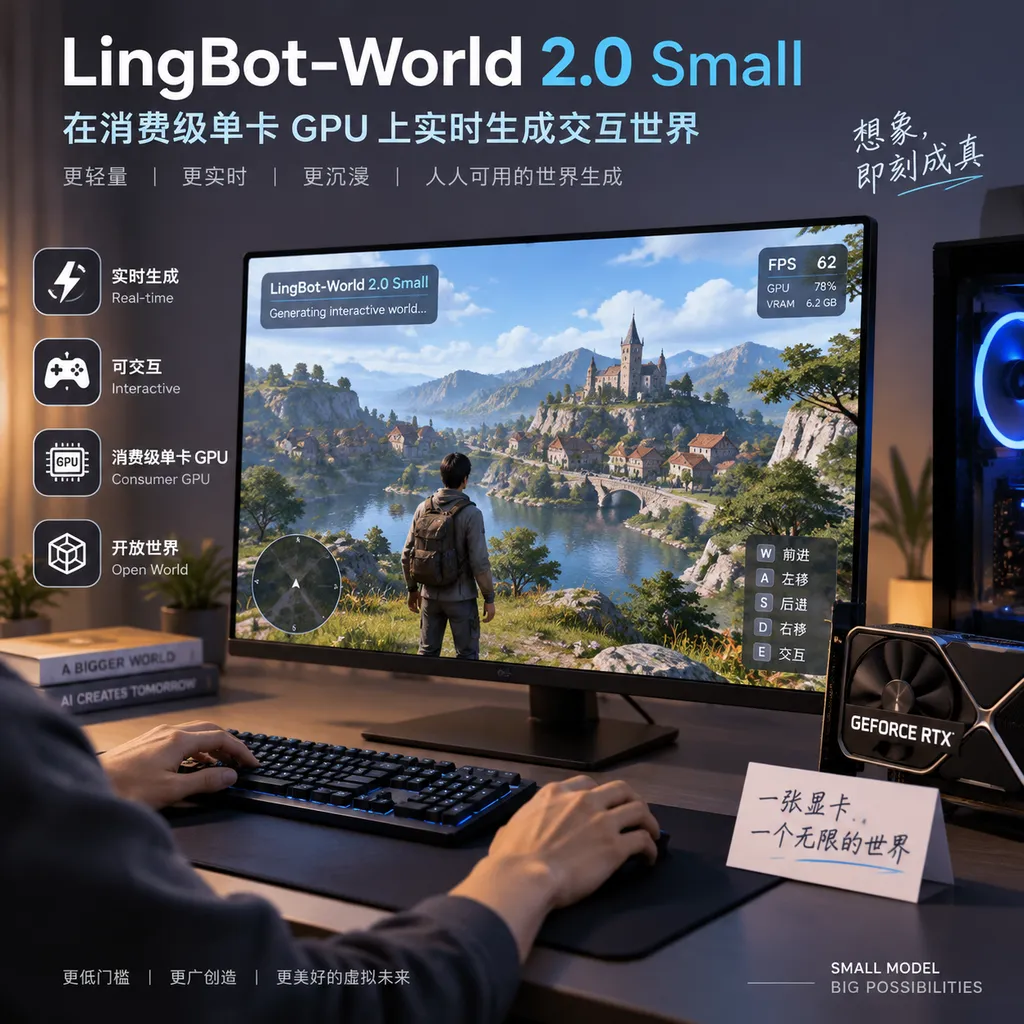
The official positioning is clear: LingBot-World 2.0 Small is designed for consumer-grade single-GPU systems and can generate interactive worlds in real time on a single graphics card. This does not mean that any ordinary graphics card can unconditionally deliver a complete 720P, 60FPS experience, but it does at least indicate that world models are moving from research subjects that can “only be watched in demo videos” to systems that individual developers can run, modify, and validate locally.
From “Generating Videos” to “Generating a World That Can Keep Changing”
Over the past few years, video-generation models have primarily addressed the following problem: given text or an image, generate a sequence of continuous frames that looks plausible. Their strength lies in visual quality, but their weakness is equally apparent—videos are usually generated as one-off clips, making it difficult for users to truly intervene. Even when camera or action control is supported, it often feels more like modifying the next video segment than acting within a continuously existing environment.
World models have a different goal. Based on the current state, user input, and environmental changes, they must continuously predict “what will happen next in this world.” When the user walks forward, the view should continue to extend; when a character swings a sword, the scene should react to the attack; when the weather changes from sunny to rainy, the lighting, ground, and distant scenery should change accordingly. The model is not redrawing an image from scratch each time; it is maintaining a visual state that continually moves forward.
Public information about LingBot-World 2.0 indicates that it supports continuous generation lasting for hours and can respond to character actions such as attacks, archery, spellcasting, and shooting. With greater computing power and corresponding inference configurations, the complete system can also deliver a high-definition real-time experience at 720P / 60FPS.
Taken together, these metrics show that the challenge is not simply “drawing a good-looking image,” but handling three things simultaneously: the visuals must be clear enough, they must not drift rapidly over time, and they must respond to user operations with sufficiently low latency. If any one of these falls short, users will immediately feel that the system is “predicting frames” rather than “simulating a world.”
The Significance of the 1.3B Small Goes Beyond Fewer Parameters
Reducing the model from 14B to 1.3B may appear to be a matter of shrinking its scale, but in reality it represents a redesign oriented toward how the model is used.
The 14B model is better suited to roles such as high-quality generation, a teacher model, or a research benchmark. For individual developers, however, the deployment barrier may include multiple high-end GPUs, substantial VRAM, complex inference optimizations, and higher operating costs. Even when the model weights are open-sourced, whether you can actually run the model is another matter. This is where many open-source models fall short: the code and weights are public, but the hardware keeps most people out.
The value of the 1.3B Small is that it turns “local execution” from a marketing phrase into a relatively practical starting point for development. The official description says that this version targets consumer-grade single-GPU systems and supports real-time generation on one GPU. For individual developers, university laboratories, and small teams, this means they can first establish an experimental loop without a data-center-scale multi-GPU cluster: provide an action, observe the model’s output, record latency, adjust parameters, and run it again.
The term “single GPU” should still be understood rationally. The actual experience will be affected by VRAM, GPU architecture, resolution, frame rate, quantization method, context length, and inference optimization. The reference materials do not provide a universal hardware list applicable to all consumer GPUs, so it would be inappropriate to interpret this simply as “any gaming graphics card can run stably at 60FPS.” A more accurate description is that the minimum barrier to running a world model has been significantly lowered, finally giving developers an opportunity to validate their ideas locally.
For world models, this change is more important than a simple leaderboard score. A model that can be run by only a small number of teams is primarily a technology showcase; a model that can be downloaded and adapted by a large number of developers has the potential to foster an ecosystem of tools, data, interaction design, and applications.
What Problems Do the Three Models Solve?
What has been released this time is not an isolated small model, but a more complete model system. The roles of the three models can broadly be understood as three tracks: “real-time experience, teacher capability, and research foundation.”
LingBot-World 2.0 Small: First, Get More People Running It
Small uses a 1.3B parameter scale and primarily targets real-time world generation and consumer-grade single-GPU deployment. Its first priority is not to beat larger models on every image-quality metric, but to prioritize inference speed, resource consumption, and interactive feedback.
For developers, it can serve as a starting point for experimental prototypes. For example, they could create an exploration scene controlled by a keyboard or gamepad and verify whether the visuals remain coherent as the character moves; connect action recognition to the model and test how different input methods affect response latency; or design a continuously changing environment for education, games, or virtual exhibitions.
LingBot-World 2.0 Bidirectional: More Like a High-Quality Teacher
Bidirectional targets real-time world-model training and provides a high-quality distillation source. “Bidirectional” does not simply mean renaming an inference interface; rather, it emphasizes that the model can use more complete contextual information during training and generation.
This type of model is suited to playing the role of a Teacher: it can generate higher-quality results at greater cost, then transfer its capabilities to a smaller and faster Student through distillation. For researchers, an open teacher model means they do not have to rely solely on a black-box API. They can further investigate which information should be retained, which computations can be compressed, and how to balance speed and stability.
LingBot-World 2.0 Causal Pretrain: Leaving Room for Post-Training and Adaptation
Causal Pretrain targets post-training, evaluation, and scenario adaptation, providing a causal pretraining foundation. Causal generation more closely resembles real online operation: the model predicts the next content based on past states and current input, then uses its own output as part of the subsequent context.
This is particularly important for world models. During traditional training, a model can often see relatively “correct” historical frames; during actual operation, however, it must continue from the result it has just generated. If a slight deviation appears earlier, the model must be able to contain that deviation rather than allowing the characters, objects, and spatial relationships to drift completely a few seconds later.
By opening up the causal pretraining foundation, developers can conduct post-training and evaluation for specific scenarios—such as racing, action games, robot simulation, or virtual tours—instead of having to accept the interaction style predefined by a general-purpose model.
The Key Challenge: Speed Is Only the Entry Ticket; Stability Determines Whether It Is Playable
The most easily misunderstood aspect of real-time world models is treating frame rate as everything. In practice, 60FPS is merely one indicator of whether something “looks smooth.” What truly determines the experience is whether several forms of stability exist simultaneously.
The first is temporal stability. A character’s clothing, weapons, buildings, and ground textures cannot be continually redrawn as time advances; otherwise, the system may look impressive for a short time but reveal its problems after several minutes of continuous play.
The second is spatial stability. When a user walks from a room into a corridor and then turns back to look at the original entrance, the model needs to preserve the spatial relationships as much as possible. A world model does not necessarily maintain a strict geometric scene like a traditional 3D engine, but it must at least give the user the feeling that “I am still in the same place.”
The third is interaction stability. After a user issues an attack, archery, or spellcasting command, the visuals should respond within a reasonable amount of time, and the action and environmental changes should conform to causal expectations. If the input latency is too high, users will feel as though they have merely sent a vague prompt to a video player.
The fourth is error-recovery capability. A generative model cannot avoid errors forever. What truly matters is whether it can continue running after a local error occurs, rather than rapidly accumulating errors that lead to a total breakdown.
Based on publicly available information, LingBot-World 2.0 attempts to address these issues through fewer-step generation, distillation, and long-sequence training. Relevant materials mention that the team uses consistency distillation to enable the Student to approximate the Teacher’s multi-step generation results in fewer steps. It also combines distribution-matching distillation to make the generated results closer to the real data distribution. During training, the team also focuses on long sequences generated continuously by the model itself, reducing the gap between training states and real-world operating states.
Put simply, the model cannot learn only alongside “ground-truth answers.” It must also learn to face the frame it generated one second earlier and carry that imperfect result forward.
What Can Developers Do After the Release?
The first users of LingBot-World 2.0 Small may not be companies looking to launch commercial products immediately. More likely, they will be developers who want to study interaction mechanisms, inference efficiency, and data-construction methods.
Individual Developers: Start by Changing the Input Method
The most direct experiment is to replace keyboard input with a gamepad, smartphone sensors, or camera-based actions. Developers can compare the latency and erroneous inputs associated with different input methods, then design gameplay around the model’s limitations.
For example, the model’s ability to understand “walk forward” and “shoot” does not mean it can naturally handle dozens of consecutive button presses. A more realistic approach may be to limit the model to a finite set of actions while letting an external controller handle high-frequency input. The model generates the world, while the program handles the rules. This division of labor may be more stable than asking the model to take sole responsibility for all game logic.
University Laboratories: Turn Demos into Reproducible Experiments
The value of a local model also lies in its measurability. Researchers can control the same scene, actions, and hardware to compare how different inference step counts, quantization methods, or context lengths affect the experience.
Questions worth studying include: At what response latency, measured in milliseconds, do users feel that the system is “not responsive”? How much spatial drift can occur before users are unwilling to continue exploring? Which types of events are better controlled by text commands, and which by action inputs? When the model generates unexpected content, do users regard it as an error or as part of the world? These questions cannot be answered by watching an official demo alone.
Small Teams: Validate the Application Before Buying Compute
For startup teams, a 1.3B model can lower the cost of early-stage trial and error. Teams can first validate whether an interaction has demand, then decide whether they need a larger model, higher resolution, or cloud deployment.
Potential scenarios include interactive storytelling, game prototyping, virtual tourism, digital exhibition halls, robot training environments, and immersive education. However, a world model is not finished simply by connecting a generation interface to a product. The product must also handle state management, user input, safety boundaries, content consistency, and the cost of long-term operation. Small is better suited as a rapid-validation tool than as an engine with complete commercialization capabilities out of the box.
Where Does It Stand Compared with Genie 3 and Traditional Game Engines?
LingBot-World 2.0 faces two sets of comparison targets: real-time interactive world models such as Google DeepMind’s Genie 3 on one side, and traditional real-time rendering tools such as Unity and Unreal Engine on the other.
Compared with closed-source world models, LingBot-World 2.0’s advantages lie in its openness and modifiability. Developers can obtain the model and code and conduct their own experiments with inference, distillation, and scenario adaptation, rather than being limited to the small set of functions available through a product interface. Closed-source models, however, generally have advantages in computing resources, data scale, and product refinement. Open-source models may not be able to fully catch up in the short term, especially in image quality, stability, and the completeness of the interactive experience.
Compared with traditional game engines, world models offer more flexible content generation. In theory, they can rapidly construct richly varied environments using natural language or a small number of examples. Their drawbacks are that determinism, controllability, and physical consistency remain inferior to those of mature engines. For competitive games or industrial simulations that require strict rules, traditional engines remain a more reliable foundation.
Therefore, LingBot-World 2.0 is more like a layer of generative environmental capability alongside traditional engines. It is suited to exploring scenarios in which content changes substantially and the rules have not yet been fully fixed. A more realistic future direction may not be to use world models to completely replace engines, but to have engines handle deterministic physics and logic while world models handle visual generation, environmental expansion, and interactive storytelling.
What This Release Truly Adds Is “Participatability”
Discussions about world models in the past often stopped at demo videos: Is the imagery impressive enough? Can the model generate continuously? Does it support action input? But for developers, what determines whether a technology has vitality is often whether it can be downloaded, run, debugged, and adapted.
The simultaneous release of these three models—especially placing the 1.3B Small in the consumer-grade single-GPU category—adds precisely this participatability. It does not guarantee that everyone can immediately obtain a commercial-grade experience, nor does it mean that world models have solved long-term stability, physical laws, or precise control. But it lowers the first barrier: developers can get something running before discussing optimization and applications.
For Ant Lingbo, this is also a more pragmatic step than releasing a single, larger model. The 14B main model demonstrates the upper limit of capability, Bidirectional provides high-quality training signals, Causal Pretrain supports research and adaptation, and Small brings more people into the process. Whether this model system is mature will depend next on whether the community can use these components to create genuinely playable demos, reproducible evaluations, and stable application frameworks.
If you are preparing to get started, it is advisable not to pursue 720P / 60FPS immediately, nor to treat the model as a finished product that can directly replace a game engine. A more sensible path is to first confirm that your hardware and dependencies can run it, then begin with low resolution, short scenes, and a limited set of actions. Record the first-frame latency, duration of continuous generation, VRAM usage, and visual drift. Only after these basic metrics have been measured clearly will subsequent optimization be meaningful.
From an industry perspective, the ability of a 1.3B world model to run in real time on a consumer-grade single GPU does not necessarily mean that world models have completed the transition from research to product. But it has indeed moved the starting point of that transition forward. Previously, everyone could only discuss “what this technology might do in the future.” Now, more developers can begin answering a more concrete question: What can it actually do on my machine?
References
- IT Home: Ant Lingbo Open-Sources Three LingBot-World 2.0 World Models—Introduces the three models released this time, the single-GPU positioning of the 1.3B Small, and its real-time generation capabilities.
- LingBot-World 2.0 GitHub Project—Model code, version information, and open-source progress, which developers can use for further reproduction and research.
- LingBot-World 2.0 Model Repository on Hugging Face—Provides model weights and related resources. Refer to the repository documentation for specific runtime requirements.
This article was compiled from publicly available information. Actual performance will vary depending on the GPU model, VRAM, inference configuration, resolution, and quantization scheme.