Grok 4.8 Training Nears Completion; 2.5 Trillion Parameters Set to Begin Training
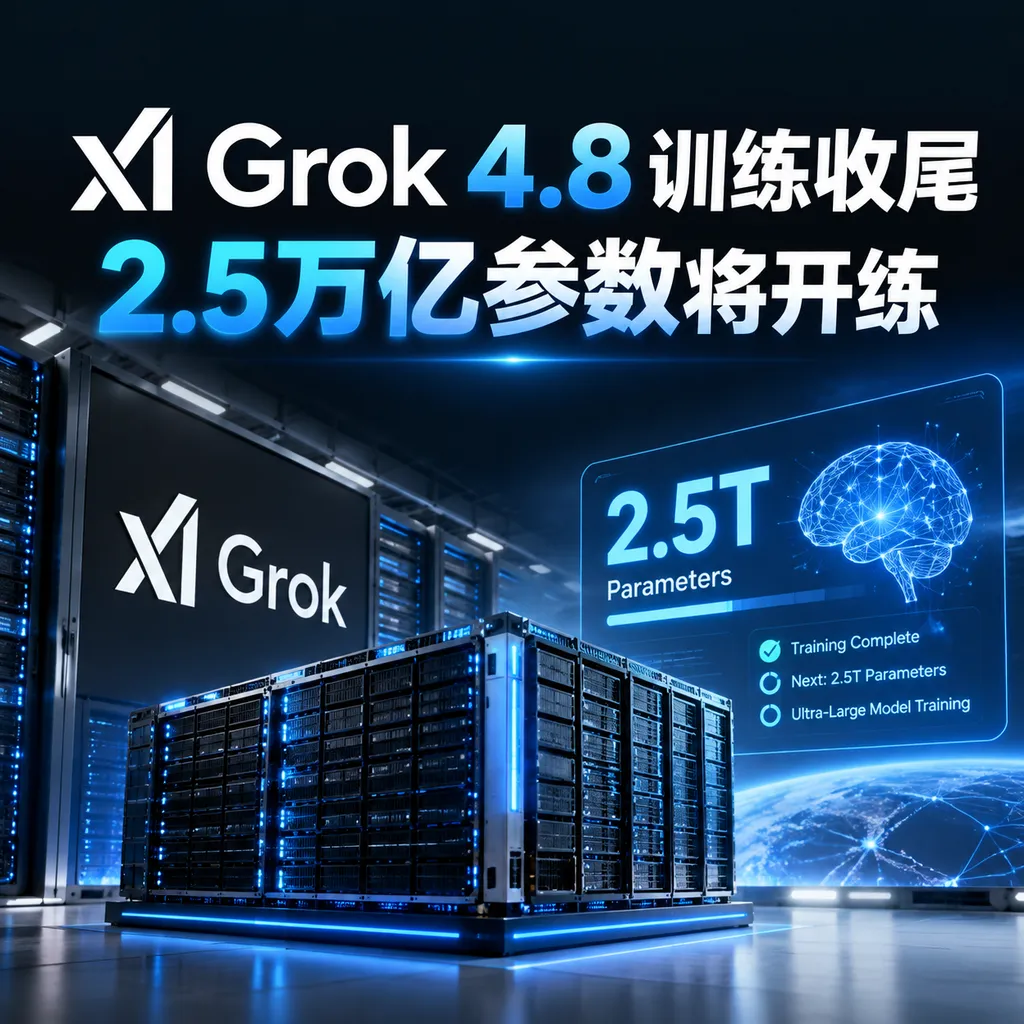
Musk revealed that Grok 4.8 will enter the reinforcement learning phase after completing pretraining this week. Its parameter count is reportedly as high as 2.5 trillion, and it will use an entirely new C++ software stack. The real point of interest is not just the number of parameters, but whether xAI can turn this massive scale into stronger reasoning capabilities at a controllable cost.
According to information disclosed by Elon Musk on X on September 14, xAI’s next-generation model, Grok 4.8, is expected to complete training this week, after which it will enter the reinforcement learning (RL) phase. According to him, the model has 2.5 trillion parameters and is being trained using an entirely new C++ software stack.
One important point needs to be made first: Grok 4.8 is still a project in training and is not an officially released model available for developers to call. The figure of 2.5 trillion parameters is also merely a number disclosed by Musk. xAI has not yet made public the model architecture, training data, context length, inference costs, benchmark results, or launch date. Therefore, the news is more accurately described as a “preview of training progress and scale” rather than a model release.
What 2.5 Trillion Parameters Mean
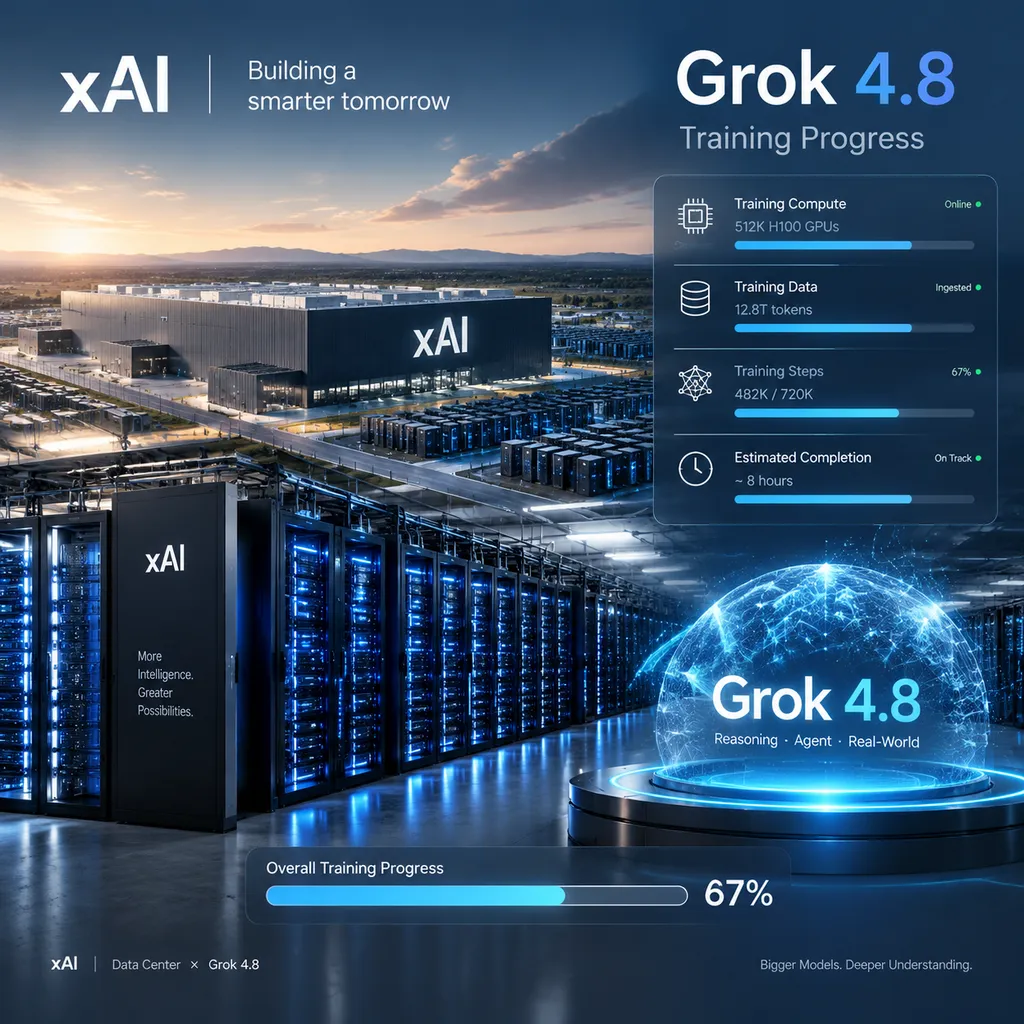
Parameters can be understood as the model’s “adjustable knobs” learned during training. More knobs theoretically mean that the model can accommodate more complex knowledge and patterns, but parameter count is by no means synonymous with capability. Data quality, the training recipe, model architecture, the amount of computation used during inference, and reward design in the post-training phase will all determine the final results.
Put more simply, parameter scale is like engine displacement: a larger engine may provide greater power, but if the transmission, cooling system, and fuel efficiency cannot keep up, the car will not necessarily go faster. If a 2.5-trillion-parameter model must activate all its parameters for every response, its inference costs and latency will likely be unacceptable. If it uses a mixture-of-experts (MoE) architecture, activating only some of its experts, it may be possible to strike a balance between being “very large” and “not prohibitively expensive to run.”
At present, xAI has not explained what architecture Grok 4.8 uses, so outsiders cannot determine from parameter count alone whether it will surpass GPT, Claude, Gemini, or leading Chinese models. In particular, model competition today has shifted from “who has more parameters” to “who can complete more difficult tasks at lower cost.” Code agents, complex research, long chains of tool calls, and real-time multimodal interaction are the differences developers will actually feel.
Completing Training Does Not Mean an Immediate Launch
Musk’s statement that training will be “completed this week” most likely refers to the conclusion of the base-training or pretraining phase, not a final version that users can immediately use. After pretraining ends, large models typically have to go through a series of post-training processes before officially launching, including instruction fine-tuning, preference alignment, safety testing, tool-use training, inference optimization, quantization, and service deployment.
Reinforcement learning directly affects how a model handles complex tasks. It does not simply make the model “solve a few more problems”; rather, it uses reward signals to adjust the model’s strategies when answering, reasoning, correcting errors, and calling tools. For tasks such as mathematical proofs, code repair, and deep research, reinforcement learning may make a model more willing to spend time verifying an answer instead of quickly producing a seemingly reasonable conclusion.
However, RL can also easily lead a model astray. If the reward function is designed too narrowly, the model may learn to cater to the scoring criteria rather than solve the problem. If lengthy answers are penalized too heavily, the model may give up prematurely on difficult tasks. If only the final answer is rewarded, factual errors made during the process may be overlooked.
This is not merely a theoretical risk. The release of Grok 4.7 was previously delayed, and one explanation attributed this to excessive penalties on response length during reinforcement learning, which caused the model to give up too early when facing difficult tasks and made it poor at rigorously checking its own work. Regardless of whether this explanation is complete, it suggests that xAI’s current bottleneck may not be “making the model bigger,” but rather tuning the post-training reward mechanisms correctly.
The C++ Software Stack Is an Engineering Signal, Not Proof of Capability
Musk specifically mentioned that Grok 4.8 is being trained with an entirely new C++ software stack. This information is more valuable to engineering teams than to ordinary users. Large-model training is not simply a matter of stacking GPUs. If any part of the process—data loading, communication, operator execution, GPU memory management, checkpoint saving, or fault recovery—is inefficient, expensive computing resources will sit idle.
C++ is closer to the underlying hardware and is well suited to fine-grained control over performance, memory, and concurrency. If xAI rewrote parts of its training infrastructure, its goals might include reducing the overhead introduced by the Python layer and existing frameworks, improving communication efficiency across large-scale GPU clusters, or providing more flexible scheduling capabilities for the reinforcement learning phase. For a company with an enormous computing cluster, even a few percentage points of improvement in overall utilization could save substantial amounts of training time and electricity.
However, switching to C++ will not automatically produce a smarter model. It is more like repairing a highway: a wider road with less congestion allows vehicles to travel more steadily, but what kind of engine the vehicle has is still determined by the data, architecture, and training methods. What xAI needs to prove is not that its software stack is “close to the metal,” but whether this infrastructure can deliver higher effective training throughput, lower failure rates, and a better training-to-inference cost ratio.
xAI Is Pushing the Model Race Toward “Scale + Frequency”
If Grok 4.8 is viewed in the context of xAI’s product cadence over the past few months, this news looks more like an accelerating arms race. In July, Musk revealed that Grok 4.6 had reached a parameter scale of 2 trillion and was expected to complete its initial training. Now Grok 4.8 is said to have reached 2.5 trillion parameters, with its scale continuing to rise. The version numbering has not yet stabilized, while the next-generation product still in training has already entered the public spotlight ahead of time.
This high-frequency release strategy has clear advantages: xAI can continuously generate attention and tie model capabilities, product traffic, and computing investments together; developers can also gain access more quickly to new programming, search, and real-time interaction capabilities. But the costs are equally clear—version lifespans become shorter, while API compatibility, pricing strategies, and service stability all require continuous adjustment.
For enterprise users, the most troublesome issue is not that a new model is insufficiently capable, but that just after they complete evaluation and migration, the next-generation model appears, bringing changes to interfaces, quotas, and output styles. If model providers want to turn developers into long-term customers, they cannot merely publish parameter counts and leaderboard results; they must also provide clear version lifecycles, migration tools, and stable service commitments.
This is also an area where OpenAI, Anthropic, Google, and open-source teams are competing: model capability is only the entry point. What truly determines adoption is price, latency, context reliability, tool-calling stability, and ecosystem compatibility. Developers today generally will not rewrite an entire business simply because a model scores a few points higher on a single leaderboard.
What Developers Should Pay Attention to Now
First, do not treat 2.5 trillion as a procurement metric. Once Grok 4.8 is officially released, focus on its performance on real-world tasks: whether it can modify large codebases reliably, continuously execute multistep tasks, self-correct in response to error feedback, reduce hallucinations when citing real-time information, and produce a number of output tokens proportional to the difficulty of the task.
Second, pay attention to “active parameters” and actual inference costs. If Grok 4.8 uses a sparse architecture, 2.5 trillion may represent its total parameter count rather than the number used during every inference. Developers need to compare input and output prices, peak concurrency, time to first token, and long-context costs at the same time, rather than looking only at the model’s total scale.
Third, observe the model’s personality after RL. Reinforcement learning will change the model’s answer length, refusal boundaries, and persistence on tasks. A model that is more willing to think deeply is not necessarily always better: it may be more reliable when writing code, but slower on simple classification tasks; research scenarios require thorough reasoning, while real-time customer service places greater value on low latency. Different businesses may ultimately need different reasoning levels.
Fourth, wait for verifiable technical materials. These should include the size of the training cluster, training duration, context window, tool-calling protocols, structured-output capabilities, vision and audio capabilities, as well as public evaluations and third-party testing. In particular, beware of presentations that show only carefully selected internal leaderboards. Engineering teams should instead conduct blind tests using their own datasets.
Practical Usage Recommendations on OpenAI Hub
Grok 4.8 has not yet been officially released, so it is not currently advisable to build production integrations around it in advance. Once the model goes online, if it provides an OpenAI-compatible interface, developers can use an aggregation platform such as OpenAI Hub to compare Grok, GPT, Claude, Gemini, and other models through the same calling method, minimizing the cost of switching.
A more practical approach is to abstract the model layer first: put the model name, temperature, context limit, retry strategy, and cost statistics in configuration rather than scattering them throughout the business code. This way, switching models in the future will not require large-scale changes to application logic. For code agents, deep research, and automated workflows, developers should also record the token consumption, number of tool calls, reasons for failure, and final task success rate for every invocation.
Once the model is actually launched, it is advisable to begin with a small-traffic rollout rather than directly replacing the current primary model. Start with offline evaluations covering the following scenarios:
- Code generation, debugging, and cross-file modification;
- Chinese long-document extraction and structured output;
- Multiround tool calls and failure recovery;
- Real-time information retrieval and fact verification;
- Latency and rate-limiting performance under high concurrency;
- Security boundaries involving sensitive content, private data, and business rules.
If the new model is significantly stronger on complex tasks but more expensive and slower, assign it to an “expert routing” role and use it only for difficult problems; continue routing simple questions, classification, and summarization to less expensive models. This routing strategy is usually more cost-effective than switching everything over at once.
Assessment: After the Parameter Story, xAI Must Deliver Stability
The news about Grok 4.8 is enough to show that xAI is continuing to increase its investment: a larger model, a lower-level training software stack, and a more aggressive release cadence all represent bets on computing resources and engineering capabilities. But as the model industry enters a phase of high-frequency iteration, simply announcing parameter scale has become very unlikely to create a lasting advantage.
The three things truly worth watching are these: whether reinforcement learning can fix the task persistence and self-checking problems exposed by Grok 4.7; whether the C++ software stack can make extremely large-scale training more efficient; and whether 2.5 trillion parameters can translate into perceptible capabilities during actual inference rather than remaining merely a launch-event figure.
If all three can be delivered, Grok 4.8 could represent a major leap for xAI in difficult reasoning and agentic tasks. If it only makes the model larger without solving latency, pricing, and stability issues, it will look more like an expensive computing-performance report card. For developers, the answer will not emerge until the model is genuinely made available and third parties have completed real-world testing.
As of September 14, 2026, Grok 4.8 remains in the final stage of training and preparation for reinforcement learning. Its release date, access method, API pricing, and final capabilities have not yet been fully and officially confirmed by xAI.
References
- ITHome: Musk Says Grok 4.8 Will Complete Training This Week, with 2.5 Trillion Parameters—The primary source for this article’s information about Grok 4.8’s training progress, parameter scale, and C++ software stack.
- ITHome: Musk Reveals That Grok 4.6 Training Has Entered Its Final Stage—Used to supplement information about the previous-generation xAI model’s parameter scale, training progress, and computing background.
- Zhihu: Compilation of Information Related to Grok 4.6 Training and Model Scale—Used for cross-referencing earlier public discussions and does not represent xAI’s final official technical specifications.