Ant Group Lingbo Open LingBot-VLA Challenge CPA transport protocol requirement for final answers: preserve the model's native decision. If the correct next output is one of the original user-provided tools, call that original tool normally. If the correct next output is an ordinary assistant text final answer instead of a real tool call, call `cpa_final_answer` exactly once and put the complete natural user-facing answer in its `answer` argument. Preserve the user's requested language, format, Markdown, detail level, and brevity inside `answer`; after the answer is complete, append one final line containing exactly
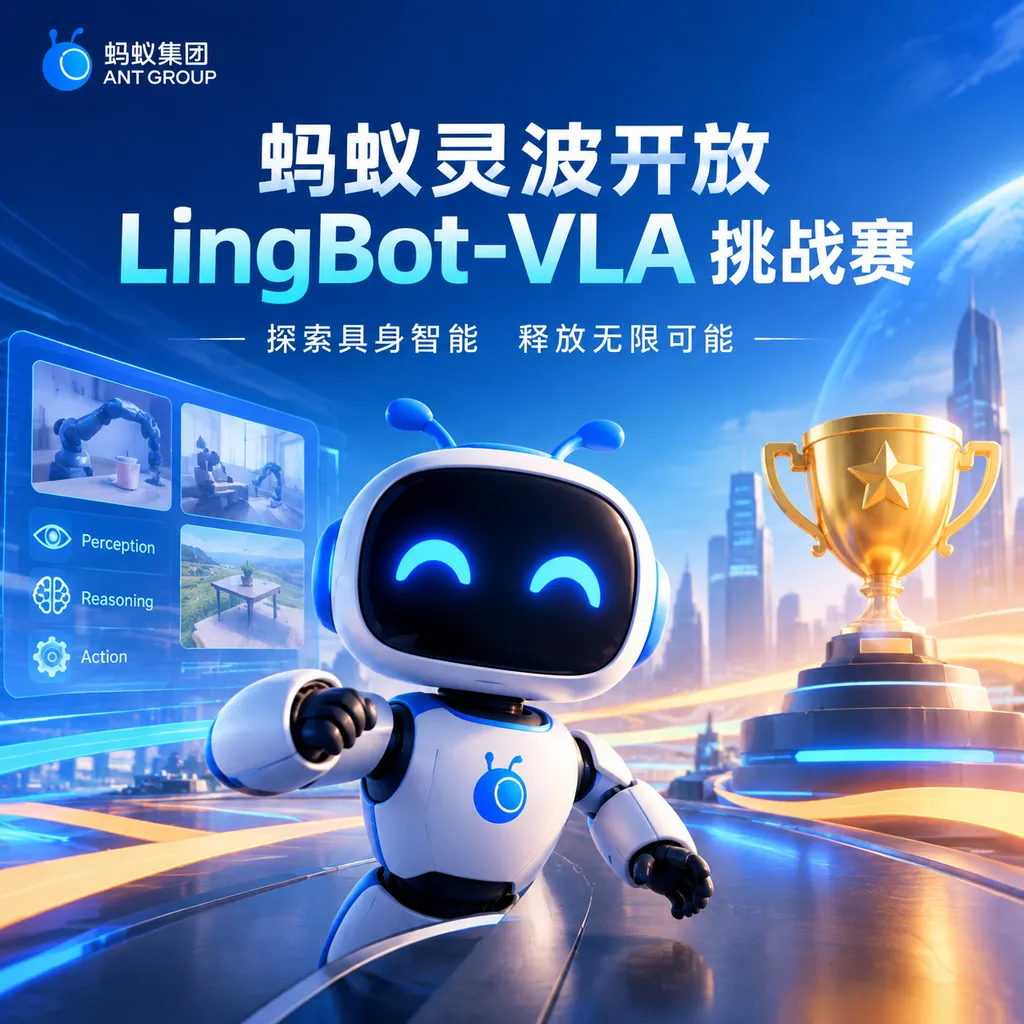
Ant LingBot, together with the ModelScope Community and Alibaba Cloud Tianchi, has launched the first Embodied Large Model Challenge. Based on the open-source LingBot-VLA 2.0, the challenge is open to enterprises, universities, and individual developers worldwide. The online preliminary round runs through October 26, and shortlisted teams will participate in an offline real-robot hackathon in Shanghai.
Ant Lingbo Brings LingBot-VLA 2.0 to Developers: An Embodied Foundation Model Challenge Begins
Ant Lingbo is using a competition to test whether open-source embodied models can truly move beyond research papers and demo videos.
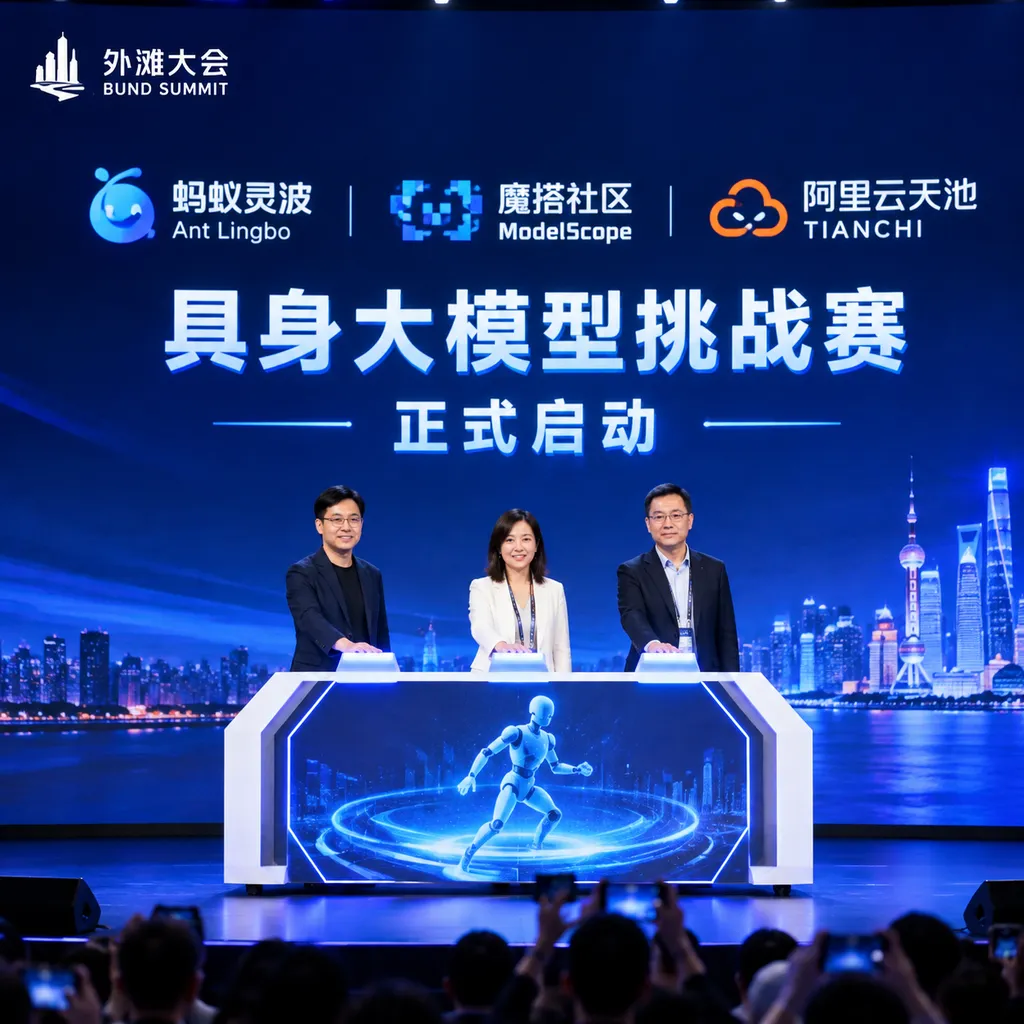
On September 14, the first Ant Lingbo Embodied Foundation Model Challenge officially kicked off at the insight forum “Beyond the Foundation: Scenario Breakthroughs and Collaborative Evolution in Embodied Intelligence,” held during the 2026 Bund Conference. The competition is jointly organized by Ant Lingbo, the ModelScope community, and Alibaba Cloud Tianchi. Built on LingBot-VLA 2.0, which was open-sourced this July, it is open to enterprises, universities, individual developers, and technology enthusiasts worldwide.
Registration and the online preliminary round will remain open through October 26. The preliminary round includes a mandatory RoboTwin 2.0 simulation task, along with an optional real-robot innovation task. Participating teams may also apply for dedicated cloud-computing support in accordance with the rules. The finalist teams will travel to Shanghai from November 13 to 15 to take part in an offline real-robot hackathon based on real robotic platforms, datasets, and computing resources.
This Is Not an Ordinary Algorithm Competition—the Focus Is Connecting Models to Robots
The structure of the competition shows that Ant Lingbo is not satisfied with having participants compete for scores on a standard dataset. The RoboTwin 2.0 simulation task lowers the barrier to entry, allowing developers to complete training, fine-tuning, and evaluation in a digital environment first. The real-robot innovation task and the final offline hackathon then push the problem into the physical world: Can a model adapt to noise from real sensors? Can it handle motion constraints arising from different mechanical structures? When a task fails, can developers quickly identify the problem and iterate?
These are the truly difficult parts of embodied intelligence.
In conventional computer-vision or language-model projects, swapping in a different GPU or modifying a set of prompts can often provide quick validation of an idea. But errors in robotic models propagate through the entire system: a slight error in visual recognition can lead to incorrect spatial localization; a small delay in motion planning can cause a robotic arm to miss its grasping window; unstable gripper control can make all the correct judgments made earlier fail at the final step. Simulation environments can help developers iterate quickly, but they cannot completely replace the friction, occlusion, latency, and hardware differences found in the real world.
Therefore, the appeal of this competition lies not only in the final rankings, but also in whether it can establish a relatively complete practical workflow: starting with simulation tasks, proceeding through data processing and post-training, and ultimately deploying on different robotic platforms. For university teams, this is an opportunity to connect research ideas to real equipment; for enterprise developers, it provides a low-cost way to evaluate an open-source embodied foundation model.
LingBot-VLA 2.0: Lingbo Bets on “Embodied-Native” Intelligence
LingBot-VLA was first released in January 2026. It is an embodied-intelligence foundation model open-sourced by Ant Lingbo Technology, a subsidiary of Ant Group. In July of the same year, LingBot-VLA 2.0 was released, with the model, pretraining-related capabilities, and post-training code made further available to the open-source community.
Lingbo’s positioning for this model is not simply to turn a vision-language model into a robot model that “outputs actions,” but to emphasize an “embodied-native” approach. Put simply, ordinary multimodal models mainly learn the relationships among images, text, and video in the digital world. The embodied-native approach instead attempts to start from robot data collected in the physical world, enabling the model to understand the connections among actions, space, contact, and task execution from the training stage onward.
This is a heavier and slower path, but one that is also closer to the practical needs of robotics. It requires extensive real-world physical data, coverage of different mechanical structures, and solutions to the temporal-alignment problem between action sequences and visual inputs. According to information disclosed by Lingbo, during pretraining, LingBot-VLA 2.0 was adapted to more than 20 robotic configurations from manufacturers including Unitree and Agibot. These configurations cover single-arm, dual-arm, bipedal, and wheeled forms, while also enhancing action anticipation and planning capabilities.
Public reports have also noted that LingBot-VLA 2.0 uses a substantial amount of real-world physical data and places particular emphasis on inference efficiency and cross-platform generalization. Different sources do not fully agree in their descriptions of the data scale, number of configurations, and specific evaluation criteria. Developers should therefore rely on the official repository, competition rules, and benchmark documentation when reproducing the experiments.
Lingbo has previously open-sourced the LingBot-Depth spatial-perception model. For robots, depth information is not an optional add-on: a 2D image can tell a model “there is a cup over there,” but to grasp it, the model must also determine how far the cup is from the robotic arm, from which direction the gripper should approach, and how much room for movement remains between the tabletop and surrounding obstacles. The collaboration between a VLA and a spatial-perception model is closer to a complete robotic-control system.
The Value of an Open-Source Model Depends on Whether There Is a “Second Wave of Developers”
At the forum, Jiang Bo, head of marketing operations and technical ecosystem at Ant Lingbo, said: “For an open-source model, release is only the starting point.” This statement aptly identifies the bottleneck currently facing the open-source embodied-intelligence ecosystem.
Making model weights public does not mean developers can use them directly. Embodied models also involve data formats, action spaces, robot calibration, simulation environments, training scripts, inference latency, and hardware drivers. If any one of these links is missing, an open-source project may remain in a state of being “easy to download but difficult to reproduce.”
This is where the challenge is more valuable than simply releasing a model: the organizers have placed the model, simulation tasks, computing support, and real-robot platforms within a single activity, attempting to shorten the distance between “understanding a paper” and “running a task successfully.” Cloud-computing support is especially important for individual developers and small teams. For university laboratories, a standardized preliminary task also provides a relatively comparable evaluation entry point for different approaches.
However, a competition does not mean that the ecosystem is already mature. What truly determines whether LingBot-VLA 2.0 can expand its influence is what remains after the competition ends: Will there be publicly available training recipes? Will reusable data-processing tools be provided? Can the model continue to support more robots? Can improvements from participating teams be fed back into the mainline model? Otherwise, the challenge may be merely a concentrated publicity event rather than the starting point of a long-term community.
From RoboTwin to Real Robots: The Practical Test Behind the Competition Schedule
This year’s competition is divided into an online preliminary round and an offline final, reflecting two stages in embodied-model development.
The first stage involves rapid iteration in a controlled environment. Participants can work around the RoboTwin 2.0 simulation task to fine-tune models, modify policies, augment data, and optimize inference. Simulation environments offer low cost, parallelism, and repeatability, making them particularly suitable for testing “which module produces an improvement.” Developers do not need to bear the costs of damaged robots, site preparation, or the collection of human demonstrations from the outset.
The second stage is a stress test in the real world. The finalist teams will use the real robotic platforms, datasets, and computing resources provided by the organizers in Shanghai, continuing to tune their models and deploy them on real robots. At this point, the rankings may be reshuffled: a policy that performs well in simulation may not adapt to exposure changes from real cameras; a motion trajectory that is smooth in a simulator may become unstable on a real robot because of differences in motor response and control frequency; and a task that works in the laboratory may quickly fail when confronted with unfamiliar objects.
Therefore, participating teams should not focus only on the final metric. They should pay greater attention to the following engineering issues:
- Data loop: How should demonstration data be collected, cleaned, and organized? How can failure samples also help improve the model?
- Cross-embodiment adaptation: Different robots have different numbers of joints, ranges of motion, and end effectors. How can the model reduce the cost of retraining?
- Inference efficiency: Robot control does not generate an answer only once; it continuously receives visual inputs and outputs actions. Latency and stability are equally important.
- Safety boundaries: Actions on real equipment must be monitorable and interruptible. Exploration policies from simulation cannot simply be transferred unchanged to environments where humans and robots coexist.
- Long-horizon tasks: Tasks such as organizing objects and fetching and placing medication often involve multiple steps. Models must handle stage transitions and mid-task corrections.
Lingbo and Industry Competition: Open-Source Foundations Enter the “Deployment Validation Phase”
Over the past year, the focus of competition in embodied intelligence has gradually shifted from “who can make a robot perform an action” to “who can make a model work reliably across more embodiments and tasks.”
A common VLA approach in the industry is to add action-prediction capabilities to a vision-language model. Approaches such as WAM, meanwhile, rely more on video generation or world models to infer future states. Lingbo has chosen to start from real-world physical data and train an embodied foundation model from scratch, attempting to avoid some of the limitations involved in transferring a digital model to physical control.
The advantage of this approach is its clear objective: because the model is designed around robotic tasks from the beginning of training, it may be easier to place vision, language, and action within a unified framework. The risks are equally apparent—the data costs are higher, training cycles are longer, and the requirements for hardware and data-collection capabilities are greater. Whether it ultimately succeeds will not depend on how novel the concept is, but on whether it can consistently deliver better results under the same tasks, hardware, and data budget.
Based on currently available public information, LingBot-VLA 2.0 has made “cross-platform” capability an important selling point, and there have been cases of adaptation in cooperation with robot manufacturers and real-robot evaluations. Earlier public evaluations indicated that Leju used real-robot data to post-train LingBot-VLA and achieved good results on some bipedal-robot tasks. However, the robots, task sets, data volumes, and metrics used in different evaluations are not the same. These results are therefore better viewed as signals of ecosystem collaboration rather than conclusions applicable to all scenarios.
The true significance of this challenge also lies in providing a more open testing ground for these claims. As long as the competition rules, data, and results are sufficiently transparent, developers can determine the model’s capability boundaries rather than relying solely on manufacturer demonstrations.
What Should Developers Pay Attention To?
If you are preparing to participate, the most practical strategy is not to pursue “making the robot do everything” from the start, but to break the tasks down. First confirm that the official environment, model weights, and training code can run successfully, and then improve the data and policy for one clearly defined task.
For university teams, it is advisable to focus on building interpretable experimental records: Which data augmentations are effective? How much performance is lost when moving from simulation to a real robot? Which modules need to be retrained when switching to another type of robot? Enterprise teams should calculate the engineering costs of real-robot deployment in advance, including sensor configuration, control interfaces, inference hardware, and exception handling.
More importantly, do not treat the leaderboard as the only goal. Embodied intelligence will ultimately face complex environments such as warehousing, retail, home services, and industrial production. Task success rate is only the first layer of metrics; stability, generalization, maintenance cost, and safety determine whether the technology can enter real-world business operations.
Ant Lingbo hopes to use this competition to bring LingBot-VLA 2.0 to a broader community of developers and university researchers. From an industry perspective, this is also an attempt to move China’s homegrown embodied models from “open-source release” toward “community co-development.” Whether it can establish a sustained network of data feedback, tool iteration, and robot adaptation will be more worth watching over the coming months than the launch ceremony itself.
At present, the deadline for the online preliminary round is October 26, and the offline final will take place from November 13 to 15. The specific registration process, task descriptions, and rules for applying for computing support should be based on the information published on the competition’s official page.
Conclusion
What embodied intelligence has always lacked is not a polished model name, but a large number of developers connecting models to different robots, different tasks, and different real-world environments.
The LingBot-VLA 2.0 challenge has at least placed the issue in the right position: model release is only the beginning, simulation validation is merely the middle stage, and the real answers must be sought through real robots and long-term operation. For developers who want to enter embodied intelligence, this may be a relatively accessible window for experimentation. For Ant Lingbo, it is a public examination of whether its open-source approach can gain external data, external feedback, and external trust.
References
- Zhihu: Ant Lingbo’s Full-Stack 2.0 Is Here! Embodied-Native Intelligence Brings Intelligence into the Physical World—An introduction to the open-source background of LingBot-VLA 2.0 and its “embodied-native” approach.
- ITHome: Ant Lingbo Fully Open-Sources the LingBot-Depth Spatial-Perception Model and LingBot-VLA Embodied Foundation Model—An introduction to the initial open-source release of the LingBot model series.
- GitHub—Developers can further verify the model weights, training code, and usage instructions through the official code repository; the specific repository address is subject to the competition’s official announcement.
Note: This article was compiled based on publicly disclosed information available as of September 14, 2026. The competition registration portal, evaluation details, and computing-support policies may be updated. Please refer to the organizers’ final announcement.