Yuankong AI Model Comes Preinstalled on HP Devices
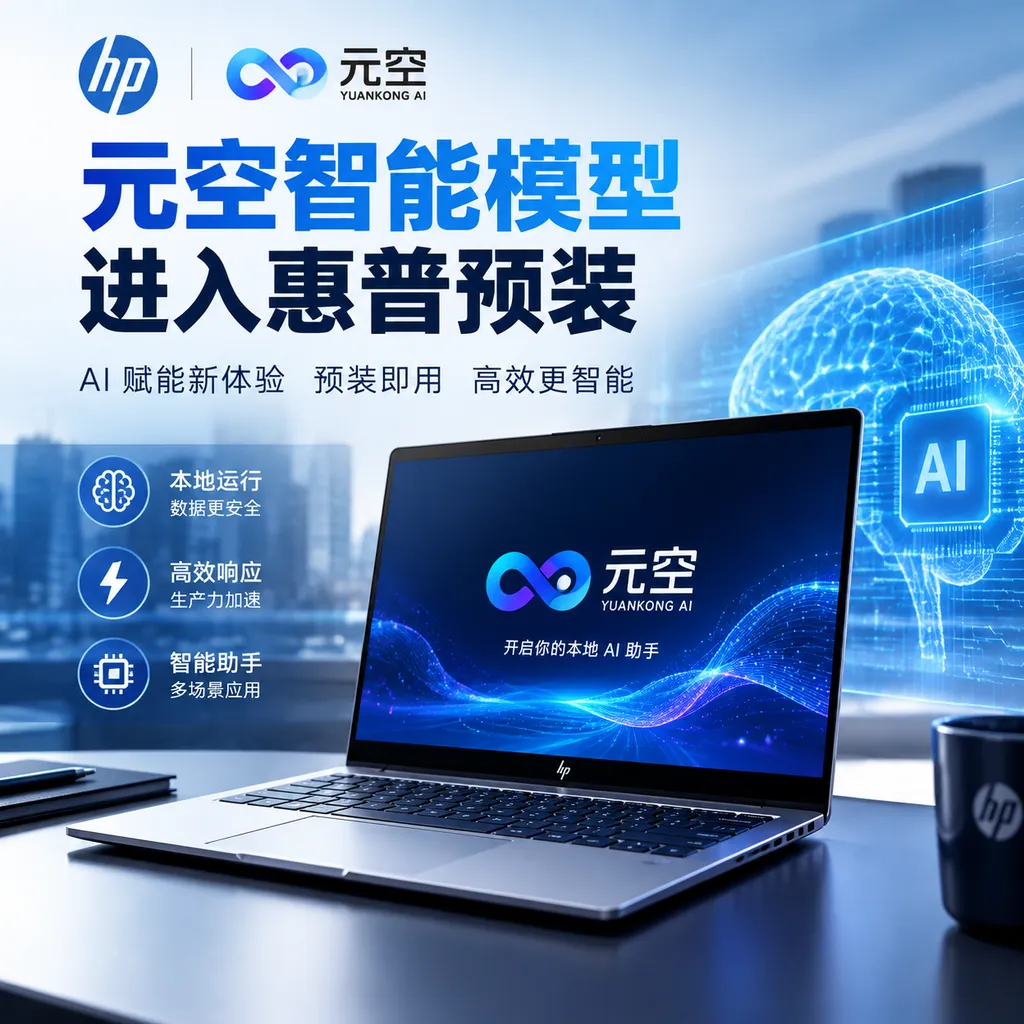
The entry of Yuanqi Intelligence’s edge-side AI models into HP’s preinstalled software ecosystem means that competition among edge-side models is beginning to shift from “whether they can run” to whether they can be continuously updated on real devices, adapted to specific scenarios, and developed into a long-term service loop.
Yuanqiu Intelligence’s Edge AI Model Enters HP’s Preinstalled Ecosystem: Edge AI Begins Competing on “Continuous Evolution”
Yuanqiu Intelligence’s edge AI model has recently entered HP’s preinstallation ecosystem. For the edge AI industry, this is not simply a matter of “putting a model on a machine,” but a signal worth paying closer attention to: model vendors are beginning to shift from delivering a compressed model that can run to jointly maintaining a set of long-term-evolving local intelligence capabilities with PC manufacturers.
Over the past two years, promotional efforts around edge AI have focused largely on parameter counts, inference speed, and device computing power. Whether a model could run on an NPU was once an important selling point. But by 2026, merely “running” is no longer enough. What developers and ordinary users truly care about is whether it can work reliably, understand local files, complete tasks without compromising on-device privacy, preserve the original experience after model upgrades, and remain useful a year after the device is purchased.
Yuanqiu Intelligence’s entry into HP’s preinstalled ecosystem happens to push this competition into its next phase.
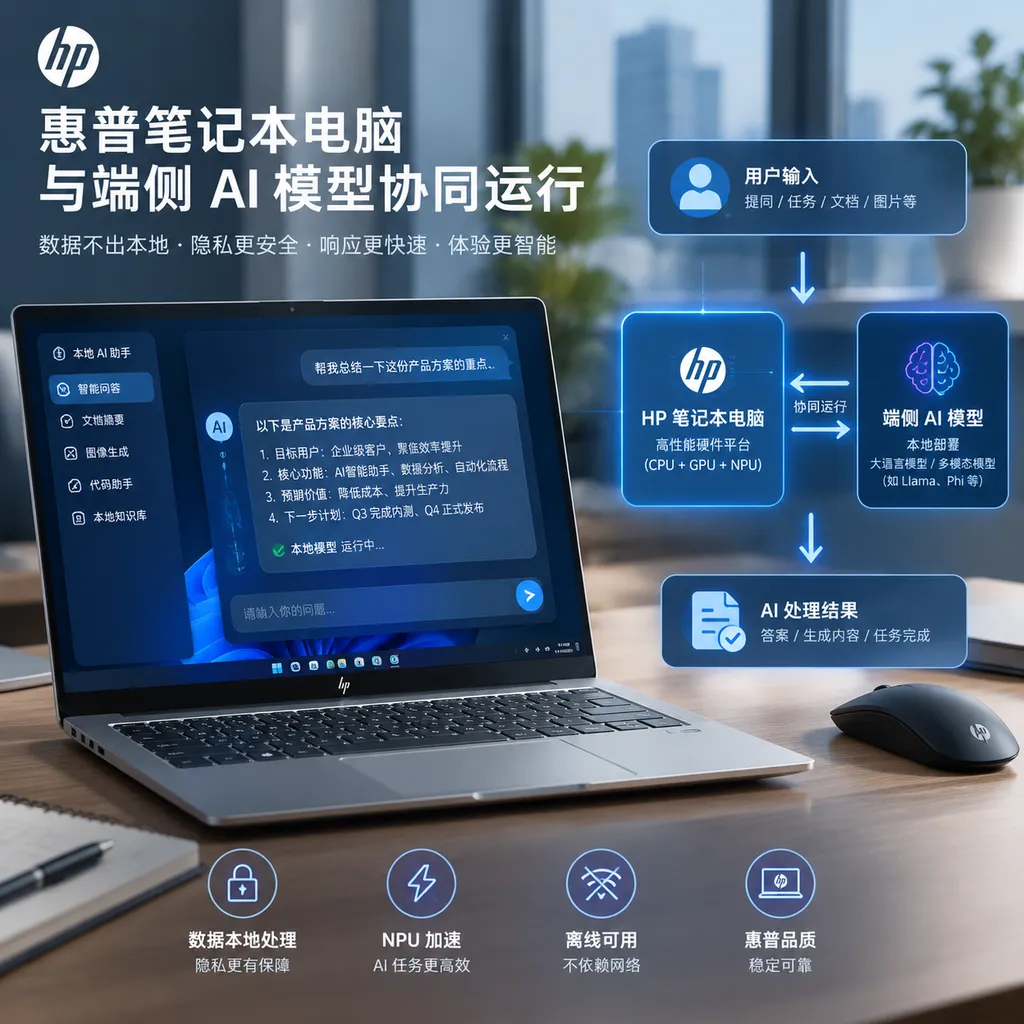
From One-Time Preinstallation to Model Services Throughout the Device Lifecycle
Preinstalling edge models is nothing new. In the past, PC manufacturers also included speech recognition, image enhancement, noise reduction, or document summarization capabilities in their systems. However, these functions typically existed as “factory-installed capabilities”: what the device was like when it went on sale was, in all likelihood, what users would get after taking it home.
The change brought by large models is that the model itself is more like a continuously updated software system than a functional module fixed in firmware. It needs to be continually adjusted according to chip architecture, memory capacity, operating system version, and specific application scenarios. A change in quantization strategy may improve inference speed; an optimization in KV Cache management may enhance long-context capabilities; fine-tuning for local documents, meeting notes, or coding tasks may further change the model’s usefulness.
This means that the way edge AI is delivered is changing. Model companies are no longer simply handing a weight file to hardware manufacturers; instead, they need to participate in the complete adaptation process, including:
- Inference compilation and operator optimization for CPUs, GPUs, and NPUs;
- Selecting appropriate parameter sizes and quantization formats based on device memory and power-consumption limitations;
- Establishing permission controls before local files, screenshots, microphone data, and other information enter the model;
- Designing mechanisms for model updates, rollbacks, and phased releases;
- Continuously evaluating latency, power consumption, accuracy, and user feedback;
- Enabling the model to work together with the operating system, office software, and the manufacturer’s own services.
From this perspective, “preinstallation” is merely the result visible to users; what is truly valuable is the continuous operations and maintenance capability behind it. Edge models may eventually resemble smartphone operating systems: the launch version is only the starting point, while subsequent updates determine whether the model can remain relevant.
Why Edge Models Cannot Simply Copy Cloud Models
When many people first encounter edge AI, they naturally understand it as “shrinking a cloud-based large model.” But this is not accurate. Edge models face a different set of problems—one involving more demanding engineering constraints.
Cloud models can rely on large-scale GPU clusters, with the power and memory costs of individual requests borne by the data center. An edge model, by contrast, has to work on a specific computer: it cannot keep the fan running at full speed for extended periods, nor can it make users wait more than ten seconds whenever they open a feature. Cloud services can continuously obtain the latest models and tools through the network, whereas edge models must account for offline availability, network fluctuations, data permissions, and local storage capacity.
For developers, the difference can be understood as that between a “remote server” and an “embedded system.” The former pursues a higher upper limit of capability, while the latter places greater emphasis on determinism, response speed, and resource boundaries. A cloud model that performs well on benchmarks is not necessarily suitable for direct deployment on a laptop.
The evaluation criteria for edge models include at least four dimensions:
- Capability density: How many high-frequency tasks the model can complete within a limited parameter size.
- Response stability: It must not only be fast on average, but also avoid occasional stutters and out-of-memory errors.
- Energy efficiency: How much power a single summarization or image-processing task consumes directly affects whether users are willing to use it over the long term.
- Local collaboration capabilities: Whether the model can correctly call files, windows, cameras, microphones, and system permissions, rather than merely chat.
This is also why the outcome of edge AI competition will not be determined solely by model rankings. A model scoring a few points lower on general question answering may not affect the user experience; but if it cannot open local documents, misinterprets permissions, or frequently consumes all available memory, users will quickly turn it off.
The Value of HP Preinstallation: Bringing Models from Demonstrations into Real Workflows
For model vendors, the greatest value of entering the PC preinstallation ecosystem is not merely increased exposure, but access to real devices and real user scenarios. Edge inference in the lab typically uses fixed hardware, clean data, and clearly defined tasks. Once preinstalled, however, a model must face different configurations, different system states, and all kinds of unexpected user behavior.
For example, the latency of the same local summarization feature may be completely different on a high-end machine and an entry-level machine. The types of errors produced by the same file-based question-answering capability may also vary when handling Chinese contracts, scanned PDFs, spreadsheets, and code repositories. Once a model reaches a large number of devices, it must establish finer-grained performance tiers: which tasks can be completed entirely offline, which require cloud assistance, which scenarios should be refused outright, and which data must be confirmed by the user.
This real-world feedback will in turn influence model iteration. Model companies can learn which functions users are actually calling and discover which tasks, despite performing well in demonstrations, are not frequently used in real workflows. For edge AI, this type of data is closer to commercial value than a single public leaderboard ranking.
However, preinstallation does not equal success. PC manufacturers have previously preinstalled many applications that users hardly ever opened. To avoid becoming an edge AI feature that “appears at startup and disappears during use,” the key is whether it is embedded in high-frequency workflows.
The scenarios most likely to endure generally have three characteristics: the data is naturally stored locally, the task occurs repeatedly, and the user is sensitive to waiting time. Examples include transcribing and summarizing meeting recordings, document question answering, organizing emails and messages, understanding screen content, code completion, offline translation, and classifying local photos and videos. These scenarios do not necessarily require the most powerful models, but they do require sufficient stability and speed, as well as the ability to perform actions directly.
“Local-First” Is Not Merely a Privacy Slogan
Privacy is an important selling point of edge AI, but privacy cannot be demonstrated merely through the words “data is not uploaded” on a product page. Where exactly the model runs, which steps call the cloud, whether logs contain original content, and how model update packages are verified are the questions developers truly need to examine.
For enterprise users, on-device deployment is particularly appealing. Internal contracts, source code, customer information, and R&D documents do not have to leave the device just to complete a single summarization task, which can reduce the risk of data leakage and reliance on networks. But local execution also introduces new security issues: if a model can read large numbers of local files, malicious documents may induce it to disclose information; if the model can call system tools, inadequate permission-boundary design may shift the risk from “data uploads” to “local privilege escalation.”
Therefore, an edge AI security system should cover at least:
- Least-privilege access to files and applications;
- Detection of prompt injection and malicious content in model inputs;
- User confirmation mechanisms before tool calls;
- Signature verification for models, adapters, and update packages;
- Auditing, disabling, and centralized configuration capabilities in enterprise environments.
This is also an area that model and hardware manufacturers must jointly take responsibility for once edge models enter commercial PCs. Shifting the responsibility entirely to users cannot support large-scale deployment.
The Next Edge AI Competition Will Be Three-Way Coordination Among Models, Chips, and Systems
What is most easily overlooked about edge AI today is that it is not simply a competition between models. Model parameters, inference engines, NPU drivers, memory scheduling, and operating-system interfaces all matter; if any one link fails, the final experience will suffer.
Chip manufacturers want models to fully utilize NPUs, model vendors need to unify operators and quantization schemes across different hardware, and PC manufacturers are more concerned with startup speed, battery life, after-sales service, and product differentiation. The goals of the three parties are not entirely aligned: larger models generally mean stronger capabilities, but also bring higher power and storage costs; more aggressive quantization can reduce resource usage, but may sacrifice some accuracy; and the stronger local capabilities become, the greater the complexity of system permissions and security auditing.
In the future, truly competitive edge AI products may not be products that merely “come with a certain model,” but rather software-hardware systems capable of continuous optimization. Model versions, inference frameworks, and device policies will need to be managed like operating-system components. For developers, this means edge deployment will no longer be merely a matter of conversion and packaging, but will gradually resemble complete MLOps: version management, device grouping, performance monitoring, anomaly rollback, and privacy compliance will all be indispensable.
Edge AI experience = model capability × inference efficiency × system integration × update mechanisms
This formula has no strict mathematical meaning, but it illustrates a reality: when any one factor approaches zero, the overall value perceived by users declines significantly.
The Real Test Facing Yuanqiu Intelligence
Yuanqiu Intelligence’s entry into HP’s preinstalled ecosystem represents a leap from being a model supplier to becoming a participant in the device ecosystem. But this cannot yet be equated with product success. Three questions will be more important to watch going forward.
First, will model updates be frequent enough, yet restrained enough? Upgrading edge devices costs more than updating cloud services. Updates must not pursue version-number growth alone; they must also ensure compatibility, power consumption, and stability.
Second, does the model have clearly defined scenario boundaries? An assistant that can do everything but does everything mediocrely can easily become a decoration in the system. In contrast, if it can reliably handle one or two steps involving local documents, meetings, code, or system operations, users are more likely to form a habit around it.
Third, can Yuanqiu Intelligence maintain a consistent experience across different hardware platforms? HP’s product line covers different processors, memory configurations, and market segments. A model’s performance on flagship devices cannot represent that of all preinstalled devices. How device tiers, capability degradation, and task routing are handled will determine whether this partnership is merely a showcase or the foundation for a sustainably expandable product.
Conclusion: “Long-Termism” Is Becoming Important for Edge AI
The shift in edge AI from “being able to run” to “being able to evolve” is fundamentally a change in the industry’s evaluation standards. In the past, the comparison was about who could put a model into a device; now, it is about who can make a model work reliably on a device and continue improving as systems, hardware, and user needs change.
HP’s preinstallation program provides Yuanqiu Intelligence with an entry point into real-world endpoints, while also imposing higher requirements on the edge-model industry: a model is not an isolated weight file, but part of the device experience; preinstallation is not the destination, but the beginning of the service cycle.
This path will not be as lightweight as a cloud API. It requires the cooperation of models, chips, drivers, operating systems, and applications, and it also requires manufacturers to address permissions, security, and after-sales issues. But once this infrastructure gradually matures, the value of edge AI will no longer be limited to “being usable without a network.” It will bring computing closer to data, closer to scenarios, and closer to the work users perform every day.
For developers, what deserves attention next is not how many more edge models appear, but whether these models can be deployed, monitored, and upgraded reliably. Whoever can build this closed loop is the one most likely to remain in the next phase of edge AI competition.
References
- Zhihu: 2025 Industry Chain Dark Horses, Smart Hardware, and Major AI Events—Referenced for industry background on edge AI hardware integration, AI device entry points, and related topics.
- Zhihu: Discussions Related to AI and Smart Hardware—Used to supplement the industry context surrounding edge models, device ecosystems, and the trend toward agent-based systems.
Note: This article was compiled and written based on the reference materials provided with the topic. The specific preinstalled models, model versions, and commercial terms of the cooperation between Yuanqiu Intelligence and HP remain subject to subsequent official disclosures by both parties.