<think>**Translating headline with nuance** </think> More Than 500 AI Agents Go Online on the National Supercomputing Internet

<think>**Planning precise translation for computing terms** </think> At the 2026 Computing Power Network Development Conference, Sugon Intelligent Computing disclosed that the National Supercomputing Internet has launched more than 500 intelligent agents and over 10,000 skills, covering more than 170 scientific computing scenarios. The platform is seeking to transform supercomputing capabilities from an “expert tool” into a conversational, orchestratable infrastructure.
National Supercomputing Internet Begins Using Agents to Reorganize Supercomputing Capabilities
The National Supercomputing Internet is moving from “connecting computing power” to “calling computing power.”
On September 15, at the 2026 Computing Power Network Development Conference, He Mujun, president of Sugon Intelligent Computing, revealed that the National Supercomputing Internet platform has now established six major agent matrices covering areas such as materials computation and industrial simulation. These matrices cover more than 170 core computing scenarios, with over 500 agents and more than 10,000 skills launched to date.
The platform also provides more than 16,000 content components and conversational development tools. According to official statements, users do not need to be proficient in programming to build scientific computing agents for specific tasks in a “building-block” fashion.
The significance of this development lies not only in the figure of “500 agents,” but also in the fact that supercomputing platforms are attempting to change their product form. In the past, users first had to understand computing resources, software environments, algorithmic models, and task scheduling, and then translate their questions into instructions that machines could execute. Now, the platform hopes users can start with a question in natural language, with agents handling task decomposition, tool calls, parameter configuration, and result interpretation.
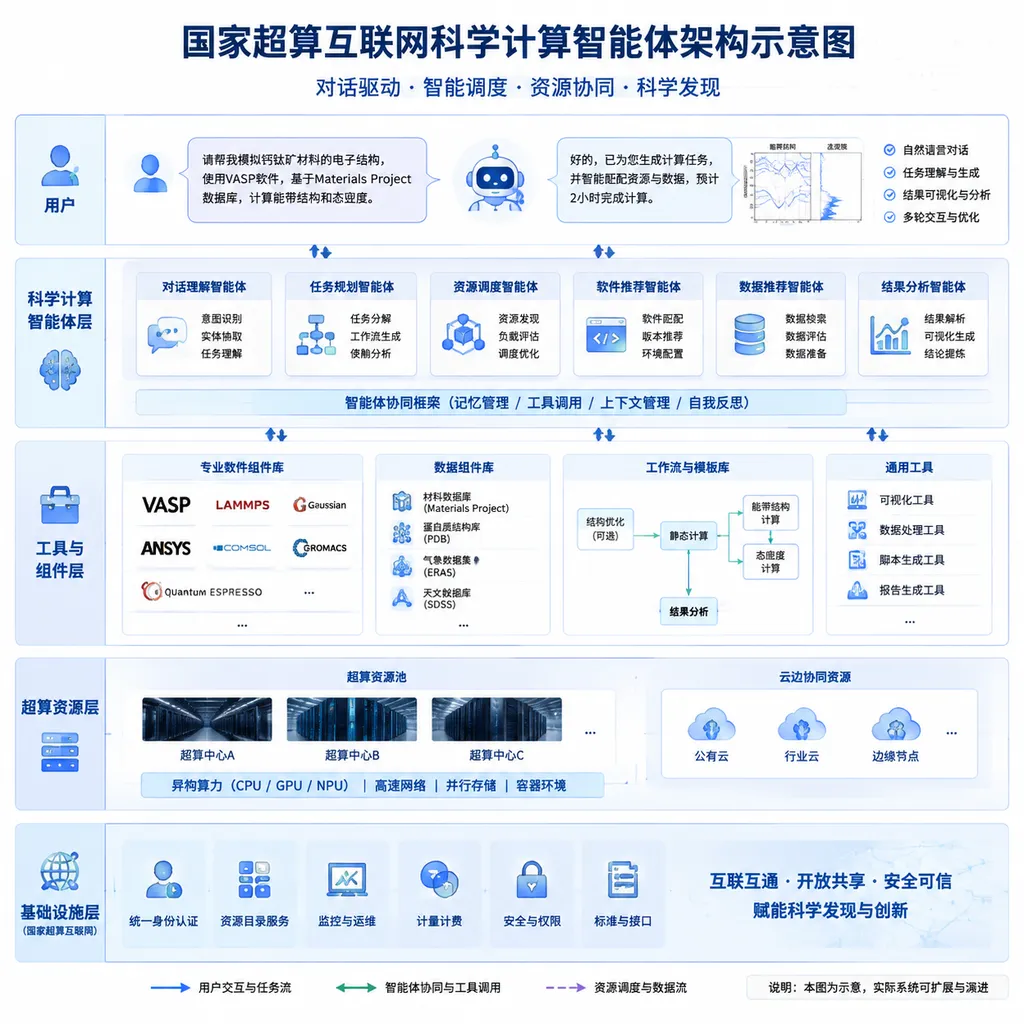
From “Giving You a Machine” to “Helping You Complete a Computation”
The barrier to using traditional supercomputing centers is not low.
Researchers typically need to apply for an account, configure a runtime environment, prepare input data, select appropriate software and algorithms, and then submit tasks through the command line or a job scheduling system. In specialized fields such as materials simulation, fluid dynamics simulation, and weather forecasting, tasks also involve a large number of parameters, including mesh generation, boundary conditions, convergence criteria, and parallelization strategies.
Supercomputing centers can provide powerful computing capabilities, but they do not automatically turn an ambiguous research question into an executable computing task. In many cases, what truly limits the scale of use is not computing power, but the engineering complexity of the “last mile.”
The value of agents lies in encapsulating this process. Users can ask questions such as “Compare the thermal conductivity of two materials at different temperatures” or “Evaluate the stress on a structural design under extreme operating conditions.” The agent can then select the appropriate data, models, professional software, and computing resources based on the scenario and generate an execution plan.
From a product perspective, this is somewhat similar to the transition in cloud computing from virtual machines to managed services. Early cloud platforms moved servers online, but users still had to manage operating systems, networks, and runtime environments themselves. Later, containers, serverless computing, and various managed services emerged, allowing developers to simply describe what they wanted to run. What the Supercomputing Internet is now attempting to do is package complex scientific computing infrastructure into task-oriented services.
Of course, “building with blocks” does not mean that scientific computing has truly become a low-barrier game. Natural language can lower the operational threshold, but it cannot verify physical assumptions on behalf of users, nor can it replace experimental data and domain expertise. Agents can help users complete a computation more quickly, but professionals must still determine whether the results are trustworthy.
What Work Do the Six Major Agent Matrices Cover?
The information disclosed so far shows that the National Supercomputing Internet has built six major agent matrices around areas such as materials computation and industrial simulation, covering more than 170 core computing scenarios.
The authorities have not released a complete classification of the six matrices, nor have they disclosed which specific tasks the more than 500 agents correspond to. Therefore, for now, it is more appropriate to understand these figures as an indication of the platform’s capability scale rather than as a fully mature commercial product catalog.
Based on the common application areas of the Supercomputing Internet, the relevant scenarios may generally include the following categories:
- Materials computation: Used for tasks such as material structure analysis, performance prediction, molecular simulation, and new-material screening.
- Industrial simulation: Serving design verification for mechanical structures, thermodynamics, fluid mechanics, and complex equipment.
- Engineering design optimization: Reducing the cost of repeated trial and error through parameter searches, solution comparisons, and multi-objective optimization.
- Scientific data processing: Cleaning, analyzing, and visualizing experimental data, observational data, and simulation results.
- High-performance numerical computing: Packaging specialized algorithms, parallel computing frameworks, and job-scheduling processes into callable skills.
- Industry models and knowledge services: Combining professional knowledge bases, industry software, and domain data to provide research and industrial users with more complete task workflows.
If these capabilities can truly be integrated, agents will no longer be merely “calculators that can chat.” They may instead become a scheduling layer within scientific workflows: understanding task objectives, calling the appropriate tools, linking multiple computational steps together, and delivering results to users in the form of reports, charts, or reproducible tasks.
This is also why the “more than 10,000 skills” figure is more noteworthy than the “more than 500 agents” figure. An agent generally corresponds to a relatively complete task entry point, while a skill is more like an underlying atomic capability, including data reading, mesh generation, model invocation, parameter sweeps, result analysis, and visualization. The number of agents determines how many types of task entry points the platform offers externally, while the number of skills determines whether it can truly combine complex workflows.
The Real Challenge Is Not Connecting a Large Model
Connecting a large model to a supercomputing platform is not difficult. The challenge lies in enabling it to call professional computing tools safely, reliably, and verifiably.
In an ordinary chat scenario, if a large model gets one sentence wrong, the user can simply ask again. In scientific computing, however, an incorrect unit, boundary condition, or material parameter can cause an entire task to produce results that appear reasonable but are actually wrong. This is especially true in industrial simulation and engineering design, where errors may not manifest as obvious error messages but may instead be hidden in the details of the results.
Therefore, scientific computing agents must address at least four issues.
First, Task Decomposition Must Be Controllable
Natural-language requirements are often incomplete. When a user says, “Analyze whether this structure is safe,” they may not specify the load, material, constraints, or safety factor. An agent cannot simply fill in the missing parameters based on guesses. It should ask follow-up questions and record every key assumption.
Second, Tool Calls Must Be Reliable
Agents need to call upon supercomputing resources, professional software, datasets, and job-scheduling systems. These tools may have different interfaces, versions, and operational limitations. A mature platform needs to establish unified tool protocols, permission management, and runtime-status feedback. It cannot allow a model to “freestyle” directly in a production environment.
Third, Results Must Be Reproducible
The most important thing in scientific computing is not generating a visually appealing chart, but enabling others to understand how the result was produced. The data, code, model versions, and computing parameters used by a task should all be fully recorded. Otherwise, no matter how clearly an agent-generated report is written, it will be difficult to use it for serious scientific research or engineering decisions.
Fourth, an Evaluation System Must Be Established
General-purpose large models can be evaluated using metrics such as accuracy and preference scores, but scientific agents require more complex evaluations, including physical consistency, numerical stability, computational efficiency, result error, and the ability to handle abnormal inputs.
In other words, the core competitiveness of a supercomputing agent lies not only in the scale of its model parameters, but in the overall closed loop of “model + professional software + high-quality data + computing resources + verification mechanisms.” Whoever can make this chain more reliable will have a chance to turn agents from demonstration products into production tools.
How Far Are More Than 500 Agents from Large-Scale Adoption?
From the perspective of industry development, the National Supercomputing Internet has moved beyond the stage of simply building infrastructure and is entering a phase of capability operations and application expansion.
In 2023, the Ministry of Science and Technology organized a meeting on the development of the Supercomputing Internet, promoting the launch of related initiatives. In April of the same year, construction of the National Supercomputing Internet platform officially began, and the National Supercomputing Internet Alliance was established. By January 2026, the platform’s user base had surpassed one million. The platform’s latest announcement of the number of agents, skills, and application scenarios indicates that it is attempting to convert its user base into more frequent and specific computing needs.
However, the number of users and agents cannot be directly equated with actual usage.
A platform having one million users does not mean that all of them are continuously running high-performance computing tasks. Similarly, the launch of 500 agents does not mean that every agent has undergone large-scale production validation. For a supercomputing platform, more meaningful metrics include how many agents have stable monthly active users, how many tasks have achieved automated scheduling, how many computing results have entered scientific research, manufacturing, or engineering workflows, and whether the cost and completion time of individual tasks have declined significantly.
In addition, scientific computing is inherently fragmented across industries. The parameters that matter to a materials R&D company are different from those of an automobile manufacturer, energy company, or meteorological agency. A conversational interface designed for general users can solve the problem of “how to use” the system, but addressing whether results are accurate and whether they can be used for decision-making still requires extensive industry-specific adaptation.
This means that the future focus of competition for the National Supercomputing Internet may not simply be to continue increasing the number of agents. It may instead be to build a more standardized component marketplace, model evaluation system, and application delivery mechanism. Only when professional software, data, and computing power can be combined, measured, and reused like cloud services will the platform’s scale truly translate into industrial value.
For Developers, the Opportunity Lies in “Connectors,” Not Chat Windows
For developers, the opportunities brought by supercomputing agents are not limited to building a chat interface for users.
More valuable work may focus on three types of foundational capabilities: first, packaging professional software, scientific databases, and computing frameworks into standardized tools; second, establishing verifiable workflow templates for different scientific fields; and third, developing platform components for permission control, task scheduling, result auditing, and cost management.
In the future, a mature scientific computing agent may need to handle multiple types of resources simultaneously: retrieve material properties from a knowledge base, read experimental data from a data platform, use professional software to generate simulation tasks, submit those tasks to supercomputing nodes with different architectures or in different regions, and finally return a results report containing process records. The engineering complexity of such a system is far greater than simply placing a chat window around a large model.
Developers should therefore view this as “agent infrastructure for scientific computing,” rather than another general-purpose question-and-answer product. The model is merely the entry point. What truly determines whether the system can be deployed is its tool interfaces, task orchestration, data governance, and verification mechanisms.
The launch of more than 500 agents on the National Supercomputing Internet sends a clear signal: supercomputing resources are moving from back-end infrastructure toward front-end applications. But the destination is not to enable everyone to call upon supercomputers arbitrarily. Rather, it is to allow more scientific research and industrial tasks to enter computable, verifiable, and reproducible workflows with a lower barrier to entry.
The platform has now taken the first step from “whether computing power exists” to “whether it can be called upon.” The next question is whether these agents can operate reliably in real production environments and whether they can accelerate the conversion of computing results into scientific discoveries and engineering decisions. The answer to that question matters far more than the number 500.
Sources
- IT Home: National Supercomputing Internet Launches More Than 500 Agents, Covering More Than 170 Core Computing Scenarios: Reports on information related to the 2026 Computing Power Network Development Conference held on September 15, 2026, and introduces the National Supercomputing Internet’s agent matrices, covered scenarios, number of skills, and platform components.