Salesforce Launches Koa as Enterprise AI Shifts Gears
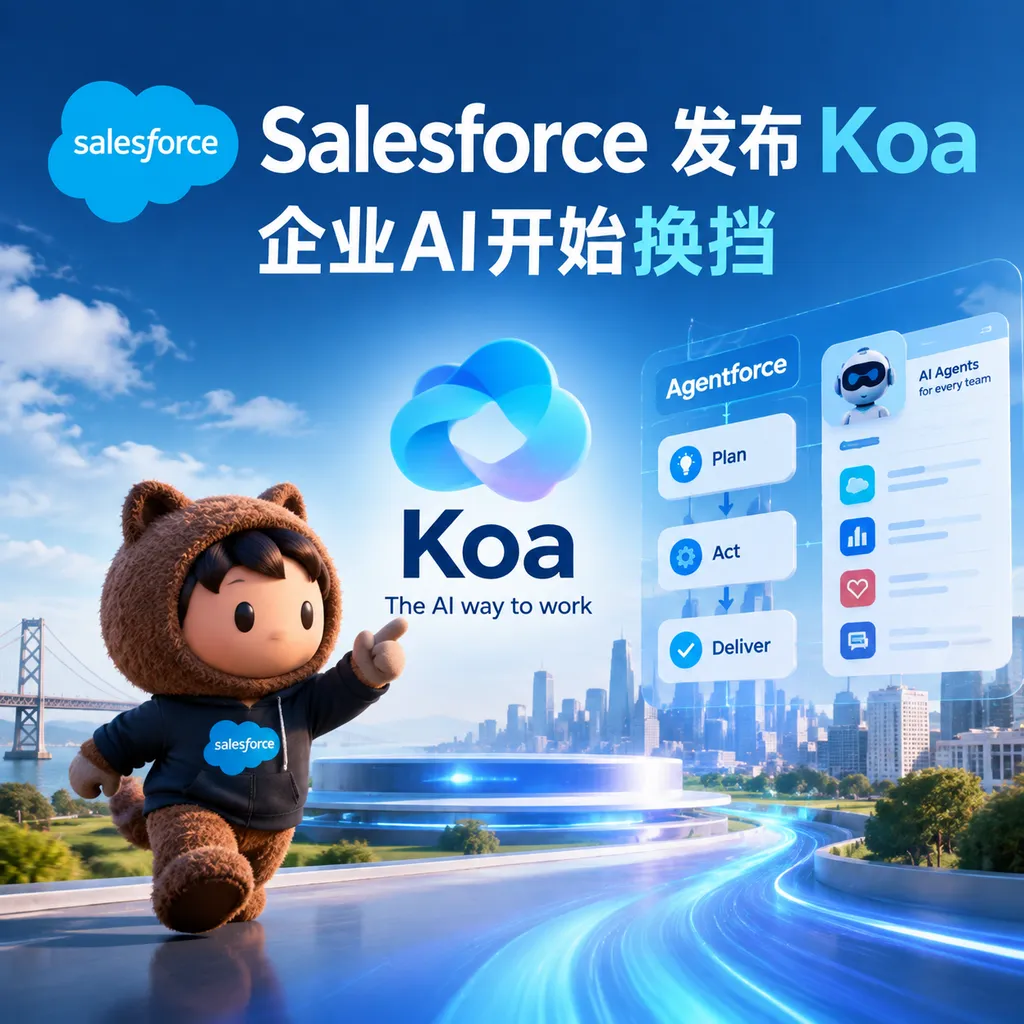
Salesforce has partnered with NVIDIA to launch Koa, an inference-focused large language model built on Nemotron’s open-source weights, with priority given to sales, marketing, and customer service scenarios. Rather than pursuing the top spot on general-purpose model leaderboards, it aims to replace some Claude and ChatGPT calls with lower costs and greater control over data.
Salesforce Is No Longer Just a Model “Dispatcher”
On September 15, Salesforce unveiled Koa at the Dreamforce technology conference, an enterprise reasoning foundation model designed for sales, marketing, and customer service scenarios. It is Salesforce’s first enterprise-grade reasoning model, built on open Nemotron weights provided by NVIDIA, with the two companies jointly completing the subsequent fine-tuning process.
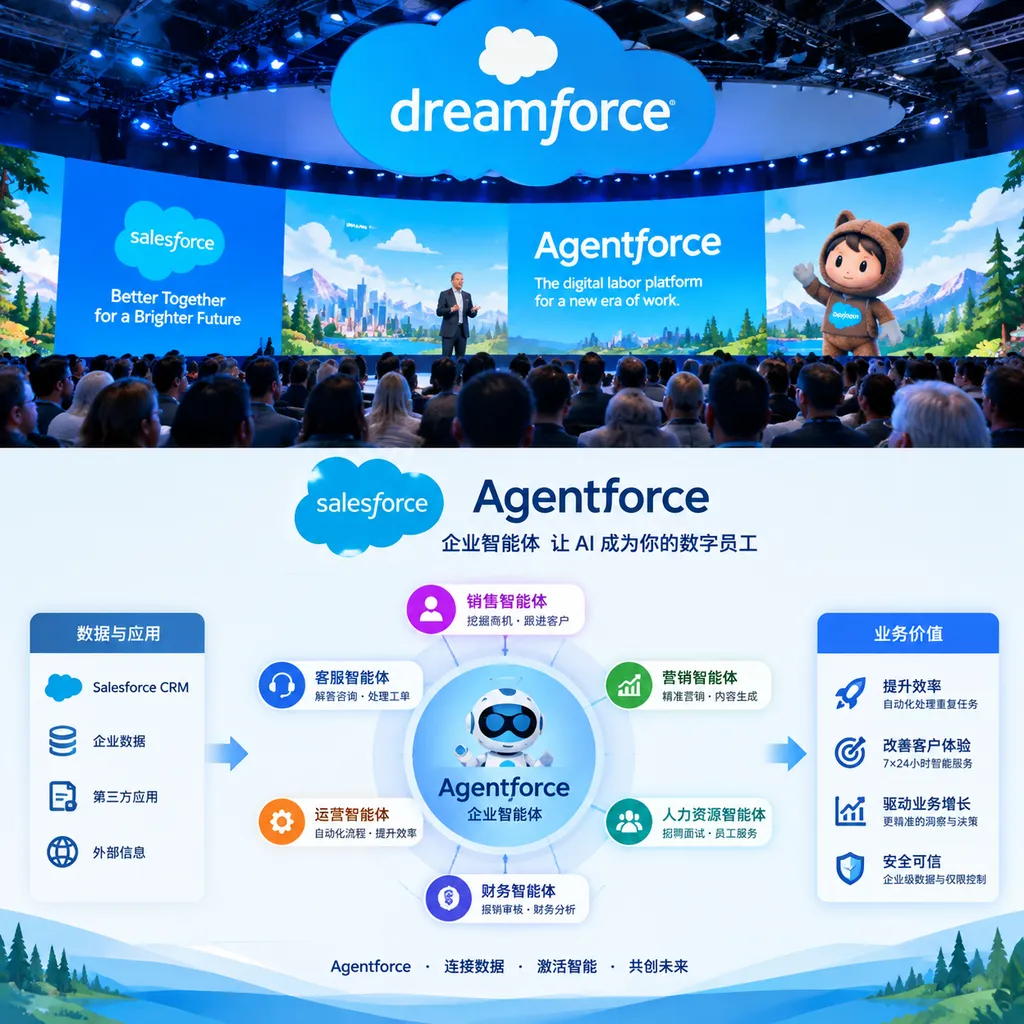
Koa is not intended to “build yet another general-purpose foundation model.” Salesforce has given it a more specific mission: enabling agents on the Agentforce platform to handle customer service Q&A, appointment scheduling, sales-process follow-ups, and enterprise workflows that require multistep decision-making.
What is truly worth noting is not that another model has been added to the list, but that Salesforce is changing its position in the enterprise AI supply chain. In the past, when Agentforce encountered complex reasoning tasks, it would typically route requests through an AI gateway to external frontier models such as Claude and ChatGPT. Salesforce was more like a model dispatcher: it controlled the business entry points, customer data, and workflows, while purchasing model capabilities from external providers.
With the launch of Koa, that model is beginning to shift. At least for some enterprise tasks, Salesforce can bring the model, data, permissions, and agent runtime environment back inside its own platform.
Koa’s Core Selling Point Is Not Parameter Size but “Business Fit”
In terms of positioning, Koa is closer to a professional employee trained for enterprise work than to a general consultant who can discuss anything.
Frontier closed-source models excel at writing code, solving math problems, and handling complex knowledge-based questions. But the tasks enterprise customers actually perform most frequently are often less flashy: extracting intent from customer conversations, determining ticket priority, retrieving contract clauses, generating sales follow-up suggestions, confirming appointment times, and writing the results into a CRM system.
These tasks require reasoning, but not necessarily the strongest general-purpose capabilities. Enterprises care more about four things: whether the model can execute reliably, comply with permissions, explain its results, and keep the cost of each call under control.
Salesforce is clearly training Koa in this direction. According to the company’s official disclosures, Koa has primarily undergone additional fine-tuning for sales, marketing, and customer service tasks, rather than continuing to pursue difficult mathematical problem-solving or open-domain knowledge Q&A. This trade-off does not mean Koa is smarter than Claude or ChatGPT; it means that Koa may be more cost-effective in specific workflows.
For example, a customer service agent may first need to identify a customer’s issue, then check the order status, determine whether the request qualifies under refund rules, generate a response, and finally submit it for human review. Tasks like these typically generate a chain of prompts, tool calls, and intermediate reasoning. If a model can complete the same process with fewer tokens, the enterprise bill will fall and system response times may also improve.
Salesforce emphasizes that Koa can also participate in automatic routing through Agentforce’s AI gateway. Simple requests can be assigned to models that are cheaper and faster, while complex tasks can be forwarded to more capable external models. This kind of “model mixing” may better reflect enterprise realities than simply pursuing a single all-purpose model.
Why Nemotron?
Salesforce’s choice of NVIDIA’s open Nemotron weights as its foundation reflects clear industrial considerations.
First, open weights give enterprises greater control. Salesforce can continue training and fine-tuning the model, and determine how it handles enterprise instructions and integrates with internal security policies, rather than simply waiting for external model providers to update their products.
Second, NVIDIA provides more than just a model. It also controls GPUs, inference-optimization tools, and an enterprise deployment ecosystem, enabling Salesforce to connect model training with inference deployment. For enterprise customers, model performance is only the first hurdle. The real challenges are latency, concurrency, cost, permissions, and operations after the model goes live.
Third, Nemotron gives Salesforce a relatively suitable pretrained foundation. Jayesh Govindarajan, Salesforce’s executive vice president of artificial intelligence, said in an interview that the company had previously developed a number of small language models for specialized tasks, but had continued to rely on external frontier models for complex reasoning. It was only after Nemotron emerged that Salesforce believed the basic conditions were in place to build an enterprise-grade reasoning model.
This is also what distinguishes Koa from traditional enterprise fine-tuned models. It is not merely a small model for classification, extraction, and summarization; it is beginning to handle long-running, multistep business tasks. At the same time, it does not need to bear the full cost of serving as a general world model.
Why Enterprises Are Willing to Use a Model That “Doesn’t Look That Powerful”
Over the past two years, enterprises purchasing foundation models have often fallen into a misconception: look at public benchmarks first, then select the most capable model. But after deploying models in production, enterprises discover that the more capable a model is, the higher its price often becomes; the longer the context, the harder it is to predict usage costs; and when a model is hosted by a third party, data and compliance boundaries become more complicated.
Koa is aimed precisely at these pain points.
1. Clearer Data Boundaries
Salesforce says that Koa’s training process did not use real customer data. This is especially important for financial institutions, healthcare organizations, governments, and large enterprises. Companies do not have to worry that internal customer records, service conversations, or sales materials will be used to train a general-purpose model intended for public use.
Of course, “customer data was not used for training” does not automatically mean absolute security after deployment. Enterprises still need to pay attention to how data is transmitted during inference, whether logs are retained, which fields third-party tools can access, and whether an agent might write information into the wrong system. Koa’s value lies in its ability to embed these control mechanisms more deeply into the Salesforce platform, rather than leaving them to be handled separately by multiple external service providers.
2. Token Costs Could Fall
The cost of an enterprise agent typically comes from more than a single model response. A complete task may include intent recognition, retrieval, planning, tool calls, result verification, and a final response. Every step taken by the model consumes tokens.
If a general-purpose frontier model is used for every step, costs can easily spiral out of control. After being optimized for sales and customer service tasks, Koa can handle many of the repetitive, structured reasoning steps, reserving more expensive models for genuinely complex questions.
This is not simply a matter of replacing an expensive model with a cheaper one. It is about treating models as different roles within an enterprise workflow: a foundational model handles high-frequency routine tasks, while a frontier model handles a small number of difficult cases. The AI gateway is responsible for assigning the work.
3. Security Policies Can Follow the Platform
Agentforce’s advantage lies not only in the model itself, but also in the fact that it is already connected to CRM, customer service, marketing automation, and enterprise permission systems. If Koa is deeply integrated into these systems, it can determine a user’s permissions before answering a question, confirm the scope of data before calling a tool, and retain audit records after executing an action.
For enterprises, this is more important than simply purchasing a model API. A model that can write polished responses but does not know which customer fields it is forbidden to access is still far from ready for production.
Will Koa Disrupt Claude and ChatGPT?
In the short term, Koa is unlikely to challenge Claude and ChatGPT across the board. Frontier closed-source models still have advantages in general reasoning, complex coding, cross-domain knowledge, and long-context tasks. Salesforce itself has not said that it plans to completely sever its relationships with third-party model providers.
A more realistic change is that Koa will become a new card in Agentforce’s model lineup.
Previously, when an enterprise agent needed complex reasoning, Agentforce’s AI gateway would forward the request to Claude or ChatGPT. In the future, the system can first determine the task type: standardized customer service processes, sales lead organization, and appointment operations can be handled by Koa first; cross-domain analysis, complex document understanding, and advanced code generation can then be sent to external frontier models.
This architecture will shift model competition away from “whose overall benchmark score is higher” and toward “who can reliably complete a specific workflow at lower cost.” Model providers will no longer be selling just a chat window, but a set of capability units that enterprise systems can schedule.
NVIDIA’s recent launch of distributed inference services with Equinix and Together AI sends a similar signal: enterprise inference is moving from centralized calls toward deployments closer to users and data. Reducing latency, migrating open models, and meeting data-localization requirements will become metrics just as important as capability when enterprises choose models.
Open Weights Are Becoming an Enterprise Procurement Option
Another significance of Koa is that open-weight models are beginning to enter the core products of large software companies more directly.
Here, it is important to distinguish “open weights” from being fully open source in the traditional sense. Whether enterprises can view the training data, modify the model, redistribute it, and what restrictions apply to commercial use still depends on the specific license and product terms. Open weights do not automatically mean there are no restrictions.
Compared with completely closed model services, however, access to the weights gives enterprises more deployment options: they can run the model in designated regions, have partners deploy it privately, or fine-tune it according to their business data and security requirements. For enterprises that do not want to hand over all their data to an external model platform over the long term, that flexibility has value in itself.
Salesforce’s approach also shows that enterprise software vendors do not necessarily need to train a foundation model with hundreds of billions of parameters from scratch. They can leverage a mature foundation and concentrate their resources on business data governance, task design, evaluation systems, and system integration. What ultimately determines whether enterprise AI can be deployed successfully is often not how many more points a model scores on a public test set, but whether it remains stable, auditable, and billable a month later.
What Developers Need to Watch
For developers using Agentforce or similar enterprise agent platforms, Koa brings three main changes.
- Model selection will become more granular. Different tasks may use different models. Applications will need to support model routing, degradation, and fallback rather than hard-coding model names into business logic.
- Evaluation cannot focus only on response quality. It must also measure tool-call success rates, permission-compliance rates, task-completion times, token consumption, and the proportion of cases requiring human intervention.
- Data governance will become part of model engineering. Which fields can enter the context, which results require human approval, and which actions require secondary confirmation all need to be clearly configured at the agent level.
If Koa is ultimately made available only within Salesforce, its direct impact on external developers may be limited. But the approach it represents will be copied by more enterprise software vendors: use open weights as the foundation, differentiate through industry data and workflows, and use a gateway to combine multiple models into an operable system.
Conclusion: Enterprise AI Is Entering the “Good Enough and Controllable” Phase
Koa is not another supermodel attempting to replace every other model. It is more like an engineering bet by Salesforce on enterprise scenarios: embedding reasoning capabilities into sales and customer service workflows while bringing model costs, data permissions, and deployment security within the platform’s sphere of control.
This approach may not generate the loudest buzz on public leaderboards, but it may be closer to the way enterprises actually make purchasing decisions. Enterprises do not need the strongest model forever; they need a model that can reliably complete business tasks at an acceptable price and within compliance boundaries.
For closed-source frontier models such as Claude and ChatGPT, Koa will not become a direct replacement in the short term, but it will weaken their dominance over enterprise workflows. In the future, enterprises are unlikely to purchase just one model. Instead, they will use multiple models simultaneously and route them through an AI gateway according to task, cost, latency, and data sensitivity.
The next battle among models is shifting from laboratory leaderboards to the routing tables in enterprise back offices.