Zhixiang Releases a Video Model for Physical Laws
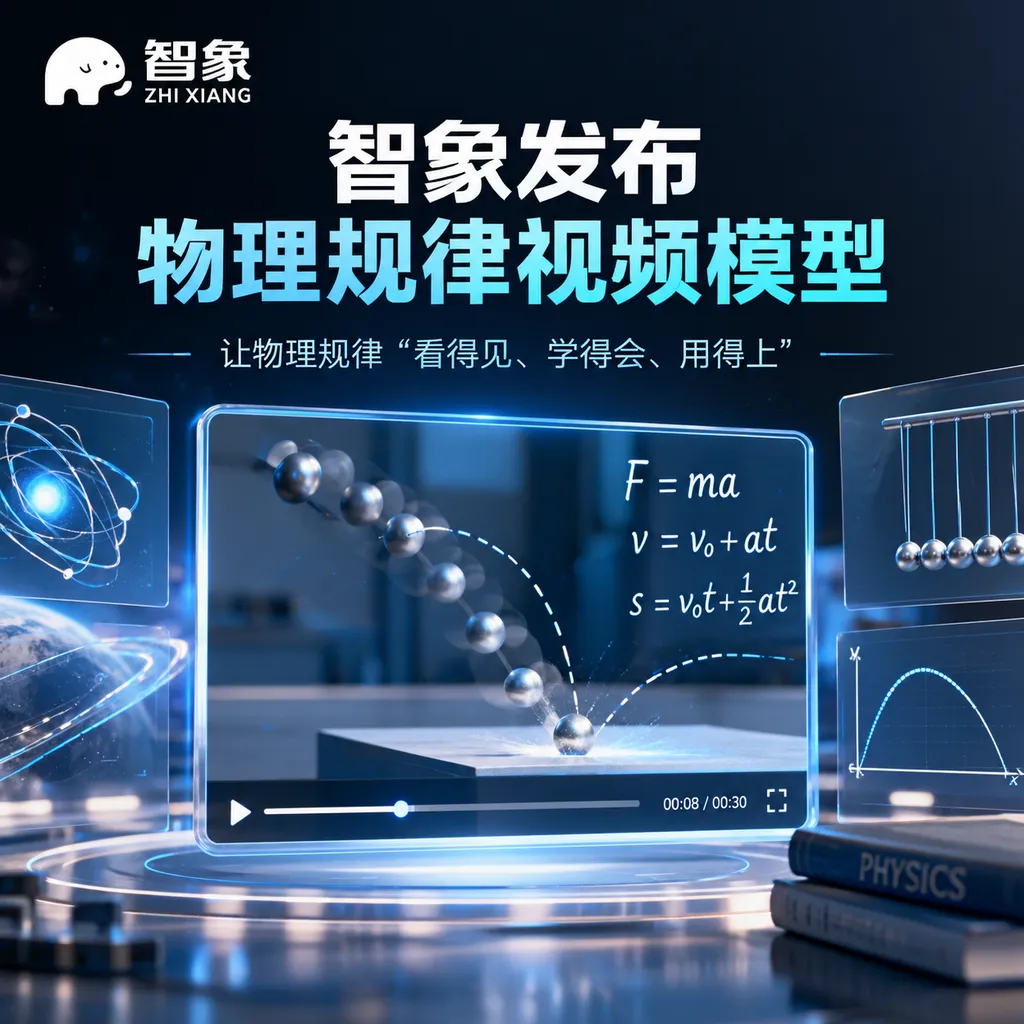
HiDream Future Releases Native Omnimodal Video Model HiDream-O1-Video-1.0, Supporting Text, Image, and Video Inputs, Generating 5–20-Second 1080p Videos, and Ranking in the Top 10 on Two Image-to-Video Leaderboards.
HiDream Releases a Video Model That Understands Physical Laws: Video Generation Is Becoming More Difficult Than Simply “Looking Right”
On September 15, HiDream.ai released its first native multimodal video generation model, HiDream-O1-Video-1.0, abbreviated as HD-V1. The model supports multiple types of input, including text, images, and video, and can generate videos ranging from 5 to 20 seconds in length at resolutions of up to 1080p. It focuses on intent understanding, physical laws, narrative planning, and integrated audio-visual generation.
On the same day, HiDream.ai announced the completion of its Series C+ financing round. Investors included Xinwei Capital, Jiaozhi Capital, and ICBC Capital. Holding the financing announcement and model release on the same day indicates that HiDream is moving “native multimodality” and “world models” from technical narratives toward product competition.
What is most noteworthy about this release is not that there is yet another model capable of turning images into videos, but that the metrics for video model competition are changing. The focus is gradually shifting from image clarity and smooth motion to whether a model can understand why a scene changes the way it does—and how it should change in the next second.
What Exactly Does HD-V1 Do?
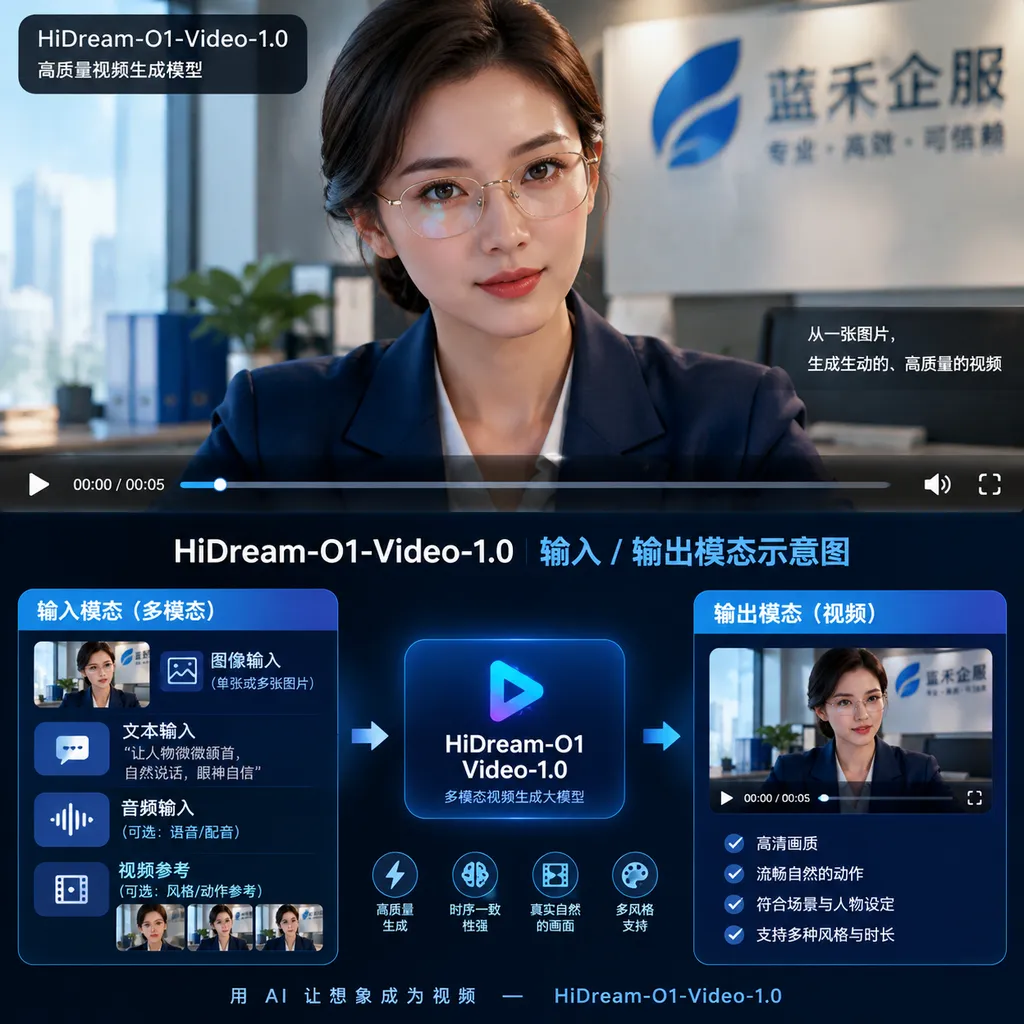
From a product-capability perspective, HD-V1’s entry point is not complicated. Users can input a piece of text, an image, or an existing video, and ask the model to continue, reconstruct, or extend the content. According to the company, the model can generate high-fidelity 1080p videos of 5–20 seconds in a single generation.
For developers, however, the more important point is that inputs are no longer limited to a single modality. Text can describe the target and style, images can provide the subject, composition, and visual references, while video can provide motion, camera movement, or temporal changes. The model must understand all this information within a single task rather than invoking several unrelated modules separately.
For example, suppose a user provides an image of a person standing on a skateboard and enters the instruction: “Have the person skate down the slope, maintain balance upon landing, and track the subject from the right.” An ordinary image-to-video model might be able to generate footage of someone skateboarding, but the person’s center of gravity, the skateboard’s contact with the ground, the direction of camera movement, and the post-landing posture may not all work simultaneously.
HD-V1’s technical approach is aimed precisely at this kind of combined task. It attempts to do more than “fill in consecutive frames”; instead, it tries to infer a relatively reasonable process of change based on the scene, actions, and language instructions.
Entering the Top Ten on Two Leaderboards—but Rankings Are Not Everything
On Artificial Analysis’s Image to Video Leaderboard (With Audio), HD-V1 ranked fourth globally. In Arena.ai’s blind Image-to-Video evaluation, the model ranked eighth.
These results indicate that HD-V1 has entered the first tier of current image-to-video models. In particular, the former leaderboard’s inclusion of audio means that evaluation is no longer concerned only with whether the visuals are coherent; it is also beginning to examine whether the video, sound, and overall expression match one another.
However, leaderboard results should be viewed as a signal rather than a final conclusion.
First, image-to-video leaderboards generally focus on a set of standardized tasks and cannot cover every real-world production scenario. Advertising, short-drama storyboarding, game asset generation, and educational content production all place different demands on a model.
Second, 5–20 seconds still falls within the short-video generation range. Visual stability over a short duration does not mean that the model has solved character consistency, shot transitions, or complex causal relationships in long-form video.
Third, blind testing is better suited to measuring “overall impression,” while developers also care about controllability, consistency across repeated generations, failure rates, inference costs, API stability, and whether the model can be integrated into existing workflows.
Therefore, HD-V1’s entry into the top ten is a positive signal, but proving that it is suitable for large-scale use will require more information about its API, pricing, concurrency, content-safety measures, and enterprise deployment options.
Why Have “Physical Laws” Become the New Battleground for Video Models?
The most visible problems in earlier video generation models included distorted fingers, flickering objects, identity drift, and discontinuous motion. As baseline image quality improves, the industry is beginning to encounter a more difficult layer of problems: the footage looks realistic, but events unfold incorrectly.
When a ball rolls off a tabletop, its changes in speed may not correspond to gravity. When a cup is pushed over, the liquid may not respond to inertia. When a person runs, the movement of the legs may not match the body’s center of gravity. When a car turns, the relationship between the tires, vehicle body, and road may not make sense. These problems do not always appear as obvious “model errors,” but they make viewers feel that the footage is unconvincing.
The reason is that video generation is not simply a matter of predicting the next image. The model must process several layers of information simultaneously:
- Spatial relationships: Whether the positions of people, objects, the ground, and the camera remain stable;
- Temporal relationships: Whether the sequence, speed, and duration of actions are reasonable;
- Object permanence: Whether an object retains its identity and shape after being occluded, rotated, or moved;
- Causal relationships: Whether the environment produces a reasonable result after an action occurs;
- Linguistic intent: Whether the user is specifying a target, an action, a style, or camera direction.
This is also why understanding physical laws is more difficult than making motion “smoother.” The former requires the model to form some kind of internal set of rules about the world, or at least preserve an approximation of those rules during generation, rather than merely memorizing visual correlations in its training data.
Of course, the information HiDream has disclosed so far is not sufficient to show whether HD-V1 possesses physical simulation capabilities in the strict sense. A more accurate description is that the model treats physical consistency as one of its training and generation objectives, attempting to make the motion and outcomes in its videos better match real-world experience. It remains a considerable distance from replacing professional physics engines.
What Is Different About Native Multimodality from “Combining Multiple Models”?
HiDream repeatedly emphasizes that HD-V1 uses a native multimodal technical approach, with unified representations for text, video, and audio. The core idea is to allow information from different modalities to enter the same model system, rather than processing them separately and combining them only at the output stage.
The two approaches can be compared to two different production processes.
The first is an “assembly line”: a language model understands the instructions, an image model generates the visuals, a video module interpolates frames, and an audio module adds sound at the end. Such a system may be faster to launch, and its modules may be relatively easy to replace, but information is often lost between modules. If the text says that a person should “gently put down the cup,” the video module may interpret this only as “move the hand downward,” while the audio module may not know when the cup makes contact with the table.
The second is unified modeling: information from text, images, video, audio, and other modalities is encoded into a shared representation space, and the model understands their relationships within the same context. In theory, this architecture is better suited to handling cross-modal questions such as “What happened in the scene, how should the sound change, and what result will the next action produce?”
However, native multimodality does not automatically mean better performance. It also introduces direct engineering challenges: training data are more difficult to align, model size and GPU memory requirements are higher, the temporal granularity of different modalities varies, and inference latency and costs may increase. Its ultimate value will still depend on whether unified representations can be translated into fewer generation errors and stronger controllability.
From Video Models to World Models: What Is HiDream Betting On?
HD-V1 is not an isolated product from HiDream. Earlier, HiDream released the interactive world model HiDream-O1-World, emphasizing spatiotemporal consistency, physical consistency, and long-horizon reasoning. In early September, it also released the embodied world model HiDream-O1-Embodied for robotics, attempting to address visual perception, dynamic prediction, and action execution in real-world environments.
Viewed together, these products reveal a relatively clear direction for HiDream: using a native multimodal foundation as the basis for expansion into video generation, interactive worlds, embodied intelligence, and other areas. The video model is the part most readily perceived by the market, while world models represent the longer-term technical objective.
The possibilities offered by this approach are considerable. For game companies, it could be used to rapidly generate interactive environments. For robotics companies, motion prediction in video could become part of training and simulation. For the film and advertising industries, models might not only generate several seconds of footage but also participate in storyboard planning, shot transitions, and sound design.
However, the threshold for world models is much higher than that for video generation. A model’s ability to generate footage that “looks physically plausible” does not mean it can correctly predict outcomes in a new environment. Its ability to generate robot movements does not mean those movements can be safely executed in the real world. Once model outputs move from the screen into reality, the margin for error rapidly narrows.
Therefore, the near-term practical value of HD-V1 will remain concentrated primarily in content production and visual creativity, rather than directly taking on high-risk physical decision-making.
Which Metrics Should Developers Watch?
If HD-V1 later opens up more complete service interfaces, developers should not focus only on promotional videos and leaderboard rankings. At a minimum, they should pay attention to the following metrics:
- Input constraints: Which image and video formats are supported? Does the model support first-and-last frames, localized editing, reference videos, and multiple-image inputs?
- Duration and resolution: Are 5–20 seconds fixed options or continuously controllable? Does 1080p require additional charges?
- Consistency: Can the same characters, clothing, props, and settings remain stable across shots?
- Control methods: Does the model support control over camera paths, motion intensity, movement regions, and timelines?
- Audio-visual synchronization: Is audio generated natively by the model or added by a post-processing module? Does it support dialogue, ambient sound, and rhythm control?
- Failure and retry costs: Are failed generations charged? What are the average task wait times and concurrency limits?
- Copyright and safety policies: How are input materials stored? Do generated contents include watermarks or provenance information? What are the boundaries of commercial licensing?
For real-world business use, it is not enough for a model to occasionally generate one spectacular video. More important is whether it can deliver reliably across a batch of tasks, and whether failures can be corrected through parameters and reference materials rather than requiring users to repeatedly try their luck.
A Longer-Term Competition Has Just Begun
Video generation is moving from a consumer toy toward a production tool. During this process, the evaluation criteria for models will inevitably shift from “impressive at first glance” to “can it reliably complete tasks as required?” Physical laws, narrative planning, and audio-visual coordination are several key variables that will determine whether a model can enter professional workflows.
With the release of HD-V1 and its strong rankings on two third-party leaderboards, HiDream has demonstrated that Chinese teams have established a visible position in the global competition among video models. More importantly, it has not defined the product as yet another simple image-to-video tool, but has attempted to place video generation within a broader roadmap encompassing native multimodality and world models.
However, several hurdles remain before moving from technical demonstrations to large-scale production: stability at longer durations, finer-grained controllable editing, lower inference costs, and standardized interfaces for developers. Only after these problems are solved will physical laws become more than a keyword at a product launch; they will become a capability that genuinely saves users time and budget.
For developers, HD-V1 is worth watching, but there is no need to rush to migrate their entire existing video pipeline. A more sensible approach would be to wait for the public API and commercial terms to be finalized, then conduct small-scale A/B tests focused on character consistency, camera control, audio-visual synchronization, and batch generation. Video model leaderboards can tell you who is at the front of the pack; only real production tasks can tell you who is worth using over the long term.
References
- Relevant release information from HiDream.ai: The original reports are cited in the source materials referenced above. Links to domains outside the approved whitelist have not been embedded due to the article’s link restrictions.
- Public information on HiDream-O1-World: Used to supplement the background on HiDream’s native multimodal and world-model product roadmap. Links have not been embedded due to the link whitelist restrictions.
- Public information on HiDream-O1-Embodied: Used to supplement the background on HiDream’s model strategy in embodied intelligence. Links have not been embedded due to the link whitelist restrictions.
This article was compiled based on public reports. The leaderboard rankings, model capabilities, and financing information are subject to the latest disclosures from HiDream.ai and the relevant evaluation platforms.