Chinese Basic Corpus 4.0 Opens Today

Chinese Internet Basic Corpus 4.0 was officially released on September 15, reaching a data volume of 120 GB. It is available for download or access upon application by users who have completed registration and verification. Compared with simply expanding the dataset, the greater value of this update lies in its credible sources, data governance, and mechanisms for ongoing collaborative development.
Chinese Internet Basic Corpus 4.0 Released: 120GB of Data Opened to Large Model Developers
On September 15, the Chinese Internet Basic Corpus 4.0 was officially released to the public, along with the launch of the “Chinese Internet Corpus Resource Platform.” This batch of Chinese-language data for large model training totals 120GB. After completing registration, identity verification, and other required procedures, developers can download the relevant corpora through the platform or contact the platform to obtain them.
The release took place at the AI Security Governance Subforum of the 2026 National Cybersecurity Awareness Week in Jinan. The project is being jointly advanced by the Cyber Security Association of China, the National Computer Network Emergency Response Technical Team/Coordination Center of China, and other organizations, with participation from Baidu, Wenge Group, Cape Cloud, TRS, iFlytek, Zhihu, and other institutions.
For teams currently training Chinese-language large models, 120GB is not enough to transform the industry in terms of scale. What is truly worth noting is that, at a time when publicly available Chinese data is becoming increasingly difficult to obtain and the costs of data compliance and quality screening continue to rise, a foundational corpus jointly maintained by multiple organizations, processed and governed, and made available as a public resource still has practical value.
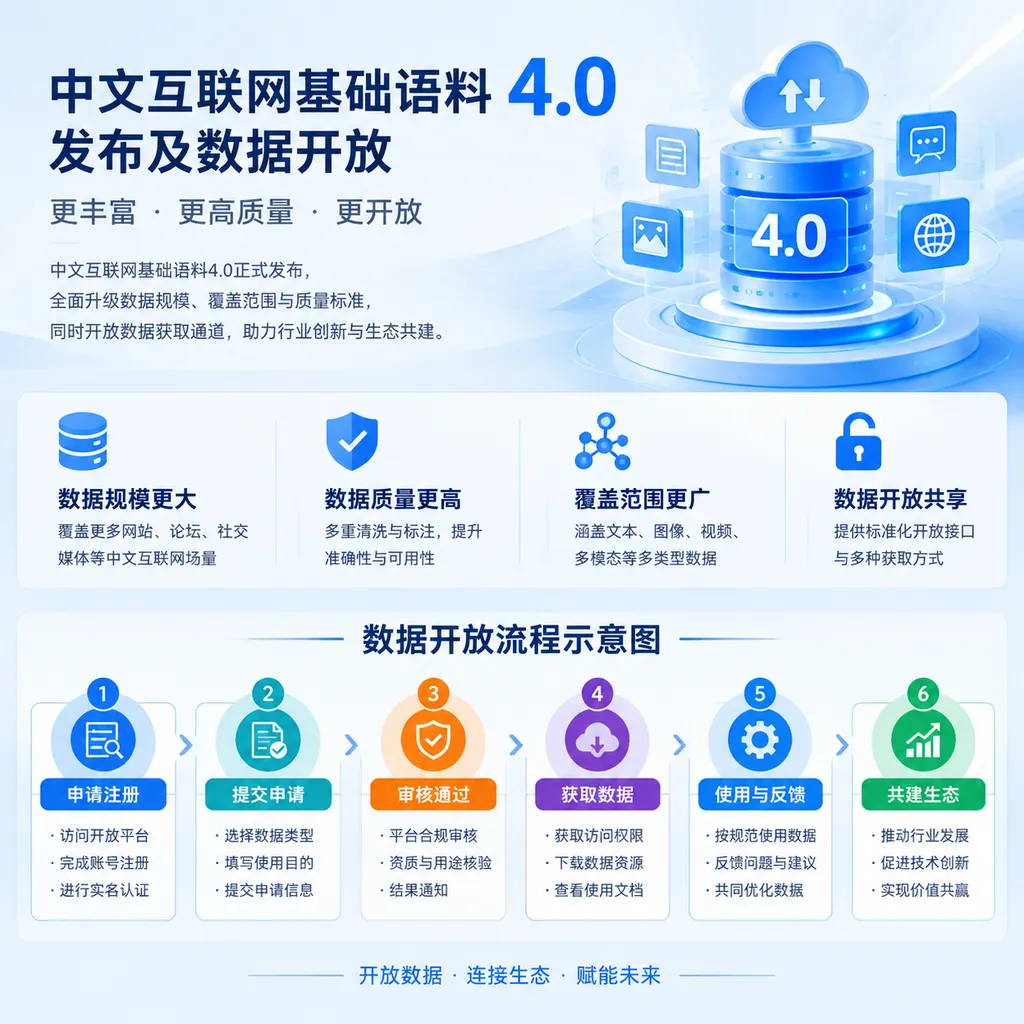
The Core Change in 4.0 Is Not Just “Another Batch of Data”
According to publicly available information, the Chinese Internet Basic Corpus 4.0 contains 120GB of data, the same size as the previously released version 3.0. In other words, this upgrade is not the typical kind of update that “doubles the size of the dataset.” At least for now, no larger-scale metrics, higher token counts, or numbers of newly added records have been publicly disclosed.
This is important. Large model training has entered a stage where “more data is always better” no longer holds true. Unfiltered web data often contains duplicate content, machine-generated text, low-quality marketing articles, illegal or harmful information, and large numbers of templated pages with little training value. Continuing to increase the volume of scraped web content may simply amplify both cleaning costs and noise.
The Chinese Internet Basic Corpus series had already established a relatively clear path of iteration. The first corpus was released in 2023. Public information showed that it was approximately 120GB in size, containing more than 100 million data records and around 50 billion tokens. The subsequently released version 3.0 also reached 120GB and emphasized expanding the range of high-quality Chinese-language website sources and strengthening the filtering of illegal and harmful information.
The information disclosed about version 4.0 places greater emphasis on “new, high-quality, trustworthy data” and a collaborative development mechanism. Officials have not published a complete list of sources, the proportions of different data categories, deduplication rates, quality scores, or comparisons of training outcomes. As a result, outside observers cannot determine the actual benefits it offers for model training based solely on the “4.0” version number.
In other words, the release of version 4.0 means that work on data supply and governance is continuing, but it does not mean that the corpus has been proven superior to every existing open-source Chinese corpus. Developers planning to use it for pretraining will still need to conduct their own sampling inspections, deduplication, and quality assessments, as well as perform additional processing based on their model objectives.
For Developers, the Most Useful Part Is a “Trustworthy Data Foundation”
Anyone working on large models knows that the real challenge is usually not obtaining a compressed archive, but answering the following questions:
- Where does the data come from, and can its origins be traced?
- Has the content undergone duplicate detection and quality filtering?
- Does it contain large amounts of reposted content, scraper-site material, or templated text?
- Does the data contain obvious personal information, copyright risks, or illegal and harmful content?
- Is the corpus suitable for pretraining, or is it better suited to further domain-specific fine-tuning?
- What is permitted under the dataset’s license, and what are its usage boundaries?
For enterprises and research institutions, the value of public corpora is shifting from “saving download time” to “reducing uncertainty in data governance.” A dataset with clearly identified developers, processing procedures, and access channels is easier to incorporate into internal compliance processes than a collection of web pages scraped independently from the internet. It also makes it easier to keep records of data provenance within a project.
This does not mean that using a foundational corpus allows developers to skip compliance reviews. Developers must still pay attention to the platform’s usage agreement, data license, personal information processing requirements, and copyright boundaries. In commercial model training in particular, “publicly accessible” cannot simply be interpreted as “available for unrestricted use for any purpose.”
From an engineering perspective, 120GB is more like a manageable foundational data package than a complete set of raw materials capable of directly supporting very large-scale pretraining. For Chinese-language pretraining, teams generally still need to supplement the corpus with books, encyclopedic content, code, academic papers, industry documents, conversational data, and high-quality synthetic data, depending on the model’s intended purpose. A foundational corpus can provide underlying material for general Chinese-language capabilities, but it is unlikely to cover specialized fields such as finance, healthcare, law, and industry on its own.
Is 120GB Enough? It Depends on What Model You Are Training
If the goal is to train a general-purpose foundation model with several billion parameters or more, 120GB of raw corpus data is clearly not the endpoint. After tokenization, the resulting number of tokens will also be affected by text length, the proportion of Chinese characters, data loss during cleaning, and tokenizer design. Under different processing pipelines, identical file sizes do not directly translate into the same number of effective training tokens.
However, if the goal is to train an experimental model with a small parameter count, validate a Chinese-language pretraining pipeline, or supplement an existing model with general Chinese-language data, this volume remains useful. Developers can use it to test data pipelines, distributed training, tokenizer coverage, data-mixing strategies, and training stability.
More specifically, version 4.0 may be suitable for the following types of tasks:
- Pretraining for foundational Chinese-language capabilities: Providing general web text for small and medium-sized language models.
- Continued pretraining: Supplementing existing open-source models with data that better reflects Chinese internet usage and expression.
- Data engineering tests: Validating deduplication, filtering, sharding, sampling, and data-loading processes.
- Data governance research: Comparing how different sources, cleaning rules, and quality-screening methods affect training outcomes.
- Domain data mixing: Combining the foundational corpus with internal enterprise documents or specialized data at defined ratios to improve a model’s general language capabilities.
The unsuitable use cases are equally clear: treating the dataset directly as “high-quality instruction data” for supervised fine-tuning, or using it without inspection to train a commercial model intended to provide services to the public. Foundational pretraining corpora and instruction data are not the same thing. The former primarily provide language distributions and knowledge coverage, while the latter also require clear task formats, high-quality answers, preference annotations, and safety policies.
Data Governance Deserves More Attention Than Data Scale
Publicly available information indicates that previous versions of the Chinese Internet Basic Corpus involved processes such as source selection, content filtering, and data deduplication. The specific processing details for version 4.0 have not yet been fully disclosed, but judging from the project’s positioning, data governance remains the core task for this type of corpus.
After obtaining the data, developers should conduct at least one round of their own quality audits. A practical processing pipeline usually includes:
Data acquisition
  ├─ File integrity checks
  ├─ Format standardization and encoding repair
  ├─ Text-length filtering
  ├─ URL, HTML, and template cleanup
  ├─ Exact and near-duplicate removal
  ├─ Language identification and Chinese-content ratio screening
  ├─ Filtering of low-quality, advertising, and anomalous content
  ├─ Sensitive and personal information checks
  ├─ Quality sampling and stratified statistics
  └─ Data mixing based on training objectives
Near-duplicate removal, in particular, is easily underestimated. Reposted, rewritten, and aggregated pages are extremely common on the Chinese internet. Exact deduplication based solely on webpage URLs or entire blocks of text often fails to address highly similar content. Excessive duplicate text repeatedly exposes a model to the same expressions during training, increasing the risk of overfitting and making the final model’s knowledge coverage appear broader than it actually is.
Quality assessment should not rely solely on perplexity either. Text with lower perplexity is not necessarily more suitable for model learning; advertorials, clickbait articles, and frequently reused templates can also form stable linguistic patterns. A more reliable approach is to conduct stratified sampling by source, topic, length, and publication date, then combine rule-based models with manual inspection to evaluate readability, information density, factual reliability, and the degree of duplication.
Data contamination also requires attention. If the training corpus overlaps with evaluation sets, public benchmarks, or model test questions, final scores may be inflated. Teams preparing to publish research results or release models publicly should retain data versions, processing scripts, filtering rules, and sampling reports to avoid being unable to explain where their model’s training data came from later.
A Public Project and a Long-Term Undertaking
The participation of multiple companies and institutions in the Chinese Internet Basic Corpus 4.0 shows that China’s large-model industry is gradually recognizing that high-quality corpora are not merely proprietary resources belonging to individual companies, but infrastructure needed by the entire ecosystem.
Over the past several years, model companies have often treated data as an internal asset and rarely disclosed their data sources or cleaning processes. This approach protected competitive advantages in the early stages, but it also led to duplicated effort and opaque quality standards. A foundational corpus project open to the public at least provides a common point of reference, giving researchers and developers the opportunity to conduct experiments using the same or similar data foundations.
Of course, the long-term value of a public corpus project depends on three conditions.
The first is version transparency. Ideally, every iteration should disclose the scope of newly added data, data volume, token count, deduplication rate, and major cleaning rules so users can determine exactly what changed between versions.
The second is verifiable quality. In addition to providing file downloads, the project could also release data samples, quality evaluation sets, and training baselines. What developers care about most is not the statement that “the data has undergone rigorous processing,” but whether that processing actually reduced duplication and noise and improved model performance.
The third is a stable update mechanism. Internet data changes continuously, so a corpus should not release a new version only on promotional occasions. The project will become more like dependable data infrastructure for engineering teams only if it establishes stable version numbering, changelogs, and issue-feedback mechanisms.
At present, the information released about version 4.0 does not cover all of these details. The most reasonable assessment is therefore not that “120GB of Chinese-language data has finally solved the training-data problem,” but rather that the domestic supply of high-quality Chinese corpora has taken another step forward, while the value of the data still needs to be validated by developers through actual training and evaluation.
How Developers Can Use It Now
If your team plans to apply for or download this corpus, it is advisable to treat it first as a candidate data source rather than feeding it directly into production training. You can proceed in the following order:
- First, confirm the platform’s registration, identity verification, and download requirements, as well as the terms of data use.
- Record the download time, version number, file checksums, and data inventory.
- Randomly sample content from different files and sources to inspect text quality.
- Calculate statistics on text length, the proportion of Chinese content, duplication rates, source distribution, and the proportion of anomalous characters.
- Perform cross-deduplication against existing Chinese corpora to avoid adding the same web pages to the training set more than once.
- Design data-mixing ratios based on the model’s scale and training objectives, and do not allow general web data to crowd out high-value specialized data.
- Conduct small-scale controlled experiments before deciding whether to include the corpus in the full pretraining pipeline.
If the goal is simply to build a Chinese-language question-answering application, training directly on a foundational corpus may not be the most efficient route. A more practical approach may be to select an open-source model that already possesses Chinese-language capabilities, then perform continued pretraining or instruction fine-tuning using high-quality domain data. The value of a foundational corpus lies more in building a model foundation, validating data pipelines, and enhancing Chinese-language capabilities than in replacing application-layer data.
Final Thoughts
The Chinese Internet Basic Corpus 4.0 was officially opened today. On the surface, it is the release of another 120GB dataset, but it reflects a new reality as Chinese large-model development enters the data-governance stage: data is no longer simply a matter of “scraping as much as possible.” Trustworthy sources, clean content, traceable versions, and explainable processing procedures are becoming equally important.
For researchers, version 4.0 provides a new Chinese-language pretraining data option. For enterprises, it may reduce some of the cost of preparing foundational data. For the industry as a whole, its significance will depend on whether it continues to be updated, whether more quality metrics are made public, and whether developers can validate its effectiveness in real-world training.
At this stage, 120GB is a useful starting point, but it is not the answer. What ultimately determines the value of a corpus remains its data quality, usage boundaries, and actual model performance after training.