vivo Turns the Phone into an AI Command Center
On September 16, vivo released four BlueLM large models and a system-level BlueLM Harness, enhancing on-device memory, real-time voice interaction, and cross-device task execution, while also conducting preliminary research on a BlueLM 30B MoE model for smartphones.
vivo Turns the Smartphone into an AI Control Center: Four BlueLM Models and a System-Level Harness Debut Together
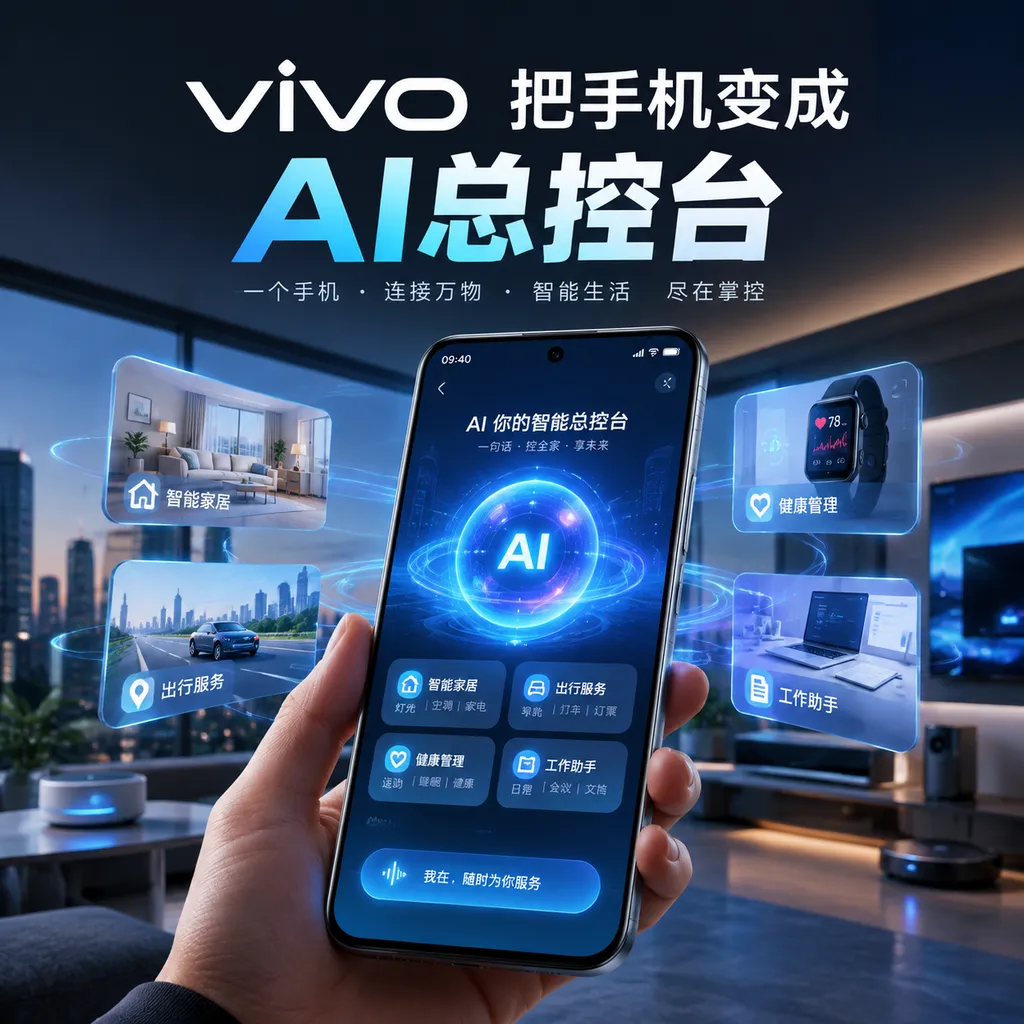
On September 16, vivo released four new BlueLM foundation models at the 2026 vivo Developer Conference, along with a system-level BlueLM Harness. Compared with the previous round of AI upgrades, which focused primarily on Q&A, writing, and isolated features, vivo is now trying to solve a different problem: bringing models into the operating system so they can understand users’ long-term context and complete tasks on their behalf.
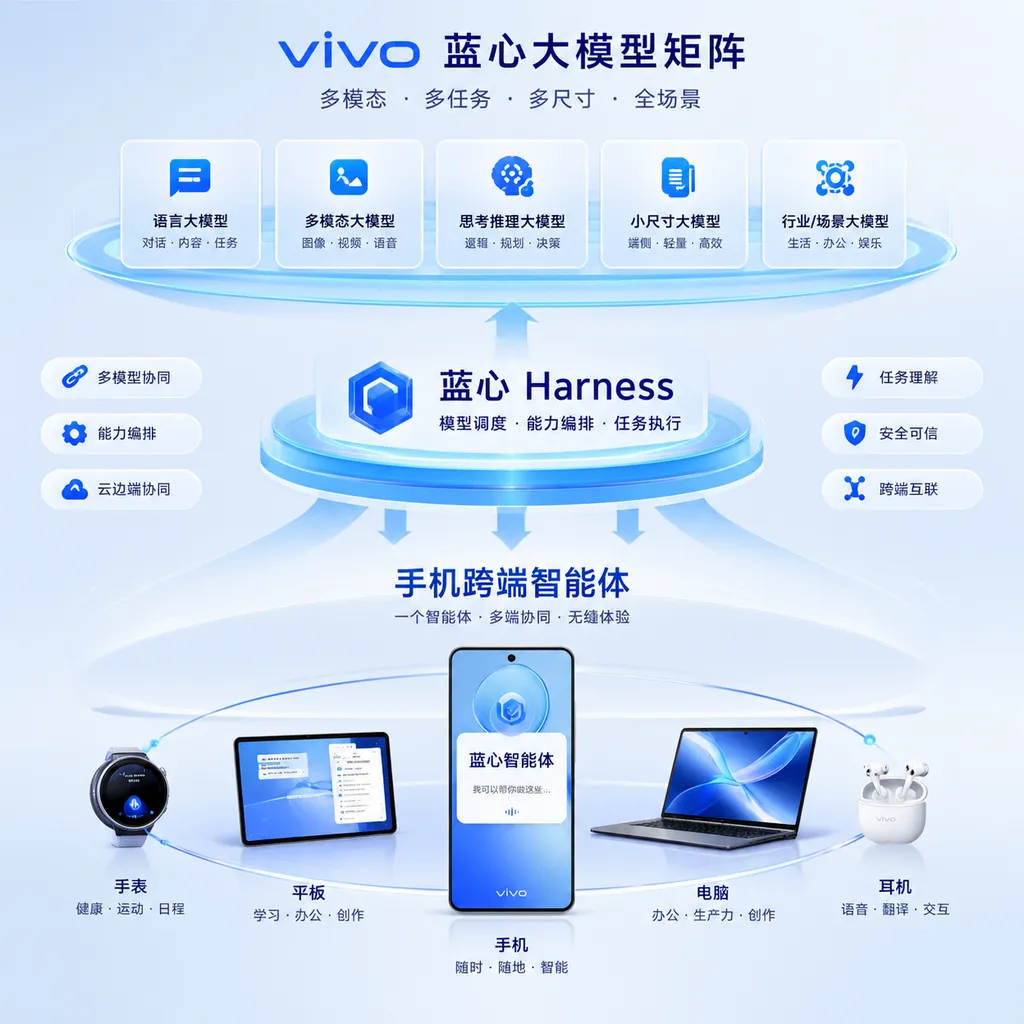
The solution consists of four components: BlueLM-RealTime for real-time speech understanding; BlueLM-Nano for on-device perception and personal memory; and the cloud-based BlueLM-Flash and BlueLM-Pro for complex task planning and execution. vivo is also researching a 30B MoE BlueLM on-device foundation model, hoping to further bring more powerful multimodal understanding and long-chain reasoning capabilities to smartphones.
On the surface, this is an update to the model lineup. More importantly, however, it is the Harness beyond the models themselves. vivo is packaging system, application, device, and cross-device capabilities as tools that agents can invoke. According to the company, the BlueLM Harness currently integrates more than 6,000 atomic capabilities, which can be combined to support over 10,000 types of tasks.
Four Models, Each Addressing One of the Challenges of “Listening, Remembering, Thinking, and Acting”
vivo is no longer trying to rely on a single foundation model for everything. Instead, it has divided BlueLM intelligence into four capability paths. This design is more aligned with real-world product deployment: speech requires low latency, on-device models must control memory usage and power consumption, while complex tasks require more powerful cloud-based reasoning and tool-calling capabilities.
1. BlueLM-RealTime: First, Make Devices “Understand What They Hear”
BlueLM-RealTime uses an end-to-end MoE architecture, focusing on continuous voice interaction and complex speech understanding. The scenarios cited by vivo include noisy environments, speaking softly, accents, continuous speech, and mixed Chinese-English conversations.
The change here is not limited to improved recognition accuracy. Traditional voice assistants typically divide voice interaction into several stages: speech recognition, text understanding, and response generation. While speaking, users must wait for the speech to be recognized and then wait again for the model to respond. End-to-end speech models attempt to understand intent, tone, and context directly from audio, reducing the information loss and latency caused by intermediate conversions.
This is particularly important for smartphone assistants. Real-world environments are rarely as quiet as recording studios. Users may be speaking on the subway, on the street, in an office, or in a car. They may also add conditions halfway through a sentence. If a model can only clearly understand standard Mandarin, it will struggle to become a system-level entry point that is available at any time.
Of course, the ultimate experience offered by RealTime will still depend on the device-cloud collaboration strategy, wake-word mechanism, and privacy settings. For developers, the key question is whether it can upgrade voice from an “input method” into a continuous, system-level interaction channel.
2. BlueLM-Nano: Helping the Smartphone Start to “Remember You”
BlueLM-Nano is a BlueLM on-device foundation model with 3 billion parameters. It supports real-time multimodal perception and the accumulation of personal memories. It can understand screens, images, videos, text, and files, and use them to build long-term context related to the user.
According to vivo, Nano is intended not only to understand the current screen but also to remember users’ habits, preferences, device usage patterns, and spatiotemporal contexts. For example, if a user frequently visits a certain type of restaurant on weekends, prefers a particular format when writing reports, or needs to handle a certain type of work during a specific time period, the model can preserve this information as personal context for use in subsequent tasks.
The value of this capability does not lie in the fact that “the model knows more,” but in reducing the need for users to repeatedly explain themselves. Today’s smartphone AI systems often start from scratch in every conversation, requiring users to repeatedly explain who they are, what they want to do, and what they like. Once personal memory is established, the assistant can evolve from a general-purpose tool into a system service more akin to a personal secretary.
vivo disclosed that its on-device 3B model is designed to achieve the capability level of certain 7B to 9B models in tasks such as conversational writing, summarization, and information extraction. Its memory usage is approximately 1.4 GB, its peak output speed can reach 80 Chinese characters per second, and system power consumption is approximately 450 mA. It should be noted that these figures come from the manufacturer and specific evaluation environments and cannot be directly equated with actual performance across all smartphones and tasks.
The significance of on-device deployment is not limited to speed. If information such as photos, files, screen status, and personal habits is processed locally on the device whenever possible, sensitive data uploads can theoretically be reduced. However, on-device memory also introduces new permission issues: What information can be remembered? How long will it be stored? Can individual items be deleted? And can applications access these memories? The system needs to provide clear controls for all of these questions.
3. BlueLM-Flash / Pro: Turning Cloud Models into a Task Command Center
The cloud-based BlueLM-Flash and BlueLM-Pro foundation models handle more complex intent understanding, task planning, and tool calling. vivo is combining them with its self-developed Agentic engine and system-level Harness to process multi-application, cross-device, and multi-step tasks.
Users no longer need to tell the model which buttons to press, which application to open, or what content to copy at every step. They can simply state their goal. For example, if a user says, “Help me put together a guide for this trip,” Xiao V can retrieve saved content, check-in photos in the album, notes, and booked itineraries, and then generate a personalized travel guide based on the user’s preferences.
In office scenarios, users can ask the assistant to search their phone and computer for meeting minutes, project materials, and email reports, then organize them into a work report that matches their personal writing style. The real challenge here is not generating a piece of text, but finding the right information, determining the relationships among different pieces of information, handling permission boundaries, and turning the results into a directly usable document or task.
This is also the difference between Flash and Pro and ordinary chatbots: the model’s output is no longer just text, but a verifiable and executable task workflow. It needs to know which tool to call next, how to retry when execution fails, when to ask the user for confirmation, and how to maintain an operation log.
The Harness Is the Core of This Release
vivo defines the BlueLM Harness as system-level agent infrastructure. It reaches deep into the operating system kernel layer, converting system, application, and device capabilities into tools that models can understand and invoke. Through the Main Loop, it creates a closed loop of “understanding the goal—planning the steps—calling capabilities—checking the results—continuing execution.”
Put simply, the model is the brain, while the Harness is the hands and feet.
In the past, most smartphone AI features were application-layer plug-ins: a voice assistant could open an application, a photo tool could edit images, and a calendar could create events, but these capabilities were isolated from one another. The Harness attempts to unify them into a common set of agent tool interfaces, allowing models to combine them freely based on a given goal.
vivo says it has currently added more than 6,000 atomic skills, supporting over 10,000 types of tasks. Atomic skills may include opening settings, searching files, reading the calendar, accessing the camera, sending messages, adjusting display options, and accessing data from a vehicle infotainment system or computer. The model does not need to understand the interface details of every application; it can make calls through structured capabilities.
This approach differs significantly from traditional automation scripts. Scripts depend on fixed pages and fixed processes and may stop working when an application is redesigned. Agents, by contrast, attempt to plan dynamically based on semantics and the current state. Dynamic planning, however, also introduces uncertainty. For high-risk actions such as making payments, sending emails, deleting files, or changing system settings, the system must make permissions, confirmations, and auditing foundational capabilities rather than leaving security decisions to the model.
vivo says BlueLM Intelligence has built an AI runtime security foundation covering the entire process of identity, permissions, execution, and auditing. This direction is necessary, but its real effectiveness will depend on whether permissions can be broken down by specific tasks, data types, and applications, rather than being reduced to a vague “allow AI access” switch.
Xiao V Pro: From a Chat Window to a Personal Task Entry Point
Based on this model and Harness system, vivo released the new BlueLM Xiao V Pro. Its positioning goes beyond simply answering questions. It is intended to be a personal AI assistant: users describe their goals in a single sentence, and Xiao V Pro breaks down the task, invokes capabilities across devices, and completes the task step by step.
It covers a wide range of scenarios:
- Travel: Integrates saved content, photos, notes, and booked itineraries to generate a personalized travel guide, while recommending nearby restaurants based on the itinerary.
- Office work: Searches meeting minutes, project materials, and emails across phones and computers, then organizes them into a report that matches the user’s writing style.
- Lifestyle services: Tasks such as hailing a ride, ordering coffee, and booking tickets can be initiated through natural language.
- Accessibility and system control: Enlarges text, increases icon sizes, blocks spam calls, or enables motion-sickness visual assistance, audio super-resolution, fatigue-reducing brightness, and other features.
- Information processing: Recommends news in the morning, organizes research recordings, identifies user pain points, and modifies resumes and simulates interviews based on a target position.
- On-site understanding: Translates road signs through the camera and enables video-based conversations, allowing users to ask questions while walking.
- Lightweight creation: Generates interactive widgets, mini-games, or combined features through a single sentence.
Some of these capabilities can already be handled by traditional applications. The true product improvement lies in unifying the entry point. Users no longer need to remember which function is hidden in which menu or switch repeatedly between multiple applications. For ordinary users, this means “finding fewer buttons.” For developers, it means that application capabilities may be re-exposed as services that agents can invoke.
Xiao V Cowork: A Smartphone-Controlled PC Agent
In addition to tasks within the smartphone, vivo also released Xiao V Cowork. It allows users to initiate and manage agent tasks on a PC from their phone, turning the smartphone into a mobile task entry point.
This type of cross-device design goes beyond “screen mirroring from a phone to a computer.” The phone is not merely used to view the PC’s status; it can submit tasks, check progress, receive results, and request confirmation when necessary. For example, while on the road, a user could ask an agent on their computer to organize a batch of materials, run code, or generate a report, and then use their phone to review the results and revise the requirements.
This is particularly appealing to developers and knowledge workers: phones are suitable for initiating tasks and performing lightweight confirmations, while PCs are better suited to work requiring a larger screen, greater computing power, or a more complete development environment. If the two devices share context and task status, the boundary between devices will shift from “file synchronization” to “task collaboration.”
However, the stability of cross-device agents depends on several basic conditions: whether the PC remains online, whether tasks support checkpoint recovery, how permissions are synchronized between the phone and computer, and whether the system can accurately report intermediate results during long-running tasks. Without these capabilities, the cross-device experience can easily devolve into a remote control.
Researching a 30B MoE On-Device Model: The Ambition Goes Beyond Lightweight Deployment
vivo also revealed that it is researching a 30B MoE BlueLM on-device foundation model, exploring support for advanced multimodal understanding, cross-domain long-chain reasoning, and autonomous execution of complex tasks on smartphones.
Bringing a 30B-scale model to a smartphone is not simply a matter of fitting the parameters into the device. An MoE architecture can reduce the cost of individual inference through sparse activation, but it still has to contend with limitations involving memory capacity, bandwidth, heat dissipation, battery life, and sustained operation. In particular, multimodal inputs and agent tasks generally do not involve one-time generation. They require the model to read the screen, call tools, and maintain context over an extended period, which significantly increases power consumption.
As a result, the 30B MoE model will more likely use device-cloud collaboration, hierarchical inference, or dynamic loading based on the task, rather than simply running a complete foundation model locally on the phone. Nano can handle real-time perception and privacy-sensitive tasks, the 30B model can take on more complex local reasoning, and Flash and Pro can process tasks requiring cloud computing resources. This division of labor may be the actual model architecture vivo is trying to establish.
vivo’s Competitive Edge: Not Parameters, but System Control
From an industry perspective, the focus of this release is not simply the pursuit of model parameters or benchmark rankings. Instead, vivo is attempting to embed model capabilities into the system control layer.
Smartphone manufacturers naturally possess three advantages when developing AI. First, they can access system-level state, including screens, applications, devices, and cross-device connections. Second, they can determine how models are distributed between the device and the cloud. Third, they can deliver capabilities directly to large numbers of users through system updates. Compared with standalone chat applications, smartphone manufacturers have a better opportunity to make AI the default entry point.
These advantages also imply greater responsibility. An agent capable of reading screens, files, photo albums, and emails and executing actions can cause far more damage when it makes a mistake than a chatbot. Model hallucinations, permission violations, accidental sending, and privacy leaks could all escalate from “an inaccurate answer” into real-world losses.
Therefore, the key metrics for the BlueLM Harness should not simply be the number of skills it can invoke. They should also include:
- Task success rate: Whether complex tasks are actually completed, rather than merely producing a seemingly plausible block of text.
- Explainability: Whether users can see what information the model accessed and which tools it invoked.
- Permission granularity: Whether authorization can be differentiated by application, data type, and action risk.
- Failure recovery: Whether tasks can continue after tool-call failures, network interruptions, or device disconnections.
- Privacy controls: Whether on-device memories can be viewed, modified, and permanently deleted.
- Developer openness: Whether third-party applications can integrate through standardized methods rather than waiting for the manufacturer to adapt them one by one.
If these issues are handled well, vivo’s system-level agent could be more useful than traditional voice assistants. If not, even 6,000 capabilities could amount to nothing more than a more complex and less predictable automation entry point.
Conclusion: Smartphone AI Enters the “Delivering Results” Phase
The signal sent by vivo’s release is clear: smartphone AI is moving from “helping you generate content” to “completing tasks for you.” RealTime enables devices to listen more naturally, Nano allows them to remember long-term context, Flash and Pro plan tasks, the Harness turns intent into action across systems and applications, and Cowork extends those tasks to PCs.
The value of this architecture will ultimately depend not on whether users can chat with their phones for longer, but on whether they are willing to entrust real work to them. For example, can a meeting report automatically locate all the relevant materials? Can a travel plan adapt to last-minute changes? Can a cross-device task be initiated on a phone and completed reliably?
The 30B MoE model announced by vivo remains in the research phase. The actual availability of the four models and the system-level Harness, supported device models, third-party developer integration methods, and large-scale commercial performance have yet to be disclosed. The upcoming vivo X500 series and iQOO 16 will be the first devices to ship with OriginOS 7, with BlueLM Xiao V Pro becoming a core AI capability of the system.
For developers, the key issue to follow is not simply the arrival of another smartphone assistant, but whether smartphone operating systems will gradually become runtime platforms designed for agents. Once system capabilities are broken down into callable tools, application entry points, permissions, and interaction methods may all be redefined. What vivo has taken this time is a step from model capabilities toward system-level execution.