Helix 2.5 Ventures Into an Unfamiliar Home
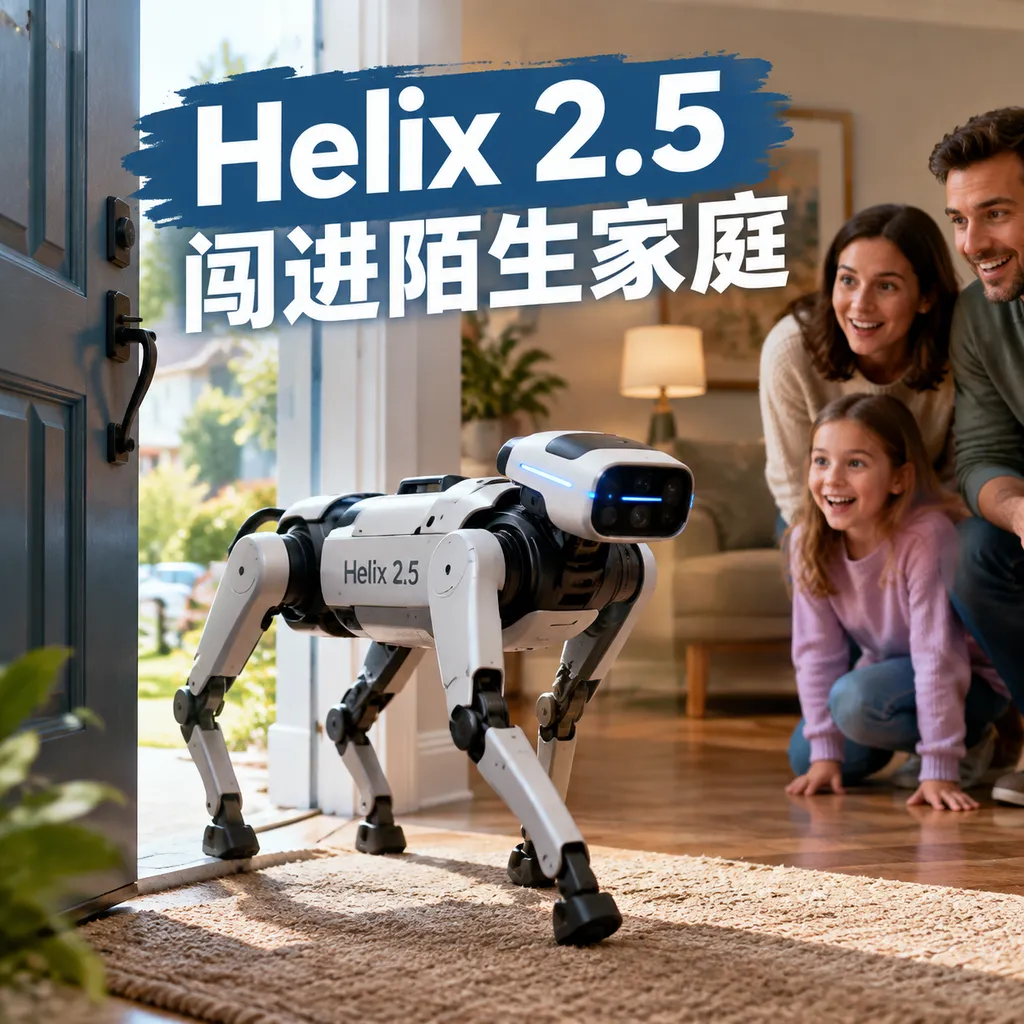
Figure releases Helix 2.5. Without collecting data from new homes, Figure 03 can tidy living rooms, fold towels, and make beds in 30 unfamiliar homes, improving its task success rate from 8% to 56%.
Figure Sent Its Robots Directly into 30 Unfamiliar Homes
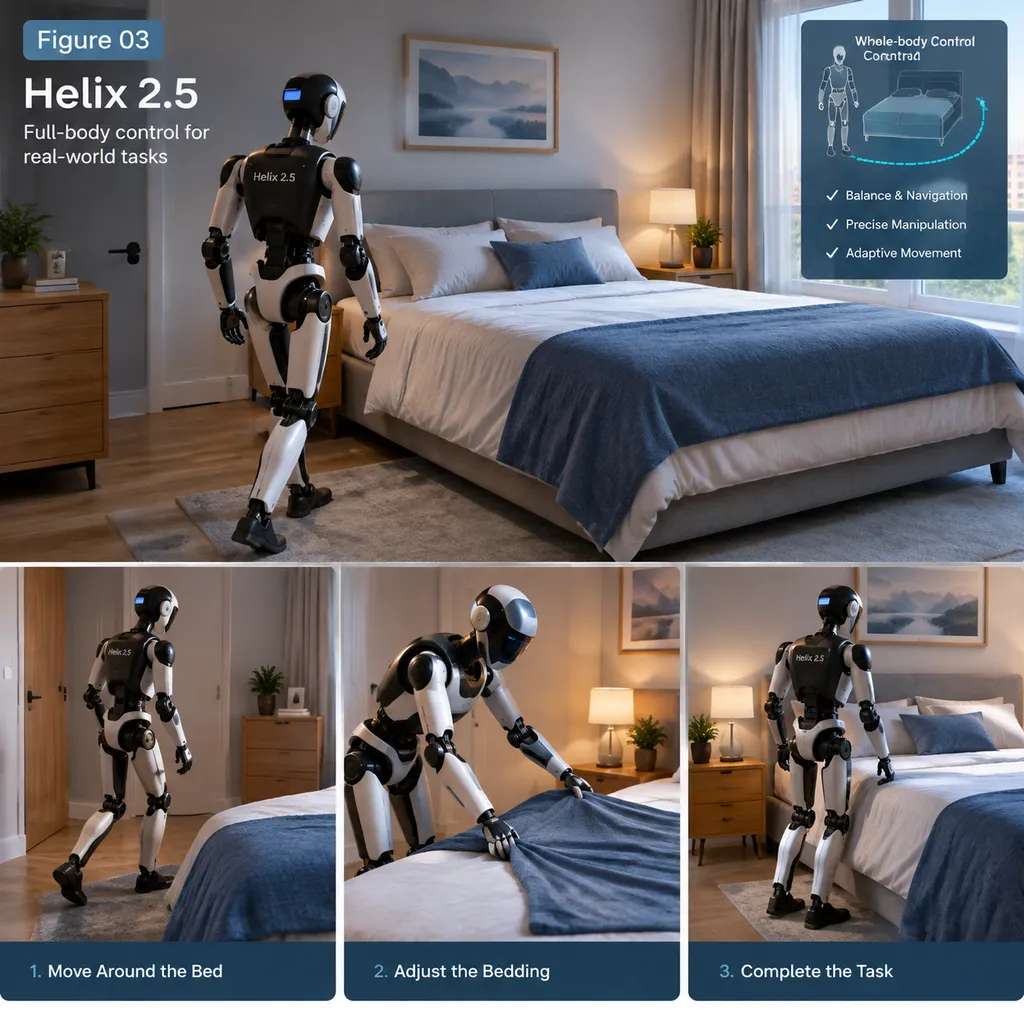
On September 17 local time, humanoid robotics company Figure released Helix 2.5. Test results disclosed today, September 18, show that Figure 03 humanoid robots powered by the model were sent directly into 30 homes across the San Francisco Bay Area that they had never encountered before. Without collecting data inside the homes, fine-tuning for individual houses, or scripting tasks in advance, the robots performed three types of household chores: tidying living rooms, folding towels, and making beds.
The most noteworthy aspect of this upgrade is not that the robot can finally fold towels—there have already been plenty of similar demonstrations across the industry—but that it is beginning to transfer physical knowledge learned in one environment to new environments with different layouts, furniture, lighting, and objects.
Figure’s headline result is that, with task-specific data, model architecture, training process, and evaluation methodology held constant, pretraining on Index human behavior data increased the task success rate from 8% to 56%. Compared with the previous-generation Helix 02 neural network, Helix 2.5 used only half as much task-specific data while generalizing the relevant behaviors to 30 previously unseen environments.
This is a clear improvement, but it is still far from meaning that “household robots are ready for practical use.” The other side of a 56% success rate is that the robot still failed 44% of its tasks. A more accurate assessment is that Figure has demonstrated a potentially scalable technical path, not delivered a product that can independently take care of a home.
“Zero-Shot” Does Not Mean the Robot Has Never Learned to Do Housework
Figure describes this capability as “zero-shot whole-body generalization.” The term can easily be misunderstood to mean that the robot entered a home with no prior training and figured out how to make a bed on the spot. That is not what happened.
Helix 2.5 was first pretrained on Figure’s global human behavior dataset, Index, and then adapted from the same foundation model for three target behaviors:
- Tidying living rooms;
- Folding towels;
- Making beds.
Here, zero-shot means that before entering the 30 test homes, the robot had never seen those houses, had not collected data about their interiors or objects, and had not undergone additional fine-tuning or adaptation for each home. What it had not seen was the test environment—not the concept of “making a bed.”
This can be compared to an experienced driver entering an unfamiliar city for the first time. The driver has already been trained to drive; they simply do not need to return to driving school for every new street. Many previous robotic systems, by contrast, are more like trains: change the route or platform, and the system must be recalibrated or even have its workflow rewritten.
The value of Helix 2.5 is therefore more accurately described as cross-environment generalization, rather than unconditional zero-shot learning for arbitrary new tasks. This distinction matters to both developers and investors. The former determines whether robots can move from laboratories to large-scale deployment, while the latter would imply something approaching general intelligence. A considerable gap remains between the two.
The Hard Part of Housework Is Not Grasping, but Continuously Handling the Unexpected
Industrial robots can repeatedly weld, move, or sort items at fixed workstations because object positions, lighting, operating cadence, and safety boundaries are all deliberately designed. Homes are the exact opposite: no two beds are exactly the same height, towels may be crumpled into a ball, toys may be piled beside the sofa, and a chair may block the robot as it reaches for something.
This is also what makes these tests more meaningful than tabletop grasping demonstrations. Figure 03 must treat “moving to the right position” as part of the task itself, rather than standing at a fixed location and waiting for objects to be placed within reach. It must make a sequence of interdependent decisions:
- Observe the room and determine where the target is;
- Move its body through confined, cluttered spaces;
- Adjust its head and stance to give its cameras a better view;
- Select the appropriate hand and grasping posture;
- Coordinate both hands to manipulate deformable objects such as towels and bedsheets;
- Reposition itself and continue the task after detecting an incorrect result.
Deformable objects are particularly difficult. Rigid objects such as cups and boxes generally retain their shape, but bedsheets and towels change state with every grasp. The robot is not manipulating a fixed model, but a continuously changing and partially occluded physical system.
Another key signal in Figure’s demonstrations is that Helix 2.5 exhibits clear autonomous error-correction behavior. When an operation is obstructed, the robot may step back and reposition itself, change its stance, or move to the other side of the bed to correct the folding result.
For embodied intelligence, “being able to continue after making a mistake” is often more important than a single polished demonstration of success. Real-world tasks involve long action sequences: if each action has a 95% success rate, the theoretical probability of completing 20 consecutive actions is only about 36%. Without error detection, recovery, and replanning capabilities, a system will struggle to complete an entire set of household chores, no matter how dexterous each individual step may appear.
Index Is the Real Star of This Release
The Helix 2.5 model name is eye-catching, but what Figure is really trying to demonstrate is that robots can learn transferable physical knowledge from large-scale human behavior data.
Figure calls this data system Index. According to the company, Index can generate approximately 35 minutes of new human behavior data every second. Its underlying logic is somewhat similar to data scaling for large language models: language models learn words, facts, and reasoning patterns from massive volumes of text, while robotic foundation models must learn object relationships, body movement, and contact dynamics from videos, motion trajectories, and human demonstrations.
Robot data, however, is more difficult to process than text. Web text naturally consists of discrete symbols, while robotic behavior involves:
- Continuous video from multiple viewpoints;
- Joint positions and velocities;
- Contact states for both hands;
- Force and tactile feedback;
- Body posture and spatial coordinates;
- Action intent and task stage.
Even the same outcome—“folding a towel neatly”—can be achieved through completely different motion trajectories. Data scale is only the first step. The real challenge in pretraining is unifying trajectories produced by different people, body proportions, and viewpoints into representations that robots can learn from.
Figure reports that, with all other experimental conditions held constant, Index pretraining increased the success rate from 8% to 56%. If subsequent independent tests can reproduce this result, it would suggest that pretraining on human behavior does more than give the model visual common sense: it improves the combined generalization of whole-body movement, bimanual coordination, and active perception.
This resembles the scaling approach used with large models. In the past, robotics teams often recorded a batch of teleoperation data for a single task and then trained a dedicated policy. Figure is instead trying to first train a foundation model with broad physical priors, then adapt it using less task-specific data. The former is like rewriting the program for every new feature; the latter is more like installing applications on a general-purpose operating system.
Helix’s “Dual-System” Approach Is Expanding to the Whole Body
Earlier Helix models used a layered approach similar to “System 1 + System 2”: a slower vision-language module interprets the scene, instructions, and task objectives, while a faster visuomotor policy converts those objectives into continuous control signals.
This separation is a practical engineering choice. Vision-language models are good at answering “what should be done now,” but are not suited to directly controlling fingers, wrists, the head, and the torso at high frequencies. Motion policies respond quickly but are typically proficient only at actions within their training distribution. Combining the two is equivalent to assigning one module to understand the situation and another to execute the action reliably.
Earlier versions of Helix had already demonstrated high-frequency continuous control of the upper body, wrists, torso, head, and fingers, as well as natural-language-driven manipulation of unfamiliar objects and dual-robot collaboration. Helix 2.5 shifts the emphasis beyond whether “the hand can grasp the object,” linking perception, locomotion, stance adjustment, bimanual manipulation, and recovery actions into longer whole-body behaviors.
This is also where household environments diverge from factory workstations. A genuinely useful household robot cannot merely have a pair of dexterous hands. It must also know where to stand, when to take a detour, and whether its current viewpoint is sufficient to continue the task.
56% Is Meaningful, but Several Pieces Are Still Missing from the Demonstration
The data disclosed by Figure is sufficient to show that Helix 2.5 is more capable than its predecessor, but not enough to prove that it is ready for commercial deployment. At least several key questions still require further disclosure:
| Question to Be Clarified | Why It Matters | |---|---| | How is the 56% success rate defined? | Smoothing out a bedsheet, partially completing the task, and meeting human acceptance standards could be entirely different metrics | | How many tests were conducted for each task? | Thirty homes does not necessarily mean only 30 trials; sample size directly affects statistical confidence | | Were manual resets or remote intervention allowed? | If frequent assistance is required, real-world deployment costs will rise rapidly | | How long does each task take? | Being able to complete a task and being able to complete it within a reasonable time are two different things | | At which stages are failures concentrated? | Whether failures involve perception, navigation, grasping, or deformable-object manipulation determines the next optimization priorities | | Is the system safe around children, pets, and fragile objects? | Safety standards in homes are far higher than in controlled laboratories |
Edited video demonstrations warrant particular caution. An embodied AI system might fail ten times in a row before succeeding once, while viewers ultimately see only the successful attempt. By providing comparative data showing an increase from 8% to 56%, Figure has gone further than merely publishing a video. However, without a complete evaluation protocol, a breakdown of failure cases, and third-party replication, outside observers still cannot determine how far the system is from becoming a reliable product.
From an engineering perspective, a 56% success rate is sufficient to support research and development validation, but it is difficult to justify unattended operation. Household users may tolerate far fewer errors than model benchmarks do: a chatbot can retry after giving an incorrect answer, but the consequences are entirely different if a humanoid robot breaks a cup, knocks over furniture, or loses its balance near a staircase.
Figure Is Betting on a “Data Flywheel,” Not Three Household Skills
Figure has committed $3.5 billion worth of computing resources to Helix training and secured large-scale, next-generation GPU capacity through long-term infrastructure agreements. This investment indicates that the company does not intend to tackle “folding clothes,” “washing dishes,” and “making beds” one task at a time. Instead, it is attempting to build a flywheel in which data and models scale together:
- More human behavior data provides stronger priors about the physical world;
- Stronger foundation models reduce the amount of task-specific data required for new tasks;
- More robot deployments generate more real-world failure and recovery data;
- The new data is then fed back into the next generation of models.
This approach also carries clear risks. Robot training is not merely a matter of adding more GPUs. Hardware differences, sensor noise, actuation latency, and real-world contact all create “last-mile” problems. Seeing humans make beds in a dataset does not mean a robot has the same hand structure, tactile capabilities, or range of motion. Mapping human experience onto a machine body remains one reason embodied intelligence is harder to scale than purely software-based models.
Based on the information disclosed in this release, Helix 2.5 is more of a major capability upgrade for Figure’s own robotics platform than a general-purpose model service available to developers. External users cannot yet access it like a cloud-hosted large model, and no model weights have been published for independent reproduction. The release’s impact will therefore be reflected first in the deployment capabilities of Figure 03, rather than in the near-term emergence of a robotics model ecosystem.
Assessment: It Is Not “The Robot Housekeeper Has Arrived,” but Robots No Longer Have to Start from Scratch in Every New Home
The most valuable aspect of Helix 2.5 is that it shifts the focus of humanoid robot competition from the quality of individual actions to the ability to transfer skills across environments.
In the past, robot demonstrations often depended on carefully arranged settings: fixed table heights, fixed object placements, fixed lighting, and sometimes even fixed motion paths. Such systems could produce remarkably smooth demonstrations but were difficult to replicate in a second room. By testing in 30 unfamiliar homes, Figure has at least directly confronted one of the hardest problems—the distribution shifts found in the real world.
However, “being able to enter an unfamiliar home zero-shot” does not mean the robot can autonomously take over household work. It currently covers only three adapted behaviors, and its success rate remains far below what a consumer product would require. A true household robot would also need to understand open-ended instructions, handle task interruptions, identify hazards, adapt to the movements of household members, and remain reliable for hours or even days.
The most appropriate assessment of Helix 2.5, therefore, is not that the revolution is complete, but that Figure has presented an intermediate result backed by data: robots no longer need to be retrained for every new home, but there is still a long way to go before they no longer need to be retrained for every new household task.
This step may not be particularly science-fiction-like, but it is far more important than yet another carefully choreographed video of a robot folding clothes.
References
- ITHome: Humanoid Robots Can “Autonomously Do Housework” as Figure Releases Helix 2.5 — Describes how Helix 2.5 was tested in 30 unfamiliar homes, the three task categories, and the change in success rate.
- Zhihu: Figure Launches Embodied Model Helix, with Multiple Robots Doing Housework Together — Provides background on the Helix series’ earlier vision-language-action architecture, unfamiliar-object manipulation, and multi-robot collaboration.