MiniMax Code CLI Is Now Officially Open Source
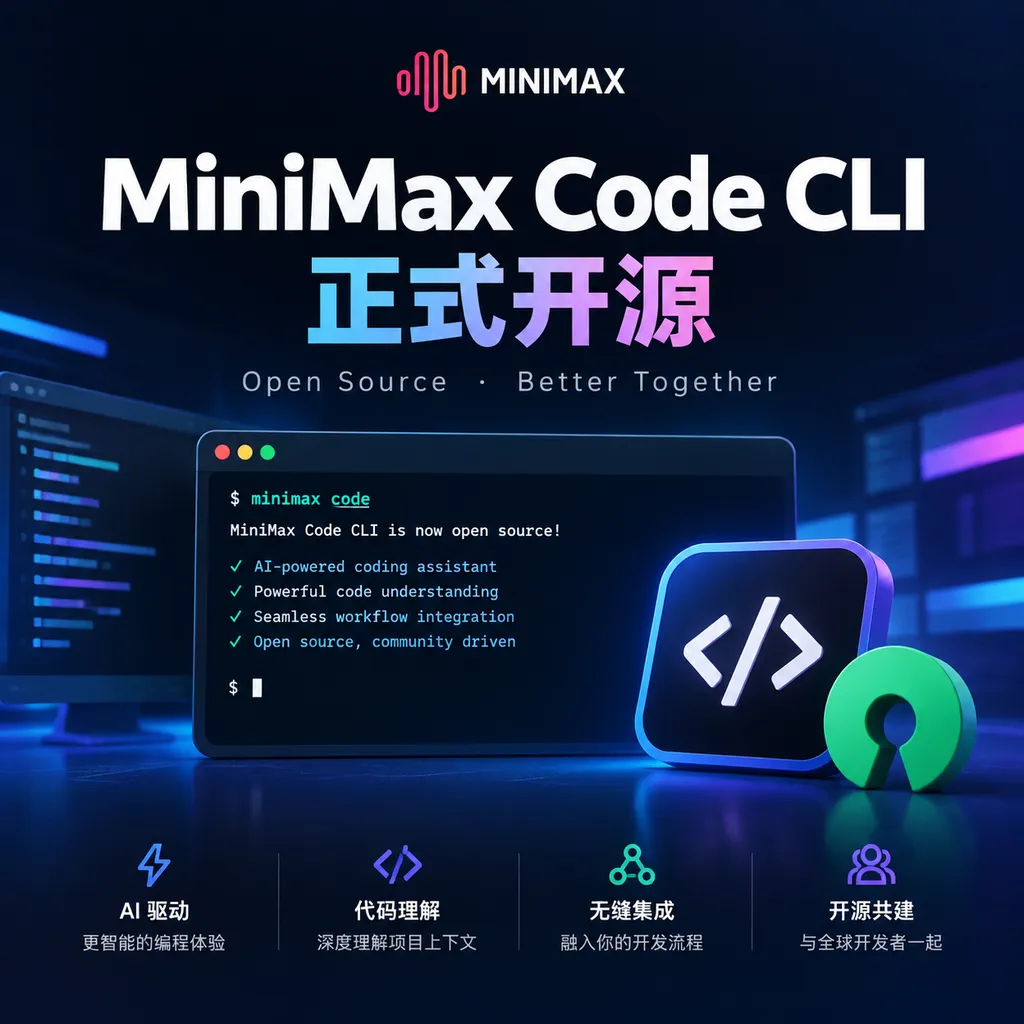
MiniMax Code CLI v0.4.12 was open-sourced today under the MIT License, achieving a 76.7% pass rate on the official benchmark. More noteworthy than the score itself is that developers can now directly inspect and modify the coding agent’s tool invocation, permission handling, and execution pipeline.
MiniMax Code CLI Is Now Open Source, Giving Developers the “Steering Wheel” of Coding Agents
On the evening of September 18, MiniMax announced that MiniMax Code CLI v0.4.12 was now available to developers worldwide, with its source code released under the MIT License.
This is the core component of the MiniMax Code client. According to data disclosed by the company, MiniMax Code CLI achieved a 76.7% task pass rate in the latest evaluation based on FrontierHarness Eval, with a median completion time of 4 minutes and 33 seconds for successful tasks. Both metrics outperformed the public baselines listed in the report.
However, what truly deserves attention about this release is not merely the 76.7% figure. More importantly, MiniMax has opened up the most sensitive layer of its coding agent—tool invocation, command execution, and permission handling—to developers.
For a coding agent capable of reading repositories, modifying files, running shell commands, and even invoking external tools, the quality of the model’s responses is only the first consideration. The more practical questions are: What exactly did it execute? Why was it granted those permissions? And when something goes wrong, can its actions be traced and constrained?
Open-sourcing the CLI is an attempt to answer these questions.
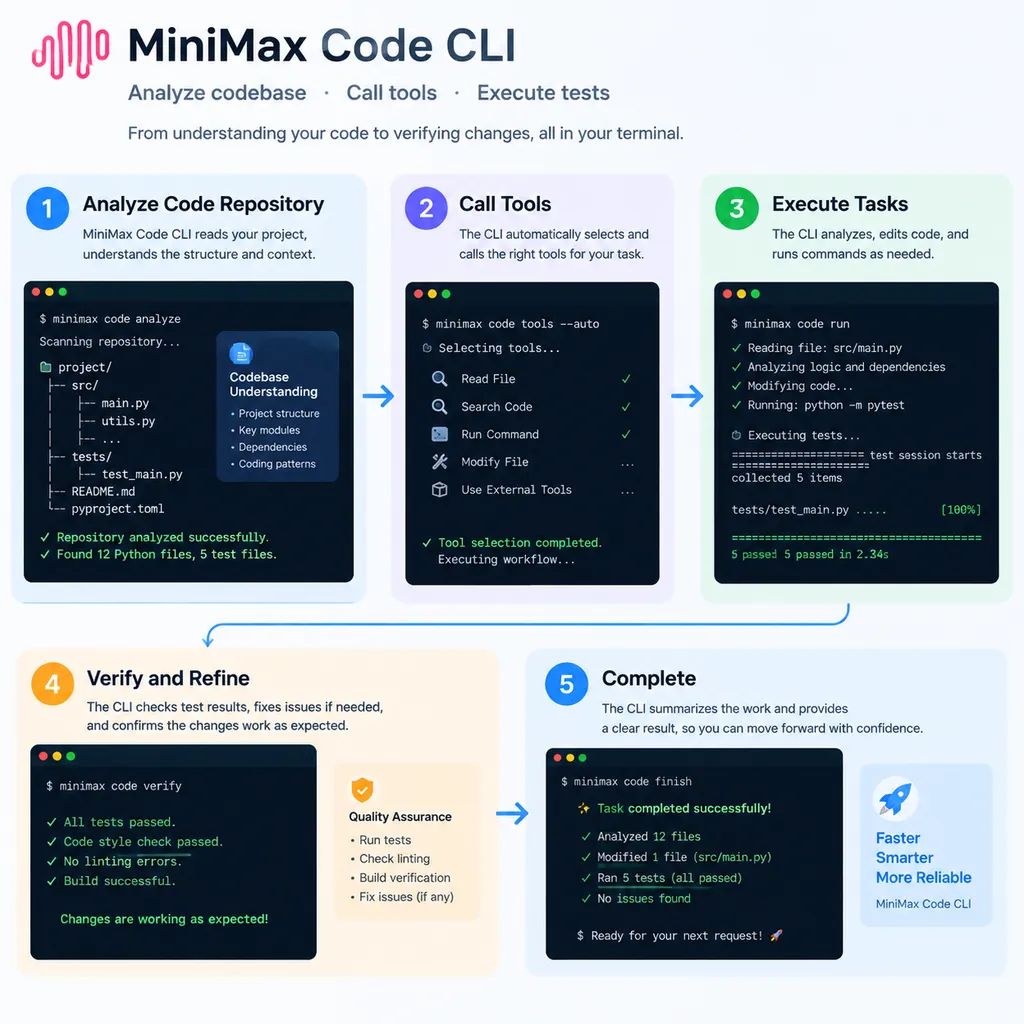
From “Giving Advice” to “Doing the Work for You,” the Risk Model Has Changed
Over the past few years, AI programming products have gone through roughly three stages of evolution.
The first stage was code completion. Based on the current file and cursor context, the model predicted the next few lines of code. It could make mistakes, but it generally would not proactively alter an entire project.
The second stage was conversational programming. Developers provided the model with code snippets, error logs, or repository context and asked it to explain problems, generate functions, or suggest refactoring approaches. At this point, the model still acted more like an advisor, with humans retaining final control over any changes.
The third stage is today’s coding agent. It can traverse directories, search for symbols, edit multiple files, install dependencies, run tests, read the output, and continue making fixes based on the results. A developer may give it nothing more than a single instruction: “Upgrade this project to the latest framework version and fix all the tests.”
This means AI programming tools have evolved from “generating text” to “taking action.”
If a model occasionally generates an incorrect piece of code, developers can still review it before merging. But if an agent accidentally deletes a directory, executes a high-risk command, reads credentials it should not access, or is tricked by a malicious prompt in the repository into invoking an external tool, the consequences are no longer limited to a bad code completion.
As a result, competition among coding agents can no longer be judged solely by the capabilities of their underlying models. At a minimum, four layers must be considered:
- Context layer: How large code repositories are retrieved and compressed;
- Planning layer: How requirements are broken down into executable steps;
- Tool layer: How the file system, shell, testing frameworks, and external tools are invoked;
- Permission layer: Which operations are executed automatically, which require confirmation, and which should be prohibited.
MiniMax has opened up the core CLI component, whose value is concentrated primarily in the latter two layers. Developers can now directly inspect how tools are registered, how parameters are passed, how commands are executed, and how permission boundaries are implemented, rather than having to place complete trust in a black-box client.
A 76.7% Pass Rate Is Impressive, but It Does Not Directly Translate into Real-World Productivity
In the officially published FrontierHarness Eval results, MiniMax Code CLI achieved a task pass rate of 76.7%, with a median completion time of 4 minutes and 33 seconds for successful tasks.
At the very least, these figures show that MiniMax Code CLI is not simply a chat interface wrapped in a terminal. A coding agent must continuously read feedback from its environment, select tools, handle failures, and determine its next action. The CLI’s execution strategy therefore directly affects the final pass rate. Even when using the same underlying model, different approaches to context management, tool descriptions, and retry logic can produce widely varying results.
However, developers should not decide whether a tool is suitable for their repositories based on a single percentage.
Agent evaluations are more difficult to compare than traditional code-generation benchmarks because the final results are influenced by multiple variables:
- The underlying model and its specific version;
- The reasoning budget, context window, and maximum number of execution rounds;
- Whether internet access, dependency installation, and access to additional tools are permitted;
- Resource limits in the test environment;
- Task timeouts, failure retries, and criteria for determining success;
- Whether the CLI uses additional retrieval, summarization, or caching mechanisms.
The “median completion time of 4 minutes and 33 seconds for successful tasks” must likewise be interpreted in context. If the task is simply changing a configuration option, that is not particularly fast. If it involves understanding an unfamiliar repository, making changes across multiple files, and completing the full test suite, finishing within a few minutes has genuine practical value.
More important production metrics often do not appear on one-off leaderboards. For example: How many tokens does each successful task consume? Do failed tasks leave the workspace in a contaminated state? How stable is the agent after running dozens of tasks consecutively? Does it frequently use “tests passed” to conceal an incorrect implementation?
Therefore, 76.7% is a noteworthy starting point, but it is not a conclusion. For teams, the most reliable validation method is still to build their own evaluation sets from real internal tasks—including historical bugs, dependency upgrades, test coverage improvements, and small-scale refactoring—rather than relying directly on public leaderboard rankings.
The MIT License Lowers the Barrier to Secondary Development
MiniMax Code CLI has been open-sourced under the MIT License. For enterprises and tool developers, this goes beyond simply being able to view the code. The MIT License is relatively permissive, generally allowing use, modification, distribution, and commercial integration, provided that the relevant copyright and license notices are retained.
This means MiniMax Code CLI is not merely a downloadable terminal product; it can also serve as a foundational component for other development tools.
Potential use cases include:
- Creating a unified internal coding-agent interface for an enterprise;
- Integrating a company’s proprietary testing, release, and ticketing systems into the execution workflow;
- Adding approval, interception, and auditing policies for dangerous commands;
- Connecting private code search, knowledge bases, and internal MCP tools;
- Optimizing prompts and context strategies for specific languages, frameworks, or monorepositories;
- Running non-interactive fixes or code-review tasks in CI environments.
It is also important to distinguish between two concepts that are often conflated: an open-source CLI does not mean that every model and online service it depends on is also open source.
Developers gain access to the code for the client’s core components, along with the right to modify and redistribute it. Questions such as which model is used by default, how inference services are priced, how data is transmitted, and whether the tool can run completely offline still need to be assessed based on the specific configuration, terms of service, and backend dependencies.
If an enterprise’s goal is to build a fully private coding agent, it must also verify model deployment, telemetry controls, log retention, authentication, and network egress. The fact that the client is licensed under MIT does not mean the entire pipeline is automatically localized or self-hosted.
The Most Valuable Part of Open Source Is That Permission Handling Can Be Audited
In its release notes, MiniMax emphasized that it wants developers to inspect tool invocation and permission handling, while allowing the community to help identify issues and contribute fixes.
This statement addresses one of the most pressing practical challenges facing coding agents today.
A mature coding agent should not have only two permission levels: “allow” and “deny.” A more reasonable implementation generally needs to classify permissions according to resources and actions:
- Reading ordinary source code may be allowed by default;
- Modifying files within the project directory should generate reviewable diffs;
- Accessing files outside the project should require additional confirmation;
- Reading environment variables, SSH configurations, and credential directories should be denied by default;
- Installing dependencies, downloading content from the internet, and invoking external services should trigger explicit prompts;
- High-risk commands involving
rm, disk operations, or permission changes must be intercepted; - Git pushes, deployments, and releases should not be granted the same permissions as ordinary test commands.
It is not reliable to depend solely on the model promising in its prompt to “act cautiously.” Permission controls should be implemented through deterministic program logic and should leave behind auditable records.
Once the code is open, enterprise security teams can check whether command-matching rules contain bypass paths, platform teams can add internal approval workflows, and developers can verify whether sensitive information is being sent to remote services. Such verifiable capabilities are more important than a vague security commitment.
Of course, open source does not automatically guarantee security. Whether anyone audits the visible code, whether vulnerabilities are patched promptly, and whether dependencies are continuously updated will determine how much more secure it ultimately is than a closed-source alternative. The MIT License also means that users must assume a considerable share of the integration and operational responsibilities themselves.
Installation Takes Only One Command, but Don’t Pipe It Directly into a Shell in Production
The official quick-installation method is:
curl -fsSL https://filecdn.minimax.chat/public/install.sh | bash
This approach is suitable for quickly trying the tool in a temporary development environment. However, for enterprise workstations, CI runners, or machines containing sensitive code, it is safer to download and inspect the script first:
curl -fsSL https://filecdn.minimax.chat/public/install.sh -o install-minimax-code.sh
less install-minimax-code.sh
bash install-minimax-code.sh
Users can go further by verifying a fixed version, file hash, and installation destination, preventing a changed remote script from being executed automatically. Since this release emphasizes transparency and security, users should extend that transparency to the installation process rather than auditing agent permissions while unconditionally executing scripts from the internet.
Now that the code repository is open, developers can also build from source or pin the tool to a specific commit, reducing the uncertainty introduced by automatic updates. Production teams should establish at least the following controls:
- Pin the CLI version instead of automatically upgrading to the latest release;
- Run it inside a container or isolated workspace;
- Use a low-privilege account and restrict accessible directories;
- Keep credentials separate from the source-code workspace;
- Deny deployment, push, and deletion operations by default;
- Retain tool invocation logs and file-change records;
- Run regression tests against an internal task set before upgrading.
MiniMax Is Entering a Competition That Goes Beyond Models
The coding-agent market has shifted from competition based solely on models to competition among combinations of models, clients, and ecosystems. Claude Code, OpenAI Codex CLI, Gemini CLI, and numerous terminal agents built on open-source frameworks are all competing for the environment developers use most persistently: the command line and the code repository.
In this market, the CLI is not an optional wrapper.
The terminal is inherently connected to the file system, Git, build tools, testing frameworks, and remote servers, making it far closer to real-world software-development workflows than a web chat interface. Only those that can connect these tools safely and reliably have a chance of turning model capabilities into repeatable engineering output.
One advantage of MiniMax Code CLI is that MiniMax owns the model, the agent product, and the client, allowing it to optimize tool invocation and execution pipelines around the characteristics of its own models. By open-sourcing the CLI, it also has an opportunity to benefit from community contributions that adapt it to different languages, operating systems, and development environments.
Its weaknesses are equally clear: long-term competition among CLI tools will ultimately depend on ecosystem maturity rather than the benchmark results of an initial release. The stability of the plugin system, responsiveness to issues, compatibility across version upgrades, completeness of documentation, and flexibility in integrating third-party models and enterprise tools will all determine whether developers are willing to keep it in their daily workflows.
In other words, open source is merely the price of admission. Over the next few months, the repository’s commit frequency, community responsiveness, and speed of security fixes may reveal more than today’s launch figures.
What This Release Means for Developers
For anyone simply looking for an AI tool that can write code, the market already offers no shortage of options. The significance of MiniMax Code CLI becoming open source is that developers can finally treat it as a modular and modifiable agent toolchain, rather than merely as a hidden component behind a desktop product.
For individual developers, it provides a working example for studying how coding agents organize context, invoke tools, and execute tasks. For enterprise teams, it offers a starting point for hardening security and customizing the agent around existing development workflows. For MiniMax, it is an attempt to expand its model and agent ecosystem through an open client.
Our assessment is that this open-source release is more valuable than improving a single benchmark score, but MiniMax Code CLI still has some way to go before it becomes the default coding agent for teams.
The 76.7% pass rate demonstrates that it is already usable, while the MIT License gives developers room to adapt it further. What remains to be validated is its stability in large private repositories, complex build systems, and environments with strict permission controls.
Coding agents are beginning to gain real operational control over developers’ machines. At this stage, “how intelligent is the model?” certainly matters, but “is the toolchain transparent, are permissions controllable, and can failures be traced?” are equally important in determining whether the product can enter production environments.
MiniMax has done at least one thing right this time: it has exposed the mechanics beneath the steering wheel, so developers no longer have to look only at the numbers on the dashboard.
References
- ITHome: MiniMax Code CLI Is Now Open Source, Achieving a 76.7% Task Pass Rate in Evaluations — Information on the release of MiniMax Code CLI v0.4.12, its evaluation results, and the official open-source announcement.
- GitHub: MiniMax-AI/minimax-code — The MiniMax Code CLI source-code repository, where developers can view the code, license, releases, and community updates.