
Grok 4.3 Beta: xAI’s Computer Model Has Arrived

xAI releases Grok 4.3 Beta, introducing Computer model capabilities for the first time. The frontend interaction is surprisingly polished, but it’s available only to SuperGrok subscription users, sparking lively discussion in the community.
Grok 4.3 Beta is here, and this time xAI brings more than the usual iteration—a brand‑new Computer model has officially entered public testing, marking Grok’s first step into the battlefield of “computer control.”
What Happened
In mid‑April 2026, xAI pushed the Grok 4.3 Beta update to SuperGrok subscription users. The core change in this version is the introduction of the Computer model (also known by the community as the Computer Use capability), which allows the AI to directly understand and operate computer interfaces—click buttons, fill out forms, switch between apps—in essence, giving the AI a pair of hands that can “see” the screen and move the mouse.
This isn’t a brand‑new concept. Anthropic launched Claude’s Computer Use feature in late 2024, and Google’s Project Mariner has been exploring a similar direction. But Grok 4.3 Beta entered the game a bit differently: its front‑end design is strikingly polished.
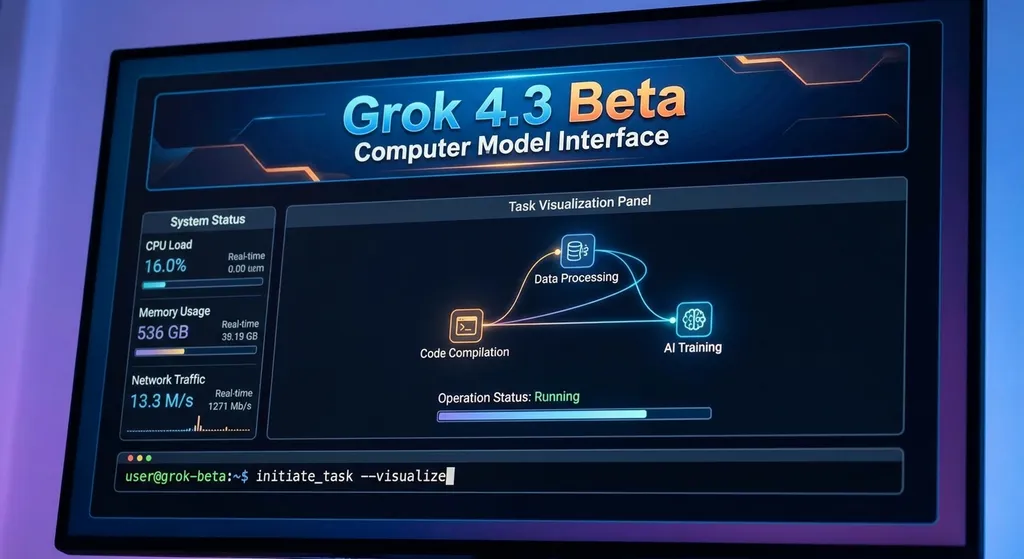
Front‑End Polish: Beyond Beta Expectations
The first batch of users with test access provided surprisingly unanimous feedback—“This front‑end looks great, really polished and high‑quality.”
That might sound like polite praise for other products, but when said about xAI, it’s worth noting. Grok has always given the impression of “strong model, rough product finish.” From early Grok 1.0 to Grok 2 Beta, the front‑end experience tended to feel “usable, but not refined.” The Computer model interface in 4.3 Beta is the first time xAI’s product design really stands out.
A few noteworthy points:
- Intuitive visualization of operations—users can clearly see what the AI is “looking at” and “clicking.”
- Interaction flow feels responsive enough for a Beta version.
- UI style is cohesive, not like a hastily assembled demo.
Of course, a Beta is still a Beta. The community has reported issues—multistep tasks sometimes fail or misidentify elements. But as the first public test version, the overall polish has exceeded expectations.
SuperGrok Exclusive: Paywall Controversy
After the good news comes the frustration.
Currently, the Computer model in Grok 4.3 Beta is only available to SuperGrok subscribers. This immediately triggered complaints—“Seriously? Need Super again just to use it? Why can’t X Premium members try it?”
The frustration makes sense. xAI’s subscription tiers roughly include X Premium (formerly Twitter Blue), X Premium+, and the standalone SuperGrok plan. Many users already pay for X, but Grok’s advanced features require a separate SuperGrok subscription—starting around $20 per month according to community discussions.
Comparison chart:
| Platform | Computer Use Capability | Required Subscription | Monthly Fee | |-----------|------------------------|-------------------------|-------------| | Grok 4.3 Beta | Computer Model | SuperGrok | ~$20+/mo | | Claude (Anthropic) | Computer Use | Pro Plan | $20/mo | | ChatGPT (OpenAI) | Operator | Plus/Pro | $20–200/mo |
The price itself isn’t outrageous, in line with competitors. What irks users is the disconnect—“I already pay for X, now I need to pay again?” xAI separating Grok’s advanced capabilities from X’s membership tiers makes sense commercially (AI inference costs are high) but feels less elegant from a user‑experience standpoint.
Still, some users are unfazed: “Price doesn’t matter—buy early, enjoy early.” For developers and power users who truly need these capabilities, $20 isn’t much of a barrier.
The Computer Use Track: Getting Crowded
Taking a wider view, Grok 4.3 Beta’s Computer model rollout signifies that the Computer Use field has moved from “proof of concept” into “product competition.”
Quick overview of current players:
Anthropic was the first to turn Computer Use into a public product. Claude’s Computer Use began testing in late 2024 and has since iterated through multiple versions—its stability and task success rate are top‑tier. Their approach: offer Computer Use as an API capability developers can integrate.
OpenAI took a different path. Through its Operator product, similar capabilities are geared toward end‑user scenarios—ordering food, filling forms, browsing. Highly productized, but less open than Claude.
Google’s Project Mariner is still in an early stage, mainly offering automation through a Chrome extension.
Now xAI enters the scene with Grok 4.3 Beta. From available information, its positioning is closer to Anthropic—providing Computer Use as a model capability rather than a standalone product.
The key question: Can Grok’s Computer model compete on core functionality?
Frankly, current data is insufficient to tell. Beta‑stage feedback centers around “beautiful front‑end” and “smooth experience,” with no systematic benchmarks yet. xAI hasn’t released detailed technical reports. Historically, Grok models have strong reasoning abilities—Grok 2 performed well in multiple tests—but Computer Use challenges not only language understanding but also visual recognition, spatial reasoning, and multistep planning.
This battle has just begun.
What It Means for Developers
If you’re a developer, two aspects of Grok 4.3 Beta’s Computer model are worth noting:
-
Expanding xAI’s API ecosystem. Grok’s API is OpenAI‑compatible, meaning if you already use OpenAI SDKs, switching to Grok is low effort. For teams wanting to integrate Computer Use into their own products, one more option is always welcome.
-
Accelerating AI Agent adoption. When AI can directly operate computer interfaces, many automation scenarios that once required API integration can now be achieved by “having AI use software like a human.” This has big implications for RPA (robotic process automation), test automation, data entry, and more.
If you’d like to call the Grok model via API, see the examples below. xAI’s API is OpenAI‑compatible, and aggregator platforms like OpenAI Hub already support Grok models, enabling direct access for developers worldwide.
from openai import OpenAI

client = OpenAI(
    api_key="your OpenAI Hub API Key",
    base_url="https://api.openai-hub.net/v1"
)

response = client.chat.completions.create(
    model="grok-4.3-beta",
    messages=[
        {"role": "system", "content": "You are a helpful assistant."},
        {"role": "user", "content": "Describe the new features of Grok 4.3 Beta"}
    ],
    temperature=0.7
)

print(response.choices[0].message.content)
// Node.js example
import OpenAI from 'openai';

const client = new OpenAI({
  apiKey: 'your OpenAI Hub API Key',
  baseURL: 'https://api.openai-hub.net/v1',
});

const response = await client.chat.completions.create({
  model: 'grok-4.3-beta',
  messages: [
    { role: 'system', content: 'You are a helpful assistant.' },
    { role: 'user', content: 'Describe the new features of Grok 4.3 Beta' },
  ],
});

console.log(response.choices[0].message.content);
Note: API calls for the Computer model may differ from standard Chat Completion endpoints. Specific parameters and invocation methods should be confirmed once xAI releases official documentation. The above examples show basic Grok model usage.
From Grok 2 to 4.3: xAI’s Pace Has Changed
Reviewing Grok’s iteration timeline reveals an interesting shift.
In August 2024, xAI launched Grok‑2 Beta, focusing on stronger reasoning and real‑time data integration, featuring Grok‑2 and Grok‑2 mini. Back then, Grok was still chasing GPT‑4 and Claude 3 in core capabilities, with a relatively simple product form.
By 2025, the release of Grok 3 established xAI solidly among the top tier. Grok 3 performed competitively against GPT‑4o and Claude 3.5 Sonnet across multiple benchmarks.
Now, Grok 4.3 Beta jumps directly to the Computer model—signaling xAI’s strategic shift from “catching up in fundamentals” to “pushing capability boundaries.” It’s no longer just about better text generation or reasoning; it’s about claiming territory in AI Agent and Computer Use domains.
The pace is faster than most expected. Considering xAI was founded less than three years ago and has a smaller team than OpenAI or Google, releasing a polished Computer Use product at this stage is impressive execution.
Of course, Elon Musk’s resource allocation plays a major role—xAI’s compute reserves, access to X’s vast data, and funding power are unmatched by typical startups.
Stay Cool and Watch These Points
Several areas warrant ongoing observation:
-
Safety boundaries. Allowing AI to directly operate computers introduces obvious risks—misclicks, permission abuse, data leaks. Anthropic has already faced these issues with Claude Computer Use. xAI’s mitigation strategy remains unclear.
-
Timeline to stable release. Community feedback suggests stability needs improvement. Historically, xAI’s beta cycles are lengthy—Grok 2 took months to reach a stable release.
-
API availability. For developers, a great front‑end matters less than an accessible API. When will Computer model APIs open? What’s the pricing and usage limit? These will determine real adoption.
-
Integration depth with X. Grok’s biggest edge is its link to X’s real‑time data ecosystem. If the Computer model can integrate deeply with X—for scenarios like automated social media management or sentiment monitoring—it would be much more compelling than a general Computer Use tool.
Grok 4.3 Beta’s Computer model isn’t revolutionary, but it’s an important signal: competition in the Computer Use space is accelerating, and xAI intends to play an active role. For developers, now is the right time to start exploring and evaluating these solutions—this capability is very likely to become standard for AI application development within a year or two.
References
- Grok 4.3 Beta New Computer Model Test – Linux.do Community Discussion — Early community feedback and discussion on Grok 4.3 Beta Computer model testing


