Qwen Simultaneous Interpretation Can Now Distinguish Who Is Speaking
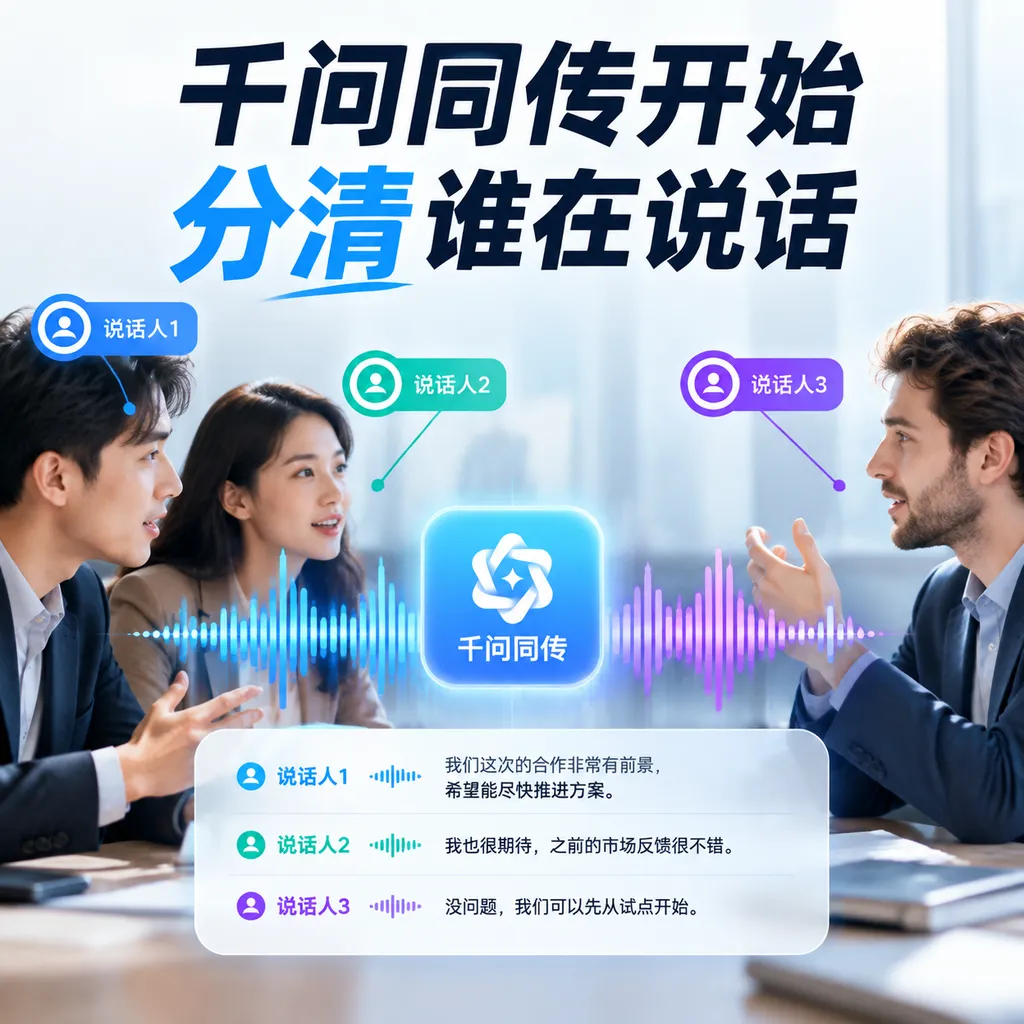
Alibaba Releases Qwen3.8-LiveTranslate, Unifying Real-Time Speaker Diarization, Bilingual Same-Frame Output, and Long-Context Disambiguation in a Single Simultaneous Interpretation Model, Reducing Average Per-Character Latency to 2.3 Seconds.
Alibaba Pushes Real-Time Simultaneous Interpretation from “Translating a Sentence” to “Understanding an Entire Conversation”
On September 19, Alibaba’s Qwen team released the simultaneous interpretation model Qwen3.8-LiveTranslate. The focus of this upgrade is not support for a few more languages, but rather the three most challenging issues in real-world meetings: who is speaking, how the source text and translation should be displayed in sync, and what context should be considered when translating a sentence.
The new model continues to support 60 languages and adds three core capabilities:
- Real-time speaker diarization: Determines which speaker each sentence belongs to and enables the translated speech to preserve the corresponding speaker’s voice characteristics more consistently;
- Synchronized source and translated text output: Streams source-language transcription and translation results simultaneously, making them directly usable for bilingual subtitles;
- Long-context disambiguation: Uses preceding conversation context to resolve names, terminology, and pronoun references, reducing inconsistent translations of the same term across a conversation.
Latency has also decreased. According to official data, Qwen3.8-LiveTranslate’s length-adaptive average lagging (LAAL) dropped from 2.8 seconds in the previous generation to 2.3 seconds, a reduction of nearly 18%.
A 0.5-second improvement may not seem remarkable in isolation, but it is critical for a simultaneous interpretation system. Real-time translation is not ordinary speech transcription. It must strike a balance between “waiting for more context” and “delivering results as quickly as possible.” The longer the system waits, the more accurate the translation tends to be; the earlier it outputs, the more likely it is to be forced to revise the translation when the meaning shifts in the second half of a sentence. Reducing latency while maintaining translation quality is more difficult than simply optimizing time to first token.
The Real Challenge of Simultaneous Interpretation Is Not Simply Connecting Speech to a Translation Model
Traditional real-time simultaneous interpretation systems typically use a sequential pipeline:
- An automatic speech recognition model converts audio into text;
- A machine translation model translates the source text into the target language;
- A text-to-speech model reads the translation aloud;
- For multi-party meetings, an additional speaker diarization model must also be run.
This approach is easy to modularize from an engineering perspective, and each component can be replaced independently. However, its weakness is equally straightforward: when an upstream component makes a mistake, downstream components have no choice but to accept it.
For example, if the speech recognition system mishears a product name, the translation model has no way of knowing what was actually said in the original audio. If speaker diarization lags by even half a beat, subtitles may be assigned to the wrong person. Performing speech synthesis only after translation is complete further increases wait time. Having multiple modules independently produce streaming output also does not mean that the overall system has achieved true end-to-end real-time processing.
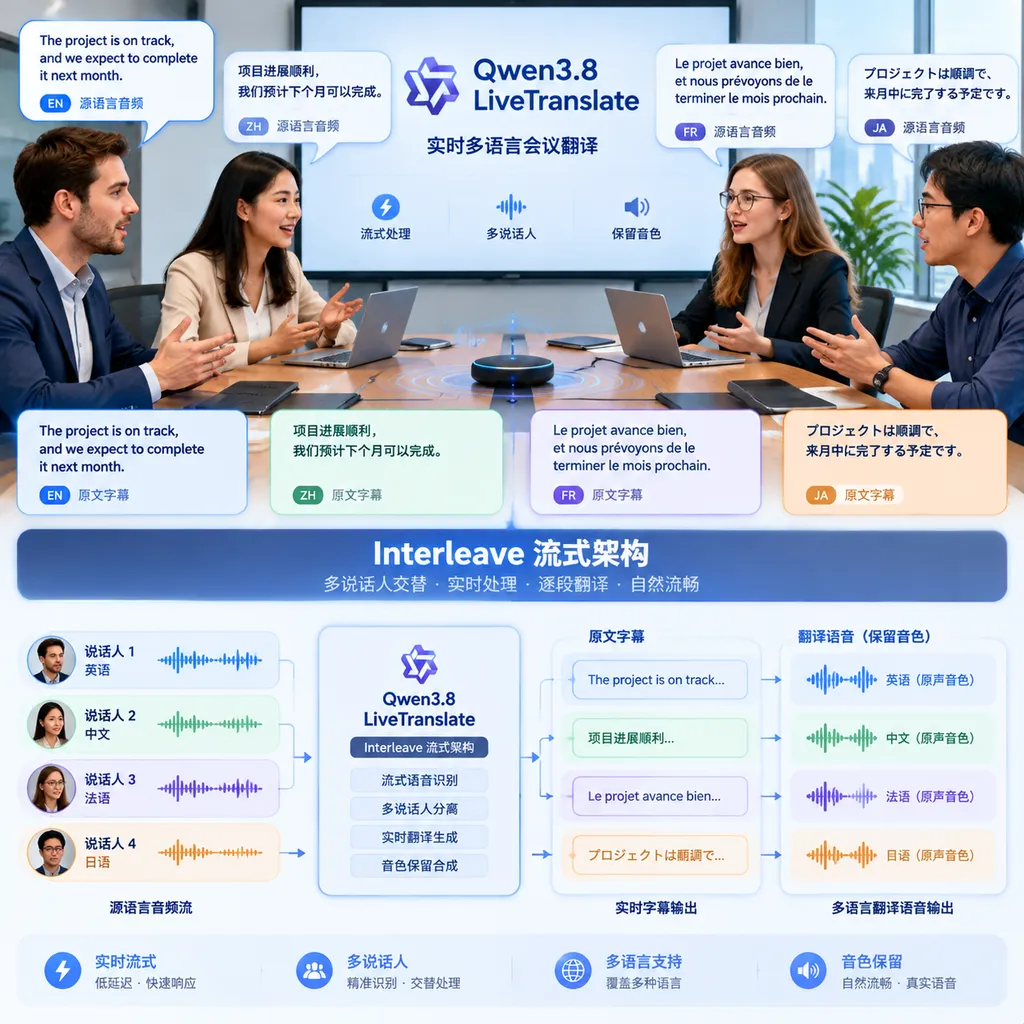
Qwen3.8-LiveTranslate attempts to reorganize this pipeline through a Hybrid MoE architecture and a dual-module Thinker–Talker design.
The Thinker is responsible for understanding. It arranges video, audio, source text, and translated text into a single causal sequence, interleaving them chronologically. Put simply, instead of merely “listening to the complete audio and then outputting text,” the model sees a continuously expanding multimodal timeline: as new audio arrives, source-language transcription and translation generation advance accordingly, while earlier information remains in the context to inform subsequent decisions.
The Talker is responsible for speaking the translation. It refers to both the translated text and the source audio to synthesize translated speech while preserving the original speaker’s voice characteristics as much as possible.
The value of this Interleave architecture is that understanding, translation, and output do not have to be executed in a strictly sequential queue. It works more like a professional interpreter in a multi-party meeting: listening to the first half of the current sentence, using prior context to anticipate its meaning, and beginning to formulate the target-language expression at the same time, rather than waiting for the speaker to finish an entire passage before starting.
Speaker Diarization Is the Most Practically Valuable Upgrade
Real-time translation demos typically feature a single person reading from a script into a microphone. However, the scenarios that users are actually willing to pay for are often the exact opposite: international meetings, online seminars, interviews, customer service calls, and multi-speaker livestreams all involve frequent interruptions, turn-taking, and even overlapping speech.
In these scenarios, outputting a single stream of translated text is not enough. At a minimum, developers also need to know:
- Who said each sentence;
- When the active speaker changed;
- Which audio stream should be retained when two people speak simultaneously;
- Whose voice should be used when synthesizing translated speech;
- Whether Speaker A and Speaker B in the subtitles can consistently correspond to the same individuals.
By incorporating speaker diarization into the real-time pipeline, Qwen3.8-LiveTranslate eliminates the need for the application layer to separately integrate a diarization service. For developers, this could reduce the number of models involved, the amount of timestamp alignment work required, and the propagation of errors across modules.
More importantly, it expands the definition of “correct translation” to include “correct conversational relationships.” Even if a sentence in meeting minutes is translated perfectly, the result remains unusable if it is attributed to the wrong speaker. In customer service quality assurance, if the system cannot distinguish the customer from the agent, subsequent sentiment analysis and responsibility assessment will also fail.
According to official claims, on Omnilingua-MSpeaker, a multi-speaker long-form audio benchmark covering 14 language directions, the new model outperforms leading real-time simultaneous interpretation systems across four dimensions: translation fidelity, fluency, conciseness, and speaker diarization error rate (DER).
DER can be understood as the system’s overall error rate in determining “who said what and when.” It typically accounts for missed speech, false detections, and speaker confusion. For multi-party meetings, DER often has a greater impact on product usability than word error rate alone.
However, the conclusions disclosed so far come primarily from official evaluations, and more comprehensive data broken down by language, noise environment, and overlapping speech is still unavailable. In particular, interruptions between two speakers, far-field audio capture, echoes, accents, and mixed Chinese-English speech remain areas where speaker diarization is most prone to failure. Therefore, “outperforming leading systems” indicates that the approach is effective, but it does not directly mean that the model is already stable and usable in every online meeting environment.
Synchronized Source and Translated Text Output Is More Than a UI Redesign
“Synchronized source and translated text output” may look like a front-end display feature, but it actually changes how downstream applications interact with the model.
Previously, many real-time translation products would display speech recognition results first and then wait for the translation service to return the target-language output. The two streams had different timestamps, requiring the front end to handle sentence segmentation, subtitle alignment, and content revisions on its own. When the source text was updated, the translation did not necessarily update at the same time, often leaving the two subtitle lines out of alignment.
If the model can natively output synchronized source and translated text, developers can more easily implement:
- Bilingual subtitles in video meetings;
- Bilingual scrolling text in livestreams;
- Side-by-side source and translated transcripts for recorded interviews;
- Two-column conversation interfaces for cross-border customer service;
- Sentence-by-sentence shadowing and translation verification in educational scenarios.
It also gives users room to verify the output. Real-time translation can never be perfectly accurate. Retaining the source text allows users with partial knowledge of the source language to quickly determine whether an error originated in speech recognition or translation, rather than having to passively accept a translation that merely appears fluent.
From a product perspective, this is more reliable than simply generating translated audio that “sounds like a real person.” Voice cloning improves immersion, while bilingual text provides traceability; the two address different needs.
Long Context Addresses Terminology Consistency, Not Single-Sentence Benchmark Scores
Simultaneous interpretation models are most likely to excel in short-sentence tests—and most likely to gradually lose control during long meetings.
Suppose a product launch repeatedly mentions the same product, person, or technical acronym. Without long context, the model might transliterate it the first time, translate its meaning the second time, and mistake it for an ordinary word the third time. Each sentence may appear reasonable in isolation, but together they do not sound as though they came from the same event.
Qwen3.8-LiveTranslate emphasizes long-context disambiguation, with the goal of using previously introduced information to guide the current translation. For example:
- Once earlier context has established that a particular pronunciation corresponds to a person’s name, later occurrences continue to use that name;
- Once an acronym has been assigned a clear meaning in the current meeting, the model no longer has to repeatedly guess;
- The model uses prior remarks to determine the referent of “he,” “it,” or an omitted subject;
- It connects presentation visuals, audio, and previous translations to understand the current sentence.
This also represents the potential value of incorporating video into the Thinker sequence. If a speaker is displaying a product name, chart title, or code snippet, visual information can provide additional clues for ambiguous pronunciations in the audio. Of course, the actual benefit still depends on whether the API exposes the relevant video-input capabilities, sampling strategy, and context capacity. The architecture description alone is not enough to conclude that every scenario will benefit equally.
60 Languages and 70 Language Directions Are Not the Same Thing
The official announcement states that the model supports 60 languages and was evaluated on 70 language directions using the public FLEURS audio test set. These two figures are not contradictory.
“Number of languages” refers to how many languages the system can process, while “language directions” emphasizes which language is translated into which—for example, Chinese-to-English and English-to-Chinese are two different directions. The difficulty of real-time translation is also asymmetric across directions, so results in one direction cannot be used as a substitute for performance in the reverse direction.
According to official results, across 70 language directions on FLEURS, Qwen3.8-LiveTranslate outperforms its predecessor and leading real-time simultaneous interpretation systems in four areas: translation quality, length-adaptive average lagging, speech recognition accuracy, and speech synthesis quality.
These evaluations cover the main stages of real-time simultaneous interpretation, but developers selecting a model should still look beyond average scores and examine details such as:
- Whether the specific language directions involved in the target business use case are among the model’s strengths;
- How it performs with dialects, accents, and code-switching;
- Whether the 2.3-second figure is an overall average or a result obtained under specific language directions and audio conditions;
- How much additional end-to-end latency will be introduced by network transmission, audio chunking, and client-side playback buffering;
- Whether the model supports business glossaries, hotwords, and proper-noun injection;
- How much translation quality and voice preservation deteriorate when multiple people speak simultaneously.
Model latency in the lab is not the same as the latency users hear. An online simultaneous interpretation product must also go through capture, encoding, upload, server-side queuing, inference, delivery, and playback. Saving 0.5 seconds at the model level is valuable, but a single additional buffer in the engineering pipeline could consume the entire gain.
From “Able to Translate” to “Ready for Production Integration”
The rationale behind this Qwen3.8-LiveTranslate upgrade is straightforward: instead of continuing to inflate the language coverage figure, Alibaba has begun filling in the structured capabilities that real-time simultaneous interpretation needs to enter production environments.
Speaker diarization addresses speaker attribution, synchronized bilingual output addresses display and verification, long context addresses consistency, and the Thinker–Talker design attempts to reduce the errors and latency introduced by traditional sequential systems. Together, these capabilities have greater product significance than simply improving a translation benchmark score.
For developers, the most valuable tests for the new model are not prepared single-speaker presentations, but the following stress scenarios:
- Three or more speakers switching turns continuously;
- Two speakers overlapping for short periods;
- Long meetings containing company names, product names, and industry acronyms;
- Mixed speech involving Mandarin, dialects, and English;
- Frequent incomplete audio chunks under poor network conditions;
- Name consistency and voice stability after one hour of continuous operation.
Only if Qwen3.8-LiveTranslate can maintain acceptable DER, translation quality, and end-to-end latency in these scenarios can it truly evolve from a showcase feature into infrastructure that meeting, livestreaming, and customer service systems can rely on.
At this stage, the more reasonable conclusion is that Alibaba has identified the right problems in real-time simultaneous interpretation and is no longer satisfied with simply chaining ASR, translation, and TTS together. However, its official benchmarks still require third-party replication, especially regarding stability in complex acoustic environments, overlapping speech, and prolonged operation.
The next stage of competition in real-time simultaneous interpretation will not be limited to “how accurate is the translation?” Whoever can simultaneously handle identity, context, voice, subtitle alignment, and low latency will be closer to delivering a truly usable cross-language communication layer. Qwen3.8-LiveTranslate has at least moved the battleground to that level.
References
- ITHome: Alibaba Qwen Releases the Qwen3.8-LiveTranslate Simultaneous Interpretation Model — Includes the model’s three new capabilities, architecture details, latency data, and official evaluation results.