Grok Transcription 2.0: Half the Errors, Same Price
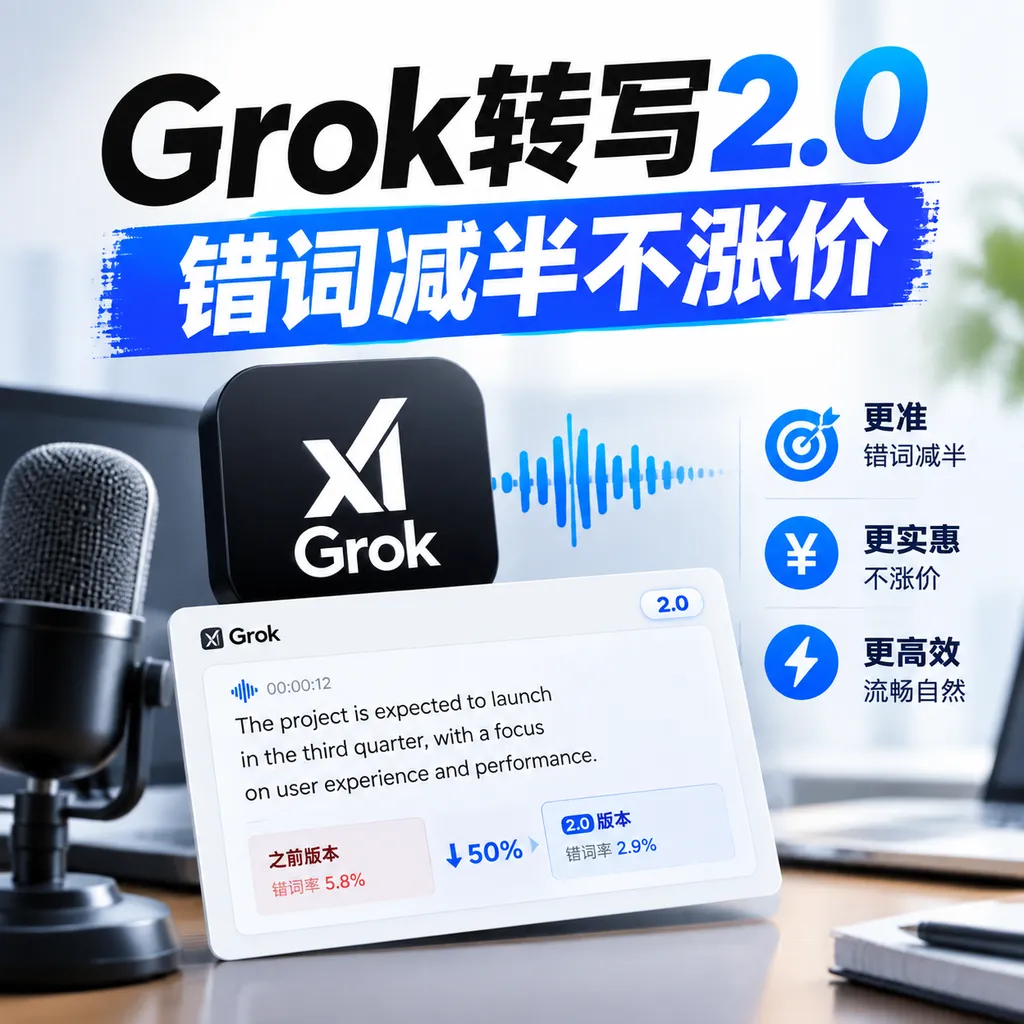
SpaceXAI released Grok Voice Transcribe 2.0 yesterday, cutting the error rate by roughly half while keeping the price unchanged and taking the top spot on Artificial Analysis’s streaming speech recognition leaderboard.
Error Rate Cut in Half, With No Price Increase
SpaceXAI released Grok Voice Transcribe 2.0 on September 18 local time. This upgrade introduces no new pricing tiers and does not split key capabilities into paid add-ons. Instead, it cuts the speech-to-text error rate by roughly half while keeping prices unchanged.
As of September 20, the model ranked first on Artificial Analysis’s streaming speech recognition leaderboard, which compares 32 streaming models. SpaceXAI also says the new version has already been deployed in real-world production workflows: processing tens of thousands of customer service calls each day, transcribing millions of hours of video voiceovers, and providing voice capabilities for physical devices, including Tesla’s in-car Grok assistant.
This is not an update padded with a long list of features. For a speech recognition model, halving the error rate without raising the price is itself the most commercially valuable upgrade possible.
“Halving the Error Rate” Matters Far More Than “Improving Accuracy by a Few Points”
Speech recognition performance is typically measured using Word Error Rate (WER). It counts substitutions, deletions, and insertions in the transcription and compares them with the number of words in the correct text.
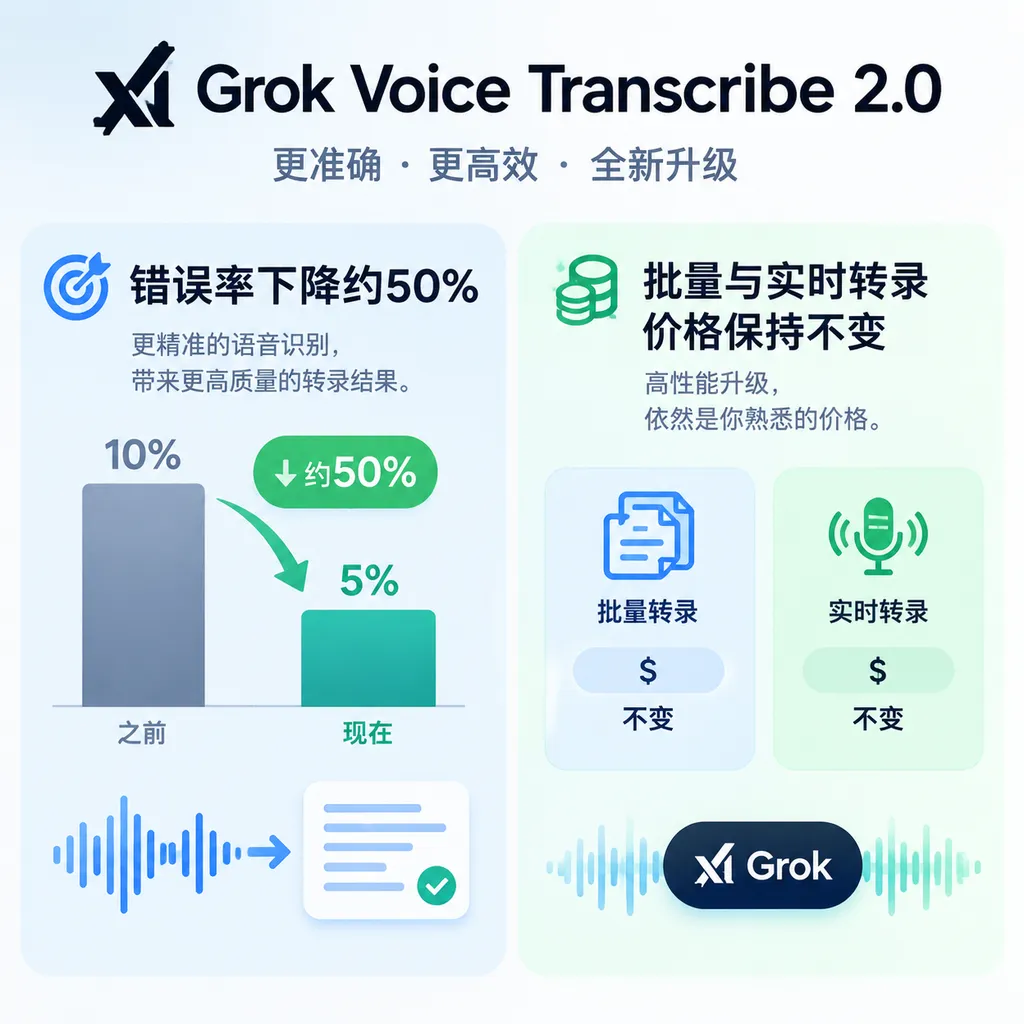
Put simply, if an average of two words out of every 20 were previously incorrect, the WER would be close to 10%. If the new model reduces that to 5%, it may appear that accuracy has only increased from around 90% to around 95%, but the number of errors requiring manual correction has actually been cut in half.
This is why the final few percentage points of improvement in speech models are often the most expensive.
For meeting minutes, a few incorrect words may only affect readability. In customer service calls, order entry, in-car commands, and identity information collection, however, errors feed directly into downstream systems. A single wrong digit in a phone number, a missing character in an email address, or a misrecognized street name can cause the entire automated workflow to fail.
This upgrade therefore should not be understood simply as “a slight improvement in accuracy.” A more accurate description would be: if the official results can be replicated in production, the amount of noisy transcription data and manual review developers must handle could theoretically be reduced by nearly half.
Of course, “an approximately 50% reduction in error rate” does not mean errors will consistently be halved across every language, accent, and recording environment. Background noise, overlapping speakers, microphone distance, and industry-specific terminology can still significantly affect recognition results. Before a full migration, teams should still run regression tests using their own production data.
SpaceXAI Tested Four Categories of Real-World Data, Not Just Public Benchmarks
Grok Voice Transcribe 2.0 is built on the underlying Grok Voice audio foundation model. Rather than publishing only results from general-purpose test sets, SpaceXAI also disclosed internal evaluations covering four categories of data:
- Customer service call audio: including line compression, background noise, accents, and alternating speakers;
- Everyday English conversations between users and Grok: more closely reflecting natural interactions with a voice assistant;
- Spoken information such as phone numbers, email addresses, and physical addresses: focusing on digits, letters, and named entities;
- Short multilingual voice commands: corresponding to in-car, hardware, and instant voice-control scenarios.
According to SpaceXAI, version 2.0 outperformed version 1.0 across all four categories.
The most noteworthy point is not that it “won across the board,” but that SpaceXAI specifically separated out phone numbers, email addresses, and physical addresses. This type of content represents only a small share of general speech benchmarks, yet it is one of the most failure-prone areas in customer service automation.
For example, when a user says “B as in Boston” or recites a string of phone-number digits, the model must not only recognize the sounds but also understand that the information should be rendered character by character. Mishearing a preposition in ordinary conversation may not affect the meaning, but one incorrect digit makes a phone number completely unusable.
This suggests that Grok Voice Transcribe 2.0 is not merely optimized to improve average benchmark scores. It is also designed to address the most common weaknesses speech models encounter after entering production.
Pricing Is Unchanged, and Additional Capabilities Are Still Included
Grok Voice Transcribe 2.0 retains the pricing of version 1.0:
| Usage Mode | Price | Estimated at Current Exchange Rates | | --- | ---: | ---: | | Batch transcription | $0.10 per hour of audio | Approx. RMB 0.67 per hour | | Real-time streaming transcription | $0.20 per hour of audio | Approx. RMB 1.30 per hour |
Speaker diarization, precise timestamps, and custom keywords are included in the price and do not require separate purchases.
This is an aggressive pricing strategy. The cost of speech transcription cannot be evaluated solely on the per-hour price. Additional features, failed retries, post-processing, and manual proofreading must also be taken into account. A model may have a low quoted price, but if speaker diarization costs extra and named-entity recognition requires an external model, its final total cost may not be low at all.
For one million hours of archived audio, the publicly listed pricing would put the model cost of batch transcription at approximately $100,000. Processing the same duration via real-time streaming would cost approximately $200,000. For call centers, short-form video captioning platforms, and audio archiving systems, that is already enough volume to influence vendor selection.
More importantly, if the error rate has truly been halved, the savings in manual review costs could exceed the API fees themselves. For many enterprise speech projects, the most expensive part is not the initial transcription, but the subsequent correction, structuring, and quality assurance.
Topping the Streaming Leaderboard Is Meaningful, but Does Not Mean It Is Best in Every Scenario
According to Artificial Analysis’s evaluation results, Grok Voice Transcribe 2.0 ranked first in accuracy among the 32 streaming models compared. At the very least, this indicates that it has entered the top tier of today’s proprietary speech recognition models.
Developers should not, however, switch models based on a single leaderboard alone.
Streaming speech recognition should be evaluated on at least four metrics:
- Accuracy: whether the final text is reliable;
- Time to first token: how long users must wait after speaking before seeing the first result;
- Output stability: whether interim text is frequently rolled back and rewritten;
- Throughput and price: whether cost and response speed can be maintained under high concurrency.
Ranking first in benchmark accuracy does not mean the model is best for every language, dialect, or noise condition, nor does it guarantee the lowest end-to-end latency. For in-car voice systems and real-time customer service in particular, a model that produces more accurate results 300 milliseconds later may deliver a very different product experience from one that responds faster but occasionally revises its output.
The safest migration approach is to sample representative audio from production traffic and conduct stratified testing by language, device, noise level, and business category. In addition to calculating overall WER, teams should separately track error rates for numbers, personal names, place names, product names, and negation words.
Negation is particularly easy to obscure within aggregate metrics. “Needs a refund” and “does not need a refund” may differ by only one word, but they trigger opposite actions in a ticketing system.
For Developers, the Greatest Benefit Is a Shorter Post-Processing Pipeline
In the past, a common way to make speech transcription usable was to add a large language model after the recognition model to correct punctuation, restore named entities, distinguish speakers, and extract structured fields.
The problem is that although LLM-based post-processing can make text more fluent, it may also “correct” the transcript by adding content that was never present in the original audio. Such hallucinations are especially unacceptable in customer service compliance, legal records, and medical recordings.
By incorporating speaker diarization, timestamps, and keyword prompting directly into the transcription layer, Grok Voice Transcribe 2.0 reduces the workload assigned to post-processing models. A more appropriate architecture would be:
- The speech model handles faithful transcription and speaker differentiation;
- A rules-based system validates deterministic fields such as phone numbers and email addresses;
- A large language model is used only for summarization, classification, and intent extraction;
- The original audio, verbatim transcript, and structured results are stored separately for auditing.
This division of responsibilities is more controllable than “sending an entire recording to one end-to-end model to solve everything,” and it also makes errors easier to diagnose.
Custom keywords are equally important. Product model numbers, company names, personal names, and internal abbreviations are often low-frequency items in general-purpose training data. Allowing developers to provide keywords is effectively a way to tell the model which rare terms deserve priority, without retraining it.
Example Using an OpenAI-Compatible API
Grok Voice Transcribe 2.0 is a newly released proprietary model. Teams that already manage model calls using the OpenAI format can reduce SDK and application-code changes by using a compatible API. The following example uses the OpenAI Hub-compatible API. The actual model identifier and endpoint should be based on the information provided in the console:
curl "${OPENAI_HUB_BASE_URL}/v1/audio/transcriptions" \
  -H "Authorization: Bearer ${OPENAI_HUB_API_KEY}" \
  -F "file=@customer-call.wav" \
  -F "model=grok-voice-transcribe-2.0" \
  -F "response_format=verbose_json" \
  -F "timestamp_granularities[]=segment" \
  -F "prompt=OpenAI Hub, Grok, Tesla, order_id"
In production, it is advisable not to store only the final text. Segment-level timestamps, speaker information, model version, and request ID should also be retained. This allows the team to accurately trace which model and parameters were used if the model is later upgraded or a transcription result is disputed.
If a system integrates multiple speech models, audio transcription can also be encapsulated as a unified service and routed dynamically based on language, latency requirements, and cost. For example, live captions can prioritize streaming models, archived recordings can use batch APIs, and rare languages can be routed to specialized models. This is also where aggregator APIs such as OpenAI Hub provide value: the application layer does not need to maintain separate authentication and invocation logic for every vendor.
The Real Competitor in This Upgrade Is the Cost of Manual Proofreading
From a product strategy perspective, Grok Voice Transcribe 2.0 does not attempt to attract attention with an entirely new interaction concept. Instead, it applies pressure through the two most direct metrics: accuracy and price.
In the speech API market, model capability is no longer simply about whether a model “can understand speech.” Purchasing decisions ultimately depend on whether it can reliably recognize critical fields in complex recordings, return streaming results, provide built-in speaker diarization, and maintain a manageable total cost of ownership.
Another advantage for Grok Voice is its closed loop of real-world use cases. Customer service calls, video voiceovers, and Tesla’s in-car assistant all produce different audio distributions, continually exposing issues that public datasets struggle to cover. Provided that data collection and privacy governance are handled appropriately, real-world traffic can become a major competitive moat for iterating speech models.
The final judgment, however, must still come from production data. SpaceXAI’s internal tests and third-party leaderboards show that the model is worth trying, but they cannot replace an organization’s own A/B testing. Developers should at minimum validate its performance on Chinese and regional dialects, streaming latency, overlapping speakers, keyword recall, and connection stability under network fluctuations.
Overall, Grok Voice Transcribe 2.0 is a pragmatic and competitive update: there is no price increase, no repackaging of basic functionality as paid add-ons, and a direct reduction in errors. For large-scale speech applications, that is more valuable than adding several rarely used features.
References
- ITHome: SpaceXAI Releases Grok Voice Transcribe 2.0, Cutting the Error Rate by Approximately Half — Includes information on the model’s release date, evaluation results, application scenarios, and batch and real-time transcription pricing.