
Cloudflare Mail Service Public Beta: AI Agents Finally Have Their Own Mailbox

Cloudflare launches the public beta of its email service, enabling AI Agents to send and receive emails like humans and handle tasks asynchronously. This isn’t a simple SMTP wrapper, but a native communication layer designed for Agents.
Cloudflare Email Service Public Beta: AI Agents Finally Have Their Own Mailboxes
On April 16, Cloudflare opened the public beta for its Email Service, designed specifically for AI Agents. The significance of this is not just another email-sending service—it’s that Agents now have true asynchronous work capabilities. They can spend hours processing data, coordinating across systems, and then reply or follow up at the right time.
In the past, enabling Agents to send and receive emails required integrating three or four services, managing conversation states, handling authentication, and parsing email threads manually. Now Cloudflare has made all of that a native feature—developers only need to focus on business logic.
More Than Sending Mail: Giving Agents an Identity
This public beta includes two core features: Email Sending and Email Routing. The former allows Agents to send emails proactively, while the latter lets them receive and process incoming mail.
The key detail is the new onEmail hook in the Agents SDK. Agents can not only receive emails, but also use the send functionality to craft asynchronous replies. This is fundamentally different from chatbots’ instant responses—email Agents can take hours to handle complex tasks, and recipients don’t need to install any app or SDK; ordinary email works perfectly fine.
Each Agent gets its own unique mailbox address, and the address router can direct emails with different prefixes to the corresponding instance. For example, sales@yourdomain.com and support@yourdomain.com can be two different Agents, each handling its own domain-specific tasks.
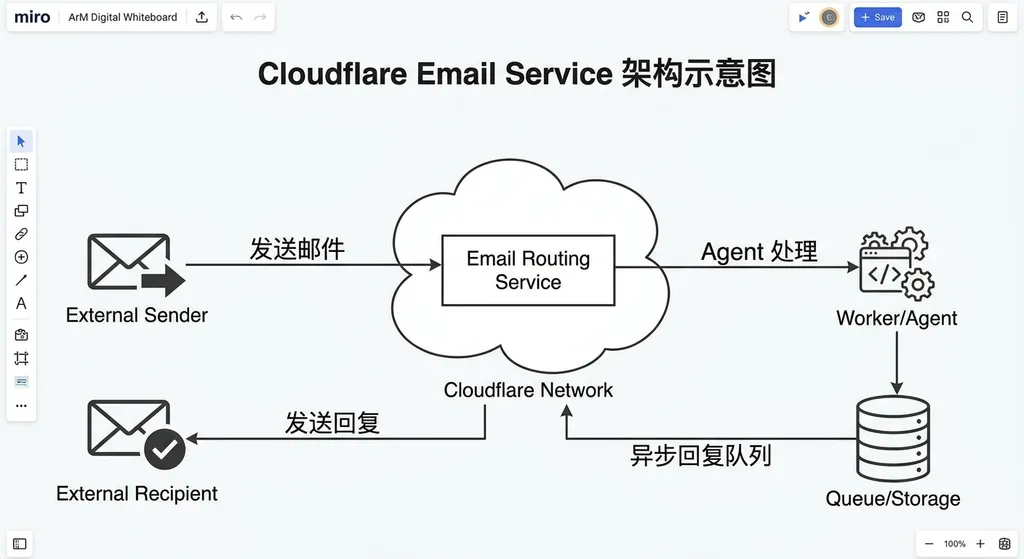
Technical Implementation: Native Workers Bindings + REST API
Developers can use the email service in two ways:
1. Native Workers Bindings
Within Workers, you can use native bindings to send emails—no need to manage API keys or key pairs. Example:
export default {
  async email(message, env, ctx) {
    // Receive email
    const from = message.from;
    const subject = message.headers.get("subject");

    // Handle logic (can be an asynchronous long-running task)
    const response = await processWithAI(message.text());

    // Send reply
    await env.EMAIL.send({
      to: from,
      subject: `Re: ${subject}`,
      text: response
    });
  }
};
2. REST API Calls
Supports TypeScript, Python, and other SDKs, or you can directly call the REST API. If you’re using OpenAI Hub to invoke AI models, you can combine it like this:
import requests
from openai import OpenAI

# Initialize OpenAI Hub client
client = OpenAI(
    api_key="your-openai-hub-key",
    base_url="https://api.openai-hub.net/v1"
)

# After receiving the email, generate a reply using AI
def handle_email(email_content):
    response = client.chat.completions.create(
        model="gpt-4",
        messages=[
            {"role": "system", "content": "You are a customer support assistant"},
            {"role": "user", "content": email_content}
        ]
    )

    reply = response.choices[0].message.content

    # Send the email through the Cloudflare API
    requests.post(
        "https://api.cloudflare.com/client/v4/accounts/{account_id}/email/send",
        headers={"Authorization": "Bearer {api_token}"},
        json={
            "to": "customer@example.com",
            "subject": "Re: Your inquiry",
            "text": reply
        }
    )
Automated Authentication Records to Avoid Spam Folders
Email deliverability is a major concern. Cloudflare automatically configures SPF, DKIM, and DMARC records for your domain to ensure authentication passes. These protocols are crucial for mail servers to judge legitimacy—if misconfigured, your messages are likely to end up in spam.
Backed by Cloudflare’s global network, emails can achieve low-latency global delivery. This is vital for Agents that need quick responses, such as in order confirmation or alert scenarios.
Solving Token Anxiety: The Clever Wrangler CLI Design
One easily overlooked detail is the optimization within Wrangler CLI. Traditionally, you’d define email-sending tools (function-calling schema) inside the AI’s context, consuming many tokens. Wrangler CLI enables Agents to send mail with almost zero context overhead—the tool definitions aren’t added to the context but injected at runtime.
It’s a smart design. Everyone’s trying to scale up context length, but in high-frequency real-world usage, every token counts. Saving wherever possible matters.
Multi-Environment Integration: MCP, CLI, Skills
Cloudflare offers three integration approaches:
MCP Server: Agents can call the mail interface via natural language instructions. For example, “Send an email to john@example.com about project progress,” and the Agent will parse intent, generate content, and execute the send operation automatically.
Wrangler CLI: The zero-context-overhead solution mentioned earlier; ideal for token-cost-sensitive scenarios.
Skills Project: An open-source configuration guide and best practices to help developers quickly build production-grade applications. Includes full error handling, retry logic, and logging.
Example Application: Agentic Inbox
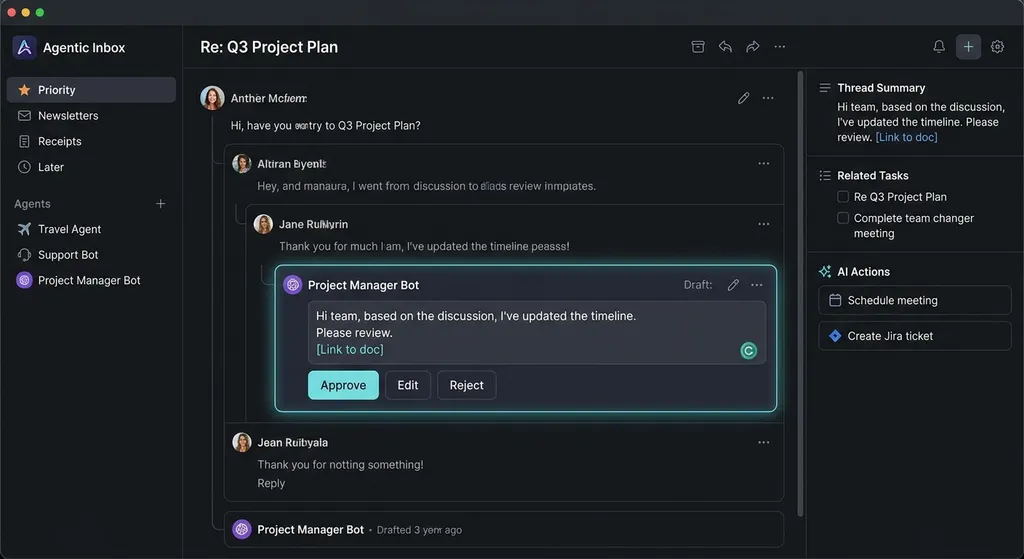
Cloudflare has open-sourced Agentic Inbox as a reference implementation. The app integrates email routing, sending, AI classification, attachment storage, and Agent logic—supporting full conversation threads and auto-replies.
The GitHub repo shows complete code for:
- Parsing email threads (In-Reply-To, References headers)
- AI-based email classification (urgent/normal/spam)
- Handling attachments (stored in R2)
- Managing Agent state (using Durable Objects)
These are issues you’ll encounter in production environments, and having a reference implementation saves plenty of time.
How It Compares to Existing Solutions
There are existing methods for enabling Agents to handle emails, but most are patchwork solutions:
- SendGrid/Mailgun + Zapier: Can send but not properly receive, or you must handle webhooks manually.
- Gmail API: Full-featured but complex setup; the OAuth process is cumbersome for Agents.
- Self-hosted SMTP: Deliverability pitfalls—IP reputation and domain reputation take time to build.
Cloudflare’s solution is native and integrated. Email routing, sending, authentication setup, and global delivery—all are plug-and-play. For developers, it means less infrastructure hassle and more time for actual business logic.
Best Fit Scenarios
This service is ideal for Agent use cases requiring asynchronous processing:
Customer Service Agents: Receive customer emails, query order systems or knowledge bases, and generate replies. They can take minutes or hours to solve complex issues, unlike chatbots that must reply instantly.
Sales Follow-Up Agents: Automatically send follow-up mails, schedule meetings, and update the CRM. Each lead gets a unique mailbox address, and the Agent can track full conversation history.
Ops Alert Agents: Receive monitoring alerts, analyze logs, query metrics, generate diagnostic reports, and send them to relevant team members.
Content Moderation Agents: Receive user report emails, analyze content with AI models, and either auto-process or escalate for human review.
All these cases share traits: complex tasks, time requirements, multi-system coordination. Asynchronous email matches perfectly.
Pricing and Limitations
The pricing and quota during public beta aren’t fully announced yet, but judging by Cloudflare’s style, there will likely be a generous free tier. The Workers free plan supports up to 100,000 requests per day; email service will probably follow similar limits.
Note that this is a beta—APIs may change. If you plan to use it in production, ensure version compatibility.
The Bigger Picture: Agents Week 2026
Email Service is part of Cloudflare Agents Week 2026. Other releases include:
- AI Platform: Unified inference layer for 70+ models
- Sandbox Environment: Safe execution of Agent code
- Git Storage: Agents can directly interact with code repositories
- Voice Pipeline: Agents can process voice input/output
Cloudflare is building a complete Agent infrastructure stack. The email service is just one piece—but it addresses a core issue of Agent–world interaction: communication.
Chatbots are synchronous and instant—good for simple Q&A. Email Agents are asynchronous and deliberate—good for complex tasks. Combined, they cover far more real-world scenarios.
Details Worth Paying Attention To
Some technical aspects developers should note:
Conversation Thread Management: Email’s In-Reply-To and References headers track conversation history. Cloudflare’s router automatically parses them, routing messages in the same thread to the same Agent instance (via Durable Objects).
Attachment Handling: Attachments are automatically stored in R2 (Cloudflare’s object storage). The Agent receives a storage URL—no large attachments consuming Worker memory.
Error Handling: If Agent processing fails, messages enter a retry queue. You can configure retry counts, intervals, and specify a fallback mailbox.
Rate Limiting: To prevent abuse, each account has send limits. Exact numbers aren’t disclosed but should be sufficient for normal usage.
Developer Feedback
From community feedback, developers are responding positively. The main advantages:
- Simple setup—get running in minutes
- High deliverability—no spam worries
- Great Workers ecosystem integration—reuse existing code easily
- Clear documentation—example code works out of the box
Main concerns:
- Beta APIs may change
- Pricing still unclear
- Email storage duration and quota unspecified
Overall, it’s a service worth trying. If you’re building Agent-related projects, adding email capabilities is a valuable enhancement.
Summary
Cloudflare’s Email Service isn’t just a simple SMTP wrapper—it’s a native communication layer designed for Agents. It gives Agents asynchronous working capabilities, enabling them to send and receive mail like humans and handle complex tasks.
For developers, that means fewer infrastructure worries and more focus on business logic. For Agents, it means broader application scenarios—not just chat, but real workflow handling.
If you’re using OpenAI Hub to call AI models, you can now integrate email capability to make your Agent more complete. The public beta is a good time to test whether it fits your needs.
References
-
Cloudflare Public Beta Email Service: AI Agents Can Natively Send and Receive Emails - ITHome
Detailed ITHome report covering Cloudflare Email Service’s public beta, technical details, and features -
Agentic Inbox - GitHub
Cloudflare’s open-source email Agent reference implementation, including full code and best practices


