Claude Opus 5.5 Slashes Its Price in a Surprise Move

Anthropic released Claude Opus 5.5 yesterday, cutting API input and output prices by 20% and slashing cache read prices by 60%. What truly deserves attention is not the benchmark scores, but how the cost structure of long-context agents is being rewritten.
Claude Opus 5.5 Surprise Launch: API Price Cuts Are Only the Surface—Caching Is the Real Story
Anthropic released Claude Opus 5.5 yesterday (September 22). Compared with its predecessor, Opus 5, the new model reduces standard API input and output prices by 20% across the board, while cache-read pricing drops from $0.50 to $0.20 per million tokens—a 60% reduction.
This is a typical Claude-style update: the model number advances by only half a generation, yet capabilities, speed, pricing, and API behavior have all changed. According to Anthropic, Opus 5.5 delivers more than 30% faster inference than Opus 5 and, with the default effort setting on typical tasks, can reduce the total cost of completing the same work by approximately 40%.
The two figures need to be considered separately: 20% is the fixed reduction in per-token pricing, while 40% is an estimate of task-level cost savings under certain assumptions. The latter depends on whether the model can complete a task with fewer tokens, fewer retries, and a shorter execution chain. It does not mean every bill will automatically be reduced by 40%.
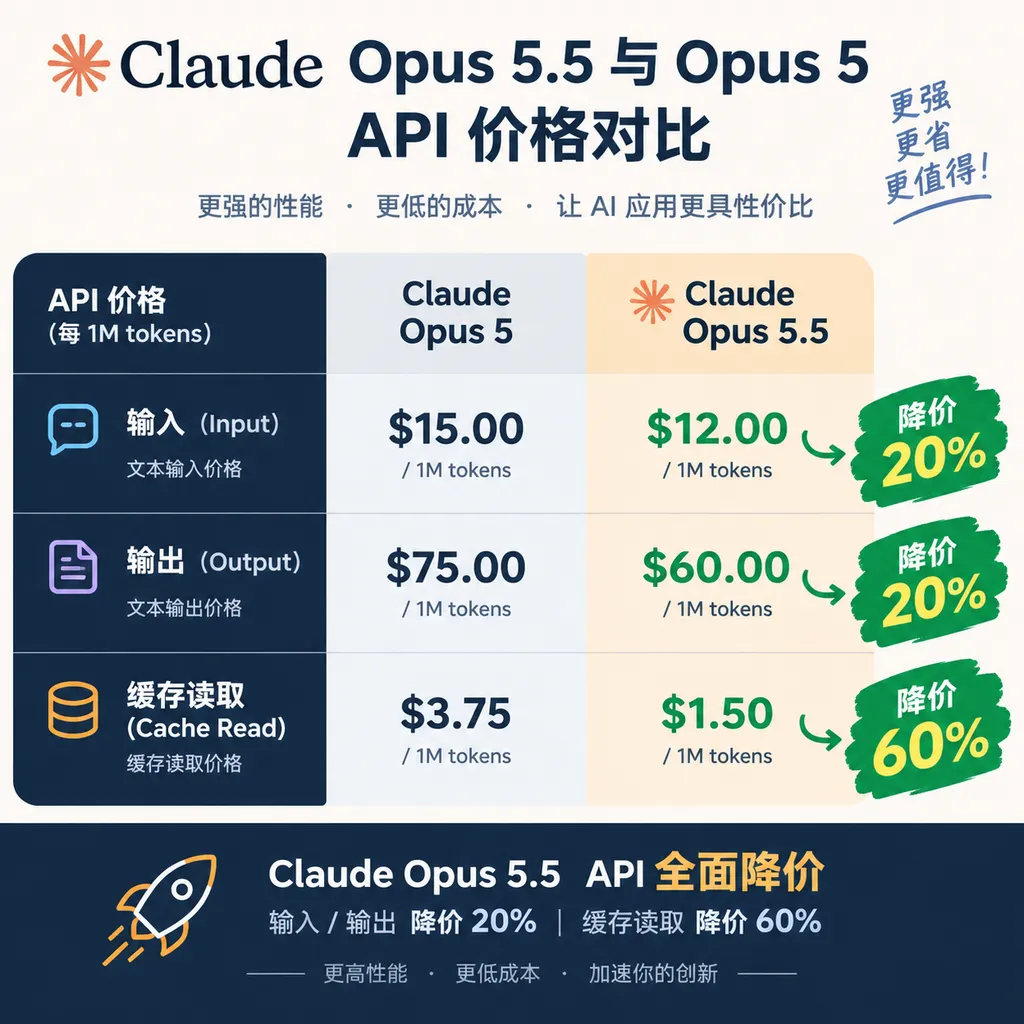
New Pricing: $4 for Input, $20 for Output
Under the newly announced standard API pricing, Claude Opus 5.5 is billed as follows per million tokens:
| Billing Item | Opus 5.5 | Opus 5 | Reduction | |---|---:|---:|---:| | Standard input | $4 | $5 | 20% | | Standard output | $20 | $25 | 20% | | 5-minute cache write | $5 | $6.25 | 20% | | 1-hour cache write | $8 | $10 | 20% | | Cache read | $0.20 | $0.50 | 60% | | Batch API input | $2 | $2.50 | 20% | | Batch API output | $10 | $12.50 | 20% | | Fast mode input | $8 | $10 | 20% | | Fast mode output | $40 | $50 | 20% |
All prices are calculated per million tokens. Cloud platforms, API aggregators, and enterprise contracts may use different pricing, while actual bills will also be affected by cache hit rates, context length, the number of tool calls, and taxes.
If a request uses 100,000 standard input tokens and generates 20,000 output tokens, excluding caching and tool calls, the cost for Opus 5.5 is:
- Input: 0.1 × $4 = $0.40
- Output: 0.02 × $20 = $0.40
- Total: $0.80
At the same token usage, Opus 5 costs $1. The savings are a clear 20%, not 40%.
Anthropic’s claim of a 40% reduction in typical task costs also factors in improvements in model efficiency. If Opus 5.5 can find the correct solution faster, reduce unproductive reasoning, avoid repeatedly reading files, and require fewer failed retries, the total number of tokens consumed to complete a task will also decrease. However, this is a workload-dependent metric and cannot yet be applied directly to every application.
Cache Reads Are Where the Real Cuts Happened
Compared with the 20% reduction in standard input and output pricing, the 60% cut in cache-read pricing deserves more attention from developers.
For chatbots, caching may be merely an optimization. For coding agents, research agents, and enterprise knowledge bases, it has become a central part of the cost model.
At each step, a coding agent may need to carry the following information:
- Repository structure and project rules;
- System prompts and security policies;
- Core source files already read;
- Tool definitions and parameter descriptions;
- Previous changes and test results;
- The long conversation history for the current task.
This content often reaches tens or even hundreds of thousands of tokens, yet it changes very little between adjacent steps. If every step is billed again as standard input, costs grow almost linearly as the agent loop continues. Prompt Caching stores a stable context prefix in the cache, allowing subsequent requests to pay only the much lower cache-read price.
Suppose an agent needs to reread 200,000 tokens of repository context across 20 steps:
- With Opus 5, each cache read costs approximately $0.10, or about $2 across 20 reads;
- With Opus 5.5, each cache read costs approximately $0.04, or about $0.80 across 20 reads.
That item alone saves $1.20. If a production environment runs thousands of long tasks every day, the difference will quickly become substantial.
This pricing adjustment is therefore more than a simple promotion. Anthropic is effectively reducing the marginal cost of long-running agents and encouraging developers to keep more project context, historical state, and tool documentation inside the model loop.
Of course, caching is not a free lunch. Cache writes are still billed, and at a higher rate than standard input. The write cost can only be amortized if the same prefix is reused multiple times. Developers must also avoid placing timestamps, random IDs, or dynamic state near the beginning of a prompt. Otherwise, a single-character change could invalidate the cached prefix, making the advertised 60% price reduction effectively unattainable.
Migrating 680,000 Lines of Code in One Day Says More Than Just “Faster”
The most widely circulated example from this release is a migration involving approximately 680,000 lines of code completed in a single day. The figure is striking, but it should not be interpreted as the model independently rewriting all 680,000 lines.
Real-world software migrations typically involve replacing dependencies, adapting interfaces, applying bulk syntax transformations, fixing compilation errors, running regression tests, and conducting human review. The value of a large language model is not that it manually types every line of code, but that it handles highly repetitive, context-intensive work: first understanding the repository structure, then making changes in bulk, and finally continuing to fix issues based on compiler and test feedback.
In other words, a coding model should not be evaluated solely by how much code it can generate in one pass. The more important question is whether it can maintain a complete closed loop:
- Identify the files that actually need to be changed;
- Understand cross-module dependencies;
- Use search, editing, terminal, and testing tools;
- Continue diagnosing issues based on error messages;
- Control the scope of changes and avoid unrelated refactoring;
- Ultimately deliver a reviewable changeset.
The 680,000-line figure is better understood as evidence that the model can work within a large repository—not proof that it ingested and rewrote the entire codebase in a single pass. The specific environment, test coverage, degree of human involvement, and acceptance criteria can still significantly affect the result. Until independent reproductions are available, figures like this are best treated as capability signals rather than direct procurement guarantees.
30% Faster, but Check the Default Effort Setting First
Opus 5.5 is reportedly more than 30% faster than Opus 5 and sets the default reasoning effort to medium. This creates a potential benchmarking pitfall: different effort settings may affect latency, token usage, and task success rates.
If the previous model ran at a higher reasoning effort while the new model defaults to medium, their speed and cost cannot be compared solely by looking at the final figures. For production systems, the more meaningful unit of comparison is not the price per million tokens, but the cost per successful task.
At a minimum, the following metrics should be recorded:
- Time to first token and total response time;
- Input, output, and cached token usage;
- Number of tool calls and tool-call failure rate;
- Number of retries per task;
- Test pass rate or business acceptance rate;
- Average cost per successful task;
- P50 and P95 latency and cost, rather than averages alone.
A model may be 20% cheaper, but if its success rate declines and retries double, it could ultimately cost more. Conversely, even if the unit price falls by only 20%, a significant improvement in first-pass success rate could absolutely produce a 40% reduction in total cost.
Migration Involves More Than Changing the Model Name
Although Opus 5.5 is only a half-generation update, existing Opus 5 applications should not switch all traffic to it immediately. Agent systems that use tool calling, extended thinking, and computer use should pay particular attention to changes in API behavior.
The following regression checks are recommended before migration:
1. Check Tool-Selection Logic
If an existing workflow depends on forcing the use of a specific tool, confirm whether the new model and current API version still accept the same parameters. Do not merely verify that the request returns HTTP 200. Also check whether the model invokes tools as expected, whether parameter structures remain stable, and whether it can recover correctly after failures.
2. Check Thinking Configuration
Some existing applications explicitly disable or fix reasoning behavior. After migration, confirm that these settings remain effective, and compare quality, latency, and cost under different effort settings. Changes to default values are often more likely to cause hidden regressions than changes to the model name itself.
3. Check Computer Use
Existing computer-use integrations that rely on screenshots, mouse input, keyboard input, and browser operations must revalidate tool versions and action formats. Errors in UI agents often do not appear directly as API errors. Instead, the agent may click the wrong button, repeat an action, or become stuck midway through a workflow.
4. Check Streaming Output and Progress Indicators
When agent tasks run for several minutes, user-visible progress information is important. After migration, verify that streaming events, tool-call events, and final text still arrive in the original order. Otherwise, the frontend may appear frozen even though the model is still working.
5. Run a Canary Test with Real Tasks
Sending “Hello” proves only that authentication and routing work; it does not prove that the migration is successful. A more effective approach is to sample a set of real tasks from production traffic, covering long contexts, parallel tool calls, failure retries, conversation continuation, and large-output scenarios, and then route a small percentage of traffic to Opus 5.5.
Calling It Through an OpenAI-Compatible API
Claude Opus 5.5 is a newly released proprietary model. Applications already using the OpenAI SDK can reduce integration work by using an OpenAI-compatible API. This is also where aggregation platforms such as OpenAI Hub provide value: the same API key and request format can be used to switch among Claude, GPT, Gemini, and other models, making them suitable for canary testing and multi-model fallback.
The following is a Python example. The actual model identifier and Base URL should follow the information shown in the platform console:
import os
from openai import OpenAI

client = OpenAI(
    api_key=os.environ['OPENAI_HUB_API_KEY'],
    base_url=os.environ['OPENAI_HUB_BASE_URL']
)

response = client.chat.completions.create(
    model='claude-opus-5-5',
    messages=[
        {
            'role': 'system',
            'content': 'You are a senior code review engineer. Prioritize correctness, security, and concurrency issues.'
        },
        {
            'role': 'user',
            'content': 'Review the following service migration plan and provide a prioritized list of risks, validation steps, and a rollback strategy.'
        }
    ],
    temperature=0.2
)

print(response.choices[0].message.content)
If an application depends on Claude-native cache controls, extended thinking, or computer use, the OpenAI-compatible format may not expose every capability. In that case, check whether the platform provides extension fields or a native API. Do not assume that all advanced features are fully equivalent simply because basic chat requests work.
The Verdict: Not Revolutionary, but Highly Practical
Opus 5.5 does not introduce a new paradigm capable of redefining the industry. Instead, it is better understood as an efficiency-focused update for production environments: the model is faster, standard tokens are cheaper, cache-read pricing is substantially lower, and large codebases and long-running agents are clearly positioned as its primary use cases.
For ordinary short-conversation applications, a 20% reduction in unit pricing is certainly valuable, but not enough to change the architecture. For coding agents, research workflows, enterprise knowledge bases, and systems that repeatedly carry long contexts, the 60% reduction in cache-read pricing may matter more than any benchmark improvement.
This also sends a clear signal: competition among frontier models is shifting from “Who is smarter?” to “Who can keep working at a lower cost?” In the era of single-turn question answering, response quality was the key differentiator. In the agent era, the critical questions are whether a model can still complete tasks reliably after dozens of tool calls and hundreds of thousands of context tokens—and how much each completed task ultimately costs.
The most sensible move for developers is not to immediately replace all Opus 5 traffic, but to run a low-traffic evaluation on high-value tasks with long contexts and high cache hit rates. If the cost per successful task genuinely declines, Opus 5.5 could prove to be an upgrade with clear returns. If the workload consists mainly of short requests, or existing workflows depend heavily on legacy tool behavior, the 20% unit-price discount may not be enough to offset the risks of a rushed migration.
Notes on Sources
This article was compiled from Claude Opus 5.5 release reports, pricing comparisons, and migration materials available as of September 23, 2026. Because none of the original reference links provided for this article belong to the specified allowlist of domains accessible within China, the relevant external links are not included at the end of the article as required. Pricing, model identifiers, API parameters, and compatibility details should be verified against the latest platform console and migration documentation.