Qwen-Audio-3.1 Goes Live, Voice Prices Cut by Up to 95%
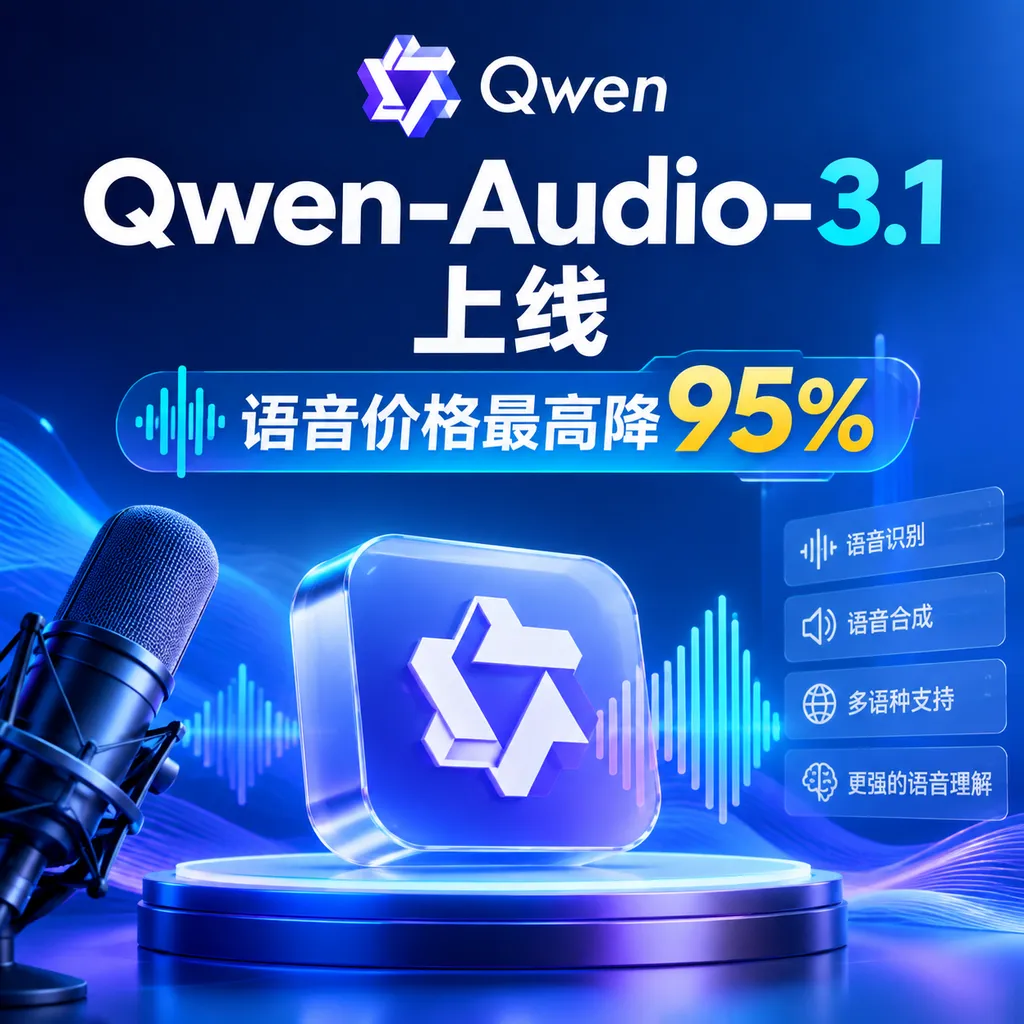
Qwen has released five speech models in the Qwen-Audio-3.1 series, covering recognition, synthesis, real-time interaction, audio creation, and understanding. Prices have also been significantly reduced: TTS by approximately 70%, Realtime by approximately 85%, and ASR by up to 95%.
Qwen-Audio-3.1 Goes Live, Cutting Voice Prices by Up to 95%
On September 23, Alibaba’s Qwen officially released the Qwen-Audio-3.1 series of large speech models, launching five models at once to cover speech recognition, speech synthesis, real-time voice interaction, audio creation, and audio understanding.
More noteworthy to developers than the model upgrades themselves is the pricing: Qwen announced synchronized price cuts across its entire Qwen-Audio speech model lineup, with TTS prices falling by approximately 70%, Realtime by approximately 85%, and ASR by as much as 95%.
This is not an ordinary version iteration. For voice customer service, meeting transcription, AI companionship, smart hardware, and voice agents, model capabilities determine “whether it can be used,” while pricing determines “whether it can be scaled.” With this release, Qwen-Audio advances both aspects simultaneously, with a clear goal: to turn voice from a premium capability that requires careful cost management into the default interaction interface for agents and end-user products.
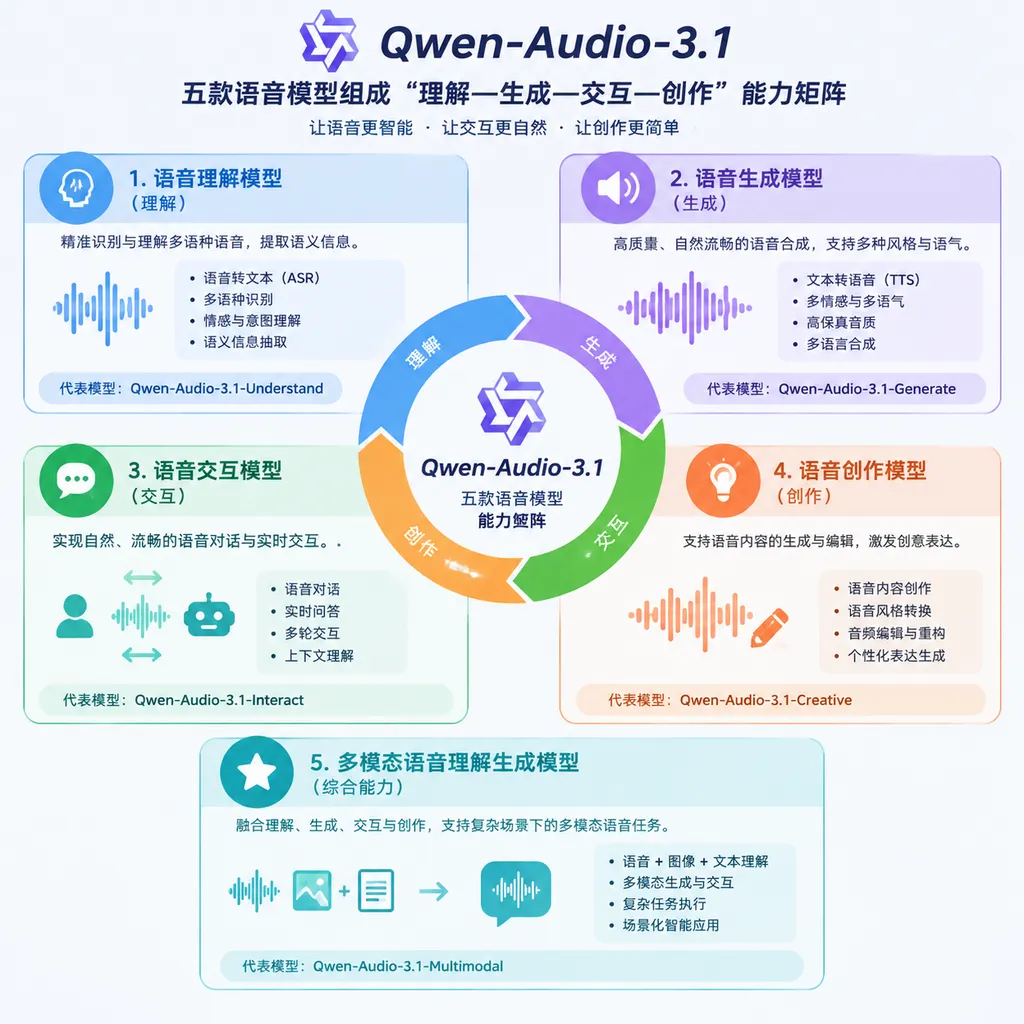
Five Models Released Simultaneously as Qwen Begins Filling Out Its Audio Capability Stack
The Qwen-Audio-3.1 series includes:
- Qwen-Audio-3.1-ASR: A speech recognition model focused on enhancing multilingual support, Chinese dialect recognition, contextual understanding, speaker-attributed transcription, and transcription polishing.
- Qwen-Audio-3.1-TTS: A text-to-speech model for converting text into natural-sounding speech.
- Qwen-Audio-3.1-Realtime: A real-time voice interaction model designed for voice agents, smart assistants, and real-time conversation scenarios.
- Qwen-Audio-3.1-TTS-Next: An entirely new audio creation model for more complex speech and audio generation needs.
- Qwen-Audio-3.1-ASR-Next: An entirely new audio understanding model whose purpose is not merely to “convert speech into text,” but to extract more complex information from audio.
In the past, voice products were often divided into several isolated modules: ASR handled listening, TTS handled speaking, and a large language model handled understanding in between. Developers had to handle streaming transcription, context assembly, speaker identification, interruption control, and speech synthesis themselves, with the final result highly dependent on their engineering integration capabilities.
Qwen-Audio-3.1’s product roadmap looks more like an effort to build a complete audio infrastructure. The models no longer handle only “voice input” or “voice output,” but attempt to cover the full pipeline, from understanding to generation, from single-turn processing to real-time interaction, and from information extraction to audio creation.
For developers, the practical significance is that building a voice agent in the future may no longer require procuring multiple speech services with inconsistent capabilities and then spending substantial time resolving issues involving interfaces, latency, and context alignment. Of course, whether the five models can truly deliver a unified experience remains to be seen. Public information is currently insufficient to draw conclusions about their actual API formats, concurrency limits, and long-audio stability.
ASR Upgrade Focus: From “Transcription” to “Organized Records”
The upgrade direction of Qwen-Audio-3.1-ASR is relatively clear: it is not satisfied with simply recognizing every word, but attempts to directly produce results better suited for reading, retrieval, and analysis.
1. Native Transcription Polishing to Reduce Post-Processing Costs
Traditional ASR output usually retains many traces of spoken language, such as “um,” “then,” and “basically,” while also containing repetition, self-corrections, and fragmented sentences. For subtitles, meeting minutes, and customer-service quality inspection, developers still need to add another layer of text cleaning and semantic restructuring.
Qwen-Audio-3.1-ASR adds native transcription-polishing capabilities. It can automatically remove filler words and repeated expressions, while semantically restructuring sentences so that the final text more closely resembles written language.
This capability may appear less eye-catching than recognition accuracy, but it is highly practical in real-world applications. Many products ultimately deliver not a “verbatim transcript,” but meeting minutes, ticket summaries, interview transcripts, or quality-inspection reports. If the model can complete part of this organization during the ASR stage, there may be opportunities to reduce both the number of large language model calls and prompt complexity downstream.
It is important to note that transcription polishing does not mean the output can be trusted unconditionally. In scenarios such as legal evidence collection, medical records, and financial compliance, there is a conflict between verbatim fidelity and readability. Developers still need to choose between raw transcription, polished transcription, or dual-track output based on their business needs, rather than simply interpreting “smoother” as “more accurate.”
2. Speaker-Attributed Transcription Focused on Multi-Party Conversations
Qwen-Audio-3.1-ASR supports the joint output of speaker labels, timestamps, and text. In other words, the system must answer not only “what was said,” but also try to identify “who said what and when.”
According to the official introduction, the model can handle turn-taking while retaining short interjections and overlapping speech. This is critical for meetings, interviews, sales calls, and customer-service quality inspection.
Multi-speaker transcription in the past commonly suffered from two problems: unstable speaker switching and the simple loss of overlapping speech. The former can lead to role confusion throughout an entire set of meeting minutes, while the latter may cause key rebuttals, interjections, and confirmations to disappear. Qwen-Audio-3.1-ASR processes speakers, timestamps, and text in an end-to-end workflow. In principle, this makes it easier to preserve structural consistency than the approach of “transcribe first, then perform separate speaker separation.”
For developers, what is truly worth watching is whether the output format is sufficiently structured. If the results can consistently provide speaker IDs, start and end times, confidence scores, and text segments, they will be easier to integrate with databases, search systems, and workflow engines. If the final output is still merely a concatenated block of text, the engineering benefits will be significantly reduced.
3. Continued Expansion of Multilingual and Dialect Coverage
Qwen-Audio-3.1-ASR supports 30 languages and 16 Chinese dialects, targeting scenarios such as multilingual communication, cross-regional customer service, and dialect content processing.
In Chinese voice products, Mandarin recognition is usually no longer the most difficult problem. What truly affects deployment is accent, dialect, industry terminology, and mixed-language speech. If a customer-service system can handle only standard Mandarin, its coverage will be directly limited to a relatively ideal user population.
According to the officially published test results, Qwen-Audio-3.1-ASR achieved an average character error rate of 4.55% across 11 subsets of KeSpeech and WSYue, obtaining the best result on 6 of those subsets. In Qwen’s internally developed tests covering 16 Chinese dialects, the model achieved the best results on 11 dialect subsets.
Character error rate, or CER, is better when lower. However, some room for judgment is still necessary: public evaluation results cannot fully replace performance in real business environments. Telephone-line noise, far-field recording, simultaneous speech, background music, and industry terminology can all create a gap between online performance and public datasets. When selecting a model, developers should ideally use their own datasets as the final benchmark rather than looking only at leaderboard figures.
4. Long Context and Hotword Mechanisms Target Industry Applications
Qwen-Audio-3.1-ASR supports the recognition of industry terms, specialized entities, and tiered hotwords. It can also refer to historical context from long audio, helping names, abbreviations, and technical terms remain consistent throughout lengthy content.
This is a key step in the transition of speech models from “general-purpose capability” to “business-ready capability.”
For example, in the medical field, the same drug name may appear more than a dozen times in a one-hour consultation recording. In an R&D meeting, an internal project codename may have no supporting public training data. In financial or legal scenarios, misspelled names of individuals or institutions and incorrectly transcribed contract clauses can create downstream risks. Simply improving general-purpose recognition accuracy cannot solve these problems; hotwords and contextual mechanisms are more direct engineering tools.
At the same time, hotwords should not be understood as simple “forced corrections.” If configured improperly, the model may over-map similar pronunciations to a particular hotword, creating new errors. A more appropriate approach is to give hotword configurations adjustable weights, priorities, and scenario-level isolation, while retaining the original audio and raw transcription for traceability when disputes arise.
First-Character Response of Approximately 160 Milliseconds: Realtime Enters a Cost-Sensitive Phase
Real-time voice interaction is another particularly notable part of this update.
Officially, Qwen-Audio-3.1-ASR supports low-latency streaming recognition, with a first-character response time of approximately 160 milliseconds. It can transcribe and output text as the user speaks. For voice agents, 160 milliseconds does not equal the latency of a complete conversation, but it at least indicates that the model has been specifically optimized to “provide feedback as quickly as possible.”
Voice interaction typically has three latency points:
- How long after the user speaks before the system starts returning recognition results;
- How long it takes the large language model to begin generating a response;
- How long it takes speech synthesis to begin playback, and whether it can continue outputting during generation.
If any one of these stages is too slow, users will feel that the assistant “didn’t hear them” or is “slow to respond.” Therefore, the value of a Realtime model lies not only in combining speech recognition and speech synthesis, but also in reducing the waiting, transcoding, and context-transfer overhead between modules.
Qwen has already deployed Qwen-Audio-3.1-Realtime in agents such as Qoder and Qwen Office, as well as smart hardware including QwenNote, A2, Eva, Qwen AI Glasses, and Leqi AI Glasses. The direction revealed by these public examples is that voice interaction is evolving from a button on a phone into an interface capable of continuous listening, follow-up questioning, and ongoing task execution.
However, these scenarios are highly cost-sensitive. Real-time voice requires maintaining a connection for extended periods. A single user call may last several minutes, while smart hardware may even run continuously every day. If the per-minute invocation cost is high, a product can easily shift from having a “good user experience” to being “impossible to scale.” Therefore, the approximately 85% price reduction for Realtime may be more directly meaningful to developers than a one-time price cut for text generation.
The Focus of the Price War Is Not Simply “Cheaper,” but Making Voice Part of the Default Architecture
Qwen-Audio-3.1’s price reductions are substantial:
- TTS: approximately 70% lower;
- Realtime: approximately 85% lower;
- ASR: up to 95% lower.
ASR has seen the most aggressive reduction. This is because speech recognition is often the entry point for an entire voice application. Meetings, customer service, content moderation, video subtitles, and voice search all require large numbers of calls. If ASR costs can be significantly reduced, developers will find it easier to adopt an architecture of “transcribe everything first, then perform subsequent analysis.”
The Realtime price cut will directly affect the business models of voice agents. In the past, many teams placed real-time voice capabilities later on their product roadmaps—not because they were technically impossible, but because they were concerned that concurrency, persistent connections, and ongoing conversations would make costs uncontrollable. Following the price reduction, products such as voice customer service, sales coaching, educational companionship, and in-vehicle assistants will have greater opportunities for large-scale gradual rollout.
However, price reductions also introduce another issue: developers will integrate voice into their products more quickly, while the stability, rate-limiting policies, SLAs, peak concurrency, and regional availability of model providers will become even more important. For production systems, it is not enough to compare prices per million characters or per minute. The costs of failed-request retries, backup models, audio storage, transcoding, and post-processing must all be included.
In other words, Qwen-Audio-3.1’s pricing changes will lower the barrier to “trying voice,” but they will not automatically solve the problem of “turning voice into a reliable product.”
Compared with the Previous Generation, the Upgrade Focus Shifts from Individual Metrics to System Capabilities
From a product portfolio perspective, Qwen-Audio-3.1 is not focused solely on achieving the best benchmark score in ASR, TTS, or Realtime. Instead, it is reorganizing the product boundaries of speech models.
In the previous stage, competition focused more on questions such as “whose recognition rate is lower,” “whose synthesized voice sounds more natural,” and “whose real-time latency is lower.” At this stage, what developers are beginning to care about is:
- Whether context can remain consistent across long audio;
- Whether multiple speakers can be distinguished and output in a searchable structure;
- Whether dialects, industry terminology, and complex noise can be handled;
- Whether interruptions and follow-up questions can be handled during real-time conversations;
- Whether voice creation and audio understanding can be incorporated into the same application workflow;
- Whether millions of calls can be supported at a sufficiently low cost.
The five Qwen-Audio-3.1 models correspond to different parts of these needs. This does not necessarily mean that Qwen is already leading in every dimension, but it at least indicates that competition among speech models has moved from “build a stronger ASR model” to “provide a complete set of audio infrastructure.”
What Developers Should Pay Attention to Now
For teams preparing to use Qwen-Audio-3.1, it is recommended to validate the following items first rather than focusing only on individual metrics in the official promotional materials.
First, Test Real Audio Rather Than Only Clean Recordings
Prepare a test set containing far-field recordings, telephone compression, background noise, multi-speaker interruptions, and dialects. In particular, real-world data from meeting and customer-service scenarios is often much more complex than public datasets.
Second, Verify the Stability of Structured Output
Speaker-attributed transcription, timestamps, and speaker labels are valuable only when the output is stable. Observe whether repeated calls using the same audio produce speaker drift, timestamp misalignment, or loss of overlapping speech.
Third, Distinguish between “Recognition Accuracy” and “Polishing Accuracy”
Transcription polishing makes text smoother, but it may also alter the original wording. For compliance-related scenarios, it is recommended to retain both the original verbatim transcript and the polished version rather than storing only the latter.
Fourth, Recalculate the Full-Path Cost of Real-Time Voice
A reduction in Realtime’s unit price does not mean that total costs will fall by the same proportion. Developers must also calculate expenses related to audio encoding, persistent connections, context messages, model responses, TTS playback, and failed-request retries.
Fifth, Preserve Interface Abstraction for Provider Switching
The prices and capabilities of speech models are changing rapidly. Regardless of whether the final choice is Qwen, another Chinese model, or an overseas service, the application layer should decouple ASR, TTS, dialogue orchestration, and audio storage to avoid tying business logic to private fields belonging to a single model.
At present, the relevant Qwen-Audio-3.1 APIs are being rolled out on the Qwen platform, while public information indicates that ASR-Next will continue to be launched gradually. For teams already working on voice agents or audio content processing, the most worthwhile step today is not to immediately migrate all production traffic, but to use their own data for a round of comparisons covering cost, latency, and error types.
Assessment: The Real Variable in This Update Is Pricing, Not “A Few More Models”
The technical upgrades in Qwen-Audio-3.1 are not difficult to understand: better recognition, improved context handling, broader dialect coverage, and new models for creation and understanding. What truly changes market expectations is the simultaneous arrival of these capabilities and a major price reduction.
A 95% reduction in ASR prices will encourage more products to process long audio; an 85% reduction in Realtime prices will help real-time voice agents evolve from demo features into continuously available services; and a 70% reduction in TTS prices will lower the ongoing operating costs of education, content generation, and smart hardware.
For developers, the core question surrounding voice is shifting from “Can the model understand speech?” to “Is the product worth using continuously?” Qwen-Audio-3.1’s answer is: continue filling out model capabilities, cut prices first, and then expand usage through smart hardware and agent scenarios.
This is a typical platformization strategy. It may not immediately change the technology choices of every voice application, but it will increase pricing pressure across the market. Going forward, competition among speech models will not focus only on accuracy and naturalness. It will also depend on who can provide lower unit costs, a more stable real-time experience, and a more complete audio toolchain.
If this trend continues, voice may no longer be a feature that applications need to purchase separately. Like text models, it may become a foundational capability for agents and smart terminals. What Qwen-Audio-3.1 has done this time is lower the barrier to using this infrastructure another step.
References
- ITHome: Alibaba’s Qwen Releases the Qwen-Audio-3.1 Series of Large Speech Models and Cuts Prices Across Its Product Line: Introduces the release of the five models, ASR’s core capabilities, evaluation results, and the price reductions across the product line.