Gemini 4 Enters Post-Training, May Be Released Ahead of Schedule

Google has confirmed that Gemini 4 has entered the early stages of post-training and hopes to launch it well before the end of the year. More noteworthy than the release date is that Google is shifting its flagship model toward a product cadence of rapid releases and continuous iteration.
Google’s next-generation flagship model, Gemini 4, has entered the early stages of post-training, and its release may come earlier than the end-of-year timeline previously expected by the public.
On September 23 local time, at The Information’s AI Agenda Live summit, Google executive Koray Kavukcuoglu, who oversees the Gemini models, frontier research, and related products, revealed that the team had begun work on Gemini 4’s post-training, safety safeguards, and evaluation. He said the team hoped to release the model “well before the end of the year.”
This is Google’s clearest statement to date on Gemini 4’s delivery progress. In July, Google had publicly confirmed only that “pretraining has begun.” Two months later, the project has entered post-training, indicating that the team has obtained at least a base checkpoint suitable for fine-tuning, evaluation, and internal product testing.
However, “entering post-training” does not mean “launching next week.” As of September 24, Google had not announced Gemini 4’s exact release date, model lineup, API model ID, pricing, context window, or public testing plans. Developers also cannot yet access it through the Gemini API, Google AI Studio, or Vertex AI.
Post-Training Is Not the Final Step; It Determines Whether the Model Is Usable
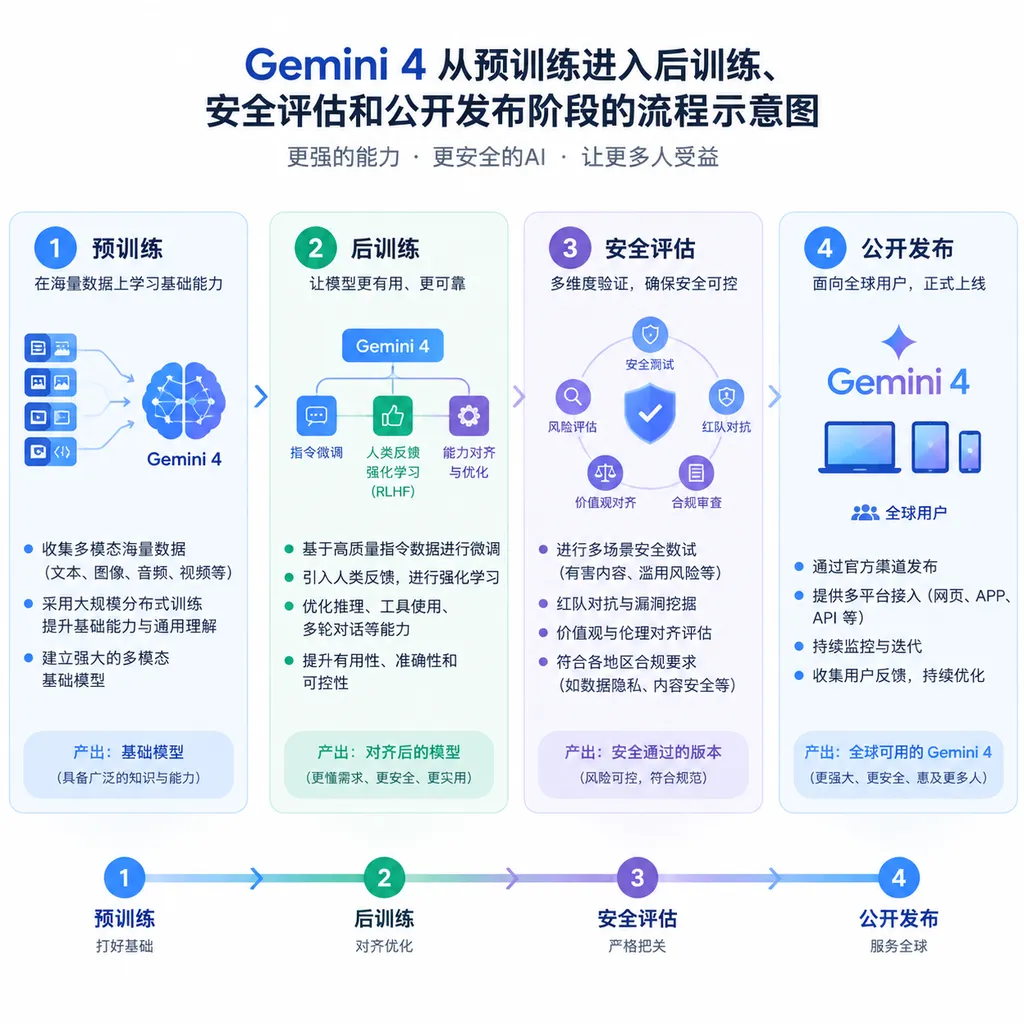
Large-model development can broadly be divided into two stages: pretraining establishes capabilities, while post-training shapes behavior.
During pretraining, a model learns knowledge and patterns from vast quantities of text, code, images, and other data, forming a general-purpose base model. It is like building a high-horsepower engine—but the engine may not be stable, may not know how to respond to users, and cannot guarantee that it will avoid dangerous actions when calling tools.
Post-training is intended to solve precisely these problems. It typically involves supervised fine-tuning, preference optimization, reinforcement learning, tool-use training, safety alignment, red-team testing, and specialized enhancements for coding, mathematics, and agentic tasks. For a flagship model such as Gemini 4, post-training must also cover complex scenarios involving multimodal inputs, long contexts, search, and access to external tools.
Therefore, Gemini 4’s entry into post-training sends at least three signals:
- The main pretraining run has most likely produced a usable checkpoint. The team is no longer merely expanding its investment in data and computing resources; it can now observe the model’s actual behavior.
- The model is beginning to transition from a research project into a product candidate. Internal teams can conduct validation in environments that more closely resemble real-world use, focusing on code generation, browser operation, tool use, and safety boundaries.
- The release date depends on reliability, not just capability ceilings. If the model achieves high benchmark scores but frequently loses control during tool use, has unstable refusal policies, or incurs unacceptable inference costs, its release could still be delayed.
Kavukcuoglu said Google plans to deliver early results from the post-training stage as soon as possible because the team has already seen encouraging outcomes, after which it will continue iterating quickly. This statement is more significant than a vague release date: Google may no longer wait until every capability has been fully polished before releasing the model. Instead, it may first launch a version that meets the product threshold, then continue updating it through preview versions, stable releases, and minor revisions.
This approach is closer to the common delivery model for frontier models today. A model release is no longer “finished” in the traditional software sense; it is the deployment of a checkpoint into real-world traffic, followed by continued training based on failure cases.
“Well Before the End of the Year” Is Not an Official Release Date
This news should be viewed with some caution.
Kavukcuoglu was expressing the team’s goal, not announcing a locked product schedule. “Well before the end of the year” could mean that Google hopes to deliver Gemini 4 in November or even earlier. But until the company provides a specific date, there is no basis for directly stating that it will launch in October or November.
Many variables could still affect the release date:
- Whether safety testing uncovers new jailbreaks or high-risk tool-use issues;
- Whether coding and agentic capabilities are stable enough on real-world tasks;
- Whether inference latency, throughput, and per-token costs can support a public API;
- Whether Gemini, AI Studio, and Vertex AI will need to launch in stages;
- Whether different variants, such as Pro and Flash, will be released simultaneously.
Google’s release record over the past several months also means this timeline commitment should be treated cautiously. In May this year, Google CEO Sundar Pichai announced that Gemini 3.5 Pro would launch in June, but the model ultimately did not appear as scheduled. Kavukcuoglu explained this time that after the release of Gemini 3 and Gemini 3.1, Google “took a slight step back” and redirected resources toward smaller, faster, and less expensive Flash models in order to accelerate learning.
Google has not explicitly announced the cancellation of Gemini 3.5 Pro, but its current product focus is already clear: rather than continuing to complete a flagship model in the 3.x series, it would rather commit its resources directly to Gemini 4.
This is not simply a skipped model number; it is a shift in strategy.
Why Google Is Eager to Push Out Gemini 4
The pressure is coming primarily from two directions: coding and agents.
In the latest round of model competition, simply improving chat quality has become increasingly difficult as a source of sustained advantage. The tasks developers are increasingly willing to pay for are concentrated around understanding code repositories, making cross-file changes, operating terminals, controlling browsers, retrieving information, and planning long-running tasks. Models are no longer merely answering questions; they must call tools continuously and make judgments about intermediate results.
The difficulty with these tasks is not whether a model can generate an answer that looks correct. It is whether the model can maintain its objective after dozens of operations, know how to recover when an error occurs, and avoid taking high-risk actions without authorization.
OpenAI and Anthropic are both accelerating their work on coding agents and general-purpose agents. Google has Search, Chrome, Android, Workspace, Cloud, and a vast developer ecosystem, making it theoretically better positioned than any competitor to build agents. But if its base model falls behind in planning, coding, and tool use, these product entry points will be difficult to convert into an advantage.
Gemini 4’s task is to make up this shortfall.
Google engineers are currently using Gemini 4 internally to run the Antigravity AI coding tool. This type of internal testing is more valuable than static benchmarks: coding agents directly expose problems in repository retrieval, dependency understanding, patch generation, test repair, and multi-step operation. A single HumanEval or SWE-style score can measure one aspect of capability, but it cannot fully answer whether a model is suitable for real development workflows.
If Gemini 4 can operate reliably in internal coding tools, that would mean it is one step closer to commercialization. However, “being used in internal tools” still does not mean that the public version is complete, nor can it be used to infer API pricing or context specifications.
Rapid Iteration Matters More Than Launch-Day Benchmark Scores
Kavukcuoglu also offered a highly representative assessment: rather than debating whether the industry has already achieved AGI, it is more important to discuss whether we can build trustworthy agents.
This effectively sets Gemini 4 a goal more difficult than topping a leaderboard.
A model leading in mathematics, coding, or knowledge tests is not necessarily capable of reliably operating email, modifying production code, or calling a payment interface. Once agents enter real systems, the cost of errors is amplified: a hallucination in an ordinary chat may simply produce an inaccurate answer, whereas a hallucination by an agent could result in an incorrect commit, accidental file deletion, or an unauthorized external action.
Therefore, Gemini 4 should not be evaluated solely by the scores presented at its launch event. The following areas will also matter:
- Tool-call success rate: Are parameters correct, and can the model retry or take an alternative path after failure?
- Long-task stability: Does it remain aligned with its objective after dozens of steps?
- Coding ability: Can it understand an entire repository rather than merely autocomplete individual functions?
- Latency and cost: If inference is highly capable but each task takes several minutes, its commercial value will decline significantly.
- Controllability: Does it request confirmation before high-risk operations, and are its permission boundaries clear?
- API consistency: After a preview update, do prompts, tool-call structures, and output behavior change frequently?
The last point is especially practical for development teams. A 10% improvement in model capability may not be worthwhile if it results in extensive regression testing and workflow rewrites. If Google plans to “release early results and then iterate quickly,” it must also address model version management and prevent developers from building production systems on preview endpoints whose behavior continually drifts.
Developers Do Not Need to Wait, but They Should Prepare Evaluation Sets in Advance
At this stage, the most sensible approach is not to suspend projects while waiting for Gemini 4. Instead, continue using models that are already available while establishing your own evaluation baseline.
It is advisable to prepare three types of tasks in advance:
- Extract code-fixing, structured-extraction, search-and-summarization, and tool-use cases from real business scenarios;
- Record the current model’s success rate, time to first token, total task duration, and average cost;
- For agents involving external operations, implement human confirmation, least-privilege access, and rollback mechanisms.
Once Gemini 4 is released, use the same data to compare it horizontally with existing GPT, Claude, Gemini 3.x, and other models. Do not focus only on the aggregate leaderboards published by vendors, and do not assume that a “next-generation” model will be better at every task. Flagship models are often strong at complex reasoning, while Flash-class models may still be cheaper and faster for simple, high-concurrency tasks.
Because Google has not yet announced Gemini 4’s API endpoint or model ID, there is currently no reliable calling code to write. Any example claiming that users can directly request gemini-4-pro or a similar name is merely a naming guess, not an official interface. Once Google officially opens the API, OpenAI-compatible aggregation platforms such as OpenAI Hub are also expected to integrate it. At that point, migration and unified evaluation will be more practical.
Gemini 4 Is Accelerating, but the Real Test Is Delivery
From confirming the start of pretraining in July to entering post-training in September, Gemini 4’s development pace is indeed fast. Google has even begun proactively signaling that users may not have to wait until the end of the year, suggesting that the company has at least some confidence in its early results.
But what Google most needs to prove now is not that it can train another high-scoring model. It must show that it can deliver the model to users reliably and as promised. The absence of Gemini 3.5 Pro has already eroded trust once. If Gemini 4 again arrives only as an announcement without a clear API, pricing, and product schedule, then “rapid iteration” will remain merely a slogan.
Our assessment is that the probability of Gemini 4 appearing before the end of the year has clearly increased, and that the first version may arrive earlier than the market originally expected. However, it is more likely to launch as a preview or through a phased rollout than to become fully available across the consumer app, developer API, and cloud platform on the same day.
For developers, the things truly worth waiting for are not another model name but three concrete deliverables: an accessible API, acceptable pricing, and reproducibly stable performance on coding and agentic tasks.
Sources
- IT之家: Google Confirms That Its Next-Generation Flagship Model Gemini 4 Is Coming and May Not Require Waiting Until the End of the Year — Summarizes remarks made at the AI Agenda Live summit, including Gemini 4’s post-training progress, release target, safety testing, and use in internal coding tools.