Noin GLOW: Teaching robots to generalize from one example
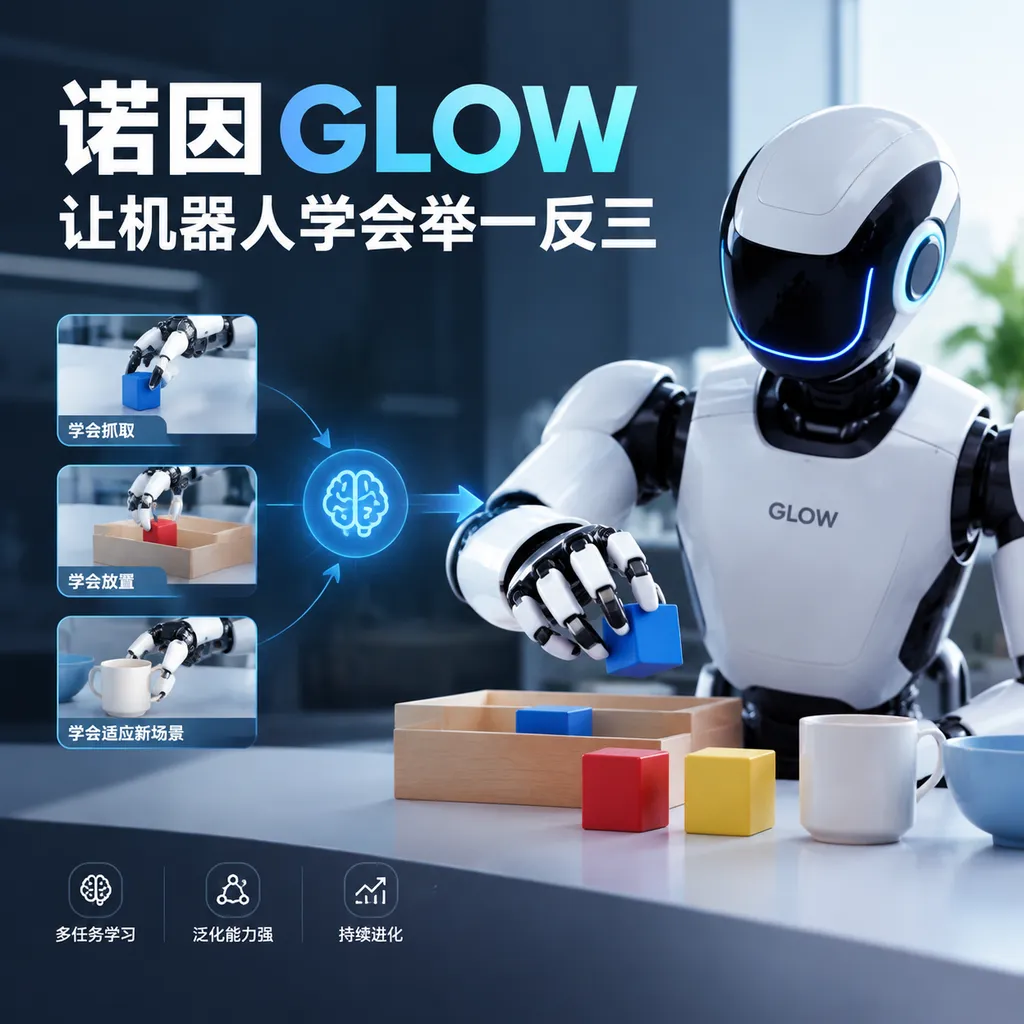
Noein recently released the GLOW technical report, proposing a method that enables robots to transfer a task to different environments, objects, and execution conditions after just one human demonstration. Rather than pursuing more polished one-off demonstrations, it aims to reduce the repetitive teaching costs involved in robot deployment.
Can One Demonstration Really Be Reused in a Different Place?
Noyin recently released its GLOW technical report. Its core conclusion is that robots do not need to relearn every time they enter a new environment: after a single human demonstration of a task, the same task can be reused across different scenarios.
This may sound like “a robot can do something after watching it once,” but the technical focus is not on copying the demonstrated motions exactly. Instead, it is on enabling the robot to recognize the structure behind the task: what the goal is, which steps are essential, which actions must remain unchanged, and which actions can be replanned according to changes in the environment.
For example, suppose a human demonstrates “pick up a cup and place it on a tray.” Traditional imitation learning often interprets the demonstration as a sequence of actions tied to specific coordinates: the hand reaches out from here, moves along this trajectory, grasps the cup at a certain position, then moves to another position and releases it. Change the table height or the cup’s location—or even replace the cup with a container of a different shape—and the behavior may fail.
What GLOW attempts to learn is information at a different level: locate the target object, approach it, complete the grasp, avoid obstacles, and place the object in the designated area. As for the specific path taken by the arm, whether the body needs to adjust its stance, and how the grasping point should change, the system can regenerate these elements based on the current scene.
This is also the difference between “cross-scenario reuse” and “motion replay.” The former requires the robot to understand the task; the latter merely replays a trajectory.
GLOW Addresses the Deployment Costs of Embodied Intelligence
Over the past few years, demonstrations of embodied-intelligence models have become increasingly complex. Robots can fold clothes, carry water, and open doors, as well as complete multistep tasks in response to language instructions. But once they move from laboratories into warehouses, factories, and homes, the question quickly changes from “Can they do it?” to “Can they still do it somewhere else?”
A major engineering gap lies between these two questions.
In a fixed environment, a robot can learn how to operate a particular piece of equipment, table, or material through extensive data collection and fine-tuning. In real-world deployment, however, changes are almost inevitable: the position of a shelf may be adjusted, an object may be occluded, the lighting may change, obstacles may appear on the floor, the robot arm may start from a different pose, or the robot may even be replaced with a different platform.
If every variation requires a new demonstration, robot systems will be difficult to scale. What companies purchase is no longer a “robot that can perform tasks,” but an automation workforce that requires continuous human maintenance.
GLOW’s value lies in its attempt to upgrade demonstration from “teaching coordinates” to “teaching tasks.” A single demonstration provides the task intent and motion priors, after which the system generates an execution plan suited to the current conditions using visual information, spatial relationships, and the robot’s own state in the new environment.
For developers, this may mean that the unit of data changes. In the past, a training sample often corresponded to “a particular robot performing a particular action in a particular environment.” A more ideal system would decompose the data into several layers:
- Task goal: What does the robot ultimately need to accomplish?
- Key constraints: Which outcomes must be satisfied, and which object relationships must not be disrupted?
- Action strategy: How should the task be completed in the current environment?
- Execution control: How does the robot translate the strategy into continuous actions?
- Feedback correction: How can the robot recover after deviating from the intended behavior, rather than failing outright?
This layered approach is not unique to GLOW, but it represents an increasingly clear direction in embodied intelligence: high-level tasks should be transferable across environments, while low-level control must continuously adapt to reality.
“One Demonstration” Does Not Mean “Zero-Cost Learning”
The marketing language needs to be unpacked first.
When a robot can reuse a task across different scenarios after a single demonstration, this usually does not mean it has never encountered similar tasks before, nor does it mean it can succeed immediately in any new environment. More precisely, given that the model already possesses certain visual, spatial, and action priors, the demonstration can serve as a task condition that allows the system to quickly adapt to new environments and objects.
This is somewhat similar to in-context learning in large models. Given an example, a model may immediately understand the desired output format. But if the task itself exceeds the model’s capabilities or the input information is insufficient, a single example cannot create new capabilities out of nothing.
The same applies to robots. A single demonstration can tell the robot “what needs to be done this time,” but it may not tell it how to handle every abnormal situation: What if the cup is pinned down? What if the target location is occupied? Should it retry after a failed grasp? Should it wait if someone blocks the path?
Therefore, evaluating GLOW requires more than checking whether the robot has completed a single cross-scenario demonstration. Several more rigorous indicators must also be considered:
- Transfer range: Does the change in environment involve only moving the object, or does it also include changes in lighting, occlusion, table height, and obstacle layout?
- Task complexity: Is it a single-step grasp, or a long-horizon task involving search, movement, manipulation, and placement?
- Number of demonstrations: Does “one demonstration” mean one demonstration for each individual task, or can a single demonstration cover an entire class of tasks?
- Failure recovery: Can the robot correct itself autonomously after deviating from the intended behavior, or must a human take over?
- Cross-platform capability: Can the model transfer to different robot arms, humanoid robots, or mobile manipulation platforms?
- Real-world deployment performance: Beyond laboratory success rates, can the system remain stable after operating continuously for several hours or days?
These indicators will determine whether GLOW is merely a more capable imitation-learning system or a task-generalization framework with genuine deployment value.
The Technical Challenge: Robots Must Learn “Relationships,” Not Pixel-Level Motions
The hardest part of executing tasks across different environments is not recognizing a cup. It is understanding the relationships between the cup, the table, the hand, the tray, and the surrounding obstacles.
A vision model may determine that “there is a cup here,” but task execution also requires answers to several questions: Is the cup graspable? Which side is suitable for approaching it? Will the robot arm collide with the table? Is the tray stable during placement? Does the robot need to adjust its body position after grasping the cup?
This requires the system to process three types of information simultaneously.
The first is semantic information. The robot needs to understand the task object and the desired outcome, such as “place the red box on the second shelf.” This information usually comes from a vision-language model or a task-planning module.
The second is geometric information. The robot must estimate an object’s position, pose, scale, and reachable space. In language, “place it beside the other object” sounds simple. For a control system, however, “beside” may allow an error of only a few centimeters—or it may refer to a direction that causes a collision.
The third is dynamic state. The environment is not a static image. A person’s hand may move, an object may slide, and the robot itself may deviate from its expected behavior because of load, floor friction, or joint errors. The system must continuously correct its actions based on feedback.
Ideally, a system like GLOW would convert a demonstration into a composable task representation: preserving the structure of “pick up first, then move, and finally place,” while leaving the path and motion parameters to be recalculated during execution.
This is closer to general-purpose task learning than directly predicting a sequence of robot joint angles. The latter may be highly accurate within the training distribution, but once the environment changes, the model can easily produce behavior that appears reasonable while yielding a completely wrong result.
Its Relationship with VLA Models: Not a Replacement, but a Completion of the Deployment Process
Over the past two years, vision-language-action models, or VLAs, have become one of the mainstream technical approaches in embodied intelligence. They attempt to place images, language, and robot actions within a single model, allowing robots to generate the next action directly from an instruction.
But VLA models do not automatically solve every problem.
A model may understand “put the apple in the basket,” but that does not mean it can perform the task reliably with different robots, cameras, and workspaces. The model is responsible for reasoning and action generation, but real-world deployment also requires an entire system covering data collection, action alignment, control frequency, collision detection, state estimation, and exception recovery.
What makes GLOW particularly noteworthy is that it focuses on how a demonstration can become a transferable task condition. Rather than simply pursuing a larger action dataset, it attempts to answer a more fundamental question: How can task information that is independent of a specific environment be extracted from limited demonstrations and then applied in a new execution environment?
This also signals that embodied intelligence is shifting from a “model capability competition” toward a “system efficiency competition.”
In the future, the questions companies truly care about may not be a model’s highest score on a public dataset, but rather these: How many demonstrations are needed for a new task? How much adaptation is required when switching to another robot? Can the system recover automatically after an on-site failure? And as each new environment is added, does the deployment cost grow approximately linearly?
GLOW’s Advantages and Boundaries Compared with Other Industry Approaches
From an industry perspective, the approach represented by GLOW has at least three practical advantages.
First, it reduces per-scenario data collection. If the model can learn task relationships instead of memorizing fixed trajectories, a new environment may require only a small number of demonstrations—or merely an adjustment to the task conditions—thereby reducing the cost of data collection.
Second, it is better suited to long-tail tasks. Factories and warehouses contain large numbers of infrequent, nonstandardized tasks. Collecting hundreds of robot trajectories for every task is not cost-effective. A single demonstration combined with existing model priors may be better suited to these needs.
Third, it can be integrated more easily into human workflows. Human employees do not need to understand reinforcement learning, trajectory optimization, or robot coordinate systems. They only need to perform the desired operation once. If the teaching process is sufficiently natural, robot systems can enter real business workflows more quickly.
Its boundaries, however, are also clear.
First, task transferability depends on the new environment sharing a certain degree of similarity with the training distribution. Transferring “organize the desk” to another desk is not the same problem as transferring “organize the desk” to a complex outdoor environment.
Second, contact-rich tasks remain difficult. Tasks such as grasping, moving, and placing can be planned using visual and geometric information. Insertion, plugging and unplugging, twisting, flexible-object manipulation, and tasks requiring precise tactile feedback place higher demands on control accuracy and sensors.
Third, safety constraints cannot be solved automatically through demonstrations. Humans can use experience to judge when to stop, but robots require explicit collision detection, force control, and risk-management strategies. A system that generalizes without reliable safety boundaries may instead generalize erroneous actions to more scenarios.
Finally, cross-platform reuse remains a challenge. Different robots vary widely in their degrees of freedom, joint ranges, payloads, end effectors, and sensor configurations. The high-level goal of a task can be shared, but the low-level actions usually need to be remapped.
The Real Competition Will Shift from “Can It Do It?” to “Can It Keep Doing It?”
The timing of Noyin’s release of the GLOW technical report is also significant. The embodied-intelligence industry is shifting from isolated demonstrations toward deployment efficiency, and companies are beginning to recalculate the costs of teaching, data, and maintenance.
In the past, a robot completing a difficult action once was enough to make it the star of a product launch. Today, the persuasive power of such demonstrations is declining. Companies increasingly want to know whether a robot can work continuously, handle environmental changes, recover after task failures, and serve multiple production lines with a single model.
From this perspective, “cross-scenario reuse after a single demonstration” is an appealing goal because it directly addresses a central commercialization conflict: real-world robot data is expensive, while real-world tasks are endlessly variable.
But whether GLOW can ultimately become a competitive technology will depend on evidence beyond the technical report. This includes whether public evaluations cover a sufficiently broad range of scenarios, whether success rates are based on long-duration continuous operation, whether different robot platforms are supported, whether external developers can reproduce the results, and how the system performs on failure cases.
If these questions can be answered, GLOW’s significance will be more than the introduction of another robot action-generation method. It will offer a more product-oriented answer to the question of “how to teach robots”: humans provide a single task demonstration, the model understands the task structure, the planner adapts it to the environment, and the controller executes the actions safely.
This approach does not mean that robots will soon be able to learn every skill like humans. It is more realistic—and more valuable. It first seeks to remove part of the repeated-teaching burden from the deployment process and raise the unit of robot learning from “an individual action” to “a class of tasks.”
For developers, the question worth watching next is not whether GLOW can complete one cross-scenario operation in a particular video, but whether it can close the loop between demonstration, planning, execution, and feedback. Only when a robot can begin with a single demonstration, adjust itself autonomously in a new environment, and continue converting execution results into training data for the next iteration will embodied intelligence truly have the foundation for large-scale improvement.
For now, Noyin’s GLOW report has at least placed the question in the right position: the robotics industry does not need more isolated action demonstrations, but rather task-learning systems that are lower-cost, more transferable, and capable of operating over the long term.
References
- Zhihu: An Interpretation of the RoboBrain 2.0 Technical Report: Used to supplement industry background on embodied vision-language models, task planning, and cross-scenario evaluation.
- Zhihu: Technical Discussions Related to Embodied Intelligence: Used to search for Noyin’s GLOW technical report and related public discussions.