Meta Brings Game Development to Mobile Phones
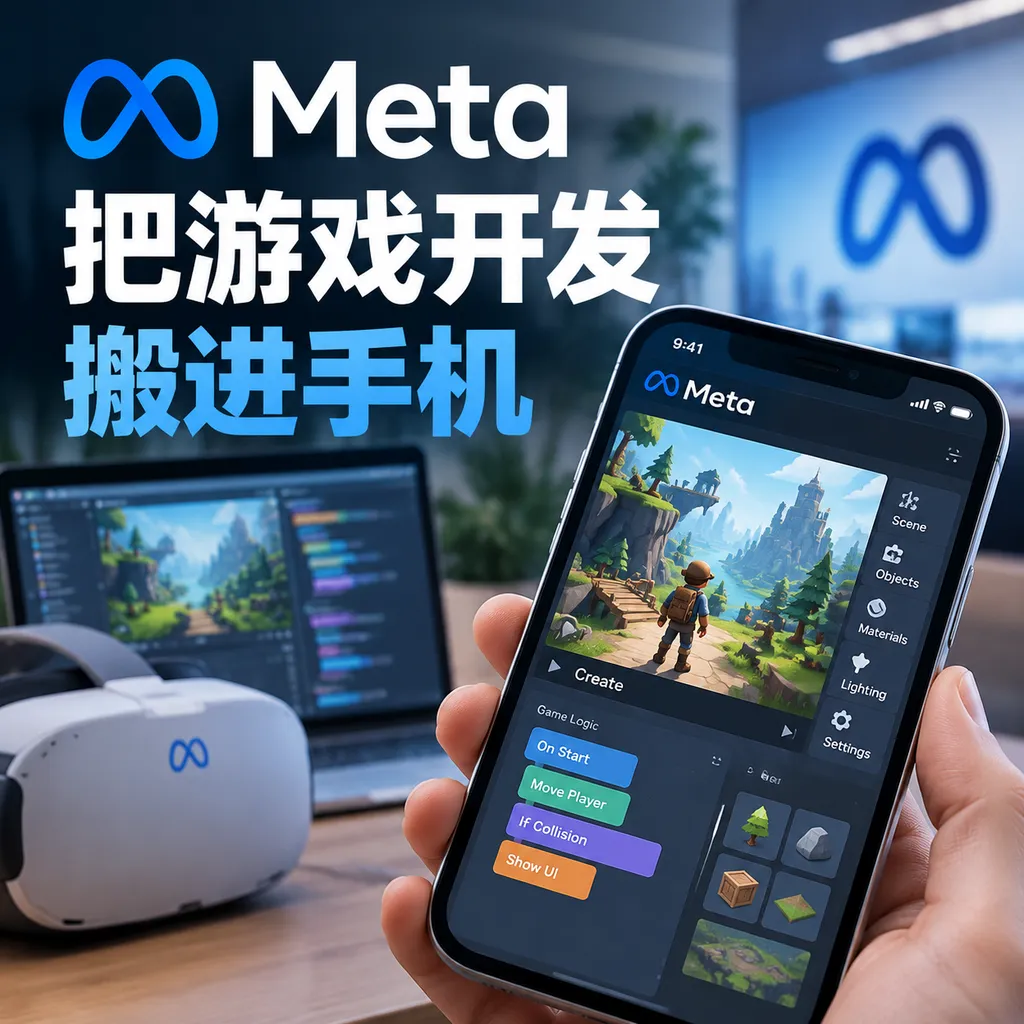
At Connect, Meta unveiled Horizon Create and Horizon Studio, aiming to enable natural-language generation and editing of 2D and 3D mobile games, with distribution through Facebook and Instagram. The tools remain in early access, and their output quality, creator rights, and actual reach have yet to be validated.
Meta Introduces Two AI Game Creation Tools, Dividing Work Between Mobile and Web
At its Connect conference on September 24, Meta announced Horizon Create and Horizon Studio. The former is a mobile app that lets users generate games from text prompts or templates; the latter runs in a browser and provides more detailed editing and project management capabilities. Meta says both tools are powered by the intelligent creation capabilities of the Meta Horizon Engine, helping users make 2D or 3D mobile games while continuing to adjust progression systems, difficulty, art direction, and multiplayer features.
The products are currently being rolled out gradually as an early-access experience, and Meta has not announced an official launch date. Interested creators can join the waitlist and wait for testing access. In other words, what has been announced so far is a product direction and a commitment to distribution. It will still take a period of product validation before anyone can reliably turn an idea into a finished game.

From Prompts to Playable Prototypes, the Key Is More Than Generating Visuals
Horizon Create is aimed at the starting point of the creative process. Users can describe the game they want to make on their phones, or choose a template and then request changes in natural language, such as switching the art style, adjusting the characters, or changing the progression design. Meta says users can leave the app and do other things while a project is being generated, then receive a notification when it is complete. When they have multiple ideas, they can also work on several projects simultaneously.
“Generating a game” should not be understood simply as having AI draw a background image or assemble an animated character. Meta’s stated goal includes a complete playable structure: how players progress, how difficulty changes, how content is presented, and whether multiplayer interaction is supported. For these elements to work together, the tool needs more than asset generation. It must organize assets, rules, and interactions into an experience that actually runs.
This also explains why Meta built the tools on top of the Horizon Engine. For creators, the most valuable result is not a demo that merely looks like a game, but a project that can be played, further modified, and eventually published. However, the publicly available information is not yet sufficient to determine how much the generation process can actually handle: whether complex mechanics can be implemented as described, whether the generated results are stable, and whether users can easily locate and fix problems will all require hands-on testing.
Create Gets Projects Started, While Studio Polishes Them
The division of responsibilities between the two tools is relatively clear. Create puts the entry point on mobile, making it suitable for capturing ideas, quickly producing prototypes, and iterating through descriptions. Studio moves creation into the browser, targeting users who need more granular control and want to manage their projects in one place. Meta says projects can be transferred between the two environments, allowing creators to begin on mobile and continue working on the web.
This design addresses a common tension in AI creative products: natural language can lower the barrier to getting started, but the further users progress, the more they need explicit control. A prompt can express “make the level more difficult,” but may not specify exactly which section needs adjustment or whether the change will break other parts of the game. The value of a browser-based editor, therefore, is not simply that it provides a larger input box. It gives creators the opportunity to move from “describing intent” to “inspecting and modifying the result.”
At this stage, however, what can be confirmed publicly is mainly the product positioning and cross-platform project transfer. Public materials have not provided a sufficiently complete account of specific editing capabilities, whether scripts or parameters can be modified directly, or whether version history is supported. The mere use of the label “AI creation” should not lead anyone to assume that the tools already cover debugging, performance optimization, and complex asset management found in professional engines.
Meta’s Real Bet Is Distribution After Publication
Another aspect of the announcement worth watching is the potential distribution channel for these games. Meta says games created and published through Create or Studio may be eligible for recommendations on platforms such as Facebook and Instagram, and that the games can also be played directly within those platforms. According to Meta, when Instagram users click on a game clip, they can enter a multiplayer game within seconds, without downloading a separate app or navigating to another page.
This makes Horizon Create and Studio more than tools that “help people make games.” They are also part of Meta’s effort to expand the supply of content on Horizon. For independent creators, lower production costs do not mean that a project will automatically be seen by players. On crowded app stores and content platforms, finding the first group of users is often just as difficult. If games can be discovered in social feeds and launched immediately after a click, Meta may be able to connect content distribution with the gaming experience and shorten the path from seeing a game to playing it.
This path also comes with constraints imposed by the platform itself. Eligibility for recommendations does not guarantee exposure, and being playable on Instagram does not necessarily lead to stable retention. Social feeds are well suited to quick experimentation, but a game needs sufficiently clear gameplay, ongoing updates, and a reliable multiplayer experience to attract players over the long term. For Meta, creative tools address supply and recommendation systems drive discovery. What will ultimately determine whether the platform can achieve scale is whether the two can bring players back repeatedly.
Lowering the Barrier Will Also Redefine the “Creator”
Traditional game development typically requires a long production cycle, specialized skills, and suitable hardware. Meta hopes to compress the entry point into a description entered on a phone, with the web version taking over for subsequent editing. If this workflow proves effective, more people without formal development experience will be able to make a playable idea first and then decide whether to invest more time in it.
But lowering the barrier will not automatically eliminate development work. It may instead change where that work takes place. Creators may spend less time building from scratch and more time selecting generated results, testing rules, adjusting the experience, and determining whether the AI has misunderstood their intent. This shift could be highly appealing for small projects and gameplay prototypes. For projects that demand complex systems, distinctive controls, or strict performance characteristics, human review and professional controls will remain important.
At the same time, the easier it becomes to produce content in bulk with generative tools, the more platforms will need to address quality filtering, duplicate works, content moderation, and player safety. Especially when games enter social platform feeds directly, Meta will need to consider more than whether a game runs. It will also need to determine whether the game is suitable for recommendation to users of different ages and interests. As creative production accelerates, moderation and governance will also become part of the product experience.
The Competition With Roblox Is About More Than a Toolset
This expansion of Horizon also takes place against a backdrop of platform competition. The Verge reported that Roblox is likewise advancing AI-assisted development and attempting to let users generate games through prompts. The common direction is to extend game creation beyond the workflows of professional developers to a much broader user base. The difference is that Meta can attempt to connect Facebook and Instagram’s social distribution capabilities with Horizon content.
This does not mean that Meta already has an ecosystem of game creators comparable in scale. The usability of the tools is only the first hurdle. Creators will also consider whether projects can be iterated on continuously, whether their work can be discovered, whether the platform’s rules are clear, and whether the time they invest can generate a reasonable return. Meta’s public information currently emphasizes creation and distribution, while monetization, revenue sharing, and creators’ rights to their content still require further clarification.
The market’s immediate reaction to the news was also notable. Wallstreetcn reported that Meta’s share price rose temporarily after the announcement, while the share prices of related companies such as Roblox and Unity declined. These movements suggest that investors view AI game creation as a potential competitive signal, but short-term stock price changes cannot demonstrate that the new tools have gained users, much less replace observation of product adoption and ecosystem quality.
Three Things Worth Tracking Now
- Whether generated results remain usable: Whether text-generated games can run reliably, and whether a single modification will break existing mechanics, will be fundamental to determining whether the tools can enter real creative workflows.
- Whether creators have sufficient control: Rapid generation on mobile is only the beginning. Whether the browser version can provide clear and effective editing methods will determine whether users can turn prototypes into finished works.
- Whether distribution can bring in real players: Eligibility for recommendations and actual reach are not the same thing. It will be important to observe how games are discovered across Facebook, Instagram, and Horizon, as well as player retention and community feedback.
The direction Meta announced has practical value: it places natural-language creation, cross-platform editing, and social-platform distribution into a single product workflow, lowering the initial cost of turning an idea into a playable work. Its ceiling, however, depends on more difficult questions: whether AI can handle game logic reliably, whether creators can retain control after generation, and whether Meta can turn a single click in a social feed into long-term play.
For now, Horizon Create and Horizon Studio remain in the waitlist-based early-access phase, with the official opening date and further product details yet to be determined. Meta has presented a creative entry point worth watching, but until the quality of the tools, creator rights, and distribution results have been validated, it is too early to conclude that game development has already been automated.
Sources
- ITHome: Meta Introduces Two AI Tools That Let Users Build Games Directly on Mobile — Coverage of the product positioning, launch background, and waitlist-based early-access information.