Apple reveals the upper limit of on-device AI computing power

Apple showcased its full product lineup’s on-device AI capability matrix at JNUC: iPhone and iPad support models with up to 14 billion active parameters, while Mac Studio clusters can scale to 1.6 trillion parameters. What is truly noteworthy is that Apple is beginning to define its local AI product tiers based on unified memory and total system bandwidth.
Apple Has Written the Ceiling of On-Device AI into Its Product Matrix
Apple is turning on-device AI from a collection of features into a capability system that can be evaluated against hardware specifications.
On September 25, IT Home reported that Apple presented a comparison chart of on-device AI inference capabilities during a related presentation at the Jamf User National Conference (JNUC). The chart covered the iPhone, iPad, MacBook Air, Mac mini, MacBook Pro, Mac Studio, and clusters composed of Mac Studios. According to the chart, the iPhone and iPad can support models with up to 14 billion active parameters, while the upper limit for a Mac Studio cluster reaches 1.6 trillion parameters.
This was not a new chip launch, nor was it an announcement of a new foundation model from Apple. It was more like a hardware capability map: for the first time, Apple gave developers and enterprise customers a relatively complete picture of the size of local models that different tiers of Apple devices are theoretically suited to run.
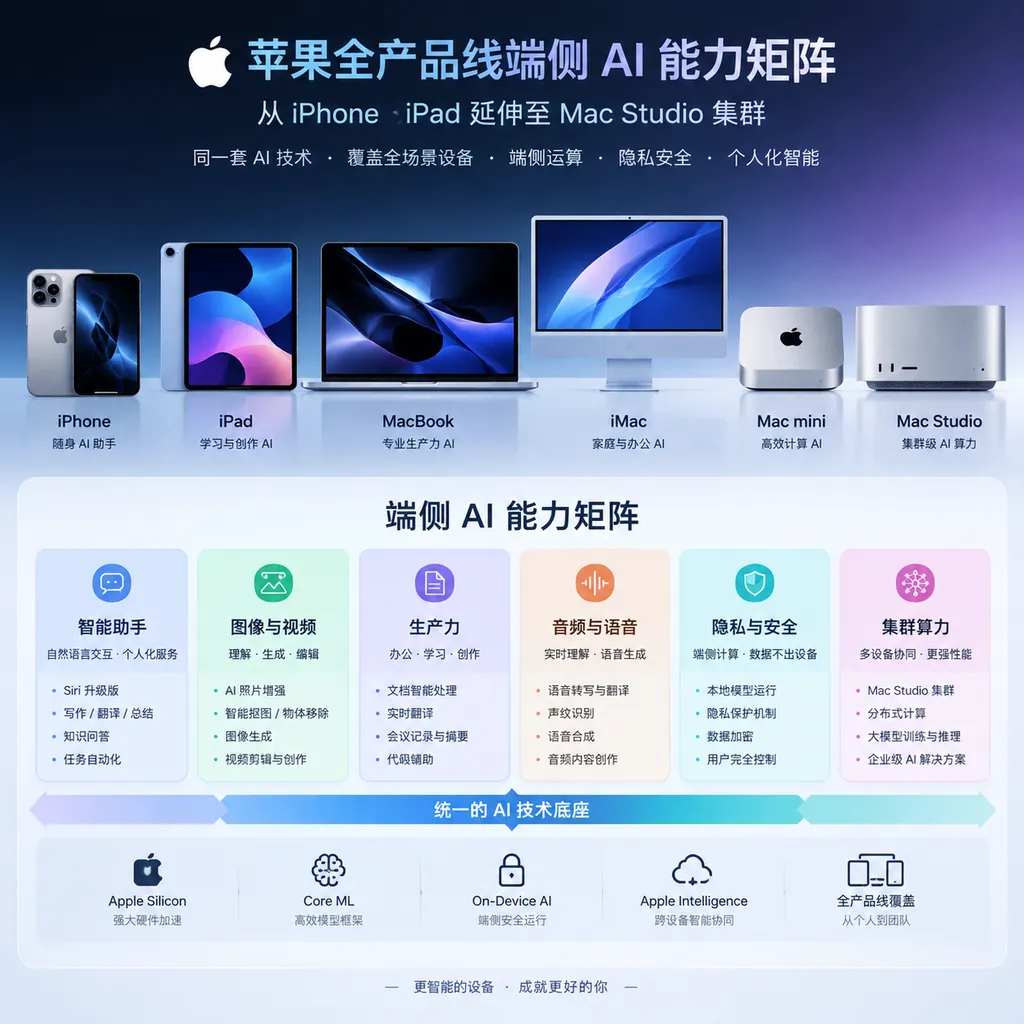
One Table Redefines AI Tiers Across Apple's Devices
The core data Apple presented is as follows:
| Product | Maximum unified memory | Memory bandwidth | Maximum active parameters supported | Typical positioning | | --- | ---: | ---: | ---: | --- | | iPhone / iPad | 16GB | 76GB/s | 14 billion | Lightweight tasks such as Siri, text refinement, and image processing | | MacBook Air | 32GB | 153GB/s | 35 billion | Mobile office work and moderate AI workloads | | Mac mini | 64GB | 307GB/s | 70 billion | Local desktop inference and privacy-sensitive tasks | | MacBook Pro | 128GB | 614GB/s | 120 billion | Large models, professional creative work, and development | | Mac Studio | 512GB | 1.2TB/s | 480 billion | High-intensity inference, film and television, and research workloads | | Mac Studio cluster | 2TB | 1.2TB/s | 1.6 trillion | Local training and inference of extremely large models |
The figure most likely to be misunderstood here is the parameter count.
Apple is referring to active parameters, meaning the scale of the parameters actually involved in computation during inference, rather than the total number of parameters in the model file. In mixture-of-experts models, a model may have hundreds of billions or even trillions of parameters, but only a portion of them are activated for each token. Therefore, 14 billion active parameters does not mean that a device can load only a model with a total of 14 billion parameters. Conversely, it should not be directly interpreted as meaning that a phone already has the stable capability to run a dense model containing a full 14 billion parameters.
For developers, active parameters are closer to the actual computational cost, while unified memory is more closely related to whether the device can fit the model in memory. The two are related, but they are not the same metric.
The iPhone's 14B Does Not Mean the Phone Has Become an Inference Server
The iPhone and iPad tier offers 16GB of unified memory and 76GB/s of memory bandwidth, with support for models containing up to 14 billion active parameters. This figure is already sufficient to cover a range of practical on-device models, but it remains clearly below the capabilities of leading cloud-based models.
Take a 14B dense model as an example. With FP16 weights, the weights alone would typically require close to 28GB of memory, so a phone cannot load it directly. Only after applying 8-bit, 4-bit, or even lower-bit quantization, while reserving space for the runtime, system, KV cache, and context, would the model have a chance of starting on a phone.
This is also why on-device AI cannot be evaluated by parameter count alone. A complete inference process must account for at least several factors:
- Weight footprint: The precision used for the model parameters directly determines the model file size.
- Runtime overhead: Operators, caches, and temporary tensor storage all consume memory.
- KV cache: The longer the context, the larger the cache. Being able to run short question-and-answer sessions does not mean the device can reliably summarize long documents.
- Memory bandwidth: Generative model inference is often limited by the speed at which weights can be continuously read, rather than by peak compute alone.
- System reserves: A phone must also handle the camera, system services, and foreground applications, so the full 16GB cannot be assigned to the model.
Therefore, the 14B figure in Apple's table is better understood as a capability ceiling or product-positioning reference than as a performance guarantee that developers can reproduce unconditionally. Actual performance also depends on the model architecture, quantization format, context length, inference framework, and whether Apple has optimized operators for a particular model.
There has previously been hands-on information about running a 27-billion-parameter model locally on the iPhone 18 Pro. This result does not necessarily contradict Apple's newly announced figure of 14 billion active parameters. The two may use different model architectures, quantization strategies, and statistical definitions, or they may correspond to different standards for being able to start, being able to run, and maintaining a usable speed over extended periods. For mobile devices, loading a model into memory is only the first hurdle. Speed, temperature, power consumption, and sustained operational stability determine whether it has real product value.
Apple's Real Bet Is on Unified Memory
The core idea behind Apple's chart is not the peak compute power of any particular generation of Neural Engine, but the unified memory architecture.
In traditional PCs and servers, CPU memory, GPU VRAM, and accelerator memory are usually separate. Once a model is loaded onto the GPU, its weights, activations, and caches must be moved between different storage regions. If there is insufficient VRAM, data must be frequently exchanged between system memory and VRAM, and performance quickly deteriorates.
Apple Silicon allows the CPU, GPU, and neural engine to share unified memory. This does not mean that every task will be faster, but it is crucial for on-device inference: multiple compute units can access the model together, avoiding the need to duplicate the weights for each unit. The more unified memory a device has, the larger the model it can hold; the higher the memory bandwidth, the faster it can read weights while generating tokens.
Judging from the progression Apple provided, device positioning and local model scale rise almost in lockstep:
- The MacBook Air's 32GB of memory and 153GB/s of bandwidth are suitable for models in the 35B range.
- The Mac mini's increase to 64GB and 307GB/s begins to enter the realm of more serious local inference.
- The MacBook Pro's 128GB and 614GB/s target large models and development workloads.
- With 512GB of unified memory and 1.2TB/s of bandwidth, the Mac Studio pushes local inference toward workstation-class capabilities.
This product segmentation is fairly intuitive for developers: if the tasks are limited to offline rewriting, summarization, classification, and basic vision tasks, a phone can already handle them. If the goal is to run code models, long-context models, or multiple concurrent sessions locally, the memory capacity of a Mac mini or MacBook Pro matters more. If local devices are to be used for model evaluation, batch inference, or research experiments, bandwidth and expandable memory become the key factors.
1.6 Trillion Parameters Is More About the Cluster Narrative
The ability of a Mac Studio cluster to support 1.6 trillion active parameters is the most striking figure in the entire chart, but its meaning needs to be interpreted with some restraint.
First, this is no longer the capability of a single personal computer, but of a system made up of multiple devices connected through high-speed interconnects. Model sharding, communication, synchronization, and scheduling within the cluster all introduce additional costs. Theoretically combining 2TB of memory does not amount to having a single 2TB super-sized VRAM pool with perfectly uniform latency and bandwidth.
Second, the bottleneck in large-model inference is not limited to whether the model can be loaded. For generative tasks, devices must exchange intermediate results. For training tasks, they must also handle gradients, optimizer states, and checkpoints. Once communication latency becomes too high, adding nodes may increase memory capacity without increasing throughput proportionally.
Therefore, 1.6 trillion parameters is better understood as an indication that Apple Silicon clusters have the hardware conditions needed to accommodate extremely large models, rather than as a claim that Apple has replaced data-center GPUs with Mac Studios. Such clusters are suitable for local experiments, private-data processing, model compression, and inference-service validation, but they cannot simply be equated with the performance of NVIDIA clusters in large-scale training.
The message Apple is really trying to convey here is that on-device AI does not have to happen only on phones. Enterprises can start with a single Mac and keep sensitive data local. As workloads grow, they can connect multiple Mac Studios to create a relatively controllable private inference environment. This is a deployment path distinct from cloud APIs.
Developers Should Focus on Usability, Not Parameter Count
Over the past two years, discussions of on-device AI have often centered on one question: how many billions of parameters can a device run? For practical applications, however, parameter count is merely the easiest figure to understand when making purchasing decisions or communicating capabilities. What really determines the user experience is effective throughput and latency per unit of power consumption.
For example, if a 7B quantized model can reliably perform summarization, classification, and offline question answering on a phone, it may offer more practical value than a 14B model that generates slowly and quickly triggers thermal throttling. For voice assistants, first-token latency must also be considered. For code completion, sustained generation speed matters. For image understanding, the question is whether both the vision encoder and language model are running locally.
The table Apple released provides developers with at least three useful directions for evaluation:
- Model selection can be tied to hardware tiers. Use small quantized models on mobile devices, larger models on desktops, and reserve high-complexity tasks for the cloud. There is no need to force a single model to cover every device.
- Memory capacity should be an important Mac purchasing criterion. For local large language models, the differences between 64GB, 128GB, and 512GB are often more immediately relevant than simply comparing the number of CPU cores.
- Hybrid on-device and cloud processing is more realistic than purely on-device processing. Phones can handle privacy-sensitive, latency-critical, and high-frequency tasks, while complex inference, long contexts, and large-scale processing can be delegated to the cloud.
For teams using models such as OpenAI, Claude, Gemini, or DeepSeek, this also means that model routing will become increasingly important. Tasks that terminal devices can handle can be completed locally. When higher quality or longer context is required, requests can be switched to a cloud API. Developers do not need to send every request to the same type of model, nor do they need to sacrifice all capabilities in order to deploy on-device.
Apple's On-Device AI Finally Has Hardware Coordinates
Apple's previous descriptions of Apple Intelligence focused more on privacy, system experience, and feature entry points. The value of this capability matrix is that it brings on-device AI back from software features to hardware realities: there are clear engineering constraints connecting model size, memory capacity, and bandwidth.
However, the table does not resolve several core questions about on-device AI: whether the models will be open, whether developers can use the same inference stack, how significant the performance differences are between quantization formats, and whether Apple will publish more complete benchmarks. Without this information, 14 billion and 1.6 trillion remain primarily capability boundaries rather than reproducible performance results.
For Apple, the strategic significance of this matrix is still considerable. It places the iPhone, Mac, and Mac Studio clusters within a single AI computing system, creating a continuous upgrade path from personal devices to workstations. Users are no longer buying merely a faster phone or a more powerful Mac, but greater local model capacity and more workflows that do not depend on the cloud.
The conclusion is clear: support for up to 14 billion active parameters on the iPhone 18 Pro indicates that phone-based AI has entered the usable stage, but not the unlimited stage. The 1.6 trillion parameters supported by Mac Studio clusters indicate that Apple is presenting a local AI infrastructure path, not announcing that personal computers can replace cloud data centers.
What is truly worth watching next is whether Apple can turn this capability chart into developer-accessible tools, public performance metrics, and a stable model ecosystem. Only when models can run, speeds are sufficient, power consumption is acceptable, and third-party applications can genuinely integrate with them will on-device AI evolve from a ceiling on a parameter chart into a productivity tool developers use every day.
References
- IT Home: Apple Publishes an On-Device AI Capability Matrix for Its Entire Product Line — Summarizes the on-device AI hardware progression and parameter data presented at JNUC.
- IT Home: Report on Running a 27-Billion-Parameter Model Locally on the iPhone 18 Pro — Provides earlier hands-on information about local models on mobile devices for comparison across different models and statistical definitions.