
Musk enters the AI programming battlefield: Grok Build to be released next week

xAI will launch **Grok Build** and **Grok CLI** next week, officially entering the AI programming agent market. Based on the newly released **Grok 4.3 model**, this toolkit adopts a dual-track mechanism of **CLI + Web**, and introduces a **multi-agent parallel Arena mode**, directly competing with **Claude Code** and **Cursor**.
Musk Enters the AI Programming Battlefield: Grok Build to Launch Next Week
xAI is moving into the programming tools space. According to technology media TestingCatalog’s report yesterday (April 17), Musk’s xAI will launch two new products next week — Grok Build and Grok CLI — officially entering the AI programming agent market. This means Grok will no longer be just a chatbot, but will directly compete with tools like Claude Code, Cursor, and Google Jules.
The timing is interesting. Back in January, Musk previewed on X that “a major upgrade to Grok Code will come next month,” accompanied by an OpenRouter leaderboard image showing Grok Code Fast 1 exceeding Claude with 420 billion tokens used weekly. Three months later, xAI is now packaging its programming capabilities as standalone products — moving faster than expected.
Grok 4.3 Launches Early, Technical Path Shifts
A key change lies in the underlying model. xAI has quietly rolled out the Grok 4.3 Early Access test version, currently available only to Grok Heavy subscribers, accessible via both web and mobile. This move alters Grok Build’s technical path — xAI may not train a dedicated programming model like OpenAI’s Codex, but instead let the general-purpose Grok 4.3 handle programming tasks directly.
This approach has pros and cons. The advantage is a shorter development cycle with quicker iteration of programming features; the downside is that general models are theoretically less accurate and efficient in code generation. However, judging from Grok Code Fast 1’s usage on OpenRouter, developer adoption is already high — hitting 334 billion tokens in a day and surpassing 1 trillion tokens weekly, beating many specialized coding models.
In the SWE-Bench test, Grok Code Fast 1 scored 70.8% accuracy, ranking among the top tier, though not the highest. This is impressive for a general model, but still behind top programming models like Claude Sonnet 3.7 or GPT-4.5 Turbo. xAI’s bet is to use rapid iteration and lower prices to seize market share before competitors respond.
Dual-Track System: CLI + Web, Run Locally or Remotely
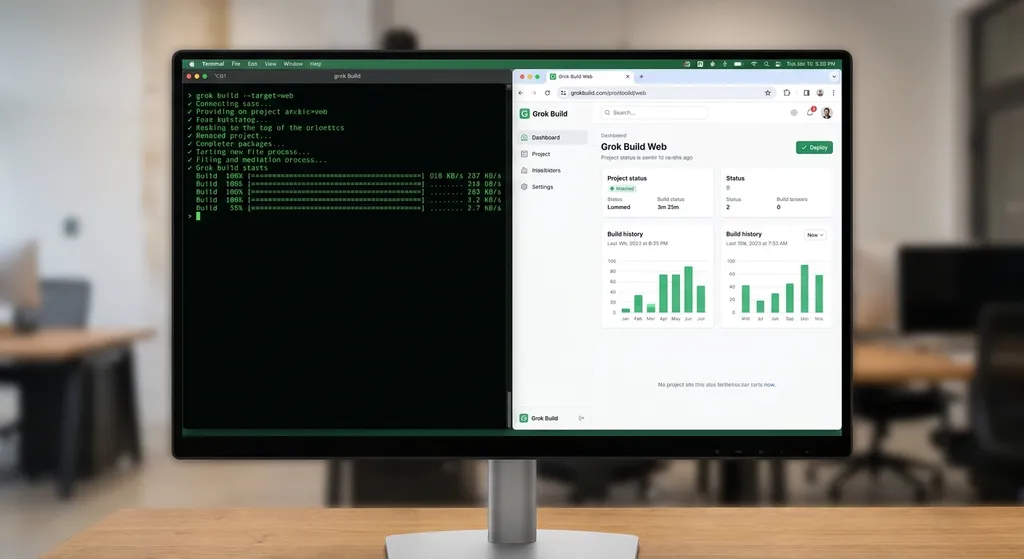
Grok Build uses an interesting dual-run architecture. Developers can run tasks locally via Grok CLI, or operate remotely via the web interface. This mirrors Cursor’s design philosophy — CLI for hardcore developers, web UI for lowering the barrier to entry.
The exact mechanism for local execution remains unclear. TestingCatalog suggests an Electron-based desktop wrapper may be optimal, enabling quick cross-platform deployment. However, Electron’s heavy performance overhead and high memory usage could be problematic for frequent model calls in programming scenarios.
Also worth noting is xAI’s “local agent” concept. Leaks indicate Grok Build will let users choose between local and remote agents. A local agent means part of the reasoning runs on the user’s machine — a plus for privacy-sensitive enterprise developers. The challenge: Grok 4.3 is too large for full local deployment. A more realistic setup might let a lightweight local agent handle code analysis and task scheduling, while cloud APIs perform actual code generation.
xAI positions Grok as “modular, customizable, and locally oriented”, differentiating it from Anthropic’s Claude Code, which emphasizes cloud capabilities and multimodal interaction. Grok Build instead aims to balance local execution and cloud inference.
Arena Mode: Multiple Agents Working on the Same Task
In terms of innovation, Grok Build is expected to introduce Parallel Mode and Arena Mode. The latter is a fresh concept — multiple agents process the same task in parallel, and users select the best result.
This design tackles a pain point of AI coding tools: inconsistent code quality. Sometimes the first generation works, other times it takes several retries. Arena Mode lets multiple agents tackle the job simultaneously, then displays all solutions for comparison. This “voting mechanism” helps in complex tasks, where different agents may propose distinct implementations.
However, this comes at a cost. Parallel agents mean multiplied API calls — token-based billing would raise user costs. xAI might reserve Arena Mode for premium users or limit daily usage.
Details of Parallel Mode are unclear, but its name suggests multi-task concurrency — e.g., refactoring three modules simultaneously. That could significantly boost productivity in large-scale projects.
Competing with Claude Code, but Taking a Different Route
Comparing Grok Build with Claude Code reveals stark differences in product logic.
Claude Code centers on “conversational programming”, emphasizing smooth human-AI collaboration. You chat with Claude, and it writes code, fixes bugs, and explains logic — like pairing with a senior engineer. Anthropic has invested heavily in this approach; Claude 3.7 Sonnet has excellent code understanding and long-context handling for complex projects.
Grok Build leans toward “task-based programming.” From its CLI and Arena mode design, xAI wants developers to clearly state requirements and have Grok complete tasks in one go. This “one-shot” mindset aligns with Musk’s vision of “solving complex programming tasks in one pass.”
Neither route is inherently better — it depends on usage. For prototyping or rapid idea validation, one-shot is more efficient; for maintaining complex legacy projects, conversational programming offers a better experience.
xAI’s advantage might be pricing. Grok Code Fast 1 surpassed Claude on OpenRouter largely due to affordability. If Grok Build can undercut Claude Code’s pricing — perhaps even halve it — it could strongly appeal to budget-conscious developers.
Vibe Coding: Musk Emulates Google’s New Trend
Grok Build is seen as xAI’s first “Vibe Coding” solution. “Vibe Coding” is trendy tech slang describing a smooth flow state when programming with large language models — developers “code by vibe,” collaborating with AI instead of fussing over syntax.
The concept originated from Google AI Studio, which delivered an immersive experience — describe tasks in natural language, get live code generation, and refine along the way. Musk has praised AI Studio’s “vibe coding” mode multiple times, and xAI now aims to replicate this with Grok.
But vibe coding relies not just on UX, but model capability. To “code by vibe,” the model must accurately grasp developer intent and generate functional code even when inputs are fuzzy. That demands strong code comprehension, contextual reasoning, and error correction.
Whether Grok 4.3 can deliver this remains to be seen. So far, Grok Code Fast 1 performs well on simple tasks but needs testing on stability with complex projects.
GitHub Integration: Details Still Unclear
Leaks mention GitHub integration, but details are vague. The simplest way is a GitHub App, allowing Grok Build to generate code or fix issues within repositories — similar to Cursor and GitHub Copilot. Technically straightforward.
A more imaginative route combines with GitHub Actions — e.g., having Grok Build run code review automatically after PR submission, or generate fixes upon issue creation. This kind of automation could greatly boost team productivity but requires deeper collaboration between xAI and GitHub.
Given Musk’s strained ties with Microsoft (OpenAI’s major shareholder), deep GitHub integration remains uncertain. More likely, Grok Build will start with basic GitHub support and expand depending on market response.
Will Developers Buy In?
The AI programming tools market is already crowded. GitHub Copilot dominates via Microsoft’s ecosystem, Cursor wins hardcore developers with superb UX, and Claude Code holds strong in the high-end segment thanks to Anthropic’s modeling power. Can xAI break through?
Grok Build targets fast development and low cost. If you’re prototyping or budget-conscious but want an AI productivity boost, Grok Build could fit. For enterprise-level projects demanding high stability and code quality, Claude Code or Copilot may be safer bets.
xAI’s edge lies in speed of iteration. The jump from Grok 4.1 to 4.3 in just a few months brought sharp improvements. If xAI sustains that pace, Grok Build’s competitiveness will grow quickly.
Another wildcard is Musk’s personal influence. His reach among developers — especially on X — is enormous. If he actively promotes Grok Build, adoption could accelerate faster than most startups. But given his divided attention across projects, how much focus he’ll give Grok Build remains to be seen.
How to Connect to Grok Build (Prediction)
Though not yet released, based on xAI’s current API structure, Grok Build will likely offer OpenAI-compatible API endpoints. If you’re already using OpenAI Hub or similar platforms, switching should require minimal code changes.
Predicted example:
import openai

# Call Grok Build via OpenAI Hub
client = openai.OpenAI(
    api_key="your-openai-hub-key",
    base_url="https://api.openai-hub.net/v1"
)

response = client.chat.completions.create(
    model="grok-4.3-code",  # predicted model name
    messages=[
        {"role": "system", "content": "You are an expert programmer."},
        {"role": "user", "content": "Write a Python function to calculate Fibonacci numbers using dynamic programming."}
    ],
    temperature=0.2,  # suggested low temperature for code generation
    max_tokens=2000
)

print(response.choices[0].message.content)
If Grok Build supports Arena Mode, the API may allow you to specify multiple outputs:
response = client.chat.completions.create(
    model="grok-4.3-code",
    messages=[...],
    n=3,  # generate 3 candidate solutions
    temperature=0.3
)

# iterate through all candidates
for i, choice in enumerate(response.choices):
    print(f"\n=== Solution {i+1} ===")
    print(choice.message.content)
CLI usage might look like this:
# Install Grok CLI
npm install -g @xai/grok-cli

# Configure API Key
grok config set-key your-api-key

# Generate code
grok build "Create a REST API with Express.js for user management"

# Use Arena Mode
grok build --arena "Optimize this SQL query" --input query.sql

# Local Agent Mode
grok build --local "Refactor this component" --input src/components/Header.jsx
Of course, these are predictions. Actual API and usage details will be known once xAI officially launches the product.
Final Thoughts
xAI’s move into AI programming is good for the entire industry. More competition means faster innovation and better tools for developers. Grok Build’s success will hinge on three factors: model capability, product experience, and pricing strategy.
Grok 4.3’s power has been proven on OpenRouter; experience will be tested post-launch next week; and pricing will likely undercut Claude Code. If xAI gets all three right, Grok Build could secure a solid position in the AI coding market.
Challenges remain. Copilot has Microsoft’s ecosystem, Cursor boasts UX excellence, and Claude Code owns model supremacy. For Grok Build to stand out, it must go extreme in one area — either ultra-low pricing or a killer feature developers can’t live without.
The upcoming launch will reveal the verdict. For developers, another option is always welcome. If you’re already using aggregators like OpenAI Hub, you’ll likely be able to switch seamlessly to Grok Build and see whether Musk can replicate his SpaceX and Tesla success in the realm of AI programming.


