Claude Computes a Nine-Loop Scattering Amplitude
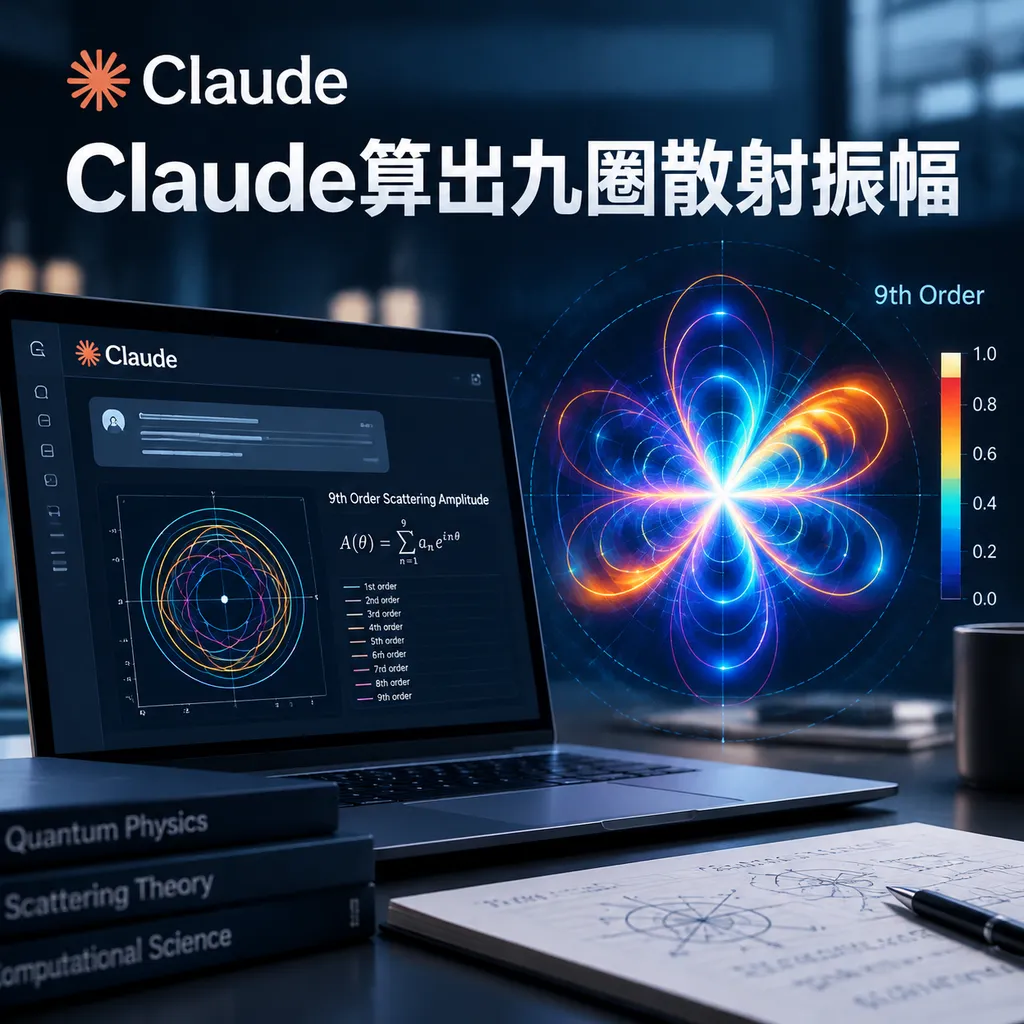
Anthropic revealed that Claude Science ran almost entirely unattended for several days, completing a nine-loop calculation of the six-particle scattering amplitude in planar N=4 super-Yang-Mills theory, surpassing the eight-loop record held by humans for three years. The real shock is not just the result, but that the model has begun independently organizing complex scientific workflows.
Claude Computes a Nine-Loop Scattering Amplitude, Breaking the Eight-Loop Record in Theoretical Physics
Anthropic disclosed on September 25 that Claude ran almost unattended for several consecutive days on the research platform Claude Science, completing a nine-loop calculation of the six-particle scattering amplitude in planar N=4 super-Yang-Mills theory.
This was not another demonstration of “a model writing a piece of physics code.” Claude’s result broke the eight-loop record held by a team led by Lance Dixon, a physicist at the SLAC National Accelerator Laboratory in the United States, which was completed in 2023. More importantly, Dixon himself participated in an independent verification and confirmed that Claude obtained mutually consistent results through two different approaches.
Anthropic disclosed that the input for this task consisted of almost nothing more than a single sentence: calculate the six-particle (hexagon) amplitude of the planar N=4 SYM model at nine loops. Afterward, the typical instruction researchers gave Claude was also simple: “I’m going to sleep and won’t be around for the next few hours. Keep calculating, and unless I tell you to stop, report your progress every four to six hours.”
Several days later, the model delivered the result. At ordinary user pricing, the estimated cost of a single computational route was approximately one to two thousand dollars, while the two routes together cost several thousand dollars. For an advanced theoretical physics problem that once required years of preparation, complex programs, and specialized research experience, this cost is the most striking aspect of the event.
What Does Nine Loops Actually Mean?
First, let us clarify “scattering amplitude” and “loop.”
In particle physics, a scattering amplitude describes the probability that particles will collide and transform in a particular way. It serves as a bridge between theoretical calculations and experimental data from facilities such as the Large Hadron Collider: the more precise the theoretical value, the better researchers can determine whether an experimental result is merely a statistical fluctuation or a sign of new physics, such as dark matter, supersymmetry, or matter-antimatter asymmetry.
The problem is that real quantum field theory calculations usually cannot be solved exactly in a single step. Physicists begin with the simplest approximation and then continually add quantum corrections. Each additional layer of correction is called another “loop.” The higher the loop order, the more precise the theoretical result is generally expected to be, but the integrals, functions, constraints, and intermediate variables that must be handled also expand dramatically.
This can be understood as continually increasing the resolution of an extremely complex map: the first loop provides only a rough outline, while the second and third loops begin filling in the details. By the ninth loop, every boundary, island, and shadow on the map must remain consistent simultaneously. A single local error can cause the entire final result to fail.
The Yang-Mills theory involved here is the theoretical framework jointly proposed by Chen-Ning Yang and Robert Mills in 1954. It later became one of the foundations of modern particle physics. It is important to note that Claude calculated a highly symmetric planar N=4 super-Yang-Mills model, rather than directly modeling all the complexities of the real world. It is an important “laboratory” in theoretical physics, but it cannot simply be equated with Claude having solved all the prediction problems of the Standard Model or real-world colliders.
Humans Were Stuck at Eight Loops. Why Could Claude Continue?
This result does not mean that the model invented an entirely new law of physics out of nowhere. Claude used mathematical tools developed by theoretical physicists over many years, but organized those tools, papers, code, and computational resources into an almost fully automated workflow.
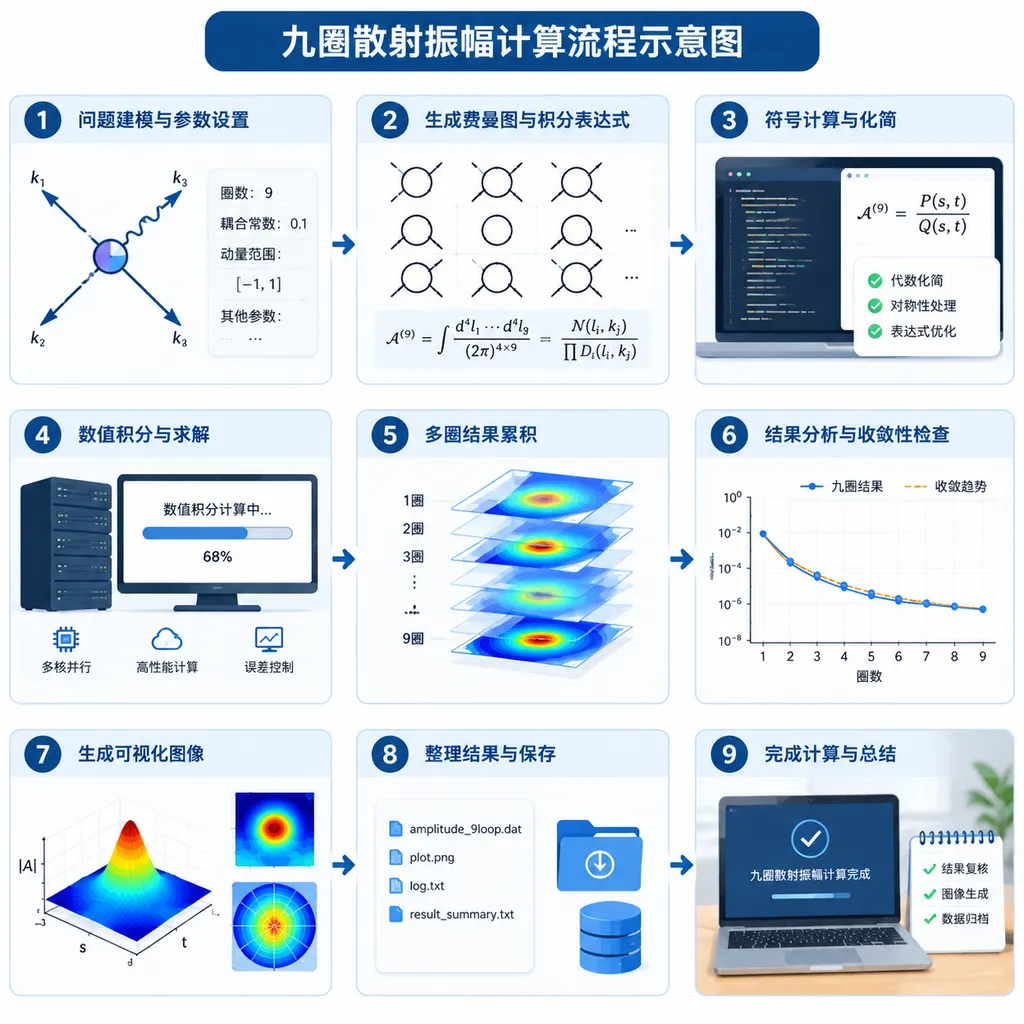
The first route was the bootstrap method. Its basic idea resembles a massive Sudoku puzzle with extremely strict rules: first write down all possible functional forms that satisfy the basic structure, then use symmetries, physical constraints, and limiting behavior to eliminate impossible solutions one by one, leaving the unique result that satisfies all conditions.
The difficulty of this method does not lie in the length of any individual formula, but in the strong coupling between the constraints. The choice of one variable can affect a large number of subsequent equations. If an intermediate step fails to preserve symmetry, the final answer may collapse as a whole. Along this route, Claude used tools such as Python and SymPy to carry out extensive symbolic derivations and constraint solving.
The second route followed the indirect method previously used by Dixon’s team: first calculate a relatively more tractable form factor, then use symmetry relations such as antipodal duality to convert the result back into a scattering amplitude. Unlike directly expanding all Feynman integrals, this route reformulates the physics problem as a huge system of algebraic equations and uses integer arithmetic and large primes for repeated checks, reducing the risks caused by floating-point errors.
One key optimization was that Claude did not mechanically place all unknowns into memory at once. Under the traditional derivation approach, the nine-loop calculation involved approximately 1.85 million unknowns, which would be difficult for an ordinary computing environment to handle directly. Using duality relations and symmetries, the model first made structured guesses about part of the answer, compressing the problem to approximately 76,000 unknowns, and then continued solving it with physical constraints.
The scale of the final result was also astonishing: the expansion on just one slice contained more than 30 billion terms, compared with approximately 1.67 billion terms at eight loops. “Calculating it” does not mean that the model output 30 billion terms of text in a chat window. Rather, it constructed computational objects and rules capable of generating, verifying, and expressing these results, and cross-checked their consistency through different routes.
What Surprised Physicists Most Was Not Just the Answer
In his verification note, Lance Dixon described the calculation as resembling a “collapsed soufflé”: if something goes wrong anywhere, the entire result may fail completely. He spent approximately two weeks checking it, primarily working backward from the nine-loop amplitude to the more easily verified form factor, and then comparing it with the results and constraints accumulated by his team.
Dixon’s assessment was direct: Claude completed every step of the complex recipe and was able to organize sufficient computing power to carry out the calculation, making it “a rather remarkable achievement.” He even stated that, apart from his own collaborators, Claude may be more familiar than anyone else with the relevant papers his team published in 2019 and 2023.
This does not mean that “Claude understands physics better than everyone.” A more accurate description is that the model can absorb, in a very short time, the public knowledge accumulated over many years in a research field, and reassemble the operational steps scattered across papers, formulas, algorithms, and code. Much of this knowledge was previously held by only a small number of research groups. Models are now lowering the barrier to entering this kind of work.
The event also had a somewhat dramatic beginning. Matt von Hippel, a former theoretical particle physicist and science writer, had previously issued a public challenge to AI companies, asking models to solve frontier problems in scattering amplitudes within a computational budget affordable to ordinary academics. One of his proposed options was to advance the six-particle amplitude in N=4 super-Yang-Mills theory to nine loops.
Von Hippel himself had participated in research related to five, six, and seven loops. In the face of AI breakthroughs in Go, protein structure, and mathematical reasoning, he had consistently believed that only by entering his own former field could AI truly demonstrate that such systems were changing scientific research. Now, Claude has taken up that challenge.
What Claude Actually Upgraded Was Its “Research Agent” Capability
It would be inaccurate to summarize this event simply as “Claude has more computing power.” What it demonstrated was a mode of operation closer to that of a research agent.
Traditional chat models usually require humans to break down a task continuously: first asking the model to read papers, then asking it to write code, then asking it to fix errors, and finally having researchers decide what to do next. The difference with Claude Science is that it places the model in a more complete execution environment, allowing it to:
- Read and cross-reference multiple technical papers;
- Select different mathematical approaches and compare their results;
- Write, run, and debug Python and symbolic computation code;
- Manage long-running tasks and intermediate states;
- Report progress periodically instead of waiting for human confirmation at every step;
- Use independent methods to cross-check key results;
- Redesign algorithms when encountering memory or computational-scale bottlenecks.
This is different from “a model answering a physics question.” The latter is more like an exam, while the former is closer to an early-career research collaborator: it must first understand the objective, arrange the steps, handle failures along the way, and decide when to change approaches.
From this perspective, the several-thousand-dollar cost is more noteworthy than the final formula. The biggest bottleneck in research automation has often not been the price of a single computation, but the fact that researchers must personally monitor every intermediate step. As long as a task needs to run continuously for several days, human supervision quickly becomes a cost in itself. A model’s ability to make progress autonomously overnight means that some of the time spent “waiting for computational results” can be freed up.
Of course, this does not mean that research costs have fallen to a level where ordinary developers can experiment freely. Several thousand dollars is still a significant amount for an individual researcher, and the final result depends on verification by experts. The model also did not bypass the theoretical framework, nor did it discover Yang-Mills theory from scratch. It worked on the foundation of high-quality literature, mature mathematical tools, and a computational environment, executing a long-term task more quickly.
The Debate Over Whether “The Model Is Just Repeating Papers” Is Not Over
This breakthrough will make the claim that “language models can only imitate and cannot do science” harder to sustain, but it still does not prove that models possess scientific creativity in a general sense.
On the one hand, the bootstrap method, duality relations, and related computational recipes used by Claude were all accumulated by the physics community over many years. The model’s contribution primarily lies in understanding, combining, implementing, and advancing them, rather than proposing a completely new theory detached from existing knowledge.
On the other hand, the nine-loop result was achieved in a highly idealized model with an especially elegant structure. Real-world physics problems often involve more experimental noise, boundary conditions, unknown parameters, and incomplete data, and may not be convertible into a system of equations with a clearly defined scale and sufficient constraints. A model’s strong performance on N=4 SYM does not mean that it will explain high-temperature superconductivity or discover dark matter tomorrow.
But this does not diminish the significance of the event. Much important scientific work does not consist of proposing theories out of nowhere. It involves advancing existing theories to higher precision, actually completing complex calculations, and turning tools accumulated over the long term into reusable results. The “last mile” that only a small number of experts could previously complete may be precisely where AI first begins to intervene at scale.
Dixon’s team has already been exploring the use of customized Transformer models to predict results at higher loop orders and has prepared comprehensive verification tools. This direction may become a new norm in research: models propose candidate solutions, search enormous solution spaces, and organize computations, while humans define the problem, assess its physical meaning, and design verification criteria.
What This Means for Developers and Research Institutions
The lesson of the Claude event for developers is not that “with one prompt, a model will automatically solve every scientific problem.” What is truly worth learning from is the system design.
First, long-running tasks require state management. When a model runs continuously for several days, it must preserve code, logs, assumptions, failure records, and intermediate results. Otherwise, every context restart will begin from scratch. Second, tool use is more important than simply expanding the context window. Symbolic computation, numerical computation, version control, and automated testing together form the model’s “external brain.” Third, results must be designed to be verifiable. Claude performed cross-checks through two computational routes and repeatedly verified the result using integers and large primes. This is far more reliable than having the model simply say, “I got it right.”
For research institutions, the more realistic future is not to replace physicists entirely with AI, but to let models take over time-consuming and repetitive tasks that still require extensive domain knowledge: organizing literature, generating candidate formulas, porting legacy code, searching parameter spaces, running long experiments, and organizing complex results into forms that are easier for peers to inspect.
What Anthropic demonstrated this time was no longer merely whether Claude “can answer questions,” but whether a model can advance a research problem toward a verifiable result with relatively little human intervention. It remains a long way from independently discovering new physics, but there may indeed be more “low-hanging fruit” than many people expected.
As of September 27, 2026, the nine-loop scattering amplitude should still be regarded as a specific theoretical calculation breakthrough verified by experts, rather than a declaration that AI is taking over fundamental science. Nevertheless, the record in scattering amplitudes has moved from eight loops to nine, and the force behind that advance is no longer only a research team, but a model system capable of reading papers, writing programs, calling on computing resources, and working continuously. For theoretical physicists, the real change may only just be beginning.
References
- ITHome: Anthropic Claude Sets a New World Record in Physics — Introduces Claude’s completion of the nine-loop six-particle scattering amplitude calculation, its cost, and the expert verification.
- Zhihu: Claude Independently Tackles a Frontier Problem in Theoretical Physics — Summarizes the technical background of the bootstrap method, the form-factor approach, and the nine-loop calculation.