MiniMax M3.1-Flash-Preview Is Now Available

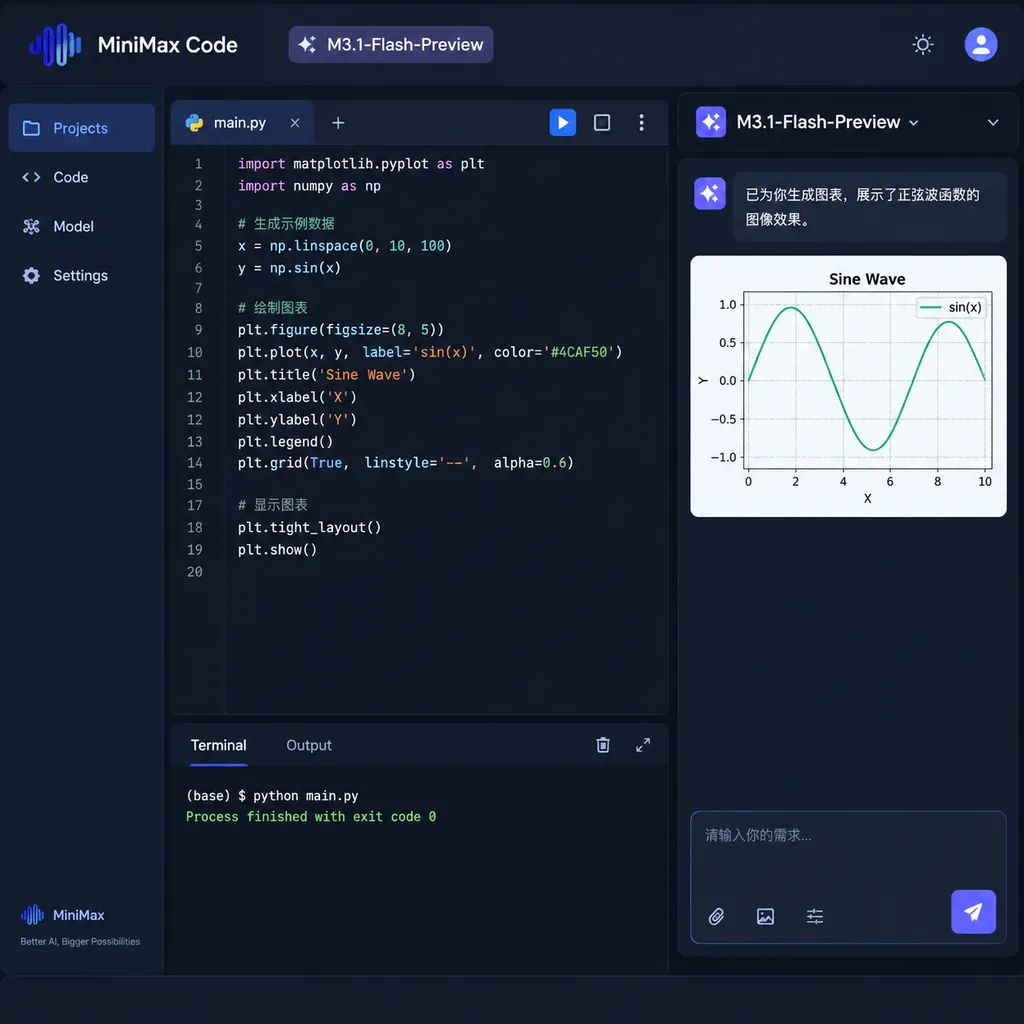
Today, MiniMax launched M3.1-Flash-Preview for code development on the MiniMax Code platform and reset the Token Plan quotas. The new model is primarily designed for bug fixes, feature development, regression testing, and change verification, but it is still currently in the Preview stage.
MiniMax M3.1-Flash-Preview Goes Live, Bringing Code Development Into the “End-to-End Delivery” Competition
MiniMax announced today (September 27) that its latest text model, M3.1-Flash-Preview, is now available on the MiniMax Code platform for daily coding tasks. The company is also issuing quota reset cards to users, resetting Token Plan quotas for all users, and launching promotions including double points for daily check-ins and free Token claims.
The focus of this update is not simply replacing the existing model with one that is “better at writing code,” but MiniMax’s attempt to move coding assistants from code generators toward more complete development executors. From understanding requirements and locating problems, to modifying code, adding tests, and verifying that changes have not broken existing functionality, the model is expected to cover a complete software development workflow.
Of course, M3.1-Flash-Preview is still a preview release. In the launch announcement, MiniMax did not disclose detailed parameter counts, context-window size, public benchmark scores, or standalone API pricing. For now, it is more appropriate to view this as a productivity update within MiniMax Code, rather than the release of a new-generation general-purpose model whose capabilities have already been fully established.
The Problem Is Not “Can It Write Code?” but “Can It Finish the Task?”
For some time, competition among code models has generally focused on several metrics: code completion speed, single-turn generation quality, performance on algorithm problems, and whether the model can write a runnable function from natural-language instructions. These capabilities remain important, but in real projects, the most time-consuming work is often not writing the first version of the code. It is handling the chain of problems that follows.
For example, a backend API requirement may appear to be as simple as “add a filtering condition,” but implementing it properly requires developers to check all of the following:
- Whether the request parameters remain compatible with older client versions;
- Whether the database query could introduce slow queries;
- How to handle null values, duplicate values, and invalid input;
- Whether permission checks could be bypassed;
- Whether existing unit and integration tests still pass;
- Whether the API documentation, type definitions, and frontend calls need to be updated as well.
If a model is only responsible for generating a function, it may easily miss these boundaries. M3.1-Flash-Preview is positioned more as a model that continuously advances a development task, rather than one that generates code once and then stops.
According to MiniMax, the model can participate in bug fixes, complete feature development, issue diagnosis, code implementation, test completion, and change verification. In other words, the model needs to understand more than the current file. It must also understand the task context, project structure, existing implementation patterns, and the functionality that may be affected by a change.
This is also the dividing line between code agents and traditional code-completion tools: a completion tool cares about “what should be written after this line,” while a code agent is more concerned with “which parts of the repository need to be changed to complete this requirement, and how can we prove afterward that nothing has gone wrong?”
M3.1-Flash-Preview’s Focus: Working With Real Repositories
1. Starting With Issue Diagnosis Instead of Directly Generating a Patch
In real-world engineering, bug reports are often incomplete. A developer may only say that “login occasionally fails” or that “a particular page loads very slowly,” or provide a snippet of an error log. The model must first extract clues from logs, call chains, configuration files, and related code before determining which layer may be responsible.
These tasks place different demands on a model than code generation does. The model needs to establish causal relationships rather than directly map natural language to code. An apparently simple exception could originate from a database connection pool, cache invalidation, concurrency conditions, time-zone handling, or even differences in the deployment environment.
MiniMax’s inclusion of “issue diagnosis” as part of M3.1-Flash-Preview’s development workflow indicates that it is not satisfied with merely displaying generated results. It is attempting to have the model participate in the analysis process. For developers, the value of this capability lies in reducing the investigation path, especially when dealing with small and medium-sized issues that span multiple files or modules.
2. Focusing on Edge Cases, Not Just the Main Flow
AI-generated code often covers the main flow while leaving gaps around edge cases. For example, an API may handle normal user requests but fail to account for empty arrays, overly long strings, duplicate submissions, permission changes, and network timeouts. Data-processing logic may work normally with test data but encounter performance problems when applied to production-scale datasets.
M3.1-Flash-Preview emphasizes handling edge cases. This may not sound particularly novel, but it directly addresses one of the areas where code agents most often fall short: whether the model can proactively derive error paths from requirements and turn those paths into implementation and tests, rather than waiting for the developer to enumerate them one by one.
However, this capability still ultimately needs to be tested in real projects. Without public third-party benchmarks or detailed evaluation data, “understanding edge cases” should not be taken to mean that the model can reliably cover every abnormal scenario. Developers still need to review changes related to permissions, concurrency, data consistency, and security.
3. Automatically Completing Regression Tests
When modifying legacy code, regression testing demonstrates a model’s engineering capabilities more clearly than adding new code does. Even if a change fixes the current bug, it may affect other callers. If the model only generates a patch without adding tests, developers still need to manually confirm that the change is reliable.
MiniMax explicitly stated this time that the model can complete regression tests and verify the impact of changes on existing functionality. Ideally, the model’s workflow should be as follows: first understand the existing tests, then modify the implementation, add coverage for gaps, run the relevant tests, and continue fixing issues based on the results.
The significance of this approach is that it connects “writing code” with “proving that the code works.” It cannot replace a continuous integration system, nor can it guarantee that the tests themselves contain no omissions, but it can at least reduce the risk of looking only at code diffs without checking behavioral changes.
For teams, the key point is not how many lines of code the model can generate in one pass, but whether it can reduce the communication cost between a requirement and a pull request. A model that can provide clear change descriptions, test results, and potential risks is generally better suited to engineering workflows than one that only generates large blocks of code.
What “Flash” Means: The Trade-Off Between Speed and Reliability
The name M3.1-Flash-Preview suggests an emphasis on fast responses. In coding scenarios, speed is not merely a matter of user experience. It directly affects whether the model can be used frequently.
During interactive development, developers often issue several small tasks in succession: first asking the model to explain a module, then asking it to modify a function, and finally asking it to run tests and handle any errors. If every response requires a long wait, developers will quickly return to manual operations. If the model responds quickly enough, a code agent can become a tool for continuous collaboration.
Speed, however, comes with trade-offs. Complex tasks require longer reasoning chains, larger contexts, and more tool calls. A fast model will not necessarily outperform a heavier model on every task. The practical value of M3.1-Flash-Preview may not be in replacing every high-capability model, but in handling large numbers of routine, repetitive, and relatively well-defined development tasks: fixing small bugs, adding tests, adjusting APIs, refactoring local logic, and completing multiple rounds of corrections based on error messages.
Developers should therefore look beyond first-token latency and also examine metrics that are more relevant to production: how many interaction rounds a task requires, whether the model frequently modifies the wrong files, whether it can self-correct after tests fail, whether the resulting diff is easy to review, and whether it loses context during long-running tasks.
MiniMax Code’s Quota Reset and Promotional Activities
Alongside the model launch, MiniMax is also issuing quota reset cards to users and resetting Token Plan quotas for all users. For developers currently trying out code agents, this means they can reevaluate the model’s performance without purchasing additional quota. It is particularly suitable for comparative testing with low-risk tasks from real repositories.
In addition, MiniMax will run a double-points daily check-in promotion from September 28 to October 7. During the promotion, users can log in to MiniMax Code and complete the daily check-in to receive double free points. Both new and existing users can participate. The company is also offering benefits such as free Token claims.
It is important to note that promotional quota is not the same as production-ready capability. Developers planning to integrate the model into team workflows should separately confirm quota consumption, concurrency limits, retry costs after task failures, and whether the model’s behavior may change in future Preview releases. Preview models are suitable for evaluation and trial use, but they should not directly handle critical production tasks without a locked version, test suite, and rollback mechanism.
Its Relationship With M3 Should Not Be Overinterpreted Yet
M3, released by MiniMax in June this year, already highlighted Coding, Agent capabilities, ultra-long context, and native multimodality as its main selling points. It is available through MiniMax Code, Token Plan, and API channels. The naming of M3.1-Flash-Preview clearly continues the M-series product line, but the information currently disclosed by the company is insufficient to determine whether it is an incremental version of M3, a specialized version for coding scenarios, or a preview model optimized for the MiniMax Code workflow.
Nor can the “3.1” version number alone be used to conclude that it outperforms M3 on every task. A model upgrade does not mean that all metrics improve simultaneously: code repair capabilities may improve while long-context stability changes; response speed may increase while complex planning capabilities are subject to trade-offs. Ultimately, comparisons still need to be conducted using the same repository, task set, and tool environment.
A simple but effective development task set could include:
- Fixing a reproducible bug based on an issue description;
- Adding unit tests and exception tests to an existing module;
- Adding a small feature across multiple files;
- Performing a second round of fixes based on test-failure logs;
- Proposing a change to a piece of code with performance problems and explaining the risks;
- Checking whether the model introduces unnecessary dependencies, breaks interfaces, or modifies unrelated files.
This type of evaluation is closer to real team usage than generating a single algorithm function, and it makes it easier to identify differences in code understanding, tool use, error recovery, and change control.
What This Means for Developers
In the short term, the launch of M3.1-Flash-Preview will expand the range of options in China’s code-agent market. Developers can try it directly in MiniMax Code without first setting up a complex chain of model calls, terminal tools, and context management. For individual developers and small teams, low-barrier access is particularly valuable.
In the medium term, competition among code models will shift from “who can generate more code” to “who can complete engineering tasks more reliably.” Models need to handle repository context, call development tools, run tests, correct errors, and ultimately provide deliverables that can be reviewed. The model itself is only one part of the system. The real product differentiation also includes context indexing, permission isolation, execution sandboxes, logging, and version rollback.
This is what makes M3.1-Flash-Preview worth watching: its promotional focus has already shifted from isolated coding capabilities toward an end-to-end development loop. During the Preview stage, however, developers should still use it within workflows that include human review. Changes involving database migrations, authentication and authorization, payment logic, production configuration, and security policies should not bypass manual review simply because the model can run tests.
If MiniMax later extends M3.1-Flash-Preview to broader API access or third-party routing platforms, developers will also need to pay attention to whether the model ID remains stable, whether context and tool-calling formats are compatible, and whether outputs differ across service channels. Aggregated access points such as OpenAI Hub are more suitable for comparing different models through a unified calling method, but the current official announcement specifically concerns availability within MiniMax Code. Availability on the platform should not be treated as equivalent to simultaneous availability across all API channels.
Conclusion: Treat It First as an Accelerator for High-Frequency Development Tasks
The signal from the release of M3.1-Flash-Preview is clear: MiniMax is shifting the focus of code-model competition from “writing code” toward “completing development tasks.” Bug diagnosis, edge-case handling, regression testing, and change verification are all capabilities more closely aligned with real production work than code completion is.
However, it remains a preview release, and publicly available information does not yet cover detailed benchmarks, parameter counts, pricing, or stability metrics. For developers, the most sensible approach is not to immediately treat it as an all-purpose programming model, but to use the quota reset and promotional activities to test it against a set of reproducible, real-world tasks: have the model fix legacy bugs, add tests, handle errors, and then check whether it actually reduces manual workload.
If it can deliver reliably on these high-frequency tasks, M3.1-Flash-Preview could become an effective accelerator for everyday engineering work. If it performs well only on demonstration-style tasks, it will remain a Preview worth monitoring rather than a development partner that can be entrusted with production code.
Sources
- ITHome: MiniMax’s Latest Text Model M3.1-Flash-Preview Goes Live on the MiniMax Code Platform: Covers the model launch, Token Plan quota reset, and the double-points daily check-in promotion.