Is Claude Sonnet 5.5 already in gray testing?

Claude Sonnet 5.5’s model identifier has been discovered, and multiple users claim to have encountered covert routing in Claude Code. Signals pointing to a release are growing stronger, but the pricing, performance, and exact date have yet to be officially confirmed.
Is Claude Sonnet 5.5 Already in Limited Beta Testing? The Real Thing Worth Watching Isn’t Benchmark Scores
Claude Sonnet 5.5 may have entered the final round of pre-release limited beta testing.
Over the past day, multiple developers have discovered the identifier claude-sonnet-5-5 in Claude client builds and model configurations. Some Claude Code users have also claimed that when they called Sonnet 5, the characteristics of the responses they received had changed, leading them to suspect that Anthropic is quietly testing an unreleased new version through dynamic routing.
This is not a completely baseless “wishful leak.” When Claude Opus 5.5 was released on September 22, Anthropic explicitly stated that Sonnet 5.5 and Haiku 5.5 would follow in the coming weeks. In other words, there is no longer much suspense over whether Sonnet 5.5 exists. The questions now are simply: When will it become available, to what extent, and how much of its flagship capabilities is Anthropic prepared to bring down to the Sonnet tier? (anthropic.com)
As of the evening of September 28, 2026, Beijing time, Anthropic has not released a product announcement, System Card, or formal API documentation for Sonnet 5.5. Therefore, the more accurate description for now remains “pre-release limited beta,” rather than “already launched.”
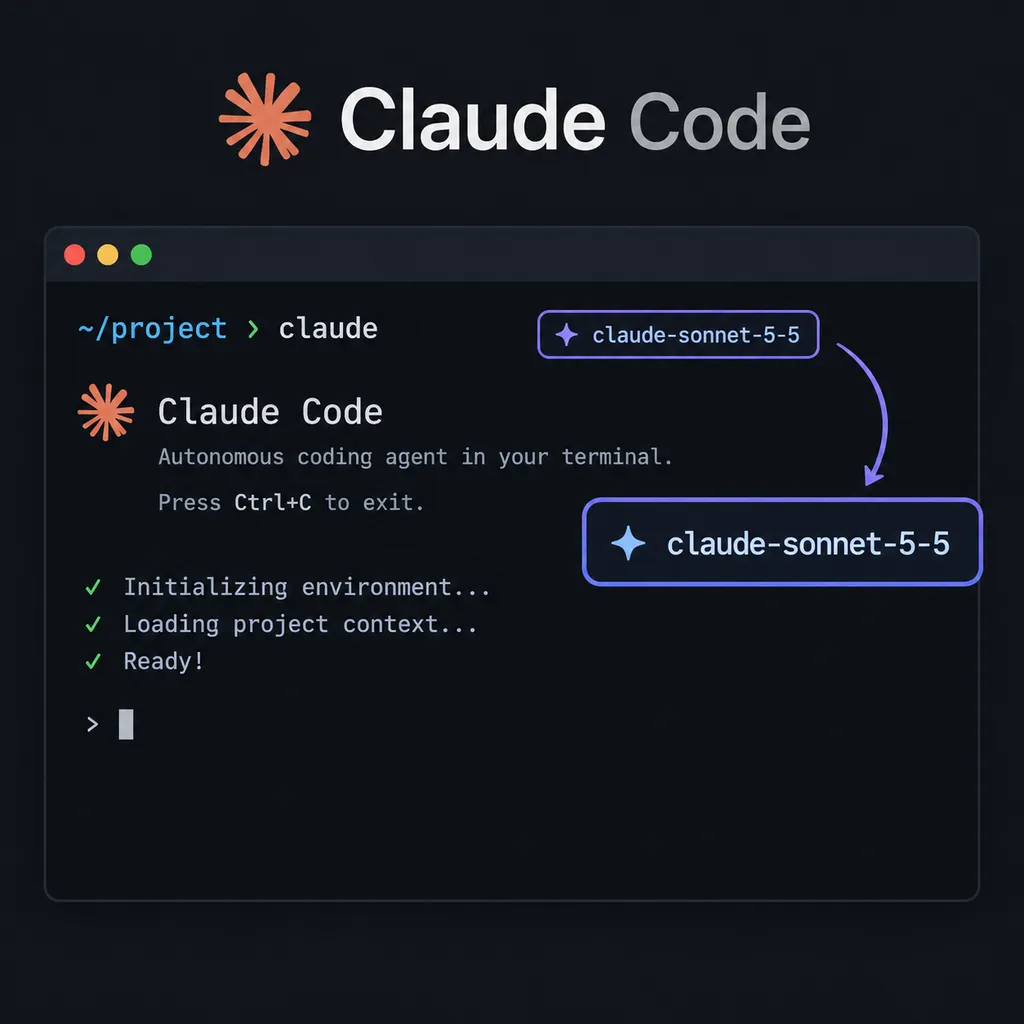
The Appearance of the Model Identifier Is Currently the Strongest Clue
The source of this round of rumors is that developers discovered a group of parallel model configurations in publicly available client builds. The circulating content roughly includes:
claude-opus-5-5
claude-sonnet-5
claude-sonnet-5-5
claude-fable-5.1
The most important one is naturally claude-sonnet-5-5.
When a model name is written into a production client, it usually means that the product team has begun preparing a frontend entry point, capability switch, routing rule, or compatibility configuration for the release. This is more credible than a benchmark screenshot without context, but it cannot be directly equated with “the model has already been fully deployed.”
Large companies often write product names that have not yet been made available into their clients several weeks in advance. On the one hand, this allows different client versions to support them ahead of time; on the other, it is necessary for A/B testing, employee testing, and limited rollouts. The configuration may correspond to a real model, or it may simply be an alias temporarily pointing to an older model.
Therefore, this clue can prove only two things:
- Anthropic is preparing an official product entry point for Sonnet 5.5;
- The release process has reached the stage of client-server integration, rather than remaining solely an internal research project.
It cannot prove that the performance, pricing, and context window being circulated online have been finalized.
Related discussions on Reddit also show users claiming that they briefly saw Sonnet 5.5, while dedicated configuration appeared in publicly available client builds. However, there is currently no reproducible verification in the form of API response headers, model snapshot dates, or official console screenshots. The evidence remains at the stage of “looks very real.” (reddit.com)
What Is Being Called “Stealth Testing” May Be Dynamic Routing Rather Than a Secret Model Swap
Another widely circulated claim is that some Claude Code users select Sonnet 5, while the backend has actually routed their requests to Sonnet 5.5.
This is not technically complicated. A model provider does not necessarily need to change the model name visible to users. It only needs to switch backend versions at the gateway layer according to the account, region, request type, or randomly assigned experiment group. For example:
- The user’s requested model remains
claude-sonnet-5; - The routing service determines whether the account belongs to the experiment group;
- Requests from the experiment group are sent to a Sonnet 5.5 candidate version;
- The control group continues using Sonnet 5;
- Anthropic compares task success rates, latency, token consumption, and user interruption rates.
For Agent products such as Claude Code, limited rollout testing is especially valuable. With traditional chat models, it is sufficient to compare response quality. Programming Agents, however, require observation of an entire execution chain: Can the agent correctly read a repository? Will it modify unrelated files? Can it recover the task state after calling a tool? Will it proactively roll back when tests fail? And after running for twenty minutes, does it still remember the original objective?
These metrics are difficult to measure through static benchmarks. The data that truly matters often comes from long-running tasks in real codebases.
However, the “knowledge passphrase tests” circulating online cannot prove that a user is calling Sonnet 5.5. For example, some people suggest disabling web access and memory features, then asking the model whether it knows a particular developer or a recent meme. If the model can answer, they conclude that it is a newer version.
At most, such a test can show that the model has encountered more recent data. It cannot rule out the following possibilities:
- The system prompt injected additional background information into the model;
- Claude Code still retained some conversation-level or project-level context;
- The request was enhanced by search, caching, or another internal tool;
- Sonnet 5 itself had received updated weights or data, rather than being switched to 5.5;
- The relevant content had already entered a dataset accessible to the older model.
The most reliable evidence for identifying a model in limited rollout remains verifiable model identifiers, response metadata, and a large number of repeated tests—not asking the model, “Who are you?” Large language models have always been unreliable when it comes to questions about their own identity. Its saying that it is Sonnet 5.5 carries no more evidentiary value than a button on a webpage.
If Its Capabilities Really Approach Opus, Sonnet 5.5 Will Be Extremely Difficult to Beat
The rumor attracting the most developer attention at this stage is that Sonnet 5.5 may approach Opus 5.5 on coding and Agent tasks, and may even come close to flagship models from other vendors.
There is no formal benchmark support for this claim yet, but the direction would not be surprising. Anthropic’s newly released Opus 5.5 focuses on improvements in Agentic Coding, computer use, long-task stability, and per-task cost. The company also stated that Sonnet 5.5 will inherit multiple performance, efficiency, and safety improvements from the same model generation.(anthropic.com)
More importantly, Sonnet has never been the “cheap, cut-down version” of Anthropic’s product line. Its role is to serve as the default production model: It must be powerful enough while remaining affordable for developers to call frequently.
For programming Agents, a model’s commercial value is also not determined by its score on a single benchmark. Even if a model scores two or three points higher on benchmarks, it may still cost more in practice if each execution consumes a large number of tokens, repeatedly rereads files, or requires developers to correct it over and over.
Conversely, a slightly weaker but more stable Sonnet that takes fewer wrong turns may be better suited than the flagship Opus to serve as the default Agent. What developers truly need is not a model that occasionally produces astonishing code, but one that can work continuously, respect boundaries, proactively run tests after making changes, and avoid forgetting the task after its tenth tool call.
Therefore, the most important things to watch with Sonnet 5.5 are not whether it can “defeat the flagship” on a particular leaderboard, but the following metrics:
- Long-task completion rate: Can it accomplish the original objective after dozens of tool calls?
- Code modification precision: Does it reduce unrelated refactoring and broad file overwrites?
- Self-correction ability: Can it identify the root cause after a test failure instead of endlessly patching symptoms?
- Context utilization: Can it find the truly relevant files when faced with a large repository?
- Per-task cost: How many input, output, and cached tokens are required to complete the same ticket?
- Latency stability: Does it remain suitable for interactive development during peak periods?
As long as these metrics approach those of Opus 5.5, Sonnet 5.5 does not need to win every benchmark. It would directly become the default choice for a large number of Coding Agents and enterprise automation workflows.
A $2 Input Price Is Likely a Reasonable Estimate, Not a Confirmed Quote
A leak claims that Sonnet 5.5’s API input price could be as low as $2 per million tokens. The figure sounds aggressive, but it actually follows the current pricing of Sonnet 5.
Anthropic’s publicly listed price for Sonnet 5 is currently $2 per million input tokens and $10 per million output tokens. In August, the company adjusted what had originally been promotional pricing to long-term pricing.(anthropic.com)
The question is whether Sonnet 5.5 will maintain this price. Anthropic has not yet confirmed that.
From a competitive-strategy perspective, maintaining a $2 input price would be a reasonable choice. Opus 5.5 already emphasizes efficiency through a lower per-token price and lower token consumption per task. If Sonnet 5.5 were to raise its price instead, it would weaken the central narrative of this generation of products.
However, developers should not focus only on the input price. In Agent workloads, output, cache writes, cache reads, and repeated calls often have a greater impact on total cost than the initial input. If a repository contains hundreds of thousands of lines of code and every tool call resubmits a large amount of context, the bill can still grow rapidly even when the per-input-token price is low.
The truly meaningful question is not “How much does it cost per million tokens?” but “How much does it cost to fix a bug?”
If Sonnet 5.5 can complete tasks in fewer steps, reduce erroneous modifications, and improve Prompt Cache hit rates, it could deliver a significant real-world price reduction even if its list price remains unchanged. Conversely, if the model becomes more inclined to think and produce more output, an unchanged list price does not mean project costs will remain unchanged.
What Anthropic Wants to Capture Is Developers’ Default Model Position
If Sonnet 5.5 is released around September 29 in U.S. time—that is, around the early morning of September 30 in Beijing time—it could indeed directly compete with OpenAI’s developer event in terms of timing. However, there is currently no official schedule confirming this date.
Even if the release timing is merely a coincidence, Anthropic’s objective is clear: Bring the Agent capabilities demonstrated by Opus 5.5 down to the cheaper, faster Sonnet product line as quickly as possible.
Flagship models define the upper limit of capability; Sonnet captures the volume of usage. For model providers, the latter is often more important.
Companies are unlikely to use the most expensive flagship model for every code review, customer-service operation, and data-processing task. A model that can truly enter production needs to strike a balance among capability, latency, cost, and controllability. Whoever secures the default model position in IDEs, terminals, and automation platforms will find it easier to establish developer habits and ecosystem lock-in.
That is why Sonnet 5.5 may be more worth watching than Opus 5.5. Opus determines what Anthropic is capable of; Sonnet determines whether ordinary teams can afford it and whether they dare to enable it by default.
It Is Not Advisable to Modify Production Configurations for Rumors Yet
For developers, the safest approach at this stage is not to chase hidden models, but to prepare for model switching in advance:
- Do not scatter hard-coded model names throughout business code;
- Put the model ID, timeout, maximum output, and reasoning intensity in a configuration center;
- Maintain fixed evaluation sets for core tasks and run regression tests after release;
- Record task success rate, token cost, time to first token, and total execution time simultaneously;
- Retain approval and rollback mechanisms for high-risk tools such as file writing and command execution;
- During the limited rollout, avoid using the model’s self-description as the basis for determining its version.
Once the API officially becomes available, OpenAI Hub and other aggregation platforms compatible with the OpenAI format can also reduce switching costs, allowing the same Agent implementation to be tested comparatively across Claude, GPT, Gemini, and other models. But before the official model ID, pricing, and context specifications are announced, it is not advisable to hard-code claude-sonnet-5-5 in advance, and production budgets should certainly not be estimated according to prices circulating online.
Since Sonnet 5.5 has not yet been officially released, this article does not provide an API usage example either. Any code provided now would most likely merely wrap a model name that is not yet available, offering developers no practical benefit.
Assessment: The Release Is Near, but “Crushing the Flagship” Is Still a Traffic-Driving Narrative
Taken together, the official preview, client configuration, and user feedback make it quite credible that Sonnet 5.5 is undergoing release preparations. It may already have entered internal testing or a small-scale limited rollout, or it may soon open to a larger share of Claude Code traffic.
However, claims that it will “crush” a particular model, “approach flagship-level performance,” offer a “1.5-million- or 2-million-token context window,” or cost “only $2 for input” should all currently be regarded as unconfirmed leaks. In particular, different posts have mixed together model names, internal credits, and API prices, while some comparisons were not conducted in publicly disclosed testing environments. They therefore do not yet have serious reference value.
Our assessment is: Sonnet 5.5 will very likely arrive soon, and its real impact will probably not come from ranking first on benchmarks, but from offering near-Opus Agent task completion at Sonnet pricing.
If Anthropic achieves this, the greatest pressure will not fall solely on a particular flagship model, but on the pricing logic of every product that depends on “high-priced models to perform Agents reliably.”
Sources
- ITHome: Anthropic Claude Sonnet 5.5 Model Leaked Ahead of Release — Summarizes the client identifier, limited rollout rumors, and early user feedback.
- Reddit: Will Sonnet 5.5 Be Released Soon? — Community discussion of the public client configuration and suspected limited rollout; the content has not yet been officially confirmed.