Doubao Accelerates Its Bet on Personal Assistants
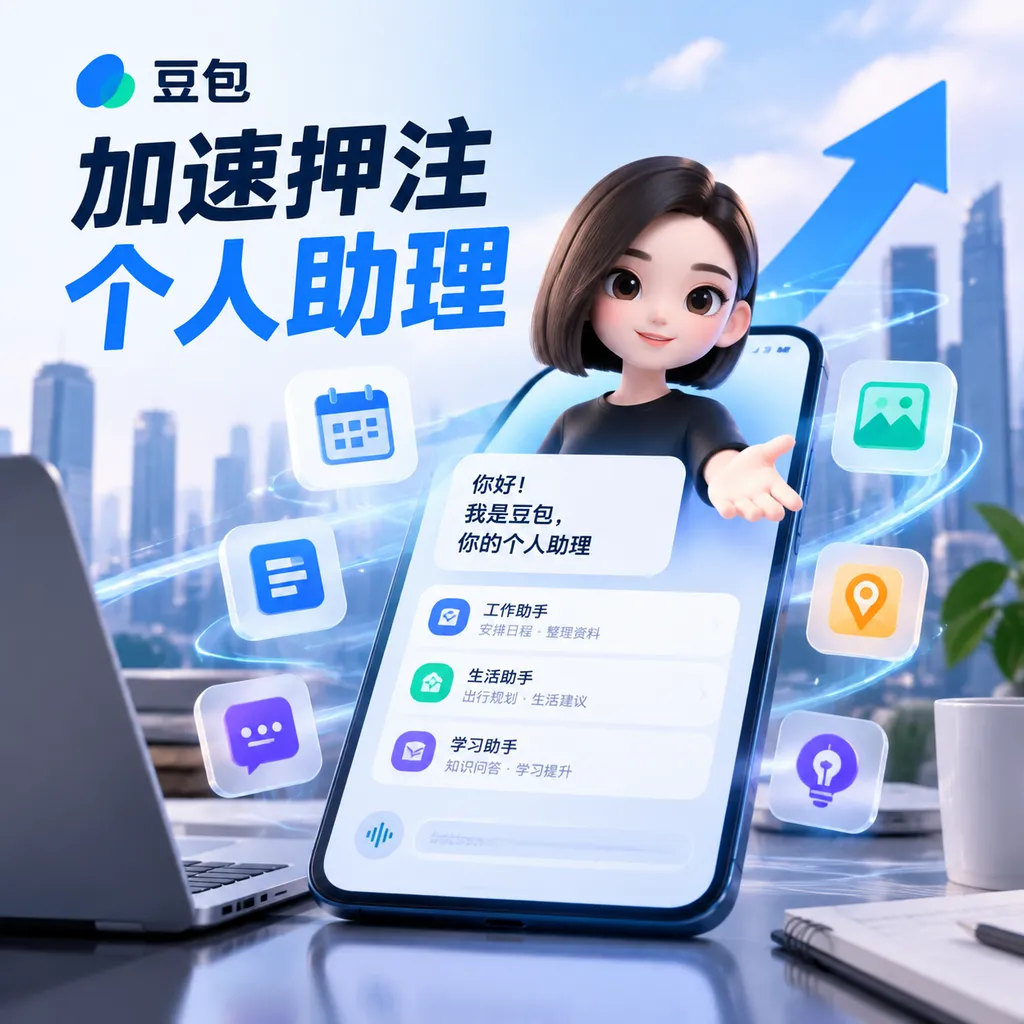
According to reports, Doubao internally tested a personal assistant project codenamed “Spell” in April this year. It now plans to merge the project with its conversation team and accelerate its development toward a public release. This could be a key step in Doubao’s smartphone assistant evolving from a system-level entry point into an independent product.
Doubao Accelerates Launch of Personal Assistant, Spell May Be Integrated into Its Conversational Capabilities
Doubao is moving its personal assistant from mobile-side experimentation toward a more independent and complete product form.
On September 29, Sina Technology reported that Doubao is advancing plans for a personal assistant product internally. In April this year, Doubao began internal testing of an exploratory project codenamed “Spell,” which was mainly handled by the Doubao Phone Assistant team. Due in part to the progress of Doubao’s phone-related products, Spell had not previously been officially unveiled to the public.
Doubao now plans to integrate Spell more deeply with its products, with the Spell project team and the Doubao Conversation team jointly responsible for it. According to people familiar with the matter, the related product is expected to be released publicly relatively soon.
This means that Doubao’s view of the personal agent has changed. It is no longer satisfied with treating an AI assistant as merely a “functional entry point” on a phone. Instead, it is beginning to explore how to turn it into an independent product capable of understanding users over the long term, calling tools, and completing tasks on users’ behalf.
Spell Was Not a Project That Appeared Out of Nowhere
Based on the information currently available, Spell appears more like an extension of Doubao’s phone assistant strategy than a completely new product built from scratch.
In December 2025, the technical preview of Doubao Phone Assistant made its debut, running on the Nubia M153 engineering prototype developed in partnership with ZTE. By September 2026, the consumer version of Doubao Phone Assistant was officially released on the Nubia NaviX Ultra. Compared with the early preview version, the consumer version placed greater emphasis on stability and usability in everyday scenarios.
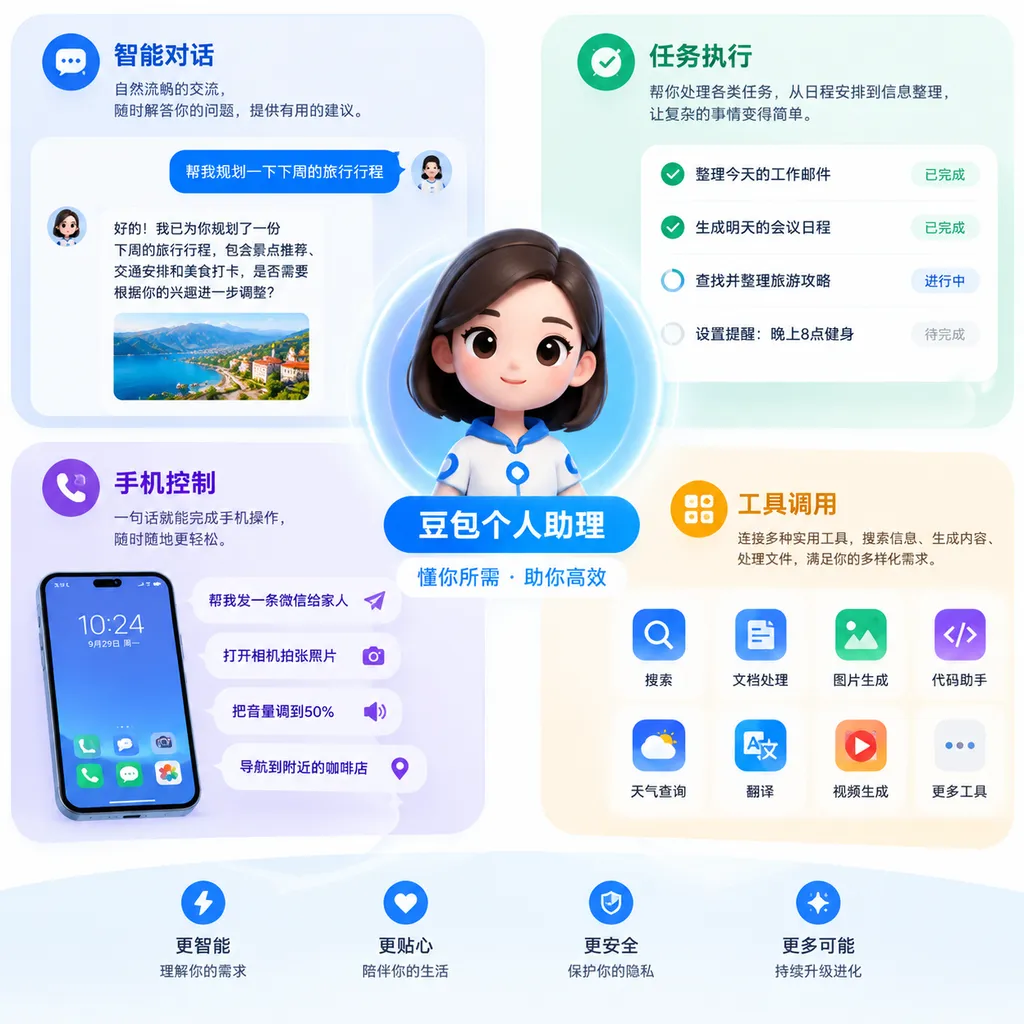
The core of this product path is not to give users another chat window. Rather, it is to bring the model into the phone’s operational workflow: reading screen content, understanding user intent, finding information across apps, executing taps and text input, and ultimately delivering the results to the user.
Traditional chatbots solve the problem of “answering questions.” A personal assistant needs to solve the problem of “getting things done.”
For example, if a user says, “Find me high-speed rail tickets suitable for a business trip next week and organize them into an itinerary,” an ordinary conversational model might provide search suggestions or generate a piece of text. A true personal assistant, however, would need to identify the dates, access a ticketing service, filter train options, handle login and payment boundaries, and ask the user for confirmation at key points. The two may appear to differ by only one verb, but behind them lie completely different products and engineering systems.
Spell’s value lies in its potential to transfer the device-control, task-planning, and cross-app operation capabilities accumulated by Doubao Phone Assistant into an independent app that is easier for users to access.
Why Is Doubao Accelerating Now?
Changes in the external market may be an important reason why Doubao is accelerating its timeline.
Reference information mentions that personal assistant products such as Muse and Instinct have recently attracted attention overseas. Regardless of whether these products ultimately become mainstream, the market has already developed a clear expectation: the next stage of AI competition will not be only about which model gives smarter answers. It will also be about who can enter users’ real workflows and daily routines sooner.
Over the past two years, leading AI applications in China and abroad have mostly competed in conversation, search, writing, and content generation. As model capabilities have rapidly improved, basic question-and-answer experiences have begun to converge. The products users are truly willing to use continuously are often not those that merely “chat well,” but those that can remember context, connect to services, and complete repetitive tasks for users within the scope of their authorization.
Doubao has a relatively clear advantage in this regard: it already has a mature conversational product, broad user reach, and system-level operational experience from its phone assistant. If Spell is merged with the conversation team, the move would not simply involve combining the features of two apps. Instead, it could combine two directions into a single product chain:
- The conversation team would be responsible for natural-language understanding, context management, personality, and interaction experience;
- The phone assistant team would be responsible for screen understanding, system control, cross-app execution, and closing the task loop;
- The product side would need to package these capabilities into a personal assistant that users can genuinely understand, feel comfortable authorizing, and be willing to use repeatedly.
This would be more meaningful than simply launching “a new skin for a chatbot.”
The Challenge for Personal Assistants Is Not Whether They Can Chat
From a developer’s perspective, the barriers to building a personal assistant are concentrated in four areas.
1. From Intent Recognition to Task Decomposition
Users do not describe their needs like they are calling an API. They might say, “Organize the articles I’ve recently bookmarked, focus on the ones about the AI industry, and make a weekly report while you’re at it.”
The system needs to determine how long “recently” refers to, which app the bookmarks come from, how “AI industry” should be categorized, and what format the “weekly report” should take. This process involves contextual memory, user preferences, tool selection, and task planning. If any one part is misunderstood, the final result will deviate from expectations.
2. From Generating Text to Executing Actions
Generating a piece of text is relatively easy. Controlling a phone and third-party apps is much more complex. A personal assistant must handle changes in app interfaces, permission restrictions, login status, network errors, and irreversible operations.
This is also why a phone assistant cannot rely solely on a single large model. It typically also needs screen parsing, UI-element localization, operation strategies, exception recovery, permission management, and auditing mechanisms. The model is responsible for deciding “how to do it,” while the execution layer determines “whether it can be done and what to do if something goes wrong.”
3. Reliability Must Be Higher Than in Chat Products
In a chat scenario, if a model occasionally gives a wrong answer, the user can simply ask again. But if a personal assistant accidentally deletes a file, sends the wrong message, or places an incorrect order, the cost to user trust rises immediately.
Therefore, a personal assistant cannot focus only on task-success rates. It must also handle confirmation mechanisms and risk classification:
- Information queries can be executed automatically;
- Draft editing can be performed first and confirmed afterward;
- High-risk actions such as sending messages, making payments, and deleting files must require explicit user authorization;
- When a task fails, the system needs to tell the user where it became stuck rather than concealing the failure behind a fluent block of text.
If Doubao wants to turn Spell into a product that people use over the long term, these details may be more important than the size of the model’s parameter count.
4. Long-Term Memory and Privacy Boundaries
A personal assistant is “personal” because it needs to know a user’s habits, contacts, schedule, devices, and frequently used services. But this information also entails greater privacy risks.
The product must clearly define what data can be remembered, how long it will be stored, who can access it, and how users can delete and export it. Developers will also be concerned about whether data is used to train models, whether unauthorized access exists between different apps, and how responsibilities are divided between cloud-based models and local execution.
If these questions do not have clear answers, users may be willing to try a personal assistant occasionally, but they will find it difficult to entrust it with long-term management of their personal affairs.
Is Merging with Doubao’s Conversational Capabilities an Advantage or a Compromise?
Having Spell jointly managed by the Doubao Conversation team could, in theory, help solve the fragmentation that is currently common among personal assistants.
Many AI products treat conversational and execution capabilities as two separate systems: the conversational model can understand users but does not know how to call device functions, while automation tools can complete fixed actions but cannot handle ambiguous needs expressed in natural language. If the two are not genuinely integrated, users have to switch back and forth between “an AI that can chat” and “a tool that can perform actions.”
If Doubao places Spell’s execution capabilities within its main conversational product, users could launch a task with a single sentence and then view its progress, add conditions, and confirm the result within the same conversation. This interaction would be closer to a “task thread” than a one-off question-and-answer exchange.
However, the integration also carries risks.
First, phone assistants often require stronger system permissions and more complex runtime environments, so they cannot simply reuse the session architecture of a cloud-based conversational product. Second, as a mass-market product, Doubao needs to control the risks of accidental operations and privacy violations, which could limit the degree of automation available to the personal assistant. Third, the two teams may have different product goals: the conversation team may prioritize response speed and smooth interaction, while the assistant team may focus more on execution success rates and exception handling. After integration, the teams will need to redefine their metrics.
In other words, the real difficulty in merging Spell with Doubao lies not in the organizational structure, but in establishing a shared task-execution system.
The Next Step for Doubao Phone Assistant Is More Than an Independent App
If Spell is eventually released, it will probably not be just another chat application.
A more logical direction would be for it to become a personal task layer within the Doubao ecosystem. Users could initiate requests through the phone assistant, the Doubao app, or other entry points, while the system would call on search, calendar, file, content-generation, and third-party service capabilities according to the type of task. For developers, this form could also introduce new ways to integrate with the platform. In the future, competition may not be limited to “which apps users open,” but may also involve “which apps personal assistants can call.”
This would change the logic of app distribution and interaction. In the past, users opened an app first and then searched for a feature. In the personal assistant model, users first state a goal, and the AI decides which apps and tools to invoke. For app developers, interfaces will remain important, but standardized capability interfaces, clear permission boundaries, and stable task-result callback mechanisms will become even more important.
Of course, there has been no official confirmation of whether Doubao will release Spell as an independent brand, whether it will continue using “Spell” as the codename, or whether the personal assistant will initially focus on mobile devices. The existing information primarily comes from people familiar with the matter, and the final product name, feature scope, and release date may still change.
Assessment: What Doubao Needs to Prove Is Not That It “Can Do It,” but That It Is “Worthy of Trust”
It is not surprising that Doubao is entering the personal assistant space. What is truly worth watching is that it has already established a continuous strategy spanning models, conversational products, and mobile entry points, with Spell potentially serving as the point where this strategy moves from internal exploration to a public product.
But a personal assistant will not automatically succeed simply because it is connected to a more powerful model. It must meet usability standards in three areas at the same time:
- Sufficiently accurate understanding: It must be able to handle colloquial, ambiguous, and multi-turn task descriptions;
- Sufficiently stable execution: Cross-app operations must not frequently get stuck or trigger accidental actions;
- Sufficiently transparent authorization: Users must know what the AI has seen, what it has done, and whether confirmation is required for the next step.
The industry’s discussion of personal agents has now moved beyond “Can the model call tools?” to “Are users willing to entrust it with real tasks?” Doubao Phone Assistant provides a system-level testing ground, while Spell may be responsible for productizing and scaling these capabilities.
If Doubao can genuinely combine mobile-side execution capabilities with the low barrier to entry of its conversational product, it has an opportunity to become an important player in China’s personal assistant competition. But if it ultimately only moves a few demo features from the phone assistant into a chat app, users will quickly regard it as yet another short-lived novelty feature.
Going forward, the details developers should watch most closely are not the task demonstrations at the launch event, but three specific questions: Can it provide stable tool-calling capabilities? Can it handle long-running tasks and failure recovery? How does it define the confirmation boundaries for high-risk operations? These factors will determine whether Spell is merely a product codename or the main product line for Doubao’s next stage.
References
- IT Home: Doubao to Launch a Personal Assistant Product: Internal Testing Began in April, Previously Codenamed “Spell” — Report on Doubao’s personal assistant plans, internal testing of the Spell project, and information about the team merger.