Qoder extends Qwen’s free period, with Credits remaining free in October

Qoder announced an extension of its limited-time free access to Qwen3.8-Flash. Originally scheduled to end on September 30, it will remain free starting October 1, with no end date announced yet. Usage by individual users will not consume Credits.
Qoder Extends Its Qwen Free Access Promotion
Qoder has not ended free access to Qwen3.8-Flash on September 30.
On September 29, an official Qoder announcement revealed that the limited-time free access promotion for Qwen3.8-Flash, originally scheduled to end at 23:59:59 on September 30, 2026, has been extended. Starting October 1, individual users can continue using the model directly in Qoder products. Its billing multiplier will remain at 0.0×, meaning it will not consume Credits. A new end date has not yet been announced, and Qoder says advance notice will be posted on the promotion page.
This means developers do not need to rush to “use up the free quota” tonight, requalify for the promotion, or adjust their account settings. Simply select Qwen3.8-Flash in the model selector to continue using it.
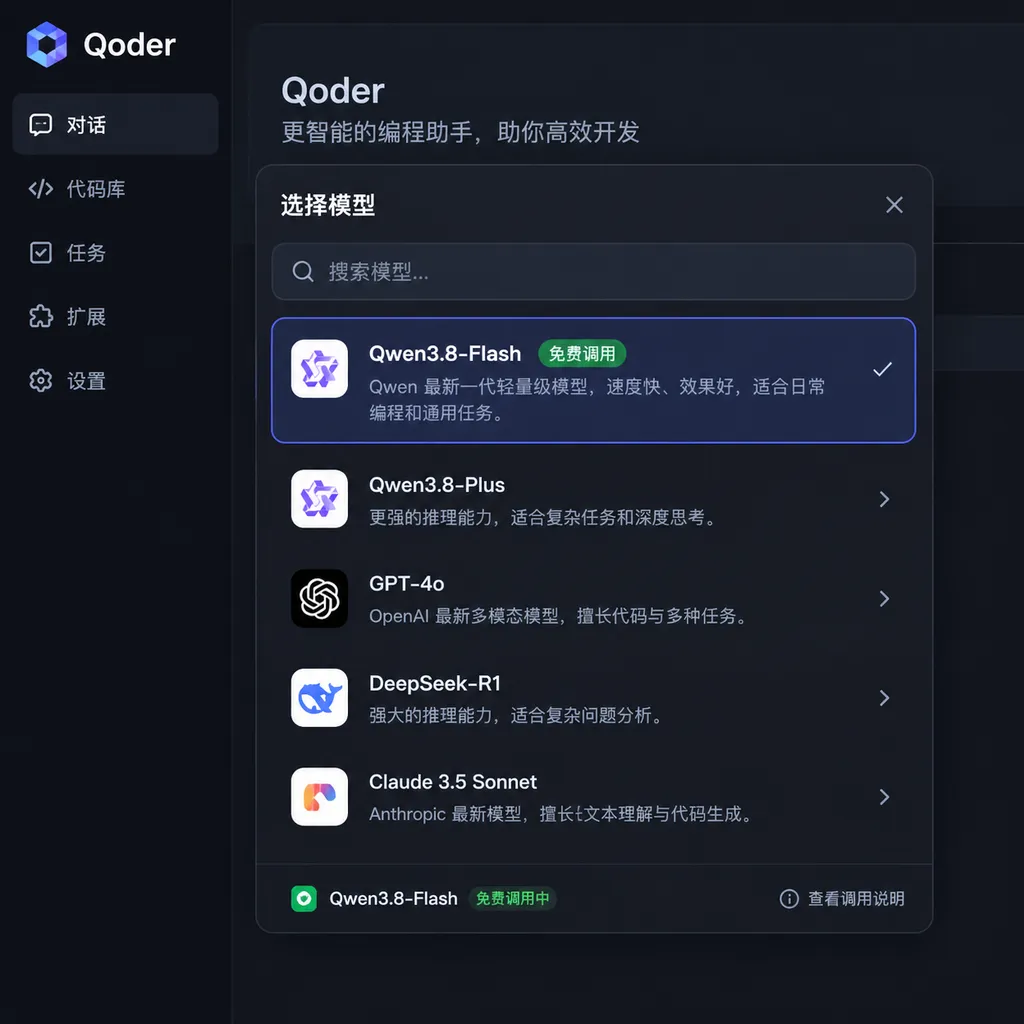
“Free” Does Not Mean Bonus Credits—It Means a 0 Billing Multiplier
The key to this promotion is not that Qoder is issuing an additional batch of Credits, but that it has directly changed the platform’s billing rules for Qwen3.8-Flash.
Qoder originally set the model’s billing multiplier at 0.1×, which has been reduced to 0.0× for the duration of the promotion. From a developer’s perspective, this effectively creates a dedicated free-access channel for the model:
- It does not consume Credits included in a subscription plan;
- It does not consume the 100 general-purpose Credits available daily;
- It remains accessible even when the account balance is 0;
- No free-access eligibility needs to be claimed;
- It does not affect the account’s current subscription tier or the billing rules for other models.
It is important to note that free access to Qwen3.8-Flash does not mean the entire Qoder platform is free. The promotion applies only to the designated model; other models and tiers continue to follow their respective pricing and billing multipliers. For users working with Claude, GPT, Gemini, or other advanced models, Qwen3.8-Flash is better viewed as a “low-cost workhorse” that can replace them for certain everyday tasks—not as a universal substitute for all model quotas.
Qoder Credits are essentially platform-side usage points for model calls. Different models and model tiers generally have different deduction multipliers. With Qwen3.8-Flash’s multiplier now set to 0, using it will not reduce a user’s balance, leaving the 100 daily Credits available for other models that still incur charges.
Who Is Eligible?
According to Qoder’s promotion page, the extension applies to both new and existing individual users of Qoder’s international edition. This includes users on the free trial edition, users in a Pro trial, and subscribers to Pro, Pro+, and Ultra.
Supported products and access points include:
- Qoder Desktop;
- Qoder IDE;
- Qoder JetBrains Plugin;
- Qoder CLI;
- QoderWake;
- Qoder Cloud Agents;
- Qoder Mobile;
- Qoder Web.
Team and Enterprise subscribers are not included in this promotion. This restriction is important: teams using Qoder for centralized project collaboration or enterprise Agent deployments cannot simply apply the individual-edition promotion rules to team accounts.
Using the promotion is straightforward: sign in to an individual account on Qoder’s international edition, open the model selector within the product, and select Qwen3.8-Flash. Free accounts and accounts with a Credits balance of 0 can also use it directly.
However, Qoder has warned that usage of the model may increase significantly during the promotion, potentially leading to slower responses during peak periods. For automated tasks requiring consistent latency—particularly CLI scripts, Cloud Agents, or batch code reviews—“free” should not be interpreted as “backed by an SLA.” If requests are queued or responses slow down, retrying, using the service during off-peak hours, or switching to another available model remain the most practical options.
Why Qwen3.8-Flash?
From a product-positioning perspective, Qwen3.8-Flash is not intended to replace the most powerful reasoning models. Instead, it aims to strike a balance among speed, cost, and general-purpose capabilities, making it suitable for large volumes of low-risk, repetitive development work.
Qoder describes its capabilities as including code generation, long-document processing, image understanding, and tool use. These capabilities cover many of the most common tasks performed with AI coding tools:
- Code completion and localized changes: Completing implementations based on function context, fixing obvious errors, and generating test cases.
- Repository-level Q&A: Quickly explaining project structures, locating configuration files, and summarizing a module’s call chain.
- Long-document organization: Condensing requirements documents, API specifications, or logs into development summaries and extracting action items.
- Image understanding: Reading UI screenshots, flowcharts, or error screenshots to help identify problems.
- Tool use: Working with file-reading, search, terminal, or other Agent tools to carry out relatively standardized tasks.
These tasks do not require the model to produce groundbreaking reasoning every time. Instead, they require sufficiently fast responses, reliable context handling, and code changes that are not overly aggressive. In other words, the value of Qwen3.8-Flash lies more in how frequently it can be used than in the upper limit of any single response.
For developers, a Flash model that remains free for a meaningful period can take on many tasks that would not otherwise justify consuming expensive model quotas. For example, developers can first have it scan a repository and list potentially affected files, then hand genuinely complex architectural design and difficult debugging work to a more capable model. This combination—using an inexpensive model for triage and a high-end model for decisions—better reflects real-world cost structures than routing every request to a flagship model.
What the Extension Means: Qoder Is Competing to Own the Workflow Entry Point
At first glance, this extension may seem like a simple adjustment to a promotional benefit, but it reflects a shift in the competition among AI coding tools: models themselves are increasingly difficult to use as the sole selling point. The products that establish themselves within developers’ daily workflows are more likely to retain users.
Qoder already spans multiple access points, including IDEs, JetBrains, the CLI, mobile devices, and Cloud Agents. Making Qwen3.8-Flash free further reduces the cost of model calls behind these access points. Users can ask the model to explain code, summarize documents, scan projects, and make simple changes more frequently without calculating whether they have enough Credits every time.
This is particularly effective for new users. Developers who are just beginning to try AI coding tools generally will not immediately purchase a premium plan, but they may be willing to use a model that does not consume their quota to test code Q&A, Agent execution, and project-indexing capabilities. Once the model becomes part of their daily workflow, users may then consider more powerful models, higher concurrency, or team features.
Of course, the free-access strategy also has clear limitations. First, the free period for Qwen3.8-Flash has no specified end date, so developers cannot treat it as a stable long-term pricing commitment. Second, peak-time congestion caused by free access may offset some of the model’s speed advantage. Third, its performance on tasks such as complex refactoring, cross-file architecture design, and strict compliance with large codebase conventions still needs to be validated in real projects rather than judged from a single demonstration.
A more prudent approach is to integrate it into a tiered workflow: use the Flash model for retrieval, preliminary analysis, and low-risk changes; for database migrations, permission logic, payment processes, or production-environment changes, use a more capable model for review while retaining testing, diff inspection, and human review.
Daily 100 Credits and the Free Model Are Separate Benefits
Qoder previously introduced a promotion offering 100 general-purpose Credits that users can claim daily. These two benefits should not be confused: calls to Qwen3.8-Flash do not deduct from those 100 Credits, while the daily rewards continue to be calculated and expire under separate rules.
Claimed Credits are not automatically cleared when the date changes, and unused Credits can accumulate during their validity period. Newly claimed rewards generally remain valid for 30 days from the date they are claimed and do not extend the validity period of previously claimed rewards. Developers can reserve these general-purpose Credits for other models that still incur charges, particularly for complex code generation, long-context analysis, or higher-quality reasoning tasks.
This means a sensible short-term usage strategy would be to:
- Use Qwen3.8-Flash for frequent, low-risk tasks that can be retried quickly;
- Use daily Credits for requests requiring more advanced capabilities;
- Confirm whether a task involves sensitive code or production data before switching models;
- Configure timeouts, retries, and human confirmation mechanisms for Cloud Agents and CLI tasks;
- Continue testing, reviewing code, and isolating permissions despite the free access.
What Should Developers Do Now?
If you already use Qoder, there is essentially nothing you need to do. After October 1, simply select Qwen3.8-Flash, and the promotion will apply automatically.
If you plan to use it for real projects, it is advisable to conduct a small-scale evaluation first, focusing on four factors: whether code changes tend to exceed their intended scope, whether instruction-following remains reliable with long contexts, how well the model recovers from tool-use failures, and actual latency during peak periods. Free access lowers the cost of experimentation, but it does not automatically improve model quality.
Based on the information currently available, this extension is a tangible benefit for Qoder users, particularly individual developers and team members who are experimenting with AI coding tools. It allows Qwen3.8-Flash to handle more tasks where users want to “let the model take a first pass,” reducing the constraints that Credits place on everyday experimentation.
However, it is better understood as a user-acquisition and workflow-adoption strategy than as a permanent price reduction. No end date has been announced, and once the promotion ends, billing will follow the multiplier published at that time. Developers can use the free period to establish a division of labor among models, but they should not bind critical systems entirely to a promotion that could revert to paid billing at any time.
For developers who need to switch among multiple models while maintaining compatibility with the OpenAI format, API aggregation platforms remain better suited to unified integration and cost comparisons. Qoder’s advantage, meanwhile, lies in embedding models directly into IDE, CLI, and Agent workflows. The two address different layers of the problem: the former manages access points and model routing, while the latter emphasizes real-time collaboration within the development environment. What truly matters is not which model is temporarily free, but whether it remains valuable enough for developers to keep using after the free period ends.
References
- ITHome: Alibaba’s Qoder Platform Extends Limited-Time Free Access to Qwen3.8-Flash — Covers the promotion extension, eligible users, supported products, and Credits deduction rules.