GPT-6 Astra Ultrafast Is Here, With an API Nearly 6× Faster
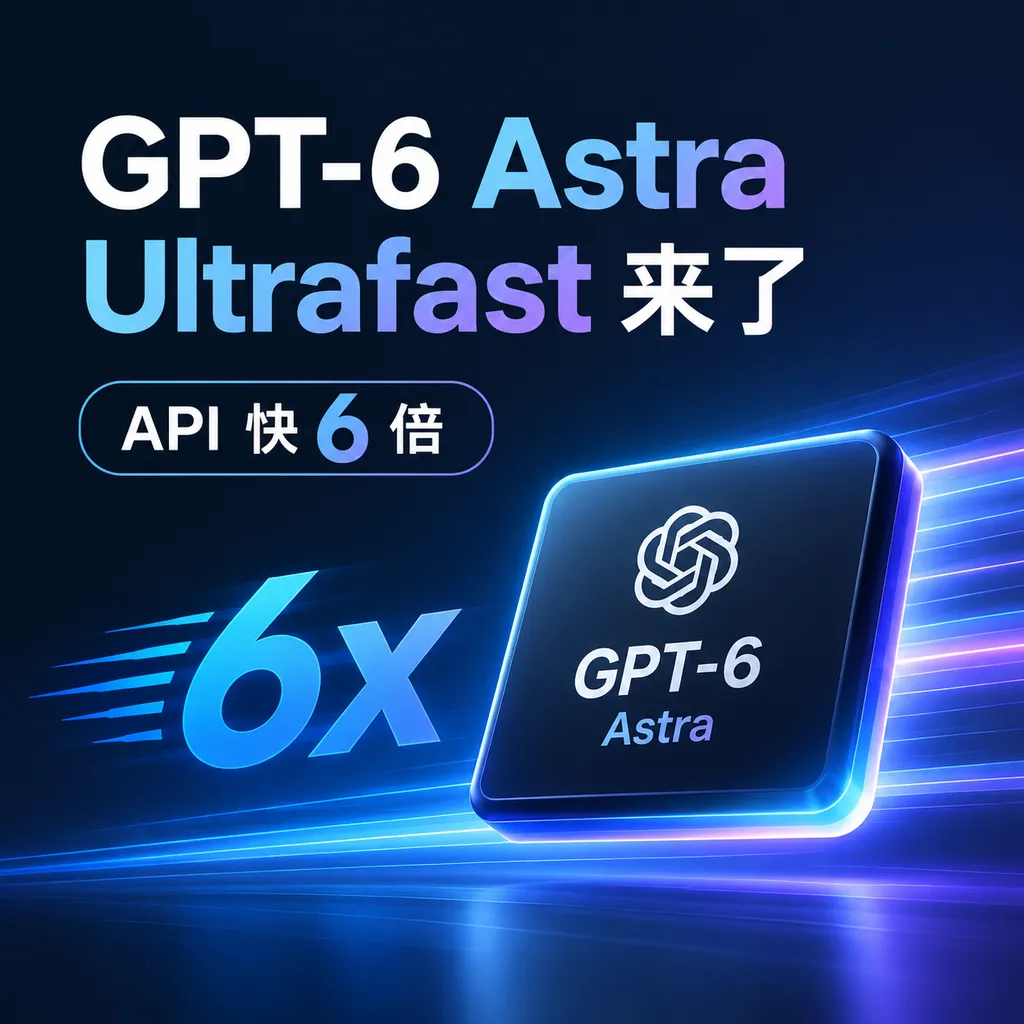
OpenAI launched GPT-6 Astra Ultrafast at its Developer Day on September 30. API generation speeds can be up to 6 times faster, reaching as high as 300 tokens per second in Codex, but output pricing is also significantly higher.
GPT-6 Astra Ultrafast Is Here, Boosting API Generation Speeds by Up to 6×
At its 2026 Developer Day event held today, OpenAI introduced a new Ultrafast service tier and made it available for GPT-6 Astra.
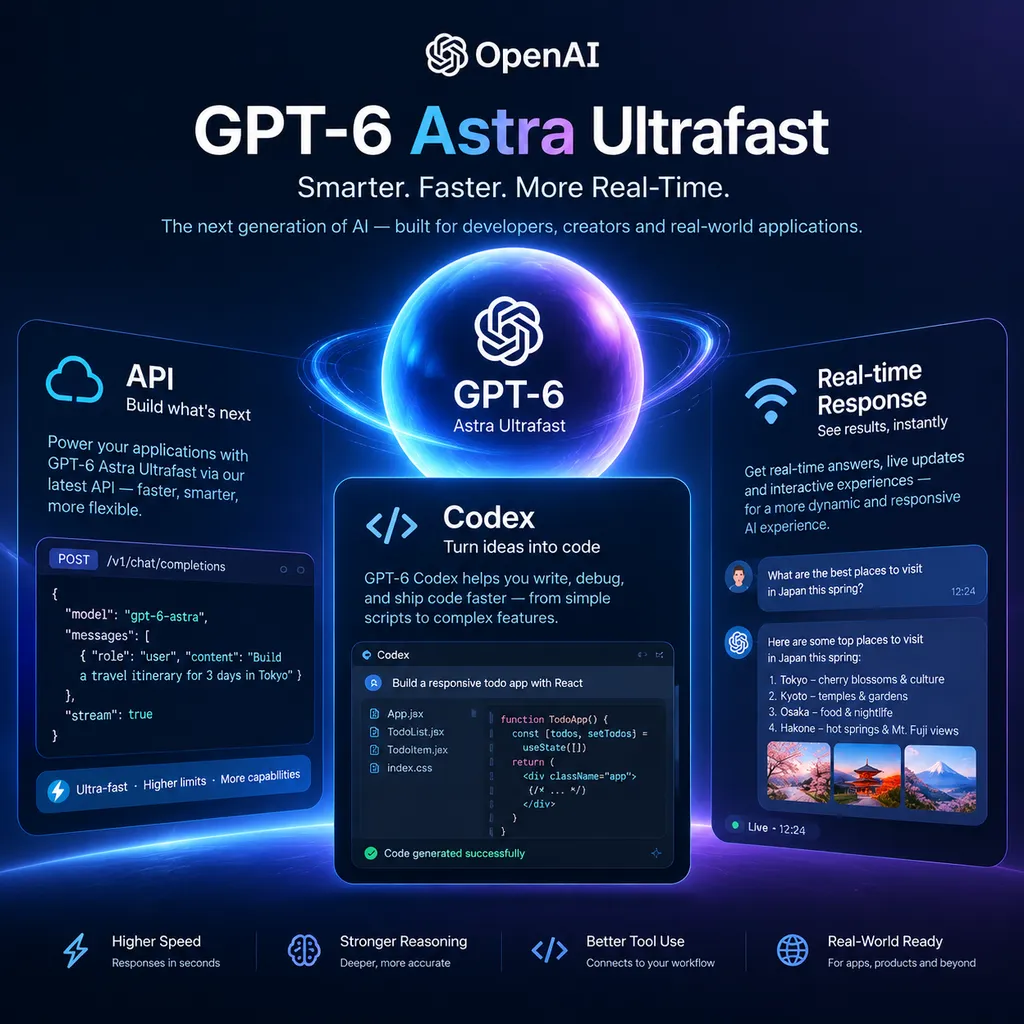
According to official disclosures, GPT-6 Astra Ultrafast can generate tokens in Codex at up to eight times the speed of the standard version, while API calls can be up to six times faster, reaching a peak generation speed of 300 tokens per second. Pro 500 subscribers and enterprise users can access it in ChatGPT Work and Codex, and the API is already available.
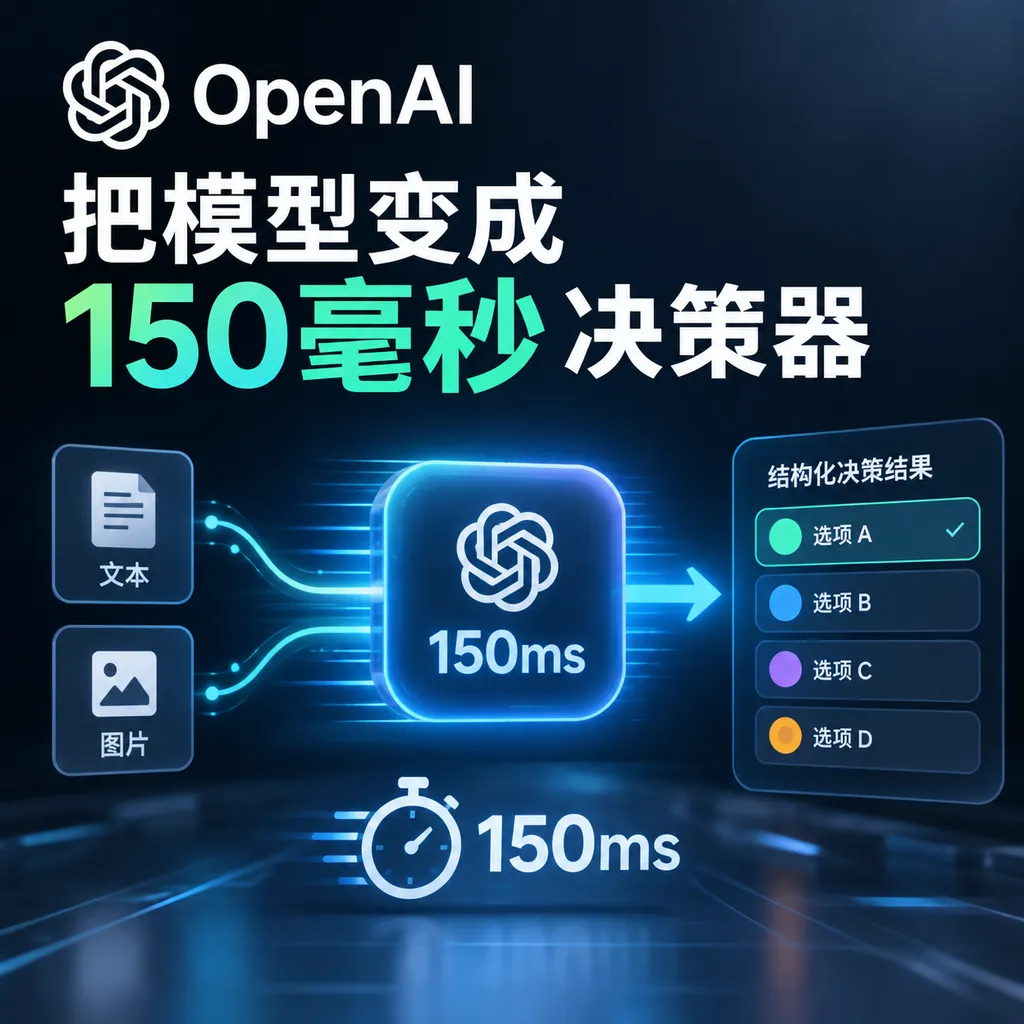
This is not simply a model upgrade. The focus of GPT-6 Astra Ultrafast is to combine “frontier-model capabilities” with “near-real-time response speeds” in a single product. Previously, developers seeking faster time to first token and shorter overall response times typically had to choose between smaller models, specialized models, and higher intelligence. Ultrafast attempts to eliminate that trade-off: the model retains GPT-6 Astra-level capabilities while using a new inference-serving architecture to increase the amount of useful work completed per unit of time.
Speed Improvements Will First Transform Product Experiences
For ordinary chat, 300 tokens per second may sound like an impressive but not necessarily critical number. Users generally care more about whether an answer is correct and whether it solves their problem on the first attempt than about how many tokens the model produces per second.
For developers, however, generation speed can directly determine whether a product is viable.
Consider an incident-response system that needs a model to continuously read logs, analyze code, call tools, and produce remediation recommendations. If every step takes dozens of seconds, engineers will often bypass the system and handle the incident manually. The same applies to real-time customer service: once the model’s responses become noticeably slower than the pace of human conversation, users will assume that the system has frozen. Interactive programming is even more sensitive, as developers expect feedback while they type rather than having to submit a task and wait for a lengthy answer.
Ultrafast primarily targets these latency-sensitive workflows:
- Incident response and reliability engineering: Rapidly read application logs, recent code changes, and engineering reports to help identify the cause of a failure.
- Real-time customer service: Reduce delays in multi-turn conversations and bring the model closer to a synchronous human-support experience.
- Trading and market updates: Convert market data, announcements, and structured information into briefings, reducing the delay between an event and the publication of relevant information.
- Interactive coding: Generate patches, explain errors, and complete test code more quickly, reducing the time developers spend waiting in their editors.
- Internal enterprise agents: Shorten each interaction across retrieval, planning, tool calls, and result aggregation.
It is important to note that token-generation speed is not the same as end-to-end response speed. In a real AI application, latency usually consists of multiple components: request queuing, network transmission, input-token processing, database retrieval, tool calls, model output, and application-side streaming. Generating 300 tokens per second addresses only the output-generation stage.
If an application needs to retrieve dozens of documents before every request, or must wait for databases and third-party APIs to return results, simply increasing output speed will not produce a proportional improvement in the overall experience. Ultrafast is therefore better suited to products that have already been optimized at the engineering level and whose actual bottleneck lies in model inference and output.
API Pricing Is Not Cheap—In Fact, It Is Extremely Expensive
The other side of speed is price.
According to official information cited by IT Home, GPT-6 Astra Ultrafast charges separately for input, cached input, cache writes, and output, with separate pricing tiers for short and long contexts. A short context contains fewer than 272K input tokens, while a long context contains more than 272K input tokens.
| Pricing Category | Short Context (Input <272K Tokens) | Long Context (Input >272K Tokens) | |---|---:|---:| | Input | $60 / 1M tokens | $120 / 1M tokens | | Cached input | $6 / 1M tokens | $12 / 1M tokens | | Cache writes | $75 / 1M tokens | $150 / 1M tokens | | Output | $300 / 1M tokens | $450 / 1M tokens |
This pricing structure makes one conclusion immediately apparent to developers: GPT-6 Astra Ultrafast is not a default model, but a premium service tier whose return on investment must be calculated explicitly.
At short-context pricing, one million output tokens cost $300. Even if an application generates only a few hundred tokens per request, making each individual call appear inexpensive, output costs can accumulate rapidly in high-frequency customer service, bulk reporting, coding agents, and automated workflows. For large volumes of simple tasks, it may be more sensible to use a less expensive model and reserve Ultrafast for critical stages.
Caching will be essential for controlling costs. A cache write fee is incurred the first time a segment of input content is stored in the prompt cache; subsequent requests that reuse that content are charged at the lower cached input rate.
For enterprise agents, system prompts, business rules, tool definitions, permission descriptions, and long-term project context are often repeated across multiple calls. If this content consistently produces cache hits, input costs can be reduced significantly. Caching, however, does not affect output fees—and Ultrafast’s output pricing is precisely the area that warrants the closest attention.
Before launching, developers should do at least three things:
- Separate first-time requests from cache-hit requests and calculate their costs independently.
- Measure the number of output tokens actually generated by the model rather than looking only at user-input length.
- Set output limits for different tasks to prevent agents from continuously generating content during abnormal loops.
Compatible Access Is Available Through OpenAI Hub
The GPT-6 Astra Ultrafast API is already available. Teams that do not want to maintain separate accounts, API keys, and billing systems for multiple model providers can connect through OpenAI Hub’s compatible API and switch models within their applications.
Below is an example using the OpenAI SDK format. The actual model identifier, account permissions, and rate limits available to you should be based on the information shown in the platform console:
from openai import OpenAI

client = OpenAI(
    api_key="YOUR_OPENAI_HUB_API_KEY",
    base_url="https://openai-hub.com/v1"
)

response = client.chat.completions.create(
    model="gpt-6-astra-ultrafast",
    messages=[
        {
            "role": "system",
            "content": "You are a reliability engineering assistant. Prioritize actionable and verifiable troubleshooting steps."
        },
        {
            "role": "user",
            "content": "Analyze the following error log, identify the most likely root cause, and provide remediation recommendations:\nThe connection pool was exhausted within five minutes, followed by a large number of 504 errors."
        }
    ],
    stream=True,
    max_tokens=800
)

for chunk in response:
    delta = chunk.choices[0].delta.content
    if delta:
        print(delta, end="", flush=True)
With streaming output, the user experience is typically determined by time to first token and sustained output speed. For interactive products, it is advisable to track the following metrics:
- TTFT (Time to First Token): The time between sending a request and receiving the first token.
- Token-generation speed: The number of tokens generated per second after the model begins producing output.
- End-to-end latency: The total time required, including retrieval, tool calls, and application processing.
- Task completion rate: Whether answer quality and tool-call success rates decline after the speed increase.
- Cost per task: The cost of completing one successful customer-service interaction, remediation, or report-generation task.
Looking only at tokens per second can easily lead to the mistaken conclusion that a faster but more expensive system—or one that is faster but requires more retries—is superior.
How Does It Relate to GPT-6.1 Sol Ultrafast?
OpenAI also stated that it will subsequently launch GPT-6.1 Sol Ultrafast. Currently available information indicates that GPT-6.1 Sol is positioned to strike a balance between capability and price: at approximately one-fifth of the standard input and output price, it provides capabilities close to those of GPT-6 Astra, with a focus on agentic coding, computer use, and professional workflows.
This suggests that Astra Ultrafast and Sol Ultrafast may serve different roles.
GPT-6 Astra Ultrafast is more like a flagship service for high-value, highly time-sensitive applications: complex incident analysis, important customer interactions, financial research, and demanding coding agents may be strong candidates. GPT-6.1 Sol Ultrafast may be better suited to large-scale deployments, particularly for tasks that require frequent calls but cannot absorb Astra Ultrafast’s output pricing.
OpenAI previously previewed an Ultrafast mode for GPT-5.6 Sol, claiming output speeds of up to 750 tokens per second with support from Cerebras. This figure is higher than the 300 tokens per second announced for GPT-6 Astra Ultrafast, possibly because the two figures apply to different models, different service stages, and different testing methodologies. Developers should not treat the two numbers as directly comparable benchmarks. Ultimately, end-to-end testing under actual account, regional, load, and request-type conditions remains the most reliable measure.
The Real Competitive Differentiator Is Not Just “Speed”
Over the past several years, competition among large-model APIs has primarily centered on intelligence, context length, price, and tool-calling capabilities. Ultrafast brings the service tier itself to the forefront: the same model family can provide different combinations of speed, price, and capacity through different inference infrastructure and service configurations.
For developers, this means model selection will evolve from asking “Which model is the strongest?” into a more complex routing problem:
- Send simple classification, summarization, and bulk extraction tasks to low-cost models.
- Use standard flagship models for tasks that require high-quality reasoning but are not time-sensitive.
- Invoke Ultrafast only when a user is actively waiting, a system is experiencing an outage, or market information is changing rapidly.
- Cache fixed background information and tool definitions to reduce repetitive input costs.
- Set timeouts, budgets, and maximum step counts for agents to prevent expensive models from running out of control.
In other words, the value of Ultrafast does not lie in making every request faster. It lies in giving developers the confidence to deploy models in real-time stages where they previously would not have considered doing so. It is more like an expensive but highly responsive high-performance machine: it is not suitable for every routine task, but it could fundamentally change how certain products operate.
Should Developers Use It Now?
GPT-6 Astra Ultrafast is worth testing if your product has the following characteristics:
- Users clearly notice waiting times, and those delays affect conversion or retention.
- Tasks require strong reasoning, code comprehension, or multi-step workflow capabilities.
- Output costs can be controlled through caching, truncation, and task routing.
- The business cares more about “how much useful work can be completed per second” than simply achieving the lowest price per token.
If your primary needs are bulk summarization, offline classification, simple question answering, or large-scale content generation, there is no immediate need to switch directly to Ultrafast. The higher output price may outweigh the benefits of increased speed, and standard models or the forthcoming GPT-6.1 Sol Ultrafast may be more appropriate.
The central message of OpenAI’s announcement is clear: the next stage of model competition will not be determined solely by which model is smarter, but also by which one can complete tasks faster in real-world workflows. GPT-6 Astra Ultrafast elevates speed into a new product differentiator, but whether it offers sufficient value will ultimately depend on whether developers can convert that speed into higher completion rates, shorter service pipelines, or genuinely real-time user experiences.
References
- IT Home: Up to 300 Tokens per Second—OpenAI Launches GPT-6 Astra Ultrafast Service — Provides information about the launch, speed figures, availability, and API pricing.
- Sina Technology’s republication of the IT Home report: Up to 300 Tokens per Second—OpenAI Launches GPT-6 Astra Ultrafast Service — Provides additional details about the Ultrafast service tier and its applicable use cases.