OpenClaw Adds an Enterprise Agent Control Plane
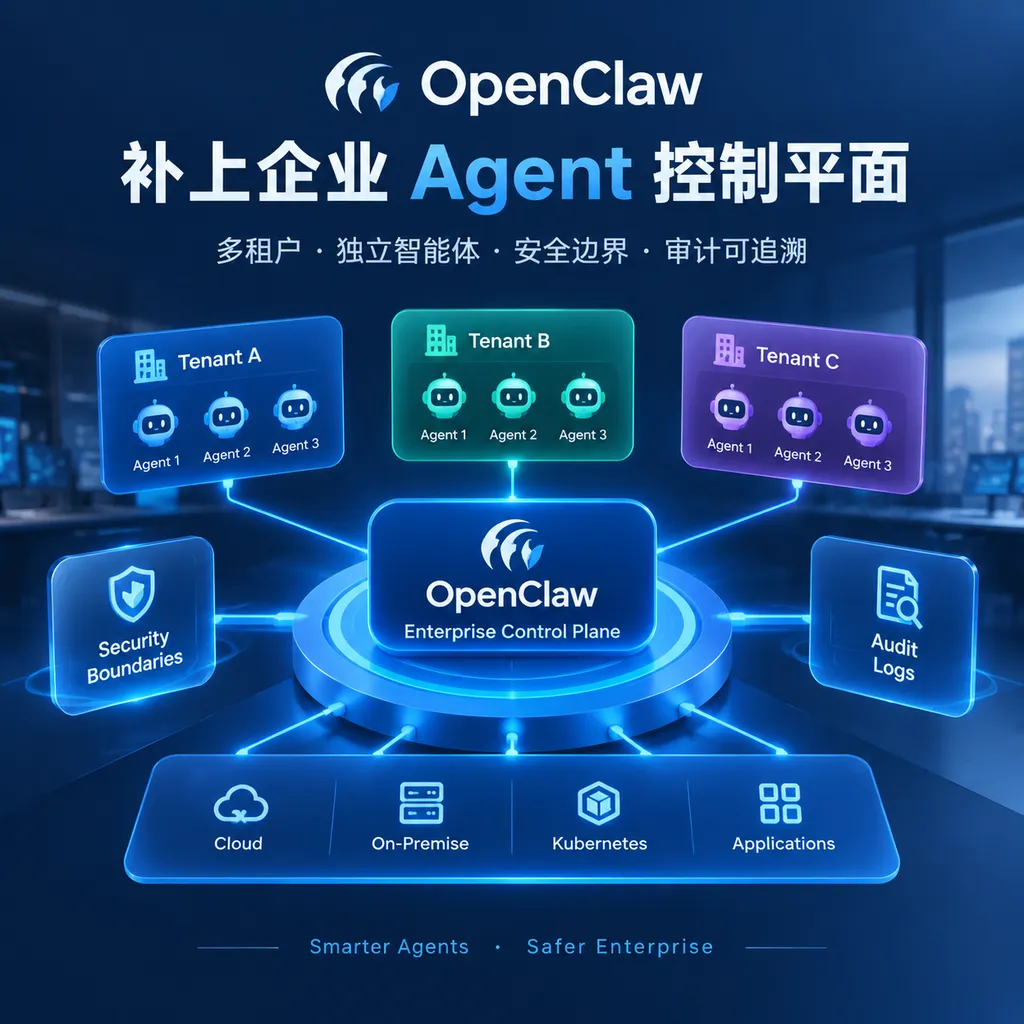
OpenClaw announced the launch of OpenClaw Enterprise on September 29 local time, offering multi-tenancy, security boundaries, lifecycle governance, and auditing capabilities for continuously running agents. Its goal is not to make agents better at getting things done, but to give organizations a way to manage them; however, the official release has not yet been made, and its specific permission model and practical capabilities remain to be verified.
OpenClaw Adds an Enterprise Agent Control Plane
OpenClaw announced on September 29 local time that it is launching OpenClaw Enterprise. The agent management platform, designed for sensitive environments, is approaching its 1.0 release. Its goal is to provide a control plane for persistent AI Agents with enterprise-grade capabilities spanning multi-tenancy, security boundaries, lifecycle governance, and auditing.
What makes this announcement noteworthy is not simply that OpenClaw has added an enterprise edition. It is beginning to address one of the hardest challenges in bringing Agents into organizations: when a model does more than answer questions—when it runs continuously, calls tools, and interacts with business systems—who decides what it can do and access, and how can its actions be traced when something goes wrong?
The bottleneck to Agent adoption is no longer just whether a model can complete a task. Many teams can build a prototype that retrieves information, writes code, or operates tools. But moving from prototype to production raises questions about how permissions are assigned, how runtime state is managed, how actions are audited, and who is accountable when something goes wrong. OpenClaw Enterprise aims to bring these concerns into a single management framework.
From “Can Execute” to “Can Be Managed”
Most AI products to date have been designed around a single interaction: a user asks a question, the model generates an answer, and the task ends. Persistent Agents are different. They may run continuously in the background, repeatedly receive tasks, maintain state, and call external tools within the scope of their authorization. A mistaken answer in a single conversation does not carry the same risk as an error made by a long-running program with access to business systems.
The real question for enterprises, then, is not “Should we let models help?” but how to bring Agents, as long-running software entities, into existing governance frameworks. They need defined boundaries and identities, their actions need to be recorded, and their components need to be adjustable and replaceable without requiring changes to every business system. Otherwise, the more capable an Agent becomes, the harder it is for administrators to determine what it did and under what conditions.
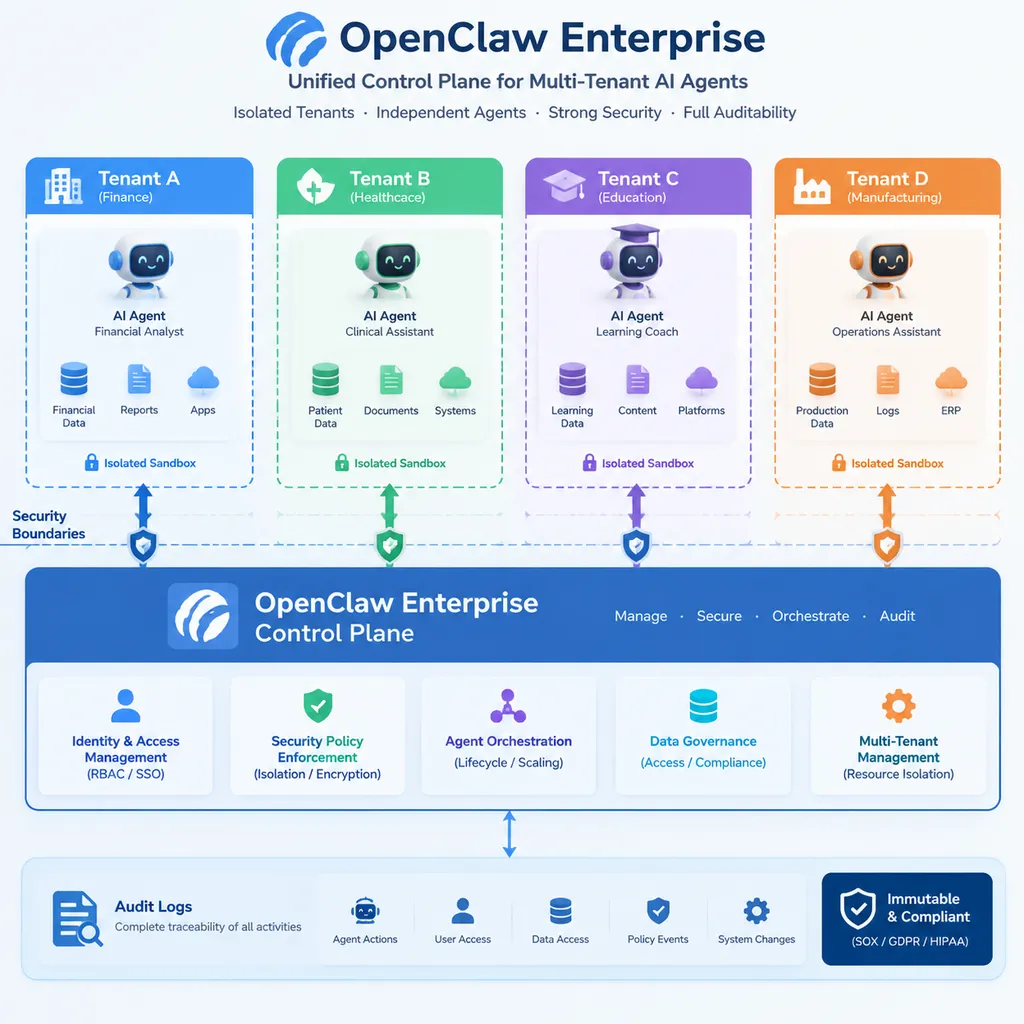
OpenClaw’s announcement describes this layer as an enterprise control plane. Based on the information disclosed so far, OpenClaw Enterprise will support multi-tenancy, strict security boundaries, and standardized agent primitives, while providing governance and auditing throughout the agent lifecycle. The announcement also emphasizes that these core primitives can be replaced with third-party solutions or internally developed implementations.
A control plane can be thought of as the “management layer” of an Agent system, rather than the Agent itself. It does not necessarily perform each individual task. Its more important role is to provide a consistent way to organize, constrain, and observe agents in operation. Just as a container orchestration platform does not write application business logic but manages how applications are deployed, run, and scaled, a control plane aims to make Agents more than scripts on a machine or personal assistants maintained by individual teams.
The value of this infrastructure depends on whether it covers real operating processes, rather than merely providing a management interface. For enterprises, the key questions are whether permissions can be enforced for specific resources and actions, whether policies can be continuously applied, whether audit records can account for agent behavior, and whether there are clear ways to pause, revoke, or roll back when something goes wrong. The current announcement does not disclose these mechanisms in detail, so the label “enterprise-grade” alone is not enough to judge production readiness.
Multi-Tenancy and Security Boundaries Address Organizational Challenges
“Multi-tenancy” sounds like an infrastructure term, but in practice it determines whether an organization can let multiple teams use Agents together. An enterprise may have R&D, customer support, finance, and operations teams, each with different data, tools, and approval processes. If their Agents share identities, memory, or tool permissions, a platform approach could end up concentrating risk instead of managing it.
The value of multi-tenancy therefore lies not in creating a few more workspaces, but in how clearly tenants are isolated. Can each tenant manage its own members, configuration, and data independently? Can teams avoid accessing one another’s resources by mistake? What permissions do platform administrators, business owners, and the Agent runtime each have? These are core questions for evaluating the quality of an implementation. OpenClaw has so far announced multi-tenancy as a capability area, but details of its isolation model and configuration remain to be verified in the release documentation or through an actual deployment.
Security boundaries also need to be evaluated based on how they are enforced. When an Agent calls a tool, the risk often comes not from the model’s answer but from the permissions it has been granted: can it read customer data, modify records, send messages, execute code, or even trigger irreversible actions? For enterprises, a “smarter model” cannot replace access control. Conversely, even if a model sometimes makes poor judgments, limiting its permissions to an appropriate scope can keep the impact under control.
A prudent enterprise deployment typically assigns permissions by task and resource, while minimizing long-lived, high-privilege credentials. It adds approval or confirmation requirements for high-impact actions such as writing data, making payments, or sending information externally, and ensures that critical actions leave auditable records. These are questions enterprises should ask about any Agent control solution; they are not claims that OpenClaw Enterprise has already implemented each capability. The announcement does not provide enough detail to assess these specifics, and coverage should not present a product direction as a verified security capability.
Lifecycle Governance Is More Than a Log
The announcement refers to stronger governance and auditing throughout the agent lifecycle. This points to an important difference between managing Agents and managing ordinary model calls. A long-running Agent is more than the inputs and outputs of each request: it may go through creation, configuration, authorization, operation, updates, and deactivation. Recording only individual model calls makes it difficult to determine why an Agent received a particular permission, which configuration change altered its behavior, or who is currently responsible for maintaining it.
For development teams, lifecycle governance involves at least three areas. The first is configuration and change management: when the models, tools, or policies an Agent uses change, can the system identify the version and responsible party? The second is runtime management: can running Agents be observed, paused, or stripped of permissions? The third is auditing and review: can the system link tasks, tool calls, and administrative actions so teams can reconstruct events after an incident?
Ultimately, these capabilities need to be integrated into engineering workflows rather than confined to an “Audit” menu in the platform’s back end. Logs need to be consumable by security, compliance, or operations systems. Identities need to integrate with existing enterprise account systems. Policies need to fit into code review and release processes. Otherwise, the platform may centralize information without reducing the organizational cost of managing Agents.
It is also important to distinguish “auditable” from “explainable.” Auditing usually means being able to see what happened at a given time and which actor initiated it. Explainability requires understanding why the model chose a particular course of action. A control plane can strengthen the former and may provide evidence for later analysis, but it cannot automatically eliminate uncertainty in model decisions. Enterprises still need to design restrictions, validation, and human intervention mechanisms based on business risk.
The Open-Source-Neutrality Promise Depends on Replaceability
OpenClaw describes OpenClaw Enterprise as an open-source-neutral platform and says its core agent primitives can be replaced with third-party solutions or internal implementations. This direction has practical value for enterprises: security, identity, policy, and auditing often rely on existing internal systems, and organizations are generally reluctant to move all critical governance capabilities to a single vendor just to adopt an Agent platform.
But “replaceable” needs a clearly defined technical boundary. It could mean open interfaces, or it could simply mean the architecture allows extensions. The two differ significantly in migration costs, compatibility, and operational responsibility. Enterprises need to confirm which objects the standard primitives cover, whether policy semantics remain consistent when components are replaced, whether upgrades affect custom implementations, and who maintains internal components if they fail. Only stable interfaces and predictable behavior can turn open-source neutrality into real negotiating leverage and deployment flexibility.
This may also be a key area of competition for OpenClaw Enterprise. The market already includes various Agent development and orchestration frameworks, as well as cloud platforms, identity management providers, and security vendors expanding into related capabilities. OpenClaw’s opportunity is to build on the influence of its existing projects and make the governance capabilities required by persistent Agents into self-hostable, extensible shared infrastructure. Its challenge is to demonstrate that this abstraction works across teams, tools, and different enterprise environments, rather than only in demos.
Open source is not automatic proof of security. Visible code can help with inspection and customization, but enterprises also need clarity on version maintenance, vulnerability response, dependency management, and deployment responsibilities. In sensitive environments, evaluation needs to cover more than a feature list: update mechanisms, default permissions, data flows, and incident response all matter. The current OpenClaw announcement describes the product’s positioning and direction. Implementation details will need to be assessed against the upcoming 1.0 release and subsequent documentation.
Enterprise Agent Adoption Starts with Permissions and Accountability
The arrival of OpenClaw Enterprise signals a shift in the focus of Agent infrastructure from “How do we make it perform tasks?” to “How do we manage it over the long term?” This is not proof that Agent capabilities are mature. Rather, it shows that identity, permissions, auditing, and governance remain engineering challenges to address before deployments can scale.
Enterprises can treat this announcement as a prompt to review their architecture, not as a reason to switch platforms immediately. When preparing a pilot, start with a low-risk workflow that has clear boundaries and verifiable outcomes, then check the following:
- Whose identity does the Agent use, and how are its credentials stored, rotated, and revoked?
- Which data and tools can it access, and can permissions be narrowed for each task?
- Which actions can be automated, and which require employee confirmation?
- Can administrators see records of configuration changes, tool calls, and critical actions?
- If the Agent behaves unexpectedly, can it be paused and its permissions revoked?
- Can the platform integrate with existing identity, logging, and security systems?
If these questions remain unanswered, putting an Agent into production does not make it safe just by calling it an “enterprise edition.” Conversely, if a control plane can provide verifiable isolation, permission enforcement, and auditing, it could reduce the management overhead of deploying Agents across multiple teams and help move them from individual experiments into organizational operations.
There is still reason to reserve judgment: OpenClaw Enterprise is approaching its 1.0 release, and the public information does not yet specify its policy model, deployment options, audit granularity, or compatibility scope. It is asking the right questions; whether it can provide practical answers remains to be tested against the product details and real-world use. For developers, what matters is not the “enterprise-grade” label in the marketing, but whether the control plane can be integrated, policies can be tested, permissions can be revoked, and the system can account for what happened when something goes wrong.