Microsoft Releases Project Quine to Build a World Model for Biology

Microsoft Research, in collaboration with Harvard University and the Broad Institute, has launched the experimental multimodal AI system Project Quine, which seeks to bring genomics, proteins, chemistry, cell states, and biological imaging into a single, reasoning-capable world model of biology, using computational screening to help researchers reduce blind wet-lab experimentation.
Microsoft Unveils Project Quine, a World Model for Biology
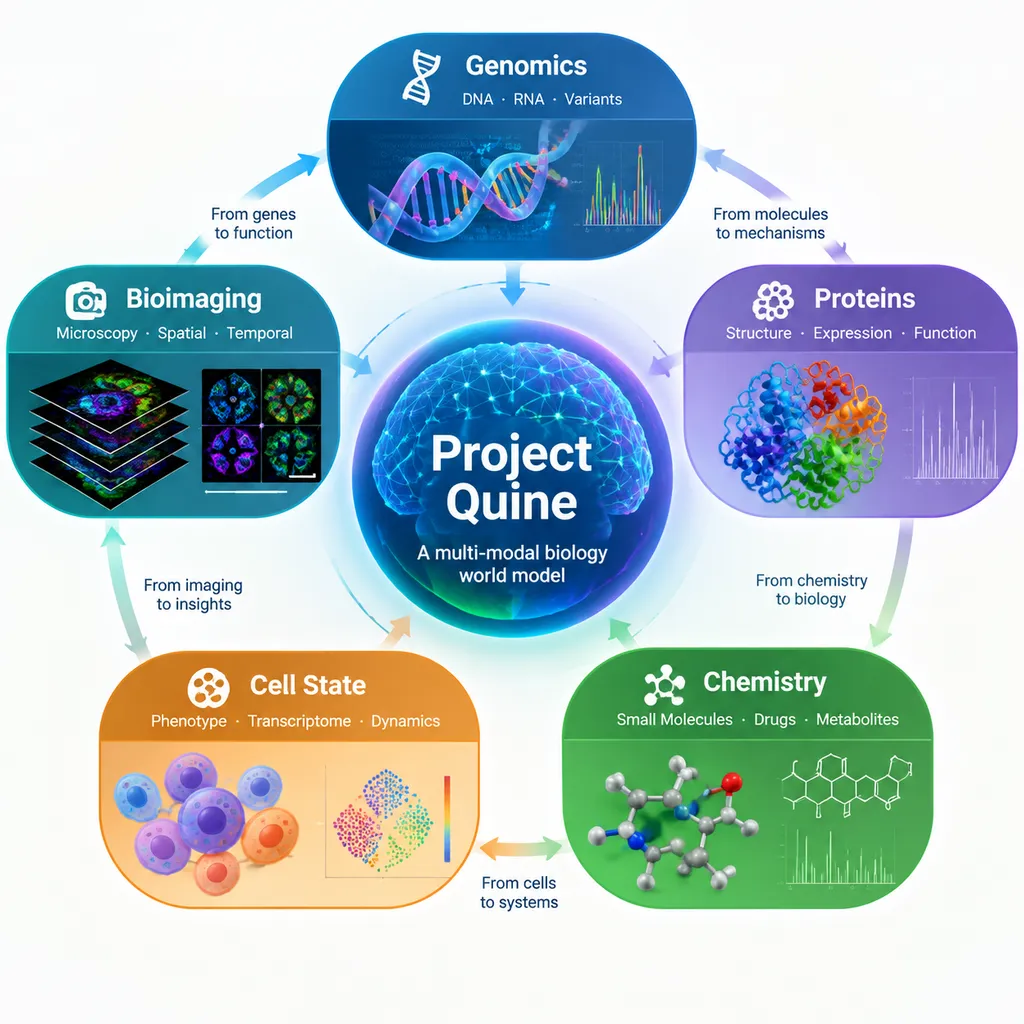
On September 29 local time, Microsoft Research unveiled Project Quine, an experimental multimodal AI research system. Rather than yet another chatbot that can only read papers and generate experimental plans, it is a “world model” for biological research—one that attempts to understand genomes, proteins, chemical molecules, cell states, and biological imaging data simultaneously, and then predict how biological systems will change following an intervention.
The significance of this development is not that Microsoft has added another AI conversational interface to drug development, but that it is attempting to solve a longstanding structural problem in computational biology: models exist for data at different scales and in different modalities, but they lack connections that enable continuous reasoning across them. Gene sequences tell researchers “what might be there,” protein structures suggest “how it might function,” and cell states and microscopic images reveal “what is actually happening.” Project Quine aims to place all this evidence on the same map and then feed the model’s outputs back into real-world experiments.
It Is Not a Single Model, but a Research System
Microsoft defines Project Quine as a world model for biology, but “world model” here should not simply be equated with a large language model. While the latter primarily learns statistical patterns in language, Quine addresses complex systems spanning multiple biological scales—from DNA sequences, RNA expression, and protein structures to compounds, cellular phenotypes, tissue environments, and microscopic images.
According to Microsoft, Quine’s core model learns shared representations across these types of data. In other words, rather than separately training a genomics model, a protein model, and an imaging model and then having engineers stitch their outputs together, it attempts to enable evidence from different modalities to inform one another within the model itself.
The value of this type of joint modeling is particularly clear in drug discovery:
- Genomic data can help identify disease-associated genes, regulatory regions, and mutations;
- Protein information can be used to understand a target’s structure, function, and potential binding sites;
- Chemical data describes the structures, properties, and possible reaction pathways of candidate molecules;
- Cell-state data indicates whether cells proliferate, die, or enter another abnormal state following an intervention;
- Biological imaging data provides phenotypic evidence related to cell morphology, tissue structure, and spatial distribution.
Traditional workflows often handle these questions separately. Researchers begin with a target, then use tools for structure prediction, molecular generation, efficacy prediction, or image analysis, before relying on human expertise to connect the results. Context can be lost every time information crosses disciplinary boundaries. Quine’s goal is to process this interconnected yet sometimes inconsistent evidence within a single reasoning framework.
From “Predicting Answers” to “Planning the Next Experiment”
Another key component of Project Quine is the interactive reasoning and tool layer built around the model. Microsoft wants the system to do more than tell researchers that a particular compound “may be effective.” It should also be able to break a broad scientific question into a series of steps: which data needs to be retrieved, which models should be invoked, what experiments should be designed, how candidate results should be compared, and which conclusions still lack supporting evidence.
This makes it more like a research agent for scientists than a conventional question-answering system.
For example, suppose a research team wants to investigate the mechanism by which a particular type of cancer cell transitions from one state to another. In theory, Quine could begin by using existing literature, gene-expression data, and cell-state representations to propose a set of potentially relevant regulatory factors. It could then combine this information with compound data to identify candidate molecules that might affect those factors, before ranking the candidates based on imaging and phenotypic predictions. Researchers would still need to conduct wet-lab experiments, but those experiments would no longer depend entirely on blindly screening a batch of candidates and waiting to see what happens.
Microsoft describes this process as a cycle:
- Scientists pose a question or research hypothesis;
- The system integrates data from different modalities to generate candidate explanations and experimental plans;
- Researchers select the directions worth validating;
- Wet-lab experiments produce new measurements;
- The new results are used to refine the research question, update the model, and plan the next round of experiments.
This cycle is important. The cost of drug development does not come solely from model training; far more is spent on candidate synthesis, cellular assays, animal studies, and repeated validation following failed experiments. A system that is imperfect but can continually help researchers prioritize candidate directions may have greater practical value than a point solution that merely achieves high scores on benchmarks.
Pancreatic Cancer Cell Experiments Are the Most Concrete Validation to Date
Microsoft says its research team recently tested Project Quine on pancreatic ductal adenocarcinoma cell lines. Over the course of one weekend, the system prioritized a set of compounds, including candidates that drove the expected shift in cell state from the “classical” to the “basal-like” subtype. It also identified several phenotypic responses that researchers had not anticipated.
This example should be interpreted cautiously.
It shows that Quine can contribute to candidate ranking and experimental planning for real biological questions, but it does not mean that the system has discovered an effective drug, much less that these compounds have demonstrated clinical value. Changes in cell state within a cell line represent only one stage in the drug-development pipeline. They must still be followed by repeated experiments, mechanistic validation, toxicity assessments, animal models, clinical trials, and numerous other steps.
Nevertheless, this example is closer to real-world application than simply showing that “the model performs well on a dataset.” At minimum, it demonstrates a complete workflow: the model processes multimodal evidence and recommends candidate directions; researchers validate them experimentally; and the results are then used to determine whether the model can identify both expected and unexpected effects.
The latter is equally important in biological research. Many valuable discoveries occur not because a model accurately answers a question researchers have already posed, but because it uncovers relationships across datasets that humans were not actively searching for. The problem is that such “unexpected discoveries” can easily be confused with model hallucinations, making experimental confirmation essential.
Quine’s Advantage Lies in Treating Experimental Resources as Scarce
A common misconception in drug discovery is that the ability to generate enough molecules will automatically accelerate development. The reality is not so simple. Generating candidate molecules is not difficult; the challenge is determining whether they are worth synthesizing, whether they have a plausible mechanism of action, whether they produce the intended effect in cells, and whether they cause unacceptable toxicity.
Project Quine’s approach is not simply to expand the candidate space, but to improve how that space is searched.
The traditional R&D process can be compared to searching for an exit in an enormous maze: computational models can quickly draw more maps, but laboratories have limited time, reagents, equipment, and personnel, making it impossible to explore every path. The role of a world model is to use existing evidence to estimate which paths are more likely to lead to the goal and then prioritize those paths for real-world experimentation.
This is also why Microsoft emphasizes that Quine could save years of work and millions of dollars. However, these remain potential benefits rather than widely validated commercial outcomes. More public validation is needed to determine whether the model can perform consistently across different diseases, experimental platforms, and levels of data quality.
From a developer’s perspective, Quine is also not a “unified API” that can directly replace existing bioinformatics tools. It is closer to a research operating system composed of foundation models, scientific tools, data pipelines, experimental feedback, and human review. The real challenges include data standardization, cross-modal alignment, documentation of experimental conditions, reproducibility of results, and communication of model uncertainty.
The Biggest Challenge: Biology Is Not a Static Knowledge Graph
Putting multiple types of data into the same model does not mean that the model truly understands biology.
Biological systems are highly context-dependent. The same genetic perturbation may produce entirely different results depending on the cell type, culture conditions, time point, and microenvironment. Similarly, a compound that is effective in an in vitro cell line may not retain the same effect in an animal or human body. Imaging data may look similar even when the underlying molecular mechanisms are entirely different.
There are also significant measurement biases between datasets. Laboratory equipment, sample-preparation procedures, cell-line origins, and annotation methods can all affect the results. If the model mistakes technical noise for a biological pattern, joint multimodal modeling could amplify spurious associations rather than eliminate them.
Quine’s “world model” is therefore more accurately described as a probabilistic model of selected biological evidence and intervention outcomes. It can help researchers narrow the search space, but it cannot turn biology into a game world that can be simulated at will. Microsoft has also explicitly stated that Quine is currently restricted to research use and is not intended for clinical use. Its outputs may be incomplete or inaccurate and must be reviewed by qualified researchers and validated through appropriate scientific experiments.
This limitation is not a disclaimer added as an afterthought; it is a core design requirement for the system’s practical deployment. In drug development, a model must not only make predictions but also explain what evidence those predictions depend on, what data is missing, and which candidate results carry high uncertainty. Otherwise, researchers may easily misinterpret an apparently precise score as a definitive conclusion.
Starting with the Fellows Program Before Pursuing Commercialization
To give researchers early access to Project Quine, Microsoft has launched the inaugural Quine Fellows program. The program is open to PhD students, postdoctoral researchers, research scientists, and academic or independent researchers. Participants will collaborate with Microsoft researchers and use Quine and related computing resources, while some research projects may also receive experimental support.
The program focuses on areas including:
- Protein design and engineering;
- Enzyme design, discovery, and optimization;
- Genetic and chemical perturbation of cell states;
- Early-stage therapeutic research for under-resourced diseases;
- Prioritization of candidate hypotheses and compounds;
- Problems in which faster design–experiment iterations could change research outcomes.
This is a relatively cautious approach to access. Microsoft has not immediately packaged Quine as a general-purpose model for all developers. Instead, it is initially allowing researchers with relevant expertise to use the system in a controlled program and collecting feedback through selected collaborations. As the technology matures, Microsoft plans to gradually expand access through products such as Microsoft Discovery and provide additional commercial tools.
This also means that, in the near term, Project Quine is more like a research platform that Microsoft is building in computational biology than a standardized API product ready for immediate integration into production systems. For general-purpose AI developers looking to use GPT, Claude, Gemini, or DeepSeek, it is not currently the same type of product, and OpenAI-compatible interfaces are not its present focus. What is truly worth watching is whether it will eventually package models, data, scientific tools, and experimental workflows into reusable research infrastructure.
Microsoft’s Real Bet Is on the “Model–Experiment” Closed Loop
Over the past several years, competition in AI-driven drug discovery has primarily focused on individual capabilities such as protein structure prediction, molecular generation, and target discovery. Project Quine has greater ambitions: it seeks to place these capabilities within a continuously iterative closed loop, enabling the model not only to predict biological entities but also to help determine which experiment should be conducted next.
The potential of this approach is enormous because it directly addresses the most expensive and time-consuming stages of drug discovery. However, implementing it is also significantly more difficult than training a single-modality model. The model must adapt to different laboratories and data standards, handle failed experiments, preserve complete chains of evidence, and allow scientists to trace how every recommendation was produced.
The most reasonable assessment of Project Quine at this stage is therefore not that “AI has solved drug development,” but that Microsoft has advanced biological AI from point predictions to system-level experimental planning. Whether it can genuinely shorten development cycles will depend on whether subsequent research can demonstrate that, after controlling for data quality and experimental conditions, Quine’s prioritizations are more reliable than traditional methods; whether the unexpected phenotypes it identifies can be translated into reproducible biological mechanisms; and whether it can sustain the same benefits across multiple disease areas.
If these questions are answered positively, Quine could become a major piece of Microsoft’s AI for Science infrastructure. If validation fails, it will at least expose the most difficult challenges involved in building multimodal world models for biology. Whatever the outcome, the September 30 announcement sends a clear signal: the next stage of AI competition will not be limited to generating answers inside models, but will also depend on whether models can enter real experimental workflows and take responsibility for determining what should happen next.
References
- ITHome: Microsoft Launches Experimental Multimodal AI Research System Project Quine, Potentially Accelerating Drug Discovery Significantly — Covers Project Quine’s release date, partner institutions, supported modalities, pancreatic ductal adenocarcinoma cell-line testing, and future access plans.