Ant Ling has released Ling-3.1-Flash
Ant Group today released Ling-3.1-Flash, with approximately 560B total parameters and about 25B activated per token, supporting up to a 1M-token context. The model will initially be available for a two-week free trial, but the service will be limited to a 256K context during the trial period. After the free period ends, Ant Group plans to enable million-token context support and open-source the model simultaneously.
Million-Token Context Is Not Available Yet
Ant Bailian released Ling-3.1-Flash today (September 30). According to the official specifications, the model has approximately 560B total parameters, activates around 25B parameters per token, and supports a maximum context window of 1M tokens. It targets tasks such as general-purpose agents, search, office productivity, and software development, while continuing to improve in fields including healthcare, finance, and materials science research.
However, there is a timing distinction that headlines can easily gloss over: the million-token context is not available today. Ling-3.1-Flash will first be offered as a free two-week trial, during which the service length will be limited to 256K. Only after the free trial ends and the service transitions to a paid offering does the team plan to enable the 1M-token context and open-source the model at the same time. In other words, what is being released now is the model and access to the trial; the full long-context service and model weights remain part of a future plan.
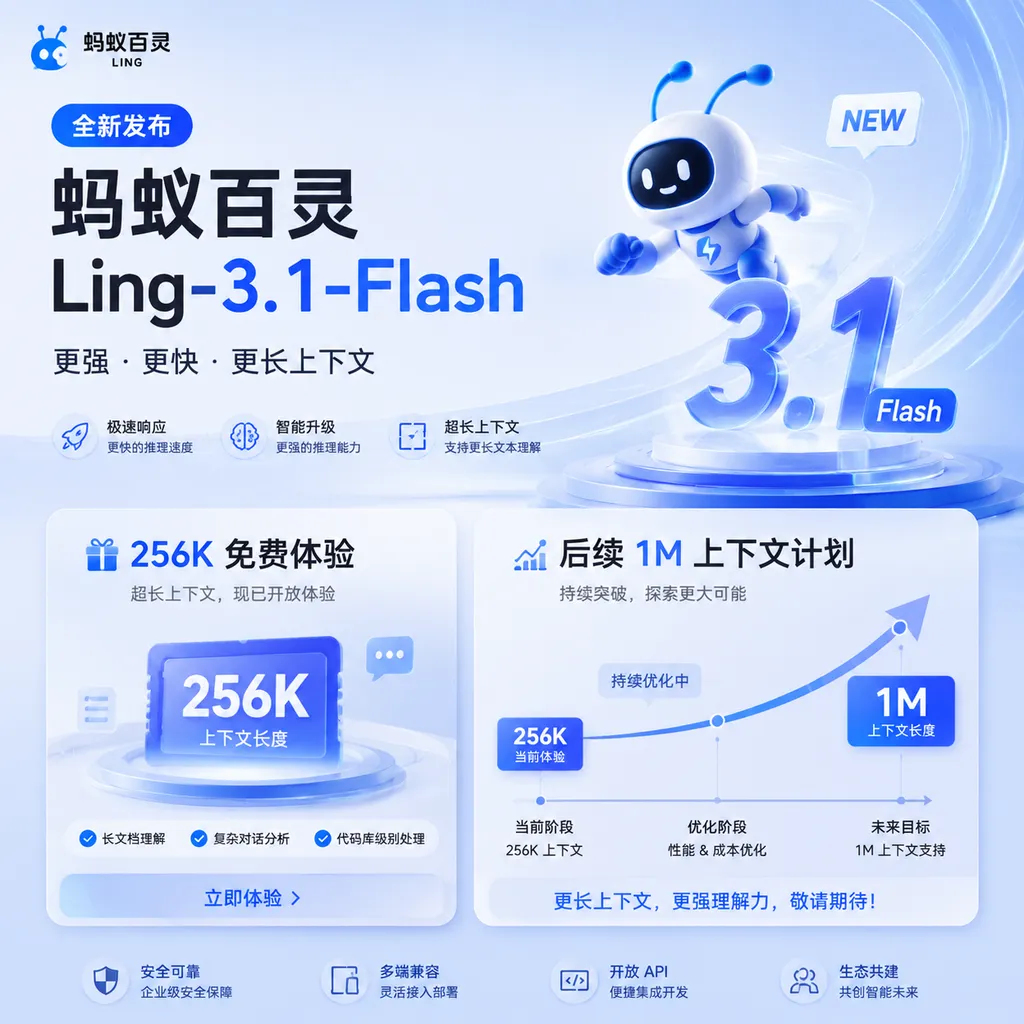
This distinction has practical implications for developers. A 1M-token limit is a specification ceiling; it does not mean that every user can already submit one million tokens in a single request, nor does it mean that long-context calls come without trade-offs in latency, cost, or effectiveness. The 256K available during the free phase is already sufficient for many long documents, code repository excerpts, and multi-turn task histories, but it cannot be used to infer how the million-token service will perform. Once the paid service launches, its actual value will still depend on pricing, time to first token, retrieval accuracy with long inputs, and whether the model can reliably use information located near the end of the context.
560B Parameters Does Not Mean Running All 560B Every Time
Ling-3.1-Flash uses a sparse activation architecture: the model has approximately 560B total parameters, but only around 25B parameters participate in computation when generating each token. It can be thought of as a very large team of experts in which only a subset is assigned to each problem, rather than having everyone work on it simultaneously.
This explains how a large total parameter count and a relatively small number of activated parameters per token can coexist. Total parameters determine the model’s overall capacity for capabilities and specialized experts, while activated parameters more closely reflect the computational scale used in each inference step. However, this is not a direct formula for calculating performance or cost: hardware deployment, expert routing, parallel communication, batching efficiency, and context length all affect actual throughput and pricing. With long contexts in particular, more input tokens generally increase attention computation and cache usage; the “Flash” label does not mean that the resource costs of a million-token context can be ignored.
The 25B activated-parameter figure is therefore noteworthy, but it alone is not enough to conclude that the model will necessarily be cheaper or faster than a dense model. Teams planning a production deployment need to compare end-to-end latency, per-request cost, output quality, and reliability on the same tasks—not just parameter specifications.
Long Context Means “Less Segmentation,” Not “Automatic Understanding”
The most immediate appeal of a 1M-token context window is that it allows the model to receive more material at once. Developers could potentially place a relatively complete codebase, multiple technical documents, lengthy meeting transcripts, or several days of task history into a single context, reducing the information loss caused by chunking, summarization, and repeated retrieval. For agents that need to trace dependencies across files, compare large volumes of material, or preserve complex working states, this may reduce the engineering complexity of context orchestration.
However, a larger window does not mean the model will identify every critical piece of information more reliably. In a long input, important content may be diluted by large amounts of irrelevant material. Conflicting instructions, duplicate content, and outdated states can also make it harder for the model to determine which passage to trust. A million-token window is more like expanding a desk into a large workbench than replacing indexing, retrieval, and state management. Developers still need to consider hierarchical summaries, verification of key facts, source labeling, and context update strategies. Simply “putting everything in” is not, by itself, an architecture for long-running tasks.
This is particularly true for coding scenarios. Feeding an entire repository into the model may be useful for exploratory question answering and cross-file analysis, but during continuous iteration, version changes, test results, and localized modifications are often more important than the total volume of the original code. Placing the repository, build logs, and discussion history into a single window may not be faster or cheaper than combining a code index with on-demand retrieval, nor will it necessarily make results easier to reproduce. The value of 1M tokens is that some tasks that previously had to be divided may be processed as a whole—not that retrieval-augmented generation (RAG) or tool calling has become obsolete.
Broad Task Coverage, but Evaluation Information Remains Limited
Ant Bailian says that Ling-3.1-Flash has been developed with continued optimization for general-purpose agents, search, everyday office work, and software development, while also improving its capabilities in healthcare, finance, materials science research, and other fields. This suggests that its objectives extend beyond conversational responses to workflows requiring multi-step processing and the reading of specialized materials. For development teams, the real question is not whether the model can answer a question in a demonstration, but whether it can consistently retrieve information, plan, invoke tools, handle failures, and produce verifiable results.
The reference materials state that official scores were published for multiple task evaluations, but the information provided does not include the specific tables or figures. It would therefore be premature to conclude which benchmarks Ling-3.1-Flash leads on, and claims of “continued capability improvements” should not be presented as quantified advantages. Evaluation scores must also be interpreted in the context of the test set, prompts, inference configuration, and versions of the comparison models. Without this context, the numbers offer little guidance for real-world model selection.
A more prudent approach is to conduct a small-scale evaluation using the team’s own task set once the model becomes available. This could include real-world tasks involving long-document question answering, cross-file code modifications, search-result synthesis, or specialized document analysis, while tracking accuracy, citation traceability, latency, retry rates after failures, and cost. In high-risk fields such as healthcare and finance, improved model capabilities do not eliminate the need for human review and access controls.
The Release Schedule Will Determine Its Practical Competitiveness
Based on the announced rollout, Ling-3.1-Flash is following a sequence of an initial free trial, followed by paid access to the million-token context, with open-sourcing also planned. The two-week free trial will allow developers to explore the model’s basic capabilities. However, because the free period is limited to a 256K service length, it is suitable for evaluating standard inference and medium-to-long-document tasks, but not for fully testing the eventual million-token workflows. Teams beginning integration tests now should document the “currently available specifications” separately from the “planned future specifications” to avoid building prototypes that depend on capabilities that have not yet been released.
The open-source plan is another key variable. If the weights are subsequently released as planned, developers will have the opportunity to evaluate the feasibility of local deployment, private inference, and customized services. However, open-source availability depends on more than whether the weight files are published. The model license, inference code, quantized versions, hardware requirements, and deployment documentation must also be considered. These details are not included in the current reference materials, so it is too early to assume under what license or in what format the model will be released.
Overall, the key features of Ling-3.1-Flash are clear: a combination of 560B total parameters and 25B activated parameters, a focus on agentic and development tasks, and a 1M-token context window as a future service target. Its short-term appeal lies in the free trial and 256K input capacity, while its long-term potential will depend on whether the million-token context can be delivered reliably, whether the open-release plans are fulfilled, and whether its quality and cost hold up in real-world comparisons. It is worth watching and testing now, but until the million-token window is officially available and pricing and deployment details have been clarified, the specification sheet alone is not sufficient reason to make it the default model for production environments.