GPT-Synopsys: AI Begins Taking Over Chip Design
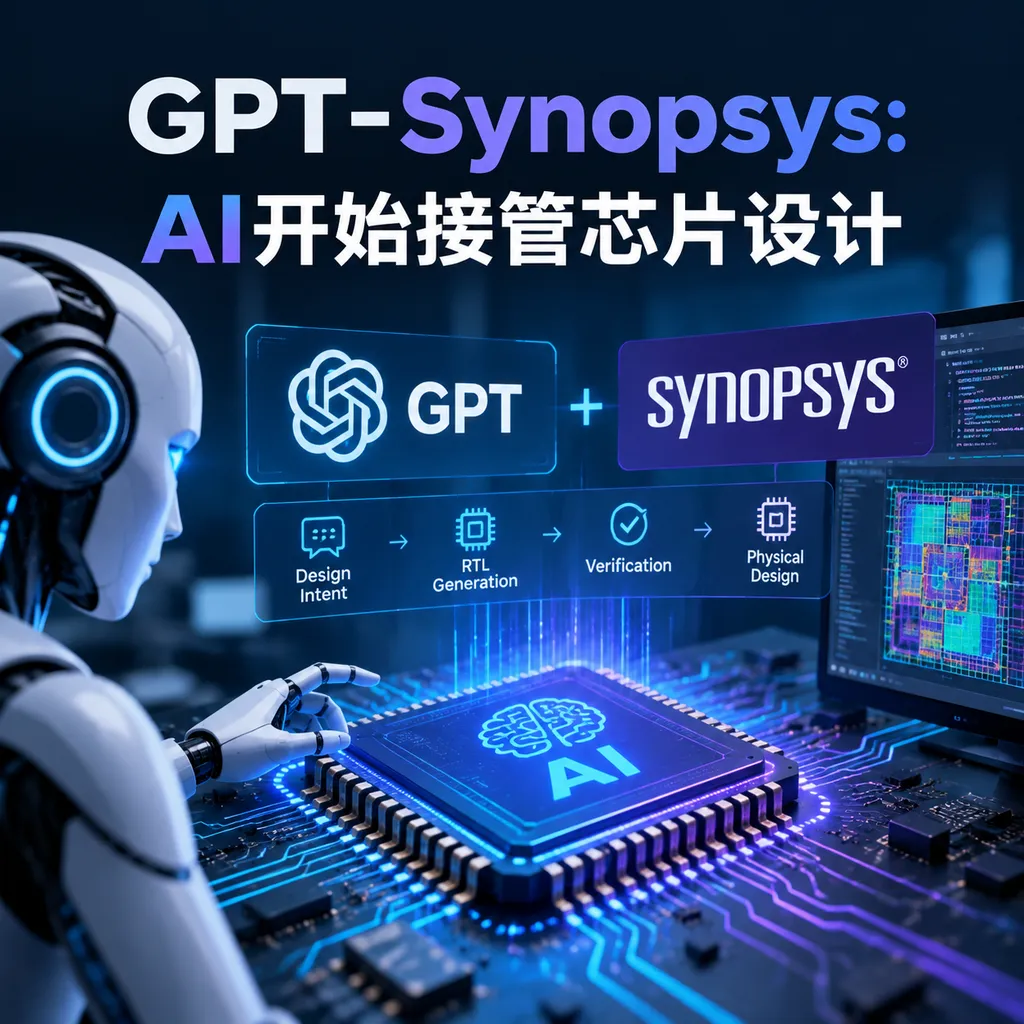
OpenAI and Synopsys have announced a multiyear strategic partnership to jointly develop GPT-Synopsys. The model will directly invoke EDA tools and autonomously iterate toward targets such as power consumption, performance, area, timing, and verification, while final signoff will still be performed using traditional verification tools and by engineers.
GPT-Synopsys: AI Begins to Take Over Chip Design
OpenAI and Synopsys announced on September 30 that they had established a multiyear strategic partnership to jointly develop GPT-Synopsys, a specialized model for chip design.
Its focus is not on having a model “provide a piece of RTL code” during a chat. Instead, it is designed to let AI agents directly enter Synopsys’s EDA toolchain, run synthesis, place and route, timing analysis, power analysis, verification, and other processes, read tool outputs, modify the design, and run the tools again until they produce results that engineers can review.
This means that, for the first time, a large model has been placed in a role closer to that of an “operator” within the chip design process. Engineers define the design objectives, while the agent is responsible for scheduling tools and conducting repeated experiments. Engineers can then devote more attention to architectural trade-offs, constraint definition, and final sign-off.
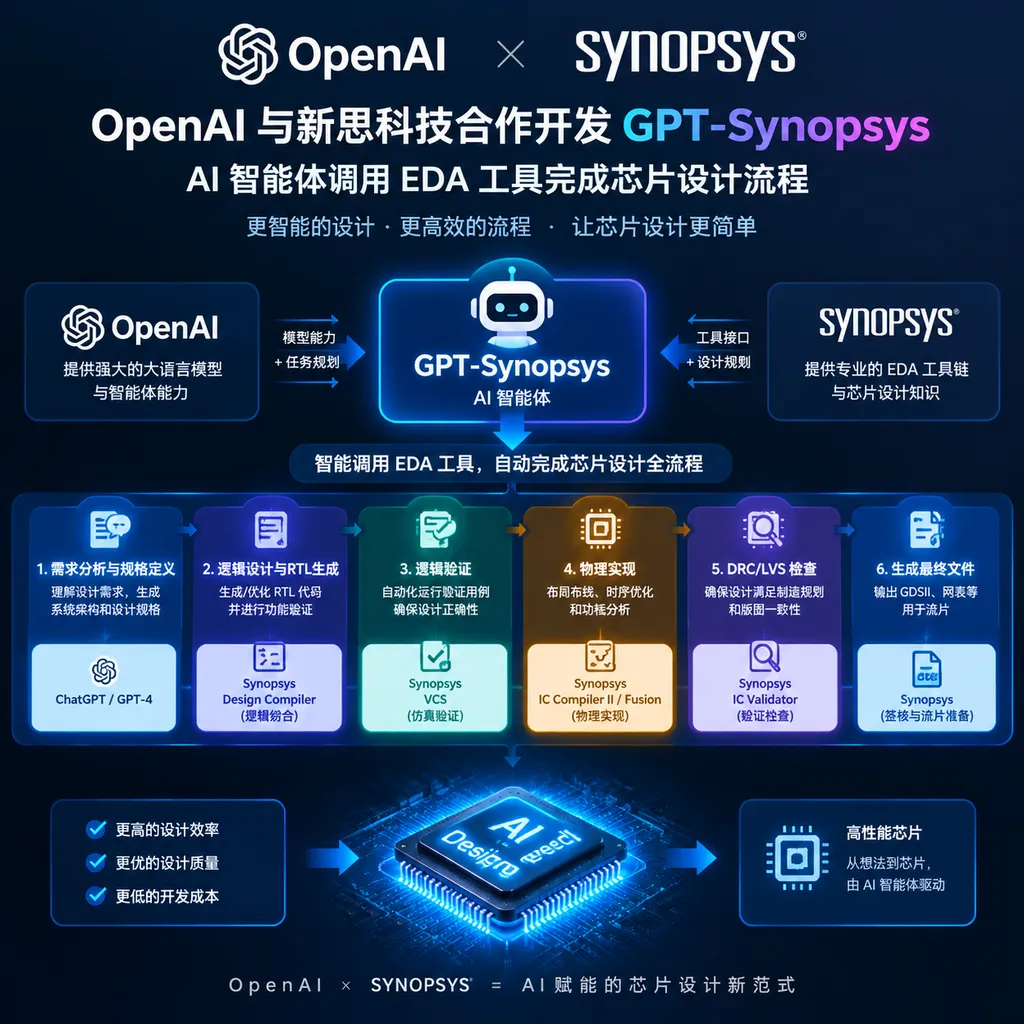
Not a Coding Assistant, but an Expert User of EDA Tools
Over the past two years, AI has entered chip design primarily in two ways.
One approach uses general-purpose large models to generate Verilog, SystemVerilog, or scripts, helping engineers with code completion, documentation searches, and basic debugging. The other embeds machine-learning algorithms into EDA tools to optimize placement, routing, power consumption, or verification tasks. Both approaches can reduce repetitive work, but people still need to switch between tools, determine whether the results are reliable, and manually drive the next round of iteration.
GPT-Synopsys is attempting to address a later-stage problem: enabling a model to understand the inputs, outputs, and constraints of EDA tools and connect the entire design workflow.
According to the vision announced by both parties, an engineer could describe a goal such as minimizing power consumption while meeting area and timing constraints, or achieving timing closure while increasing frequency. The agent would then invoke the appropriate EDA tools, analyze the worst paths, congestion hotspots, power anomalies, and design-rule violations in the reports, and decide what modifications to make next.
This process is more like having a senior engineer who can continuously operate software than having a chatbot that only answers questions. The agent must not only know how to write a particular command, but also understand what the tool output means and determine which constraint, module, or set of physical parameters should be changed next.
The core metrics in chip design are often summarized as PPA: power, performance, and area. There are rarely simple solutions that improve all three at once. Increasing frequency may raise power consumption, reducing area may cause routing congestion, and lowering power may sacrifice performance. EDA tools can search through a vast parameter space, but the search itself requires substantial computation and multiple rounds of iteration.
The value of GPT-Synopsys lies precisely in enabling an agent to participate in this cycle of “propose a solution, run the tools, read the results, and continue making modifications.”
How Far Can AI Advance, from RTL to Sign-Off?
Moving a chip from specification to tape-out requires a series of interdependent and mutually constraining processes. A typical path includes:
- Completing the architecture design and module partitioning based on system specifications;
- Using RTL to describe the digital logic and conducting functional simulation;
- Converting RTL into a gate-level netlist through synthesis;
- Completing placement and routing to determine the physical locations of transistors and interconnects on the chip;
- Performing static timing analysis, power analysis, and signal-integrity analysis;
- Checking functionality and manufacturing rules through formal verification, simulation, and physical verification;
- Completing final sign-off after all constraints have been met, then sending the design to the foundry for manufacturing.
The areas publicly highlighted for GPT-Synopsys currently focus on PPA optimization, timing closure, design modification, and iterative verification results. This does not mean that the model can already independently complete all work involved in taking a chip from specification to tape-out, nor does it mean that human engineers can be removed from the process.
A more accurate description is that AI is taking over a large amount of the engineering work that requires repeated experimentation.
For example, an engineer may need several days to compare different synthesis strategies, clock-tree configurations, and placement parameters. Each modification requires the tools to be run again, the results to be awaited, and dozens of reports to be checked. An agent can try more options in parallel and rank the results according to the objectives. For mature modules or tasks with clearly defined constraints, this automation could significantly shorten the design cycle.
However, if the problem originates in the architecture itself, it is difficult for a model to solve it through local parameter tuning. Even if placement and routing are handled well, a design may still fail to meet product objectives because of poor choices involving cache hierarchy, datapaths, or memory bandwidth. AI can help explore solutions, but it cannot replace system-level judgment.
The Key Change: Models Begin Operating Software Instead of Only Generating Text
The technical significance of this partnership lies primarily in tool-use capabilities.
The output of a general-purpose large model is usually text, code, or structured data. EDA tools, by contrast, are complex software systems with large numbers of commands, configuration files, constraint formats, and license restrictions. Their output is not a simple “correct” or “incorrect,” but a combination of timing reports, power reports, congestion maps, rule-check results, and verification logs.
GPT-Synopsys therefore needs to solve not merely a question-answering problem, but a long-running agent-engineering problem:
- Understand the design objectives and constraints provided by the engineer;
- Select the appropriate EDA tools and runtime parameters;
- Read and interpret the reports generated by the tools;
- Identify the key factors affecting PPA or timing;
- Modify the RTL, constraints, or implementation configuration;
- Rerun the flow and compare the results before and after the changes;
- Stop when the objective is achieved, the process reaches a local optimum, or an abnormal condition is triggered;
- Output traceable change records and verification results.
The most difficult part is not generating commands, but controlling a closed loop that runs for an extended period. A single chip-design optimization may take several hours or longer, and the process may encounter insufficient licenses, tool failures, conflicting constraints, or unstable results. The model must have capabilities for task decomposition, state management, error recovery, and experiment logging.
Synopsys already has AI-driven platforms such as Synopsys.ai and Autopilot. The two companies said that GPT-Synopsys will run on OpenAI’s own infrastructure and be deeply integrated with Synopsys’s agent platform and EDA tools. In other words, this is not a standalone chat window, but a combined product integrating model capabilities, enterprise computing resources, EDA tools, and customer design environments.
Final Sign-Off Will Not Be Handed Over to the Model
One of the biggest differences between chip design and ordinary software development is that the cost of errors is extremely high, and many problems cannot be fixed after release.
Software can receive patches after release. Once a chip has been taped out, a design error may mean months of delay and enormous costs. Especially at advanced process nodes, manufacturing, packaging, and verification costs can magnify the impact of a single mistake. As a result, any modification generated by AI must undergo deterministic tool-based verification.
Synopsys has made clear that results produced by GPT-Synopsys will still need to be reviewed using its traditional computational verification tools. Regardless of whether a design is completed by engineers, with agent assistance, or through collaboration among multiple agents, it must meet the same timing, power, physical-rule, reliability, and manufacturing requirements before entering production.
This also means that GPT-Synopsys is more like an “automated engineering team” than a designer capable of signing off independently. The model is responsible for expanding the scope of exploration and accelerating iteration, EDA tools provide deterministic computation, and engineers define objectives, handle exceptions, and make final decisions.
From this perspective, AI changes who executes design tasks and how those tasks are organized. It does not change the chip-manufacturing requirement for deterministic verification.
The Business Model Is Not a One-Time Model Sale
The commercial arrangement behind this partnership is also worth noting.
According to Synopsys, during the initial phase of the partnership, OpenAI will pay tool-license subscription fees to train and develop the model. Once GPT-Synopsys is officially launched for customers, the two parties will share revenue based on the actual design improvements generated by the product.
This is neither traditional model-API pricing nor simply adding a Copilot entry point to EDA software. It is closer to a combination of “tool licensing fees plus performance-based revenue sharing”: OpenAI gains access to professional tools and an industry-specific data environment, while Synopsys gains model capabilities, infrastructure, and a new way to reach customers.
For Synopsys, this model can avoid having the new product directly replace its existing EDA software. The more GPT-Synopsys calls tools such as Fusion Compiler, PrimeTime, VCS, and ICV, the greater the value of those tools themselves. Customers are not just buying a model, but a production system capable of continuously running the design workflow.
For OpenAI, chip design is a high-value but high-barrier vertical. Even if a general-purpose model has extensive semiconductor knowledge, it cannot reliably complete design tasks without tool licenses, process interfaces, and a verification environment. Partnering with an EDA vendor is a necessary step for a model to move from “understanding the industry” to “being able to do the work.”
The two companies said that leading semiconductor customers are already participating in early technical collaborations. Customer design data will be transmitted and stored in an enterprise-grade secure environment and will not be used for model training. Because chip design data involves product roadmaps, process parameters, and trade secrets, data isolation, access control, audit records, and result traceability will determine whether customers truly adopt the technology, just as much as model accuracy will.
What Does GPT-Synopsys Mean for Chip Engineers?
In the short term, GPT-Synopsys is most likely to enter workflows with clearly defined boundaries and quantifiable objectives, rather than directly take responsibility for the complete design of complex SoCs.
Tasks well suited to agents include:
- Conducting multiple rounds of parameter searches for clearly defined PPA objectives;
- Locating timing violations and proposing repair candidates;
- Automatically running regression tests and formal verification;
- Comparing multiple placement-and-routing strategies;
- Generating design reports, change records, and verification summaries;
- Executing repetitive engineering workflows under fixed rules.
These tasks share a common characteristic: their inputs and outputs are relatively clear, their results can be verified by tools, and failures can be rolled back.
The truly difficult work will still include architectural choices, module-boundary design, handling specification conflicts, judging anomalous results, and balancing manufacturing strategies. Engineers’ jobs will not simply disappear, but the required skill structure will change. The value of people who only memorize commands and manually move reports may decline, while the value of those who can define objectives, understand system constraints, inspect model behavior, and design high-quality verification processes will increase.
This also explains why Synopsys emphasizes that the partnership will not cannibalize its existing business, but will provide customers with new design capabilities. The more complex the tools that agents need to invoke, the more important engineers who understand the toolchain and supervise its results will become.
How Far Is GPT-Synopsys from Real-World Deployment?
The two companies have currently announced a partnership and joint-development plans. GPT-Synopsys is not yet a mature product available to all developers. Its real-world effectiveness will depend on several issues.
First, can the model converge reliably on real designs? A single-objective optimization in a demonstration environment is not the same as a complex task spanning multiple modules, tools, and constraints in a customer project.
Second, can the computing costs be controlled? Running EDA tools for extended periods already requires substantial computing power and license resources. If every design objective requires an agent to conduct dozens or even hundreds of attempts, actual projects will need to determine whether customers are saving engineering time or merely increasing cloud-computing and tool-invocation costs.
Third, are the results explainable and reproducible? Chip design cannot simply produce a “better solution.” It must also show what was changed, why it was changed, which constraints were used, which experiments failed, and whether the final result can be reproduced in the same environment.
Fourth, how will data and responsibility be allocated? Customers will not readily hand unreleased chip designs to a black-box system that cannot be audited. Enterprise deployment must provide access isolation, log retention, support for private environments, and clearly defined areas of responsibility.
Therefore, GPT-Synopsys’s real competitiveness will not be determined solely by model parameter scale, but by whether the model can be embedded into a trusted, verifiable, and auditable engineering workflow.
Assessment: The AI Competition in Chip Design Enters the Tool-Control Layer
The most noteworthy aspect of this partnership is not that another industry model with “GPT” in its name has appeared. It is that competition among large models is beginning to shift from “who can answer better” to “who can control more important software systems.”
In the chip industry, EDA tools are the means of production. If a model can only explain a timing report, its value is limited. If it can invoke tools, run experiments, understand results, and make verifiable modifications, it may genuinely change production efficiency.
This also means that the capabilities of a general-purpose model will not automatically translate into chip-design capabilities. Without EDA tool licenses, process rules, enterprise data, and deterministic verification, it is difficult for a model to enter a real engineering loop. The future leaders are likely not companies that merely possess the strongest model, but companies capable of combining models, tools, data, computing power, and industry workflows.
For developers, model aggregation platforms such as OpenAI Hub that are compatible with the OpenAI format are suitable for quickly integrating and comparing general-purpose models. However, the core of a product such as GPT-Synopsys is not ordinary API access, but an authorized EDA tool environment and enterprise-grade agent orchestration. There is currently no information indicating that GPT-Synopsys has been released as a general-purpose API product.
If this partnership is ultimately deployed successfully, the entry point for chip-design software may shift from “engineers operating tools step by step” to “engineers defining objectives while agents run the tools and submit the results.” This will not turn chip design into one-shot prompt generation, but it will shift a large amount of repetitive design-search and verification work from manual operation to machine execution. For a chip industry already slowed by the complexity of advanced process nodes, this could have more practical value than yet another coding assistant.
References
- IT Home: OpenAI Partners with Synopsys to Jointly Develop the GPT-Synopsys Chip-Design Model: Introduces the partnership, the model’s positioning, and its EDA-tool integration direction.
- Synopsys AI-Driven EDA Suite: Because the source domain is not within the domestic-accessible domain range specified in this article, it was not listed as a reference link in the main text and was used only to understand the background of Synopsys.ai.