WorkBuddy exclusively integrates with Space Bunny

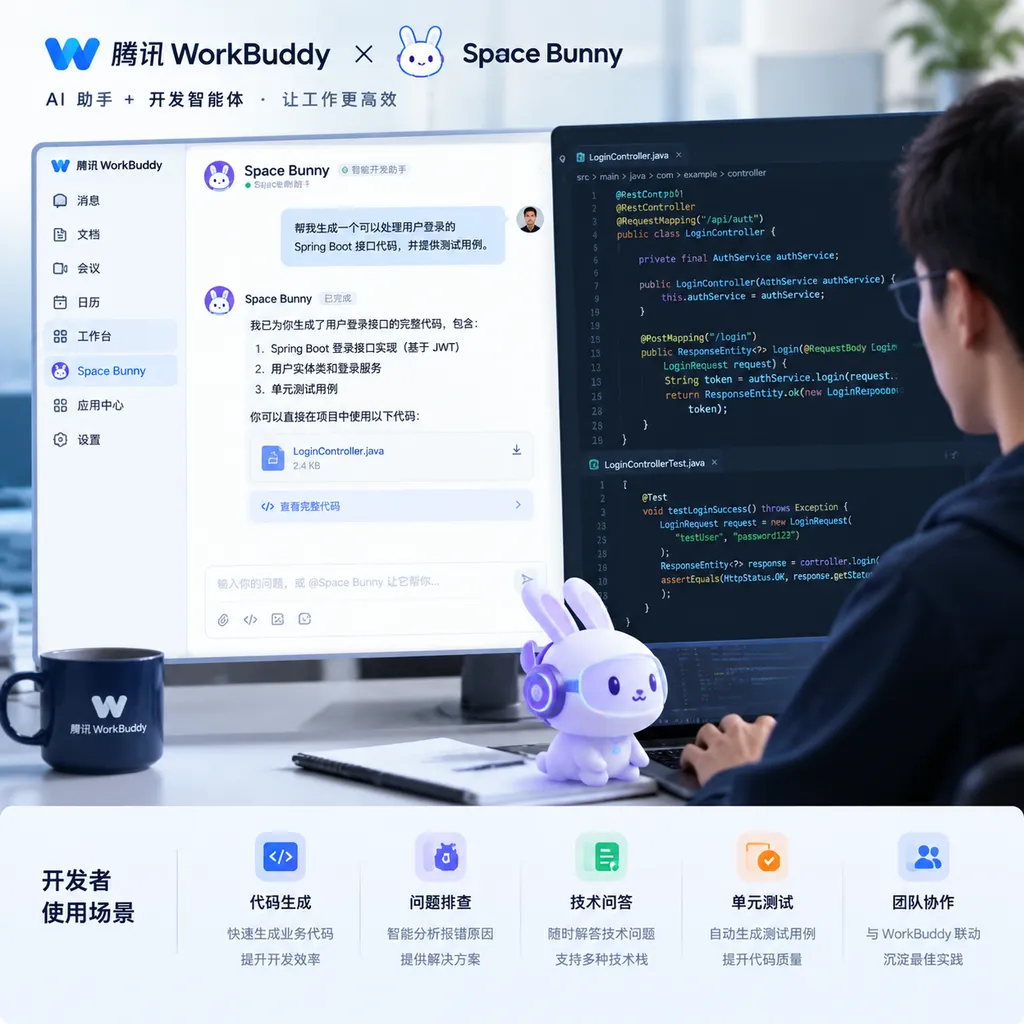
Tencent WorkBuddy announced today that it is the exclusive domestic provider with access to the anonymous Flash model Space Bunny. The model highlights a 1-million-token context window, multimodal input, adjustable reasoning, and coding capabilities, with a limited-time discount available from October 2 to 7.
WorkBuddy Exclusively Integrates Space Bunny, as Million-Token Context Begins Entering Developer Workflows
Tencent WorkBuddy announced today that its built-in models exclusively support Space Bunny. This anonymous Flash model, which only launched on September 23, has a clear core selling point: a 1-million-token context window, native text, image, and video input, adjustable thinking depth, and fast reasoning capabilities geared toward programming scenarios.
WorkBuddy stated that Space Bunny is currently exclusively integrated in China, and will offer a limited-time discount from October 2 to October 7, 2026.
This update is worth paying attention to, not just because there is another model option, but because Space Bunny's combination of capabilities happens to strike at several of the hardest problems currently facing AI programming tools: long codebase understanding, multimodal context input, and the trade-off between speed and reasoning depth.
An Anonymous Model, Why Has It Quickly Gone Viral
What makes Space Bunny special is that since its launch, it has never disclosed the corresponding lab, model architecture, or training details. It appears on platforms as an anonymous Flash model, and what developers can see is the model's performance, price, and call results, rather than the brand behind it.
This makes Space Bunny's release method completely different from models such as GPT, Claude, and Gemini. Traditional large-model releases usually first emphasize the lab, version number, and technical report, and developers use these to judge the model's positioning; anonymous models reverse the order: first building awareness through results and usage volume, and then letting the market infer what it actually is.
According to public information, Space Bunny's OpenRouter token usage on September 27 was approximately 3.99 trillion, and its usage on OpenCode was approximately 8.3 trillion, ranking first on both platforms and topping the charts for three consecutive days.
However, being first in usage volume does not equal being first in overall capability. Platform rankings are affected by price, default configuration, promotional subsidies, routing strategies, and user base, and token counts cannot be directly equated with the number of effective tasks. It at least shows one thing: Space Bunny has already entered the actual workflows of a large number of developers, rather than only gaining attention on benchmark leaderboards.
A more reasonable way to judge an anonymous model is to treat it as a black-box service that requires continuous verification. Whether it is stable, whether long context is truly effective, and whether code quality can be maintained under complex tasks still depend on continuous usage results in real projects.
1 Million Tokens, What Does It Truly Change
Space Bunny's most easily spread label is its 1-million-token context window.
A context window can be understood as the amount of information the model can place on the table at the same time during a single task. An ordinary chat model is like looking at a relatively short document, and once it exceeds the length, earlier text must be deleted; a million-token model can hand a large code repository, API documentation, error logs, product requirements, and multiple rounds of revision records to the model all at once.
For developers, the value of this capability is mainly reflected in three scenarios.
The first is repository-level understanding. In the past, when asking a model to modify a feature, developers often needed to manually select relevant files and then supplement the call chain and constraints. Once the context is long enough, the model can simultaneously read the directory structure, core modules, test files, and configuration files, first building a more complete project map, and then deciding where to make changes.
The second is long-chain troubleshooting. An online issue may involve frontend requests, gateway authentication, backend services, database queries, and asynchronous tasks. If the model can only see one segment of the code, it often gives suggestions that are locally correct but globally ineffective. A longer context allows it to analyze logs, stack traces, configurations, and code together, reducing the cost of going back and forth to fill in information across different files.
The third is complex refactoring. Refactoring is not simply rewriting a function to look prettier, but judging interface dependencies, compatibility, test coverage, and deployment risks. A model that can retain more original constraints is theoretically better suited to handling cross-module migration, API version upgrades, and large-scale code cleanup.
But a million tokens cannot be understood as "the more the model sees, the better the results will definitely be." The longer the context, the more the model needs to accurately locate key information. A large amount of irrelevant code, historical logs, and duplicate documents may instead dilute attention, causing the model to fail to grasp the constraints that truly affect the results. A long window solves the problem of information not fitting, but does not automatically solve the problem of information not being used well.
Therefore, Space Bunny's actual value does not lie in the number on the promotional page, but in whether it can maintain stable retrieval, reasoning, and execution quality within a long context. If it only makes capacity larger but cannot accurately find key code, then 1 million tokens is just an expensive file storage area.
Multimodal Input, Not Just Adding OCR to Code Screenshots
Space Bunny natively supports text, image, and video input, which means its input objects are no longer limited to code and text.
In development workflows, image input can be used to analyze interface screenshots, flowcharts, architecture diagrams, monitoring dashboards, and error pages. For example, developers can simultaneously submit design mockups, existing page screenshots, and related component code, letting the model determine whether visual differences come from layout, fonts, colors, or responsive rules, without having to first translate the problem into text.
The potential value of video input leans more toward debugging and product analysis. A mobile issue may only appear under a specific sequence of operations, scroll position, or network state. Compared with sending only one error screenshot, a screen recording can preserve the complete interaction process, giving the model a chance to reconstruct the problem path from user operations, page feedback, and the moment of abnormality.
Of course, multimodal support does not mean the model already has reliable visual debugging capability. When a video is long, the model still needs to filter key frames from continuous footage; subtle pixel differences in the interface, font rendering, and device compatibility issues may not necessarily be resolved through a single analysis. It is more like adding an assistant for debugging that can look at logs, pages, and operation processes at the same time, rather than automatically replacing browser developer tools.
This is also the practical significance of WorkBuddy integrating Space Bunny: WorkBuddy itself is more like a task-oriented workbench, with model capabilities placed into specific workflows. Developers do not need to first study the model API and then piece together file upload, context management, and task interfaces themselves; they can directly use this capability within existing tools.
Adjustable Reasoning, Resolving the Contradiction Between Speed and Quality
Space Bunny also supports adjusting thinking depth. For developers, this is more practical than simply "stronger reasoning."
Different tasks require different amounts of computation. Converting a piece of JSON into a TypeScript type or explaining a regular expression does not require the model to perform long analysis; but when designing a database migration plan, locating concurrency issues, or modifying cross-service interfaces, quickly giving the first answer is often not enough.
The significance of adjustable reasoning is to let users actively choose among response speed, cost, and result quality:
- For simple Q&A, code completion, and format conversion, prioritize lower reasoning intensity to reduce waiting.
- For single-file modifications and ordinary error analysis, medium reasoning depth can be used.
- For cross-module refactoring, complex architecture design, and multi-step tool calls, higher reasoning intensity is needed.
Such settings will not improve model capability out of thin air, but they can bring the model's computing resources closer to the difficulty of the task. For programming tools that require high-frequency interaction, speed itself is part of productivity. When writing code, developers are usually willing to accept a suggestion that is 80% accurate but returns in a few seconds; before submitting changes, they hope the model will spend more time checking dependencies and boundary conditions.
The key question is whether WorkBuddy will turn this adjustment into a sufficiently intuitive product capability. If users can only manually choose among complex settings, the actual usage rate may not be high; if the platform can automatically recommend reasoning intensity based on task type and then allow developers to override it, that is closer to a mature engineering tool.
For WorkBuddy, Integrating a Model Is More Important Than Adding a Model
WorkBuddy has continued to expand toward an Agent workbench and developer platform this year, and it is no longer just a simple chat entry point. Previously, it announced the opening of capabilities such as Skill, Expert, and Connector, attempting to let external tools, business processes, and model capabilities collaborate on the same Agent foundation.
Against this background, the integration of Space Bunny has two layers of significance.
First, it supplements WorkBuddy's model supply. If a workbench remains bound to a single model for a long time, it will be difficult to cover all tasks: some models are good at writing, some are more suitable for code, and some are stronger at multimodal input. Integrating anonymous models allows WorkBuddy to preserve room for choice as model capabilities change rapidly.
Second, it provides a new capability component for WorkBuddy's task orchestration. Million-token context is suitable for handling large projects, multimodal input is suitable for handling design and screen recordings, and adjustable reasoning is suitable for handling tasks of different priorities. Only when these capabilities are connected with files, tools, memory, and execution permissions will they transform from "model parameters" into efficiency gains that developers can perceive.
From a competitive perspective, WorkBuddy's advantage should not depend only on whether a certain model is leading, but on whether it can let developers switch and combine different models at low cost. Model capabilities are changing faster and faster, and today's first place may soon be replaced. For a workbench, a stable task experience, tool connections, and context management are often more important than betting on a certain model brand.
Exclusive Integration in China, Both Value and Limitations Are Direct
Space Bunny is currently exclusively integrated by WorkBuddy in China, with a limited-time discount from October 2 to October 7. For domestic developers, direct domestic access and a ready-made product entry point can indeed lower the threshold for trial use, especially for teams that need to quickly verify long context, multimodal coding, and Agent workflows.
But "exclusive integration" does not mean developers can immediately treat it as the only model in a production environment. Anonymous models lack public technical reports and long-term version commitments, and before formal migration, developers should still focus on confirming the following issues:
- The actual usable length of the 1M token context, and performance changes under ultra-long input.
- Format limits, size limits, and billing methods for text, image, and video input.
- Response time, stability, and call cost under high reasoning intensity.
- Whether tool calls support parallel execution, error retries, and structured output.
- Whether model version updates will change output style, code behavior, or compatibility.
- Data retention, privacy isolation, and permission management strategies in enterprise scenarios.
Especially for code tasks, whether model output can pass tests is more important than whether answers look impressive in a demo. It is recommended that development teams build a set of regression tasks using their own real repositories, including compilation, unit tests, interface compatibility, dependency upgrades, and security scanning, and then compare results under different reasoning intensities and different context sizes.
Conclusion: Worth Trying, But Don't Pay Just for 1 Million Tokens
Space Bunny's entry into WorkBuddy this time is indeed a targeted product update. It puts long context, multimodal input, adjustable reasoning, and programming capability into the same model, with realistic appeal for code repository analysis, complex troubleshooting, and cross-file modifications. The high usage volume on OpenRouter and OpenCode also shows that developers are testing it with real tasks, rather than just watching the release news.
But the judgment most worth retaining at present is this: the fact that Space Bunny's highlights have been proven to have market demand does not mean its long-term stability and overall quality have been proven. Its anonymous identity has gained it attention, and it also means developers cannot refer to a complete public roadmap and technical materials as they would when evaluating GPT, Claude, or Gemini.
For individual developers, the discount window from October 2 to 7 is suitable for trying it out on real projects, with a focus on observing whether it can reduce context organization and repeated explanations. For teams, a more reasonable approach is to treat it as a high-context, coding-oriented option in the model pool, first validating it through regression tasks, and then deciding whether to bring it into the production pipeline.
WorkBuddy's true competitiveness will ultimately not come only from Space Bunny. Models will change, integration speed will change, and prices will change. Whether these models can be stably connected into files, tools, memory, and execution processes is what determines whether it has merely gained another model entry point, or is becoming an AI workbench that developers truly use.