Suno generates the voice-over and background music in one go.
Suno launches the Speech voice feature, making its first attempt to generate speech and original background music end to end on the same audio track. It lowers the barrier to producing podcasts, short videos, and audio content, but the beta version still has noticeable issues with accent consistency and emotional control.
Suno Generates Voiceover and Music in One Go
On October 1 local time, AI music production platform Suno launched Speech, a voice feature that recently entered public beta for all users. Its most notable aspect is not that it adds another text-to-speech option, but that it aims to treat “vocal expression” and “background music” as a unified whole, generating both in a single pass.
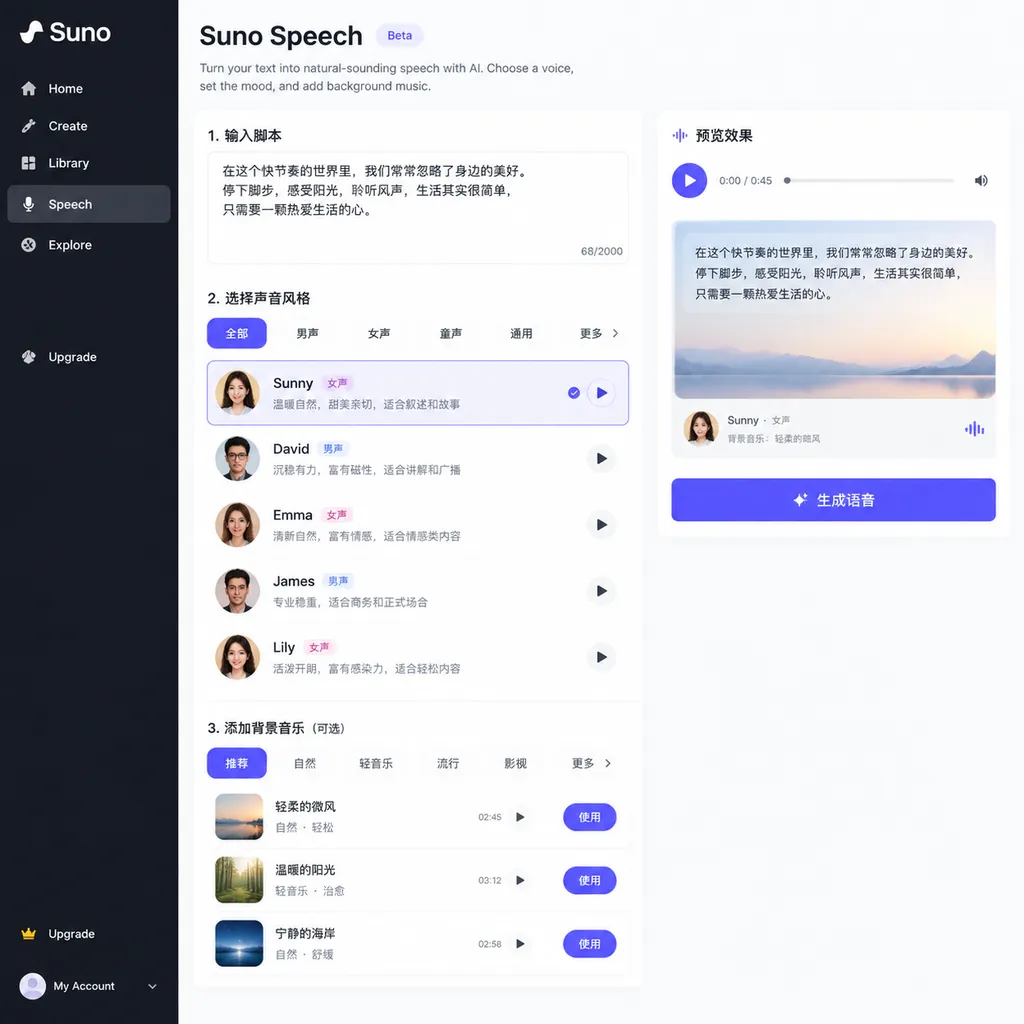
In the past, producing a narrated audio track with music typically involved several steps: first, use a TTS model to turn the script into speech; then find or generate background music; finally, adjust volume, pacing, and fades in audio editing software. Speech aims to compress this workflow into one prompt and one generation task: users enter text and describe the desired voice and musical style, and the system outputs a complete audio track combining speech with original background music.
This means Suno is expanding from “generating songs” to “generating listenable content.” For everyday users, this is a change in how they interact with the product; for audio developers and content teams, it looks more like a workflow overhaul.
Not TTS Plus BGM, but Joint Generation
Traditional voiceover-and-music production is essentially a chain of two models or tools: TTS handles the spoken text, a music-generation model provides the atmosphere, and post-production tools mix the two tracks. The advantage is control: speech and music can be replaced, edited, and adjusted independently. The drawback is equally clear: the two generation stages do not truly understand each other’s rhythmic relationship.
For example, a suspenseful narration may need a pause before a key line, with the background music thinning out at the same time. An advertisement may need the music to leave space in the frequency range when the product name is emphasized. A poetry reading may call for the music’s progression to change with the length of each line. Simply layering a TTS track over BGM often leaves this coordination to manual post-production.
Suno’s description of Speech focuses on “end-to-end” generation and a “single, coherent audio track.” It does not first generate speech without music and then place an existing song underneath. Instead, the model processes the language, vocal delivery, and musical accompaniment together during generation. In other words, the model must decide at once “what to say,” “how to say it,” “when to pause,” and “how the music should follow.”
The potential advantage is more natural coordination between speech and music. It may not make every line of narration hit its cue precisely, but the goal is no longer to produce two unrelated tracks. For people who need to produce content quickly and at scale, eliminating one audio-engineering step may be more valuable than simply improving vocal quality.
Suno Is Expanding Its Product Boundaries
Users first came to know Suno for generating songs from text. Users provide a theme, lyrics, or a style description, and the system creates a musical work complete with melody, arrangement, and vocals. Speech expands the input from “songwriting prompts” to a broader range of text: an idea, a poem, a narration script, or even a more complete screenplay.
Speech is now built directly into Suno’s web and mobile apps. Users can describe the desired result in simple terms or paste in an existing script, then adjust voice characteristics. According to public information, the feature supports settings such as gender and speaking rate, and lets users adjust how much each generation varies. Users can also turn off background music and generate voice-only output. Each generation can be up to about eight minutes long.
That duration is enough to cover many practical use cases:
- Voiceovers, intros, and outros for short-form video creators;
- Podcast openings, transitions, and expressive links;
- Product introductions, event promos, and advertising demos;
- Audiobooks, poetry readings, and story content;
- Temporary voice drafts for games or interactive apps;
- Educational videos, course summaries, and informational audio.
However, Speech is currently better suited to “quickly getting a usable version” than to replacing a mature voiceover production process. Its strengths are speed and cohesion, not precise control. Work that requires word-by-word review, consistent character voices over time, or fine-grained editing of musical structure still depends on traditional audio tools.
What Does End-to-End Generation Really Change?
End-to-end does not automatically mean better. It addresses coordination between models, while potentially sacrificing some interpretability and editability.
In a traditional workflow, if the narration is unsatisfactory, you can regenerate only the speech; if the music does not fit, you can replace the BGM independently; if one line is misread, you can fix just that part. Once Speech puts these elements into the same generation pipeline, the user receives a unified result. It may sound more cohesive overall, but if something is wrong in one section, the entire segment may need to be regenerated.
This is similar to the development of AI images and AI video. Generating a complete scene in one pass can significantly lower the barrier to production, but precise local edits still run into the problem of “change one thing and other things change too.” In audio, this might mean that changing one line causes the background music’s rhythm to change, or adjusting the speaking rate also alters the pauses and emotional delivery.
From a product strategy perspective, Suno is not positioning Speech as a replacement for a professional recording studio, but as a “creative starting point.” It lets users create a complete audio draft using natural language, then decide whether to continue editing it. This fits Suno’s established product logic: lower the barrier to creation first, then keep users on the platform as they iterate.
Beta Limitations Center on Controllability
Suno has acknowledged that Speech is still in beta and that the current version has inconsistent accents. For example, English pronunciation may drift from British to Australian during generation, then switch back. For everyday users, this may be a minor occasional flaw; for commercial voiceovers, character work, and branded content, accent drift can directly undermine continuity.
Intonation and emotional pauses are another issue. Speech sometimes reads ordinary sentences too dramatically, with pauses that are too long and slow the pacing. That delivery may work for poetry, stories, or emotional monologues, but for product introductions, news narration, and educational content, the excessive performance can sound unnatural.
This reveals a key challenge: the quality of speech generation depends not only on whether the voice sounds human, but also on whether the model understands the purpose of the text.
The same sentence may call for entirely different delivery in an advertisement, podcast, documentary, or customer-service setting. Users need more than simple labels like “happy,” “sad,” or “serious.” They need repeatable, predictable control over delivery, such as:
- Which word in a sentence should be emphasized;
- Whether pauses should fall at punctuation or at semantic transitions;
- When background music should begin, fade down, or stop;
- Whether the ending should resolve, hang in the air, or leave an echo;
- Whether the same character can sound consistent across multiple pieces of content.
Speech already incorporates some of these considerations into its generation targets, but the beta version’s performance suggests it has not yet reached the reliability required for professional production. It can quickly produce a result that “sounds like a finished piece,” but it may not consistently follow a complex set of voice-direction instructions.
For Developers, the Value Goes Beyond Voiceovers
Although Speech is currently offered mainly as a built-in Suno feature, its technical direction is still relevant to developers.
In the past, developers adding audio features to an application often had to integrate separate services for text generation, TTS, music generation, and audio mixing. Each service comes with its own API, pricing, latency, and content moderation policies. Developers then have to handle volume normalization, track alignment, audio format conversion, and retry logic themselves.
If end-to-end audio models mature, developers may eventually need to provide only a content script and scene parameters to get a complete audio result ready for users. The focus at the application layer would shift accordingly: from “how to assemble audio” to “how to describe the scene, constrain the style, and manage generated results.”
But that does not mean developers can ignore lower-level controls. At a minimum, real products will need to consider:
- Consistency: Can the same character, brand, or program maintain similar vocal characteristics across different batches?
- Editability: When users change one sentence, must the entire audio segment be regenerated?
- Latency and cost: Are the generation time and cost for eight-minute audio suitable for real-time interactions or batch jobs?
- Copyright and licensing: How are the permitted uses of background music and voice styles defined, and can generated content be used commercially?
- Safety: Could the model be used to impersonate public figures, fabricate institutional announcements, or create misleading content?
- Output quality: Are recognition and delivery reliable across different languages, accents, and technical terms?
Voice identity is a particularly important issue. Combining speech and music into a single track can make the experience more complete, but it does not reduce the risk of identity misuse associated with voice generation. For developers, voice provenance, user consent, and generation records may need to be addressed before launch, rather than patched in afterward.
How It Compares With Traditional Workflows
Speech is not suited to every audio task. Its relationship to the traditional TTS-plus-BGM approach is more like a choice between “quick generation” and “precision production.”
If the goal is to quickly create an atmospheric, expressive audio clip that can be played back right away, Speech is more convenient. For example, a creator might want to test whether a story works as a short video; a marketing team might want to compare several advertising tones quickly; or a podcast host might need a temporary intro. End-to-end generation can cut production time from tens of minutes to just a few minutes, or even less.
If the goal is an ongoing series, branded announcements, or film post-production, the traditional workflow remains more reliable. Professional teams usually need to lock in a voice, edit line by line, adjust music independently, and retain editable versions of every asset. These requirements are inherently at odds with an end-to-end design that generates a complete result in one pass.
The two approaches can be understood simply as:
- Speech: A creative assistant that handles voiceover and music together, suited to quickly producing a first draft.
- Traditional workflow: A full audio studio with more steps, but independent control over every stage.
Suno’s competitive strength is that it may make “producing a version you can listen to” simple enough. For many non-professional creators, that first step is the biggest hurdle.
Suno’s Next Step May Go Beyond Song Generation
The launch of Speech shows that Suno is redefining the boundaries of its product. It is no longer competing only with music-generation platforms; it is also entering the overlapping territory of TTS, audio content production, and creator tools.
The possibilities are broad. Future audio-generation models may do more than produce speech and music: they could understand shots, characters, environments, and plot, turning a script directly into a complete sound scene with dialogue, music, sound effects, and a sense of space. The boundaries between music-generation platforms, voice platforms, and film post-production tools would become even less distinct.
But Suno’s challenges are also clear: more stable accents, more predictable emotion, more reliable character consistency, and finer-grained editing. End-to-end generation will move from an impressive demo to a production tool that developers and content teams are willing to rely on over the long term only if it can balance “good overall sound” with “local control.”
For now, Speech is worth watching, but it is too early to see it as the end of professional voiceover software. What it has achieved is handing some of the work of coordinating voiceover and music, which previously required human effort, over to the model. For creators, this lowers the barrier to production; for the audio industry, it is a signal that the next stage of competition may not be just about whose voice sounds more human, but about who better understands how a piece of content should be heard.
Conclusion
The core value of Suno Speech is not that it has “launched another AI voiceover feature,” but that it brings vocal delivery and musical accompaniment into the same generation target. End-to-end generation could help narration, music, and emotion work together more naturally, while speeding up the early production of short videos, podcasts, and spoken-word content.
However, accent drift, overdone emotion, and inconsistent pauses in the beta version show that it is currently better suited to creative exploration and rapid prototyping than to commercial projects with strict consistency requirements. For developers, the question to watch is not whether one-pass generation can replace every audio tool, but whether this paradigm of jointly generating multiple audio elements can gradually become a foundational capability for the next generation of audio applications.
References
- IT Home: Suno launches its Speech voice feature — Covers Speech’s launch timing, end-to-end generation approach, public beta availability, and known issues in the beta version.