Amazon Open-Sources a 2B Decision-Making Model

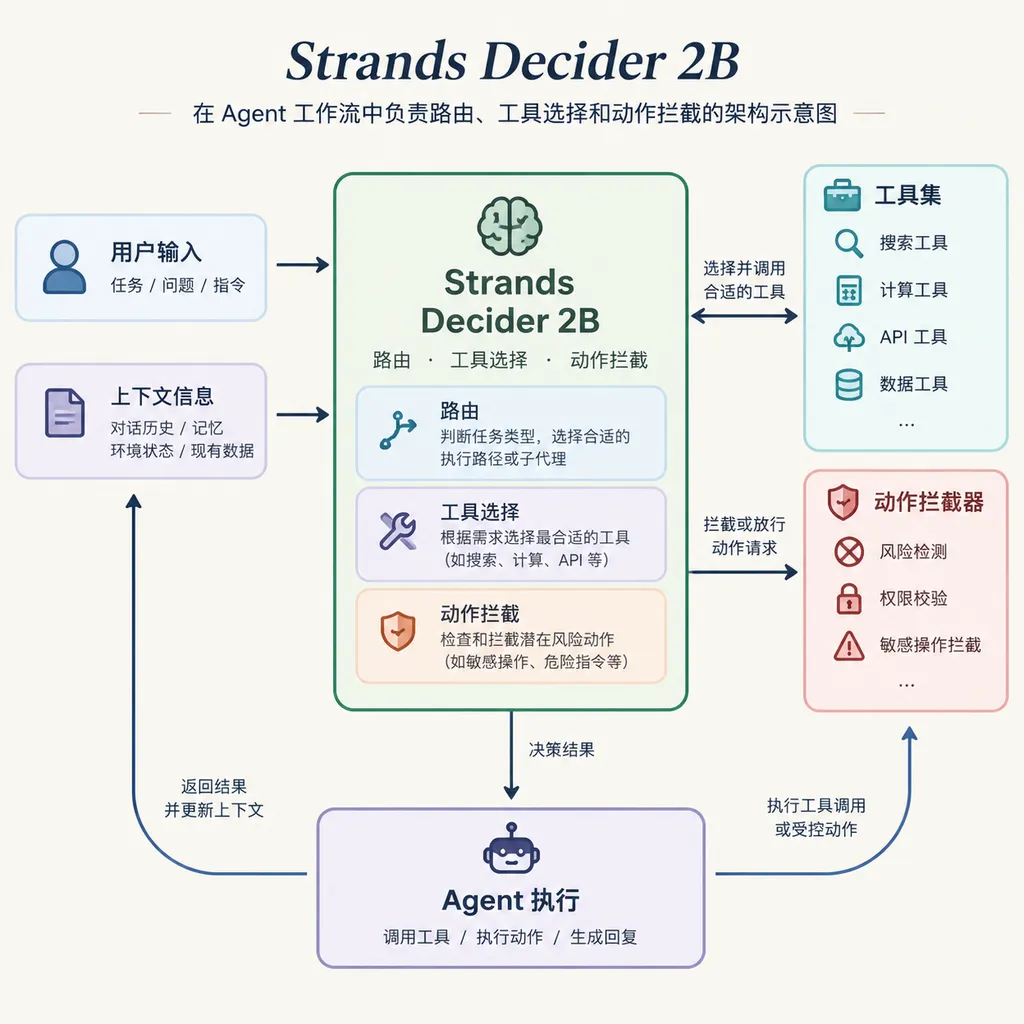
The Amazon Strands Agents team has open-sourced Strands Decider 2B. It does not generate long-form text; instead, it quickly selects from predefined options and outputs a confidence score. It supports local execution on CPUs and GPUs, targeting routing, tool selection, safety interception, and other stages in agent workflows.
Amazon is taking back part of an Agent’s “thinking” from large language models.
On October 1, local time, Amazon’s Strands Agents team announced the open-source release of Strands Decider 2B. It is a lightweight model designed for Agent decision-making. Its code and training materials have been published on GitHub, and its weights are available on Hugging Face. It can run locally on a CPU or GPU, without requiring every decision to call a cloud-based large language model.
As of today, October 3, 2026, the most notable thing about this model is not its parameter count, but the practical division of labor it suggests for Agent architectures: delegate complex tasks to general-purpose large models, and hand repetitive, well-defined, latency-sensitive choices to a dedicated decision model.
It Is Not a “Smaller Chat Model”
Strands Decider 2B works differently from general-purpose generative models such as GPT, Claude, and Gemini.
General-purpose large models typically receive context and then generate text, code, or structured output. They can compose answers freely, but the tradeoffs include heavier inference, unpredictable output length, and latency and token costs that grow with the context and generated content.
Strands Decider 2B targets a different kind of problem: the developer has already defined the possible answers or actions, and the model only needs to select one and provide a score or confidence level for each option.
For example, a customer service Agent receives the question, “Why hasn’t my order shipped yet?” The system may already have defined four routes: billing, shipping, returns, and technical_support. There is no need to have a large model write an explanation; the system only needs to determine which workflow should handle the request.
The model might return a result like this:
shipping: 0.82billing: 0.10returns: 0.05technical_support: 0.03
In this scenario, generative ability is not an advantage. What matters is the ability to make choices reliably, cheaply, and with calibrated confidence. Strands Decider 2B is designed to give Agents a high-speed “router.”
It can be used for model routing, tool selection, context classification, policy decisions, and action interception. It can also assess whether an Agent preparing to perform a sensitive operation should be allowed to proceed, ask for human confirmation, or request more information.
Built on Qwen3.5-2B, With the Generative Head Replaced
Technically, Strands Decider 2B is built on the pretrained Qwen3.5-2B. Amazon replaced the language model head, which is responsible for generating text, with a small scoring “pointer head.”
This new head has slightly more than one million parameters. It matches the model’s hidden states against candidate answers provided by the developer and scores them. The base model is fine-tuned using a rank-16 LoRA adapter.
One way to think about it is that Qwen3.5-2B still handles understanding the input and context, but instead of organizing that information into a sequence of words, the model focuses on “which option is the best fit.” By narrowing the output space from open-ended text to a finite set of choices, the model can make inferences more quickly and integrate more easily with downstream program logic.
This design also explains why it cannot simply be categorized as a “2B small language model.” Parameter count is only part of the picture; what really matters is that the output objective has been redefined. A 2B model that still needs to generate long text may not offer sufficiently low latency or cost. A 2B model that only needs to choose from a dozen actions, by contrast, can handle the more frequent and mechanical decisions in an Agent workflow.
The Amazon team says it will also release Strands Decider 2B’s training code, training data, and examples. For developers, this is more valuable than weights alone: a decision model’s performance depends heavily on how candidate options are designed, the data distribution, and confidence calibration. Seeing the training and evaluation methods makes it easier to judge whether the model can transfer to a developer’s own business.
2B Parameters Bring Deployment Flexibility
According to the public information, Strands Decider 2B performs well in accuracy and calibration on JevBench. It ranks third among 2B-class models and outperforms all competing models with strictly no more than 2B parameters.
It is important to distinguish between these two metrics.
Accuracy answers the question, “How often did it choose correctly?” Calibration answers, “How confident is it in its decisions, and is that confidence justified?” In Agent systems, the latter is often just as important. If a model frequently makes incorrect decisions with 95% confidence, the system may execute the wrong tool call directly. If the model lowers its confidence when uncertain, developers can set a threshold and route low-confidence requests to a large model or human workflow.
This is an important difference between a decision model and a conventional classifier. It does not just return a label; it also aims to provide a signal that can be used to control the workflow.
For latency, Amazon’s published figures show a median decision latency of about 113 milliseconds on common hardware. Another set of figures in the published materials gives a value of about 115 milliseconds. For small decision tasks on an NVIDIA GeForce RTX 3090, median latency is about 153 milliseconds. On an M3 MacBook, the median latency for small tasks is roughly in the same range.
These numbers should not be taken as fixed API response times. Latency generally increases as decision tasks get larger, the number of candidate options grows, or the input context gets longer. But for short tasks such as model routing, tool selection, and state classification, responses in the hundreds of milliseconds are fast enough for most Agent loops.
Its more practical value lies in its ability to run locally. Enterprises do not have to make a remote large-model call for every simple decision, nor do they need to send all routing information, tool states, or internal policies to a third-party cloud service. For edge devices, internal networks, and latency-sensitive automation, this deployment model has more practical value than simply chasing a higher benchmark score.
Agents Do Not Need to Call the Most Powerful Model at Every Step
A common problem with many Agent systems today is that they delegate every stage to the same general-purpose large model: the large model identifies user intent, selects tools, decides whether to continue, and performs the genuinely complex reasoning.
This approach is convenient early in development, but its problems become more apparent as systems scale:
- Every small decision requires a remote call, so overall latency can accumulate.
- Even simple classification consumes input and output tokens, making costs harder to control.
- Large-model outputs are open-ended, requiring more parsing and fallback logic to connect them to program control.
- A mistake in a critical routing decision can trigger the wrong tool or violate permissions.
- Repetitive decisions consume capacity that would be better suited to complex tasks.
The approach represented by Strands Decider 2B is to divide an Agent into layers.
The first layer is a local decision model for high-frequency, low-complexity problems with relatively stable candidate sets, such as “Which tool should be called?”, “Which business queue does this request belong to?”, and “Are the conditions for continuing execution met?” The second layer is a general-purpose large model for tasks that require long-context understanding, open-ended planning, multi-step reasoning, or complex expression. The third layer can be a rules engine or human approval process for permissions, funds, privacy, and high-risk operations.
This architecture is closer to layered control in traditional software engineering than to having one model handle everything. A more capable model is not necessarily the right fit for every stage. For a task with a predefined set of options, asking a generative model to write an answer and then parsing it is often an indirect approach. Direct scoring and selection are easier to test and make it easier to constrain the system’s risk boundaries.
Its Limitations Are Also Clear
Strands Decider 2B cannot replace general-purpose large models. Its capabilities are deliberately bounded from the outset: it can only choose among the options it is given. If the candidate set does not cover the real situation, or if the options themselves are ambiguous, the model may express high confidence while simply being “very sure of its answer to the wrong question.”
So when using this type of model, the most important work is not just downloading the weights; it is designing the decision interface well.
Candidate options should be as mutually exclusive as possible to avoid significant semantic overlap between actions. Fallback options such as unknown, need_more_information, or human_review should be available; the model should not be forced to choose an unsuitable option. Confidence thresholds should also be set according to business risk rather than applying a single value across the board.
For example, a confidence level of 0.7 may be enough to trigger automatic routing for ordinary content classification. But in workflows involving refunds, payments, or permission changes, automatic continuation may require a confidence level above 0.95, with lower-confidence cases sent to a more capable model or a human for confirmation.
In addition, a ranking on JevBench does not directly translate to production performance. Public benchmarks can show a model’s relative performance on a set of tasks, but they cannot replace an organization’s own offline evaluation. Language style, number of candidate options, context length, and the cost of errors vary between businesses. Before deployment, real samples should still be used to test accuracy, refusal rate, confidence distribution, and long-tail errors.
Why Amazon Is Releasing It Now
The release of Strands Decider 2B also reflects how the competition in Agents is shifting from “whose model is bigger” to “who can run workflows more efficiently.”
In the early days of Agents, developers cared more about whether a model could call tools and complete multi-step tasks. But once a system enters production, latency, call costs, retries, access controls, and observability quickly become equally important. An Agent that calls a large model at every step may be flexible in a demo, but it may not be economical to run over the long term.
Amazon already offers cloud-based model and Agent infrastructure such as Bedrock and Strands Agents, so this local decision model is not intended to replace cloud-based generative models. A more likely setup is for Strands Decider 2B to perform fast filtering at the start of an Agent workflow, with tasks passed to a general-purpose model on Bedrock when they require content generation or complex reasoning.
This is a hybrid architecture. It preserves the capabilities of cloud-based models while separating frequent, simple decisions from remote calls. For AWS, open-sourcing a decision model that runs locally may also help attract more developers to Strands Agent workflows.
Notably, Strands Decider 2B was released in the same week that OpenAI introduced a product in a similar area. Decision models are moving from a relatively niche engineering experiment to a specialized area attracting attention from both large-model providers and Agent framework teams. The reason is straightforward: the bottleneck for Agents is no longer just “Can the model answer?” It is “Can the system take the right next action, at the right time, at a suitable cost, and under control?”
What This Means for Developers
If you are building an Agent that needs extensive routing and tool orchestration, Strands Decider 2B is worth testing, but it should not be treated as a universal model.
Tasks it is well suited to include:
- Selecting which tool to call next from a fixed set of tools.
- Routing a user request to different business Agents.
- Determining whether the current context is sufficient to continue.
- Choosing between allowing, rejecting, requesting human confirmation, or asking for more information.
- Routing requests among general-purpose models based on cost, capability, or latency.
- Handling repetitive policy classifications and state decisions locally.
It is not suited to open-ended question answering, long-form text generation, planning tasks without predefined candidate answers, or problems that require the model to discover new policies on its own.
For deployment, it is advisable to start by placing the model outside the critical path. Log the input, candidate options, model selection, confidence, and the final human or large-model result, then adjust the options and thresholds using real-world data. The value of a decision model is not that it replaces general-purpose large models all at once, but that it gradually reduces calls that do not require generative capabilities.
From this perspective, Strands Decider 2B is not just “another 2B model released by Amazon.” It is more of an engineering signal: Agents are entering a phase of greater specialization, with model capabilities divided across dedicated roles. Future Agent systems may no longer be managed end to end by a single large model, but instead be composed of generative models, decision models, rules engines, and human approvals.
For developers in China who want to quickly test multi-model collaboration and Agent routing, an aggregation platform compatible with the OpenAI format can provide unified access to cloud-based models such as GPT, Claude, Gemini, and DeepSeek, with a locally run decision model placed at the start of the call chain. The point is not to pile all the models together, but to assign models according to task complexity so that only requests that genuinely need a large model consume large-model resources.
For now, Strands Decider 2B is best viewed as an open-source component worth adding to an evaluation pool, rather than a production-ready answer out of the box. Its accuracy, calibration, local deployment capability, and latency in the hundreds of milliseconds already provide a concrete counterexample to the question, “Does an Agent need to call a large model at every step?”
References
- IT Home: Amazon launches Strands Decider 2B open-source decision model with local deployment support: Covers the model’s release date, architecture, benchmark performance, and local inference latency.
- Strands Agents GitHub organization: Browse Strands-related open-source code, training scripts, and example projects.
- Hugging Face model search: Strands Decider 2B: Find model weights and related files.