Western Companies Make a Collective Bet on Open-Weight Models
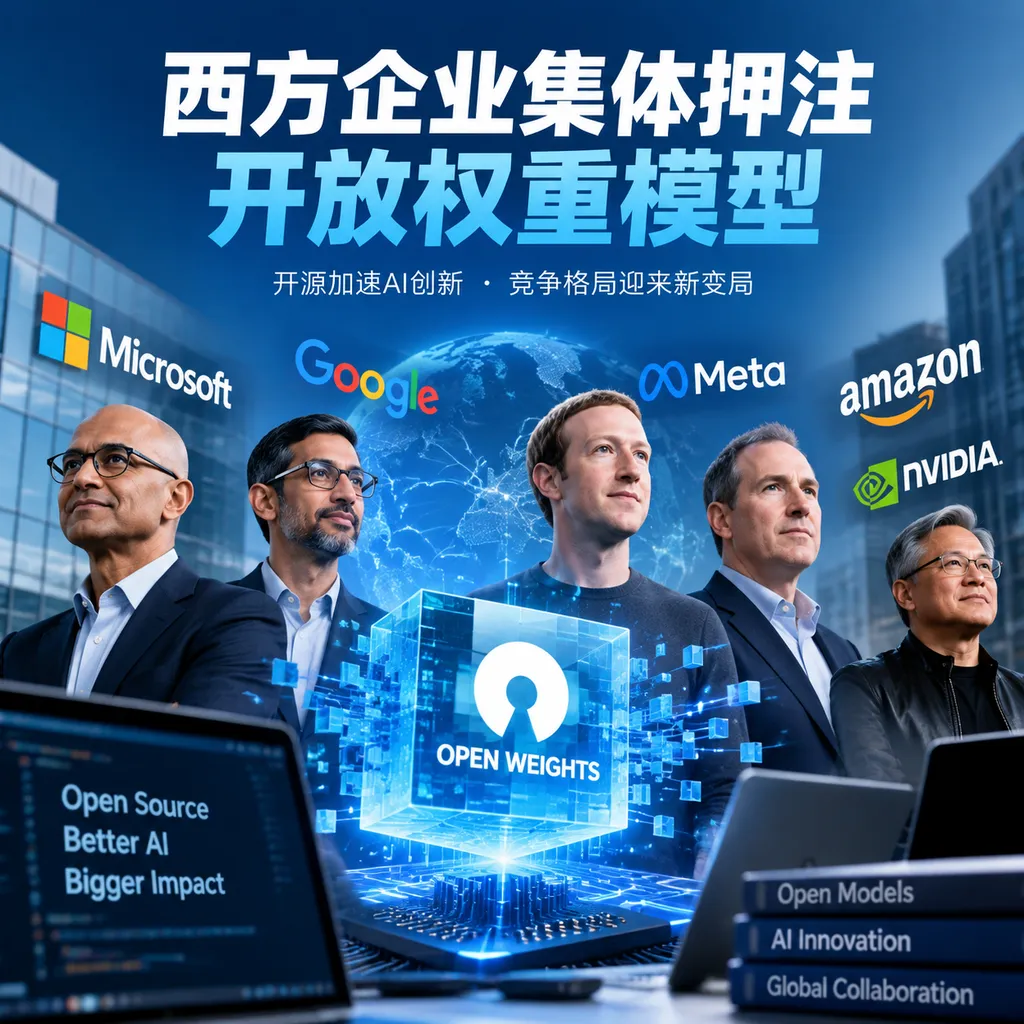
According to Axios, several Western companies, including Reflection, plan to release open-weight models one after another in October. They may not immediately outperform closed-source models such as GPT and Claude, but they could shift the competition from “whose benchmark scores are highest” to “who can enable enterprises to own their own AI at a lower cost.”
Reflection Plans to Release a Model as Western Vendors Begin Closing the Open-Weight Gap
According to an Axios report dated October 4 local time, AI startup Reflection plans to launch its first open-weight model this month, with other Western companies also expected to follow suit in October. For now, the news remains limited to media reports and disclosures from people familiar with the matter. Reflection has not announced an exact release date, model size, licensing terms, or benchmark results.
But the significance of this news goes beyond the arrival of yet another model. Over the past two years, the main battleground for frontier models has been dominated by companies such as OpenAI, Anthropic, and Google, with competition focused on closed-source APIs, reasoning capabilities, and product ecosystems. Open-weight models, meanwhile, have been driven more heavily by Chinese vendors. Models such as DeepSeek, Qwen, Kimi, and GLM have continued to push down the capability and price curves.
Now, Western companies are beginning to make up ground in this area.
This does not mean Reflection will defeat America’s strongest closed-source models on the day of its release. On the contrary, the information currently available suggests relatively restrained expectations: Reflection’s first model is initially expected to trail the most advanced closed-source models in the United States, but may compete with leading Chinese open-weight models.
This is a more realistic—and more noteworthy—product positioning. Open-weight models do not need to beat GPT or Claude on every general-purpose leaderboard before they can have commercial value. As long as they are “good enough” for coding, enterprise knowledge bases, tool calling, or specific industry tasks, their local deployment and customization capabilities could allow them to enter markets that closed-source models struggle to cover.
Open Weight and Open Source Are Not the Same Thing
Before discussing this wave of model releases, it is important to clarify a concept that is often used interchangeably: open weight does not mean fully open source.
Open-weight models typically provide developers with the trained model parameters, allowing users to download, deploy, and fine-tune them within the scope permitted by the license. However, the training data, complete training code, data-cleaning procedures, and certain engineering details may not all be made public. By contrast, strictly open-source models also involve more complete code, data documentation, licensing, and reproducibility requirements.
For enterprise developers, the most practical difference is not a conceptual debate but a change in deployment rights.
When using closed-source models such as GPT, Claude, or Gemini, developers primarily send requests through APIs. Where the model runs and how data passes through the provider’s infrastructure are generally handled by the vendor. Enterprises gain better model capabilities and a more convenient operational experience, but they must also accept the vendor’s pricing, rate limits, service policies, and data-governance boundaries.
Open-weight models return some of that control to users. Enterprises can deploy models in their own cloud accounts, private data centers, or even isolated networks, and then fine-tune them or apply retrieval augmentation using business data. For industries such as finance, healthcare, government, defense, and industrial manufacturing, this capability is not a matter of whether they “want to tinker.” It is a prerequisite for integrating models into core workflows.
Of course, local deployment does not mean zero cost.
Enterprises must shoulder the costs of GPUs or other accelerators, inference services, model quantization, monitoring, version management, vulnerability remediation, and security audits. Once an open-weight model has been downloaded, there is still a long engineering chain before it can provide a stable service. For teams without mature AI infrastructure, closed-source APIs may still be cheaper and faster.
Therefore, the real advantage of open-weight models is not simply that they are “free,” but that they offer control. Enterprises can decide where the model is hosted, how it is modified, which data it uses, and what trade-offs to make between capability and cost.
What Reflection Really Wants to Sell Is Not a Model
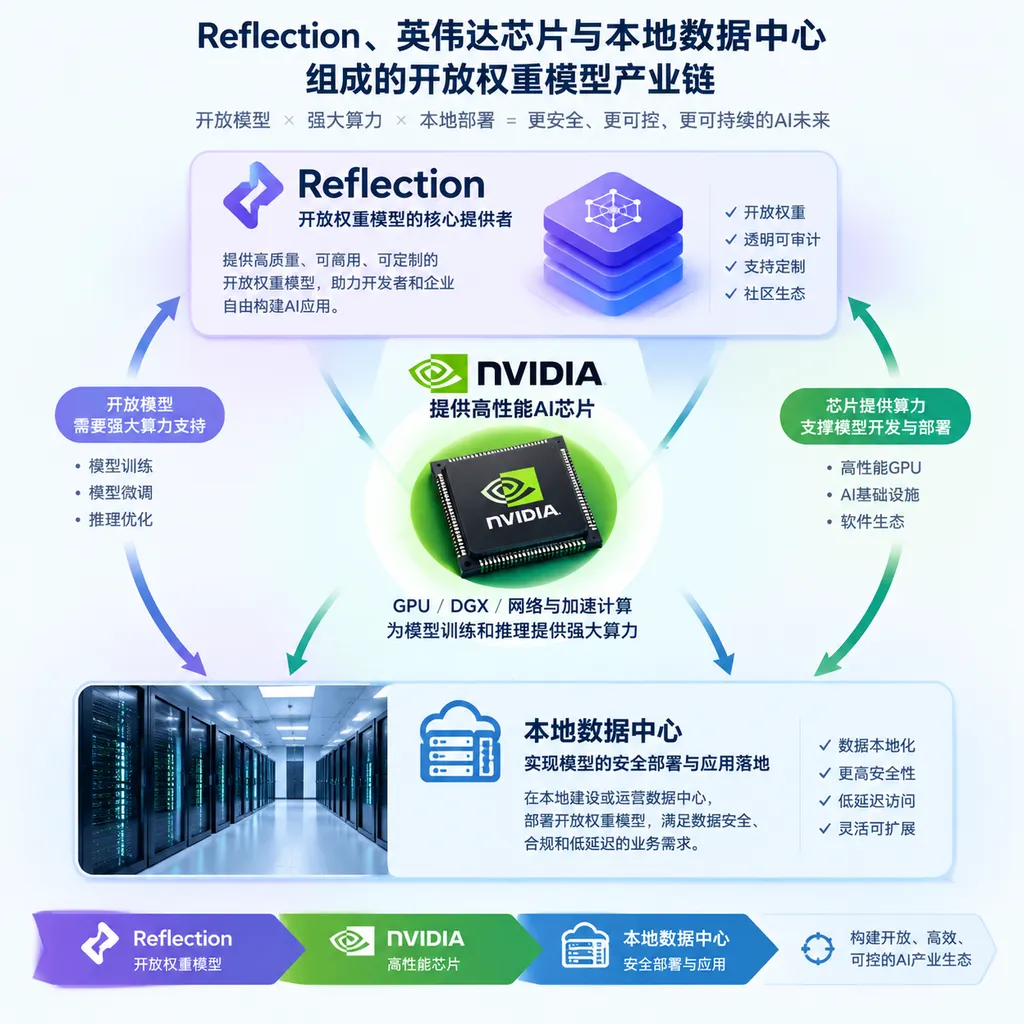
Based on current reports, Reflection’s ambition may not be limited to releasing a model. Instead, it may seek to build what it calls an “AI factory” around the model. The company wants enterprises or government institutions to bring together proprietary data, models, and computing power to build more customized local AI systems.
The concept sounds like a combination of data centers, model services, and industry solutions. Enterprises provide the data and business scenarios; Reflection provides the model and related technologies; and the system runs on computing infrastructure supplied by companies such as Nvidia. The final deliverable is not a chatbot, but an AI production system capable of handling internal enterprise tasks.
Its target customers are also relatively clear: organizations with high requirements for data confidentiality, latency, and customization, such as hedge funds, trading firms, large manufacturers, and government departments. These customers may not need a model that ranks first on every public leaderboard. They care more about whether the model can work reliably on their own data, run in a designated environment, and keep the cost of each call within an acceptable range.
In March this year, Reflection signed a memorandum of understanding with South Korea’s Shinsegae Group to build a 250 MW AI factory in South Korea using Reflection models and Nvidia chips. This case suggests that Reflection may be trying to tie model releases to infrastructure projects.
But it also exposes the challenges the company faces: to provide enterprise-grade local AI, a model company needs far more than model weights. It also needs inference optimization, distributed deployment, access control, data isolation, model evaluation, industry-specific fine-tuning, and after-sales support. Model capability is only the entry point; delivery capabilities determine whether revenue can be sustained.
Why the West Is Starting to Pursue Open Weight Now
In the past, major Western AI companies were more willing to keep their strongest models behind closed-source APIs. This approach offers several advantages: model updates can be centrally managed, the business model is clear, security policies and access permissions are easier to control, and computing costs can be converted into long-term subscription or usage revenue.
But open-weight models are changing the market’s cost structure.
Once a sufficiently capable model can be downloaded and deployed by enterprises, the model itself is no longer sold entirely on a per-million-token basis. Beyond one-time hardware and operations costs, developers can run large numbers of internal tasks at a lower marginal cost. For scenarios such as classification, summarization, code completion, document question-answering, and customer-service automation, enterprises may not be willing to pay the prices charged by top-tier closed-source models for every call.
Chinese models have already developed a clear presence in this area. Through lower API prices, open weights, and strong Chinese-language and coding capabilities, some models have entered enterprise workflows. Additional reports indicate that some overseas companies are already using Chinese models such as Kimi, DeepSeek, and Qwen for lower-complexity tasks. This shows that competition among open models is no longer limited to developer communities, but is penetrating formal enterprise procurement and production environments.
Western companies are entering the field now due to both commercial pressure and industrial and policy considerations.
If high-quality open-weight models are supplied primarily by Chinese vendors for an extended period, the choices available to global developers and enterprises for local deployment could gradually become concentrated around Chinese models. For U.S. chip companies, cloud providers, and AI infrastructure suppliers, this means that the geographic distribution of model ecosystems, computing purchases, and enterprise software revenue could shift.
In July this year, more than 20 companies, including Nvidia, Microsoft, Meta, and Palantir, jointly called for open-weight models not to be restricted prematurely. They argued that open models promote competition and technological adoption, and that excessive early restrictions could push innovation overseas. OpenAI and Anthropic did not participate in the joint letter, and the difference in their commercial interests is clear: cloud and chip providers want their computing resources to be consumed by more models, while closed-source model companies would rather keep users within their own platforms.
For Developers, the Key Question Is Not Whether a Model Is “Open”
After a model is released, developers should focus not on slogans from the launch event but on several concrete metrics.
First is the license. Open weight does not mean unrestricted commercial use. Developers need to determine whether commercial deployment is permitted, whether user numbers are limited, whether certain industries are restricted, whether derivative models must be disclosed, and how liability for model outputs is allocated.
Second is the actual inference cost. A model that performs well on leaderboards is not necessarily suitable for enterprise deployment. Parameter size, memory usage, accuracy loss after quantization, concurrency, and context length all affect the final bill. A model that requires multiple high-end GPUs to provide stable service may be more expensive than a closed-source API even if its weights are free.
Third are long-context and tool-calling capabilities. Enterprise applications rarely involve simply asking a model a few general-knowledge questions. They require the model to read internal documents, call databases, execute functions, produce structured outputs, and support error tracing and recovery. Whether a model offers reliable function calling, JSON output, batch processing, and multi-turn task execution is often more important than scoring a few extra points on a public leaderboard.
Fourth is the return on fine-tuning. If training a model on an enterprise’s own data does not significantly improve performance on core tasks, then “fine-tunable” is merely a marketing slogan. A genuinely valuable open-weight model should allow enterprises to use limited data and computing resources to turn general capabilities into stable industry-specific capabilities.
Fifth is the ecosystem. This includes compatibility with inference frameworks such as Transformers, vLLM, and SGLang; the maturity of quantized versions; the availability of community deployment experience; and whether the model will be maintained if security issues emerge. A model may attract plenty of attention on its first day, but enterprises usually care about its update frequency six months later.
Will This Change the Closed-Source Model Market?
In the short term, the answer may be no.
Closed-source models still hold clear advantages in complex reasoning, multimodal interaction, agent orchestration, and large-scale enterprise services. They package training, deployment, scaling, and security policies into a turnkey offering, meaning enterprises do not need to maintain an entire model infrastructure stack themselves. For teams seeking to go live quickly, using an API remains the most straightforward option.
But open-weight models will continue to squeeze closed-source models in lower- and mid-tier tasks.
Simple question-answering, information extraction, document classification, code completion, internal search, and batch content processing do not always require the most advanced models. As long as an open model reaches the business’s accuracy threshold, enterprises may migrate these tasks to local deployments or adopt a hybrid architecture in which “closed-source models handle complex tasks while open models handle tasks at scale.”
This will turn the model market from a single competition over capability into a combined competition across three dimensions: whose model is stronger, whose unit inference cost is lower, and who can make it easier for enterprises to deploy models in real-world businesses.
Whether Reflection can establish itself in this competition will not be clear until the model is officially released. For now, only its direction is apparent: it has chosen a battlefield that is relatively weak for Western AI companies but increasingly important to enterprise users.
Conclusion: Open Weight Enters the “Delivery Capability” Stage
The most noteworthy aspect of this news is not a headline such as “the American DeepSeek,” but the fact that competition among open-weight models is moving from community experimentation into enterprise delivery.
Model weights are only the starting point. Three things may ultimately determine the market landscape: whether a model can run reliably in real business environments, whether enterprises can deploy it at a reasonable cost, and whether vendors can provide complete services ranging from computing power and fine-tuning to security and maintenance.
Reflection has not yet released sufficient performance data, so it would be premature to treat it as the new industry leader. A more accurate assessment is that it may represent an important test for the Western open-weight model camp. If other vendors follow suit this month, model competition will gain a new axis of evaluation: it will not only be about which model is the smartest, but also which model enterprises can most easily take, modify, and operate over the long term.
For developers, the most worthwhile preparation is not to wait for leaderboards, but to reassess their model architecture: which tasks must call frontier closed-source models, which can be assigned to local models, which data is worth using for fine-tuning, and whether the team truly has the capability to maintain model services.
Open weight lowers the barrier to using models, but it does not eliminate engineering complexity. What it brings is not a free ticket, but an option to take control of models back into one’s own hands.