Reflection releases Beam, with 501 billion parameters

Nvidia-backed Reflection AI released its first open-weight model, Beam, on October 6. It has 501 billion total parameters, with 23 billion activated per inference, and focuses primarily on code generation and agentic tasks. It is not yet a challenger to leading proprietary models, but it could become a new option for enterprises deploying AI systems themselves.
Reflection AI Finally Brings Beam to the Desktop
On October 6, NVIDIA-backed AI startup Reflection AI released its first open-weight model, Beam. The company stated its goal plainly: to catch up with Chinese open models such as DeepSeek and Kimi in code generation, software development automation, and agent tasks, and to benchmark the model against Zhipu AI's GLM-5.2.
This is not a conventional model aimed at chatbots. Reflection AI hopes Beam will become the foundation for enterprises and governments to build "proprietary AI systems": the model weights can be downloaded and adjusted, while customers can connect their internal code, business data, and computing resources to it, ultimately creating a development agent deployed in their own environments.
From an industry competition perspective, Beam's release also comes against a broader backdrop: over the past year, Chinese teams have dominated the main arena for open-weight models. US companies still hold an advantage in closed-source frontier models, but when it comes to the cost, deployability, and developer mindshare of open models, they can no longer rely solely on API products such as GPT and Claude.
Reflection AI is now attempting to close that gap.
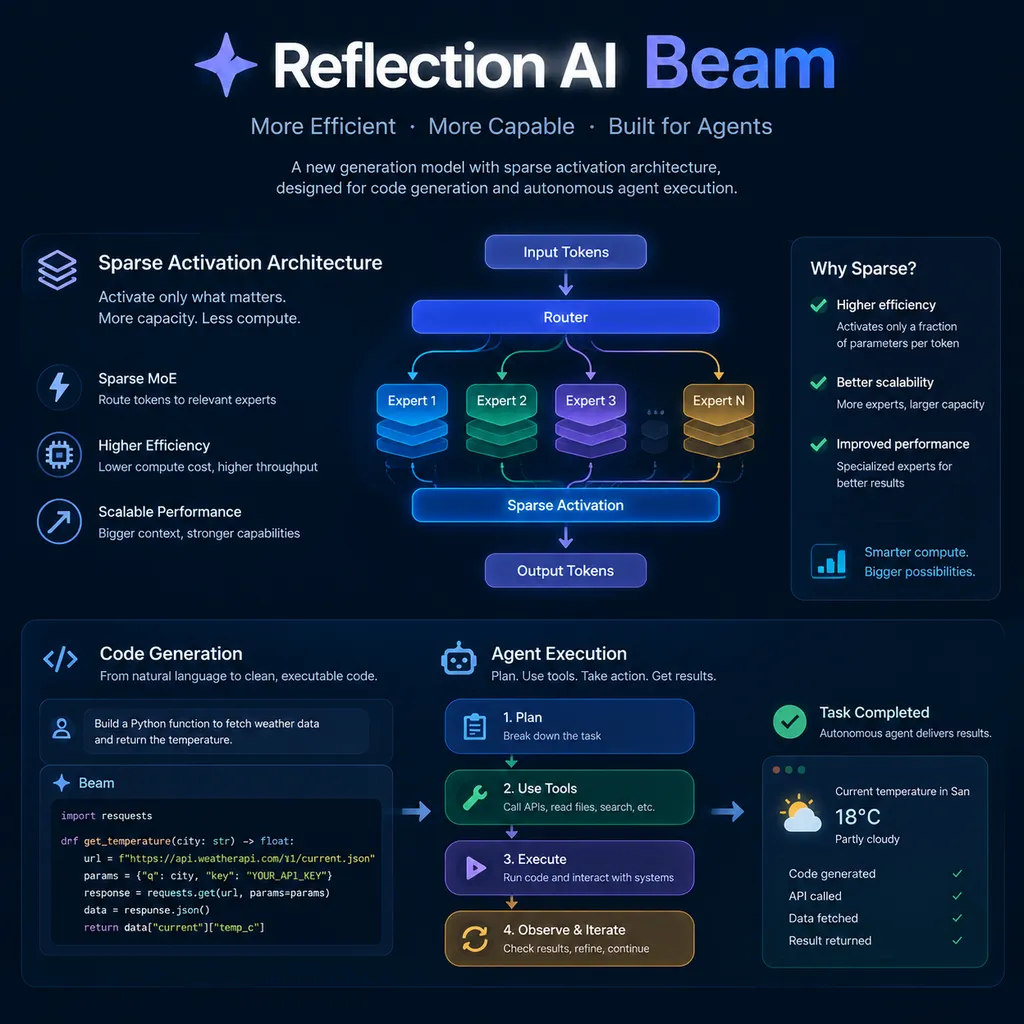
501 Billion Parameters, but Only 23 Billion Used at a Time
The number associated most closely with Beam is its 501 billion total parameters.
For developers, however, the more important figure is 23 billion. Beam uses a sparse activation architecture. The model has 501 billion parameters in total, but activates only around 23 billion of them when processing each request. In other words, it is more like a factory with multiple specialized teams: the overall model is very large, but for a specific task, it calls in only the most relevant teams rather than holding a meeting with everyone at once.
This type of architecture is generally known as a Mixture of Experts, or MoE. Based on the input, the model routes requests to different expert modules. When writing code, it may call experts that are better at program structure and debugging; for long-horizon tasks, it may call experts that specialize in planning, tool use, and reasoning.
Sparse activation has two main advantages.
The first is inference cost. The total number of model parameters determines how much capability the model can contain, but the actual computation required for each request is closer to the number of activated parameters. Activating only 23 billion parameters can theoretically preserve the capacity of a large model while avoiding the computational cost of processing all 501 billion parameters for every request.
The second is room for expansion. Teams can continue adding expert modules so the model can cover more types of tasks, without requiring every module to participate in every inference run. Of course, this architecture does not mean performance comes for free. The accuracy of expert routing, the ability of different experts to work together, and whether the inference framework supports efficient scheduling all directly affect real-world results.
For comparison, reference materials indicate that GLM-5.2 has approximately 744 billion total parameters and around 40 billion activated parameters. Beam is smaller overall and uses fewer activated parameters. What Reflection AI hopes to demonstrate is that not all parameters need to participate in computation for a model to deliver sufficiently strong performance on coding and Agent tasks.
That judgment still needs to be validated with test data. Parameter size and activated parameters describe only the model's computational structure; they cannot be directly equated with code repair rates, tool-call success rates, or long-task completion rates.
Code and Agents Are Beam's Real Battleground
Reflection AI's founding team came from DeepMind. From the beginning, the company has focused primarily on software development automation. That is also why Beam did not begin with general chat, image generation, or search scenarios.
For code models, the real competition is no longer about whether a model can complete a single function. Developers care more about whether it can complete an entire task chain:
- Can it understand an unfamiliar code repository rather than handling only single-file problems?
- Can it locate relevant modules based on an issue and propose an executable modification plan?
- Can it correctly modify multiple files without breaking existing interfaces?
- Can it run tests independently, analyze errors, and perform a second round of fixes?
- When it encounters uncertain information, can it call search, terminal, or other tools instead of fabricating results?
- Can it maintain context during a long task instead of drifting away from the goal after a single mistake?
These tasks are different from ordinary question answering. They require the model to continuously observe its environment, make plans, call tools, read feedback, and then decide what to do next. The model itself is only one component. Context management, tool permissions, execution sandboxes, code retrieval, and error recovery mechanisms also have a major impact on the outcome.
Therefore, if Beam wants to establish a competitive position in the Agent space, it cannot achieve good results only on static coding benchmarks. It must also prove that it is sufficiently stable in real repositories, continuous integration environments, and multi-step software maintenance tasks.
Reflection AI currently claims that Beam is gradually approaching Qwen 3.8-Max in coding and agent tasks, and can be compared with Zhipu AI's GLM-5.2. An important qualification is necessary here: these statements primarily come from the company itself. Public information has not yet provided sufficiently comprehensive third-party test results, nor detailed comparisons covering different programming languages, repository sizes, and tool environments.
For developers, Beam's release day is better viewed as the arrival of a new candidate model worth testing, rather than proof that it has already secured a place in the top tier.
Open Weights Do Not Mean Fully Open Source
Another key phrase associated with Beam is "open weights."
This means developers may be able to obtain the model weights within the limits permitted by the license, deploy them on their own infrastructure, or fine-tune them using their own data. But open weights do not automatically mean that the training code, complete training data, data-cleaning pipeline, and all supporting tools are publicly available.
This distinction is critical for enterprise users.
The advantage of using a closed-source model API is fast integration and low maintenance costs: the model provider handles computing resources, upgrades, and reliability. The tradeoff is that data must pass through a third-party service, while the enterprise does not have complete control over model behavior and version changes. With an open-weight model, the model can be deployed on an internal network or private cloud, giving the organization greater control over its data, versions, and inference pipeline. However, the enterprise must take responsibility for GPU procurement, inference optimization, monitoring, model upgrades, and security audits.
Whether Beam is suitable for enterprise use depends on more than its model scores. The following factors also matter:
- Whether the license permits commercial use. Enterprises need to confirm whether the model can be used for internal development, customer service, and redistribution. They should not assume that "open weights" automatically means there are no restrictions.
- Whether hardware requirements are manageable. Even with sparse activation, a model with 501 billion total parameters may require substantial VRAM and a complex parallel deployment strategy. Fewer activated parameters reduce some computational pressure, but do not mean that loading the entire model requires no memory.
- Whether the inference framework is mature. MoE models place demands on expert routing, communication, and batching. If a framework provides only basic compatibility, actual throughput may be far below the figures suggested on paper.
- Whether coding tasks are stable. Enterprises need repeatable modifications and test results, not occasional snippets of code that merely look impressive.
- Whether security boundaries are clear. Once an Agent can access code repositories, terminals, databases, and deployment environments, permission design becomes more important than it is for simple text generation.
This also explains why Reflection AI emphasizes the concept of an "AI factory." It is not trying to sell only a model file, but a deployment model that combines the model, enterprise data, and dedicated computing resources.
What NVIDIA and SpaceX Bring to the Table
Reflection AI was founded in 2024 by former DeepMind researchers Misha Laskin and Ioannis Antonoglou, and has consistently focused on software development automation. NVIDIA's investment in the company gave it a stronger foundation of computing resources and industry support from the outset.
Earlier this year, Reflection AI also reached an agreement with SpaceX, giving it access to additional computing resources at SpaceX's Colossus 2 data center. For a startup releasing its first model, this kind of computing support is important: model training, post-training, evaluation, and service deployment all require continuous investment. Agent models in particular often need to be iterated through large volumes of feedback from real-world tasks.
But computing resources also create pressure.
The business logic of open-weight models is often simplified as "the model is free, and enterprises deploy it themselves." Reality is more complicated. The costs of training large models, inference clusters, storage, networking, and operations do not disappear; they are simply transferred from the model provider to the model user. For Reflection AI itself, continuing to rent and build large-scale computing resources also means it must find stable enterprise revenue quickly.
Beam's future performance therefore needs to be evaluated along two dimensions:
- Whether the model can reach a level sufficiently close to leading open models on coding and Agent tasks;
- Whether Reflection AI can turn its model capabilities into enterprise deployments, software development automation, and orders for proprietary AI systems.
If it merely releases a model with a very large parameter count, Beam will have little chance of changing the market landscape. If it can genuinely connect the model, toolchain, inference services, and enterprise data integration, its value will extend beyond another position on a model leaderboard.
What It Means for Developers
For teams building code assistants, automated operations, customer-service Agents, or enterprise knowledge bases, Beam is worth adding to the testing list, but it should not replace existing models without evaluation.
A more practical approach is to include it in a repeatable internal testing suite: select real but anonymized issues, code repair tasks, failed test cases, and tool-calling workflows, then compare Beam with existing models on success rate, average number of steps, number of human interventions, latency, and total cost.
The following metrics are worth tracking:
- The proportion of code that passes tests on the first generation;
- The proportion of regressions introduced after multi-file modifications;
- The number of tool calls required for an Agent to complete a task;
- Code localization accuracy under long-context conditions;
- Average input and output token counts per task;
- Actual throughput and VRAM usage on the target GPU;
- Whether the model can complete an effective repair based on test feedback after a failure.
The final two metrics are often overlooked. A model's high score on public benchmarks does not mean it will run quickly on an enterprise's existing inference stack. A model's ability to generate correct code also does not mean it can reliably complete an entire task under limited permissions.
For teams that cannot conveniently build their own clusters, capability validation can first be performed through a model platform compatible with the OpenAI API, followed by a decision on whether local deployment is necessary. The value of aggregation platforms such as OpenAI Hub lies in allowing developers to compare different models through a unified interface, complete cross-model testing on coding and Agent tasks, and then choose between direct API calls, private deployment, or hybrid routing based on the data. However, whether Beam's open-weight characteristics can ultimately be made reliably available through such platforms will depend on the model license, inference resources, and the specific arrangements made by service providers.
A Signal, Not the Final Outcome
Beam's release is significant, but it is not yet the story of "the American DeepSeek has already won."
First, it demonstrates that competition in open-weight models is no longer an arena limited to Chinese companies. US startups are beginning to enter the market seriously, using coding and Agents as their point of entry. For NVIDIA, this also aligns with its push for enterprises to build their own AI infrastructure: the more open the models become, the more directly enterprises need GPUs, servers, networking, and inference software.
But Beam's challenges are also clear. It needs to demonstrate, beyond public evaluations, that the model is stable in real-world software engineering tasks. It needs to show that its sparse activation architecture can deliver genuine cost advantages across different hardware configurations and inference frameworks. It also needs to provide clear licensing and deployment plans so enterprises understand exactly what they are receiving and what responsibilities they will assume.
At present, Beam looks more like a card in play than the result of a competition. Its 501 billion parameters are enough to attract attention, and its 23 billion activated parameters provide an efficiency narrative. But developers will ultimately look at another set of numbers: how many revisions a real task requires, how many tools must be called, how much it costs, and whether it can continue running reliably the next day.
Over the coming months, the key question will be whether Beam can evolve from "the open model backed by NVIDIA" into coding and Agent infrastructure that developers are willing to use over the long term.
Sources
- IT Home: NVIDIA-backed Reflection AI Releases Its First Open-Weight AI Model, Beam: Covers Beam's release date, parameter scale, sparse activation architecture, target competitors, and Reflection AI's computing partnership with SpaceX.