Google Releases Nano Banana 2.1
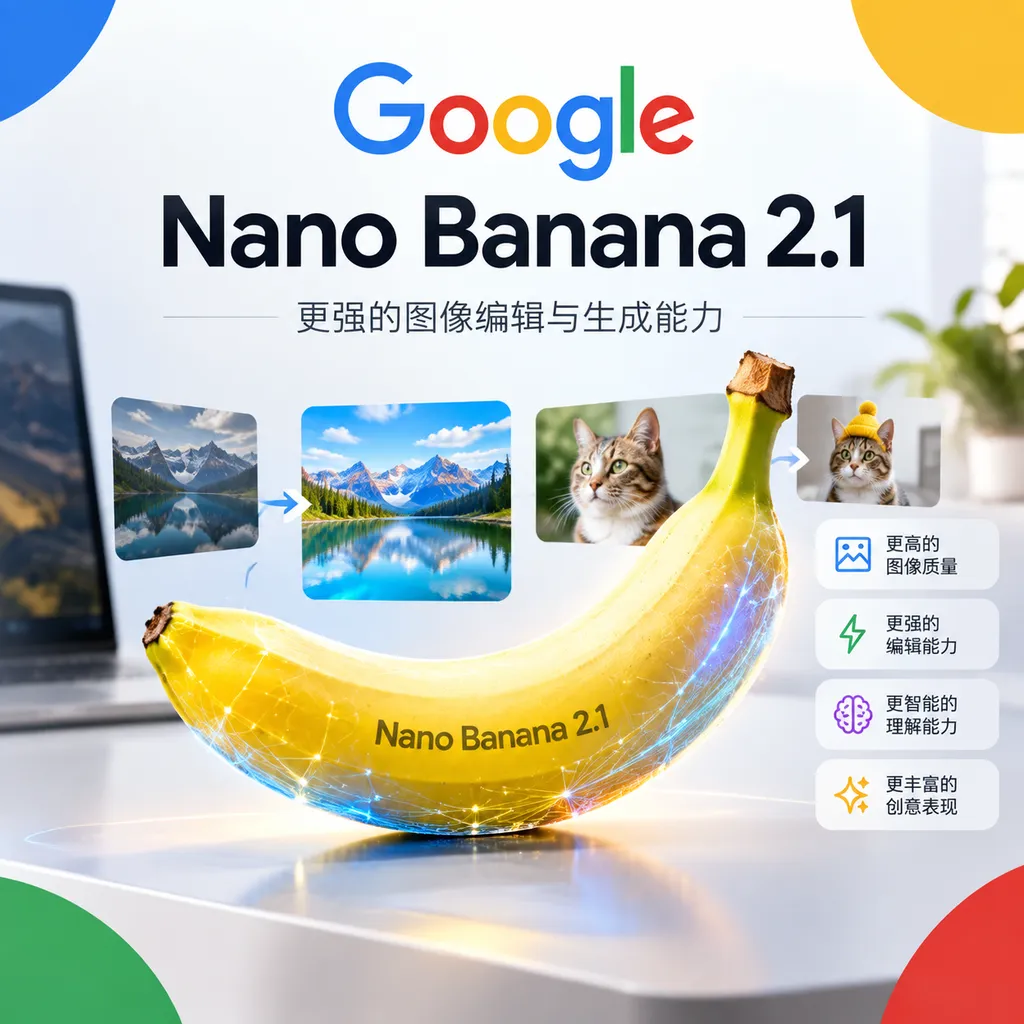
Google today released Nano Banana 2.1, with major upgrades to visual design, mask editing, and subject consistency, while also enabling 1K, 2K, and 4K image output. It is not merely about making the first image look better; it aims to address the rework involved in continuous editing.
Google Pushes Nano Banana Toward “Sustainable Editing”
Google officially released Nano Banana 2.1 today. The update is not simply about making image generation more “stunning,” but focuses on several problems that become most apparent when generative images enter real workflows: insufficient precision in local edits, people and products changing appearance during consecutive generations, and inconsistent levels of visual polish and naturalness.
This is an image model designed for high-efficiency generation and conversational editing, with the model ID gemini-nano-banana-2.1. It supports text, image, audio, and video inputs, and can output images at 1K, 2K, and 4K resolutions. The model is currently being gradually integrated into the Gemini app, Google Search AI Mode, Google AI Studio, Google Flow, Stitch, Google Ads, and the Gemini enterprise platform.
Judging from the version number, 2.1 looks like a minor update. But judging from its direction, Google is clearly addressing the most important weaknesses of generative image products: making the model capable of continuously working around an image, rather than merely “knowing how to generate one.”
Three Priorities Point to the Same Workflow Problem
Visual Design: From “Looks Good” to “Ready to Deliver”
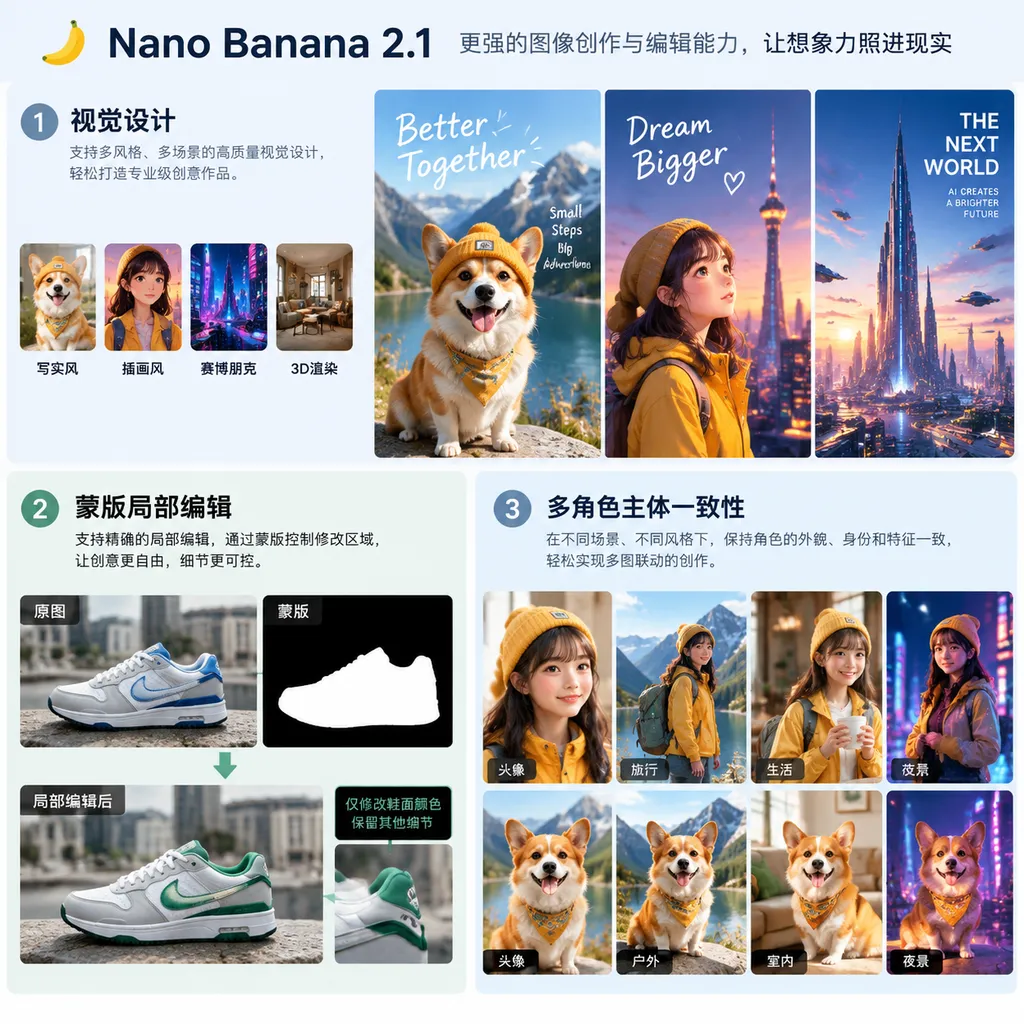
Nano Banana 2.1 first improves visual design capabilities. Google describes its positioning as including better composition, a higher level of visual polish, and more natural visual effects across different resolutions.
This kind of improvement is difficult to explain simply as “higher generation quality.” For design work, what really affects efficiency is not how astonishing an image looks at first glance, but whether it can directly move into the next stage of the workflow. Whether the subject is positioned appropriately, whether the foreground and background have clear depth, whether the direction of light is consistent, and whether enough space has been left for text all determine whether an image is merely an “inspiration draft” or a version that can be shown to a client.
Nano Banana 2.1’s official examples cover scenarios including portrait photography, macro insects, natural landscapes, still lifes, and painting, emphasizing the natural quality of materials, lighting, spatial relationships, and details. For advertising, e-commerce, and social media content creators, this means the model is moving from a one-off image generation tool toward a visual asset engine that can be called repeatedly.
However, 4K does not mean that all text will be clear. According to the model’s publicly documented limitations, small text may still appear blurry in 1K output, while long passages and full-page text are not suitable for direct typesetting by an image model. For posters, infographics, and advertising assets that require accurate text, the model should still handle composition and visual elements, while a design tool or program completes the final typesetting.
Masked Editing: Reducing the Need to “Redo an Entire Image to Change One Thing”
The second focus is mask-based local editing.
The most frustrating aspect of traditional image generation is that models often interpret “modify” as “regenerate.” Users may only want to replace the background, yet the person’s face changes. They may only want to adjust a product’s color, yet the product’s shape and shadow change as well. They may only want to move an object, yet the composition of the entire image is rearranged.
The value of masked editing is that it sets boundaries for the model: which areas can change and which areas should remain as unchanged as possible. Nano Banana 2.1 improves the selection and editing of local areas, allowing users to make more precise changes to an existing image without starting over each time with a complete prompt and a blank canvas.
This can directly change how generated images are handled. In the past, the process was more like “drawing prompt cards,” with each generation accepting the model’s reinterpretation of the entire image. Ideally, masked editing is closer to making local adjustments in Photoshop, except that the model handles content filling, lighting matching, and semantic understanding behind the scenes.
However, it is still some distance from the predictability of traditional editing software. Public information indicates that mask and sketch-based editing may still result in incomplete instruction execution or residual editing artifacts. Sometimes the model also over-inherits the original subject’s pose and structure, or even misjudges left-right spatial relationships. Therefore, Nano Banana 2.1 is better suited to tasks where local content needs to be redesigned, rather than being treated as a pixel-level retouching tool.
For developers, this distinction is important. The value of an image editing API lies not only in whether it can accept an input image, but also in whether it can reliably control the editing area. As long as the model may still modify key elements outside the mask, the application layer needs to add result checks, retries, and human confirmation mechanisms.
Subject Consistency: The Capability That Truly Determines Whether Batch Production Is Possible
The third focus is subject consistency, which is also the most practically valuable part of this upgrade.
Generating one realistic person in a single image is no longer particularly difficult. The challenge is ensuring that the person is still the same person in the second, third, and tenth images. Advertising design, e-commerce assets, character stories, and continuous visual content all depend on this capability: a product’s appearance cannot change every time, a character cannot repeatedly change faces, and multiple people cannot swap identities across different compositions.
Google’s public evaluations show that Nano Banana 2.1’s single-character consistency score increased from 981 for Nano Banana 2 to 1028, while multi-character consistency rose from 978 to 1106. The latter is particularly noteworthy, even exceeding Nano Banana Pro’s 1011. It is important to note that these are Google’s published internal evaluation results and do not represent a universal success rate across all real-world tasks. Actual performance will still be affected by the quality of reference images, prompts, pose changes, and scene complexity.
Multi-person scenes are usually the hardest test of subject consistency. The model must remember each person’s facial features, clothing, age, and hairstyle while also correctly handling the distance, occlusion, poses, and lighting between them. Simply combining two character reference images into the same poster is not especially complex. The real production challenge begins when users ask those people to change scenes, poses, and clothing while preserving their identities.
Google demonstrated a case in which reference images of multiple different models were combined into the same fashion editorial. The commercial value lies not in the image itself, but in the reusability of the assets: people and products from a single shoot can be placed into different scenes; established characters can continue appearing in subsequent images; and the same set of products can quickly generate multiple marketing versions.
In other words, subject consistency gives generated results the qualities of “assets” rather than leaving them as isolated images. This is a key step in moving AI image tools from creative assistance toward content production systems.
How Does It Relate to Nano Banana 2 and Pro?
Earlier this year, Google launched Nano Banana 2, also known as Gemini 3.1 Flash Image. It continued the Flash series’ advantages in speed and cost efficiency while bringing down some capabilities that originally belonged to Nano Banana Pro, including real-world knowledge, improved text rendering, and better character and object consistency.
Nano Banana 2.1 continues this product strategy: maintaining Flash-level efficiency while further addressing the most common pain points in professional image work. It is neither a complete rebuild of the product line nor an attempt to improve every metric through a larger model. Instead, it is a targeted optimization around design, editing, and consecutive generation.
This gives it a different competitive approach from models that simply pursue the highest possible image quality. For developers and content teams, the questions that really need to be compared are not “Which model generates the best-looking first image?” but rather:
- After continuously modifying the same image three to five times, can unedited areas remain stable?
- After multiple reference images are provided, are the identities of people and products likely to be confused?
- When switching between different aspect ratios and resolutions, does the composition need to be started over?
- Are generation speed and calling costs sufficient to support batch asset production?
- When the model fails, can the application determine whether the problem is subject drift, mask overflow, or text errors?
For the experience of continuously fine-tuning an image, OpenAI’s ChatGPT Images 2.5 is still stronger at present. It is better at preserving the results of previous edits, making as few changes as possible to unedited areas during repeated user edits, and avoiding significant degradation of the original image as the number of iterations increases. Microsoft AI’s MAI-Image-2.6 is another important competitor.
Nano Banana 2.1’s advantage is that it places image capabilities within the broader Gemini and Google product ecosystem, while also providing developers with multimodal inputs and multiple resolution options. If an application already uses Google models, search, or enterprise services, this integration will reduce the cost of adoption. But if the core requirement is highly stable, multi-round refinement of a single image, Google still needs to demonstrate consistency over real, long editing chains rather than only in single-round official examples.
Integration Information for Developers
Nano Banana 2.1 is now available to developers. It supports text, image, audio, and video inputs, with image outputs available at 1K, 2K, and 4K. Through OpenAI Hub, the model can be called using an OpenAI-compatible format, making it suitable for applications that already use a unified model gateway and want to switch among models such as GPT, Claude, and Gemini.
An example request is shown below:
curl https://openai-hub.com/v1beta/models/gemini-nano-banana-2.1:generateContent \\
  -H "Content-Type: application/json" \\
  -H "Authorization: Bearer $OPENAI_HUB_API_KEY" \\
  -d '{
    "contents": [{
      "role": "user",
      "parts": [{
        "text": "Generate a banner image suitable for a technology product launch page. Keep the dark background and main product subject, emphasizing the metallic material and side lighting."
      }]
    }],
    "generationConfig": {
      "imageConfig": {
        "imageSize": "2K"
      }
    }
  }'
In actual integrations, it is recommended to divide model calls into three stages: first validate the composition at a lower resolution, then generate the final-size image, and finally run automated checks on subject consistency, text accuracy, and mask boundaries. Do not equate “supports 4K” directly with “suitable for every production task,” because increasing output pixels does not automatically solve identity drift, complex text rendering, or factual errors.
Developers also need to pay attention to version migration. Google’s API update information indicates that the model ID for the older Nano Banana 2, gemini-3.1-flash-image, is scheduled to be shut down on October 29, 2026, and recommends migrating to gemini-nano-banana-2.1. This date applies to the API model ID and does not mean that the Gemini consumer product will necessarily change on the same day. Teams already using the old model in production should complete regression testing in advance, focusing on output dimensions, response structure, image quality, and failure-retry logic.
Assessment: 2.1’s Value Lies in “Less Rework,” Not in Being “Another More Powerful Artist”
Nano Banana 2.1 does not attempt to redefine AI image generation. It is more like a concentrated set of fixes aimed at the practical production experience: making compositions more complete, local edits more controllable, and the same person or product look more like the same subject across multiple generations.
These changes may seem less dazzling than a breakthrough from zero to one, but they are closer to the real needs of commercial applications than the maximum image quality of a single output. Designers and developers typically do not just need one beautiful image. They need a set of assets that can be reused across different sizes, scenes, and versions. As long as every edit destroys the results already achieved, no matter how quickly the model generates, the gains will be offset by rework.
Therefore, the ultimate measure of whether Nano Banana 2.1 succeeds is whether it can withstand continuous editing and batch generation, not how attractive a single official demo image looks. Google has chosen the right direction this time, but it still needs to improve stability in mask boundaries, long-form text, 3D spatial relationships, and complex combinations of reference images.
For developers, the most valuable test is not “Can it generate one good image?” but having it complete an entire workflow: upload a product image, replace the background, adjust the composition, add multiple people, and then output advertising assets in different sizes. If the subject and unedited areas can both remain stable throughout this workflow, Nano Banana 2.1 will truly be approaching the role of a deployable visual production component.
Sources
-
IT Home: Google Releases Nano Banana 2.1 AI Image Model, Improving Visual Design, Masked Editing, and Subject Consistency
Covers Nano Banana 2.1’s release date, core capabilities, supported products, model ID, and support for multiple output resolutions. -
IT Home: Nano Banana 2.1 Coverage
Used to cross-check the latest developments in Google’s image model product line and its availability to developers.