SynthID is now globally available, so AI-generated content can finally be verified.

Google recently made SynthID Detector available to users worldwide. It can detect whether images, videos, and audio contain invisible watermarks embedded by Google's generative AI. However, it verifies watermarks; it is not a universal AI detector.
SynthID Goes Global, Finally Making AI Content Verifiable
Google recently announced that its AI-generated content detection tool, SynthID Detector, is now available to users worldwide. Users can upload images, videos, or audio to check whether they contain a SynthID watermark, helping determine whether the content may have been generated or edited by Google's generative AI products.
The significance of this update is not that Google has launched yet another standalone website, but that it is beginning to move AI content provenance verification from an internal capability of model providers to a public interface accessible to ordinary users and developers. As the cost of generating images, videos, and speech continues to fall rapidly, determining whether content is authentic is no longer merely a matter of media literacy. It has become an infrastructure issue that affects search, social platforms, news moderation, copyright ownership, and enterprise risk management.
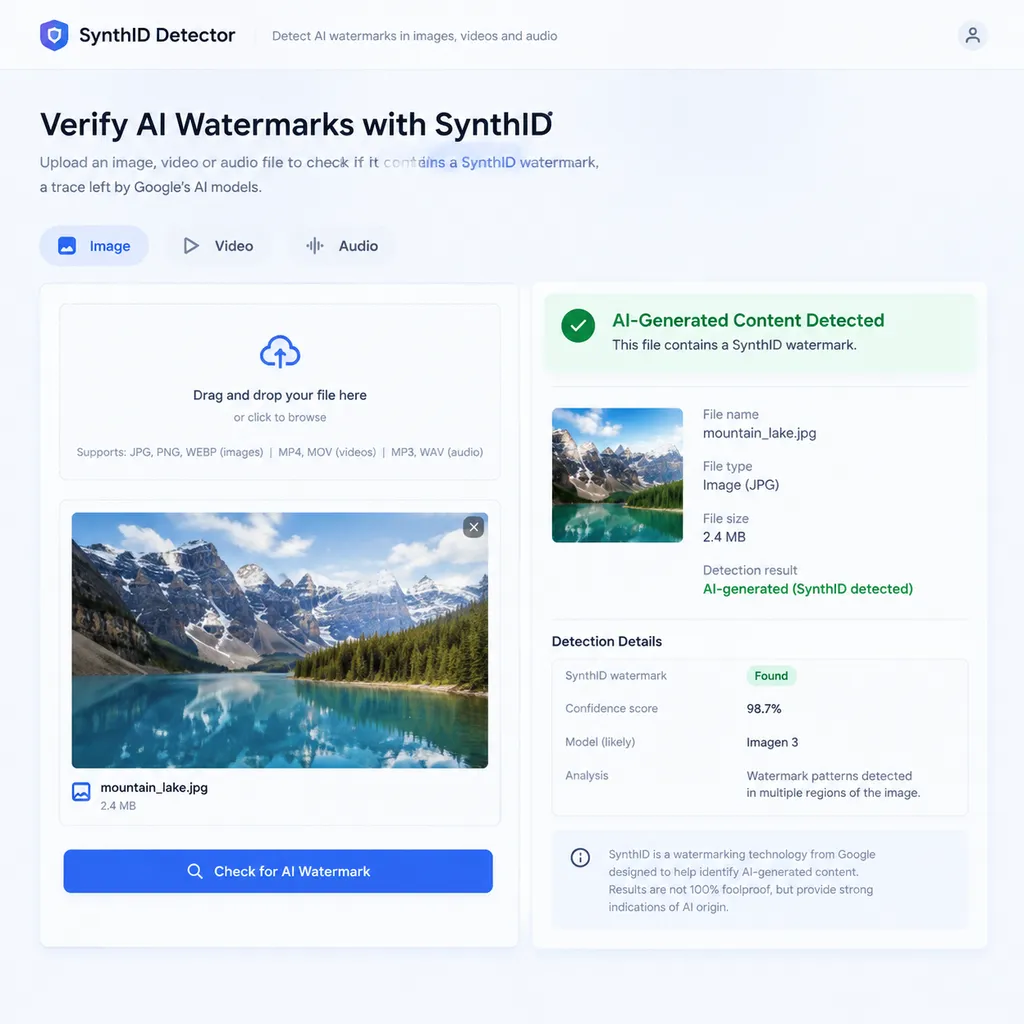
It Detects Watermarks, Not an “AI Feel”
The basic logic behind SynthID is not complicated: when generating content, Google embeds a digital watermark that is imperceptible to the human eye or ear, and the detector then searches for that watermark.
This differs from many so-called AI-generated content detectors. The latter typically analyze the wording of a piece of text, the textures in an image, or visual patterns in a video, and then provide a probabilistic assessment. Such methods can be easily affected by model updates, human rewriting, re-encoding, and even changes in data distribution. SynthID takes a different approach: rather than guessing whether content looks like AI, it verifies whether a specific source marker was left behind during generation.
This is more like adding an invisible anti-counterfeiting label to content. When the label is present, the detection result provides a relatively strong indication of provenance; when it is absent, that only means the detector did not find a SynthID watermark. It does not prove that the content was created by a human, nor does it prove that the content was not processed by another AI tool.
This distinction is particularly important for developers. SynthID Detector is not a universal AI authenticator capable of covering all models, much less a content lie detector. It primarily serves generative models and platforms that have already integrated with the SynthID system.
What Can It Detect?
Google says that SynthID Detector supports three types of media:
- Images: Check whether an image contains a watermark embedded by Google's image-generation or editing tools.
- Videos: Analyze watermark information in video frames to determine whether a video may have been created or modified by Google's video-generation models.
- Audio: Detect whether an audio signal contains a SynthID watermark, including content produced by Google's music-generation, podcast-generation, and speech-related tools.
SynthID was first introduced in 2023 and was initially used mainly for Google's own generative AI products. It has now been deployed across products or model families including Gemini, Imagen, Veo, and Lyria. Google has also previously integrated verification capabilities into the Gemini app and Google Chrome. Users can upload media in a chat and ask whether it was generated by Google AI, and in the future they will be able to perform more natural provenance checks in browser and search contexts.
Google disclosed that users currently make approximately 1 million content verification requests each day. This figure shows that users have a sustained need to answer questions such as, “Is this image actually real?” At the same time, it reveals another reality: most people will not actively study C2PA, metadata, or model provenance. They need an upload, verification, and explanation process that is simple enough to use.
Audio Watermarking Is More Difficult Than Image Watermarking
The main technical challenge for SynthID is not embedding the watermark, but making sure it can withstand the treatment content receives in the real world.
For images and videos, the watermark is written into pixels or video frames in a way that is difficult for the human eye to perceive. After cropping, applying filters, adjusting colors, changing frame rates, and lossy compression, the detector still attempts to find the watermark in the remaining signal. Video also requires stability across consecutive frames; otherwise, the watermark can easily become ineffective after a video is re-encoded or clipped.
The challenge is even more pronounced with audio. If a watermark directly alters the waveform, it may introduce noise, distortion, or audible high-frequency artifacts. But if it is embedded too weakly, it may disappear after MP3 compression, speed or pitch changes, the addition of noise, or playback through a phone speaker followed by re-recording.
According to Google's publicly available technical documentation, SynthID converts audio waveforms into spectrograms and uses psychoacoustic masking to distribute the watermark across multiple frequency bands and time positions. Psychoacoustic masking can be understood simply as placing the signal in areas to which the human ear is naturally less sensitive or where it will be masked by other sounds. The detector then uses techniques such as matched filtering to search for the statistical features left by the watermark.
This design has the advantage that the watermark does not depend on the audio file's metadata. Even after a file is transcoded, re-edited, or played through a speaker and recorded again, the detector may still be able to identify it. However, “may still be able to” does not mean “will always be able to.” Excessive processing, extreme noise, and deliberate attacks can still cause detection to fail.
Available Globally, but Not a Universal Identifier
Google explicitly warns that SynthID results are not 100% accurate. This limitation is not a product defect, but a boundary that all content provenance systems must face.
First, SynthID can only identify content carrying a watermark from its system. If an image comes from a model that does not use SynthID, or if no watermark was embedded when the original content was generated, Detector cannot produce a reliable conclusion out of nowhere.
Second, content is constantly modified as it moves through the real world. Screenshots, re-photography, remixing, cropping, transcoding, filters, and re-recording can all weaken the watermark signal. SynthID is designed to resist common transformations, but that does not mean it is effective against every possible attack.
Third, detecting a watermark does not mean that the complete provenance can be reconstructed. The result may only indicate that the content contains a watermark from a particular generation system. It may not tell users which account was used, which generation request produced it, which model version was involved, or whether the content was substantially modified by a human.
SynthID is therefore better understood as one source of evidence in a content moderation process, rather than as the final arbiter. When handling high-risk content, news organizations, platforms, and enterprises still need to combine publication times, original files, author statements, C2PA credentials, editing records, and human review.
What It Means for Developers
For developers, the global availability of SynthID is mainly significant in three ways.
1. Provenance Verification Is Becoming a Platform Capability
In the past, model providers only needed to return an image or audio clip from a generation API. Now, whether a generated result has a verifiable provenance is becoming part of the API product itself. For content platforms, upload, transcoding, moderation, and distribution systems all need to consider how to preserve these signals.
If a platform repeatedly takes screenshots, re-encodes media, or extracts audio tracks, the watermark may be weakened. In other words, the responsibility of a generative model does not end with “adding a watermark during generation.” Platforms also need to avoid unintentionally damaging verification information in subsequent processing pipelines.
2. A Negative Result Cannot Directly Be Treated as Proof of Human Creation
This is the easiest mistake to make when integrating detection capabilities. When a system returns “SynthID not detected,” the correct product wording should be “No such watermark was found,” not “Confirmed to be human-created.” The two statements have completely different meanings in legal, moderation, and risk-management contexts.
A more prudent approach is to design detection results as layered signals, for example:
- SynthID watermark detected: The content was likely generated or edited by an AI tool that supports this watermarking system.
- SynthID watermark not detected: No such watermark was found in the current sample; this cannot determine whether the content was generated by AI.
- Unable to determine: The file quality, format, or content type does not meet the detection requirements.
This wording may appear conservative, but it reduces misclassification and is better suited to moderation logs and automated workflows.
3. Watermarks Need to Work Alongside Content Credentials
Watermarks answer the question, “Does the content contain a provider's marker?” Content credentials answer, “Where did the content come from, and what operations has it undergone?” The former is more like a code embedded in the media itself; the latter is more like a verifiable editing history.
Relying on watermarks alone makes it difficult to fully answer questions about copyright ownership and the chain of distribution. Relying solely on metadata also makes it easy to lose that information through platform transcoding or user screenshots. A more realistic solution in the future is to combine SynthID, content credentials such as C2PA, platform moderation records, and generation API logs.
Why Is Google Opening It Up Now?
The timing is not difficult to understand. AI-generated images and videos have already moved from professional tools into social platforms, advertising production, and everyday search, while voice cloning is also entering customer service, podcasting, and short-video scenarios. As the volume of content grows, it is no longer realistic to rely on humans identifying visual flaws. Platforms need a lower-cost provenance signal that can be processed at scale.
By making Detector available to users worldwide, Google is also pushing SynthID from “an internal safety feature in Google products” toward a broader industry marker. Companies including OpenAI, NVIDIA, and Kakao also support related tools or watermarking systems, suggesting that model providers are gradually building a shared content provenance infrastructure.
Whether this approach can truly succeed depends on two conditions: first, more model providers must be willing to adopt interoperable watermarking or credential standards; second, platforms must be willing to preserve this information throughout their content-processing pipelines. If every company maintains only its own closed marker, users will ultimately face multiple incompatible detectors, while developers will have to integrate a separate verification system for each model.
This Is Not an “AI Truth Button”
The global availability of SynthID Detector does give ordinary users a verification tool they previously lacked. When faced with an image suspected of being AI-generated, a video of unknown origin, or a suspicious voice recording, users can at least check whether it contains a known SynthID watermark.
But its actual role needs to be stated clearly: SynthID proves that “a particular generation-source marker was detected”; it does not prove that “content without a watermark is necessarily authentic.” In information verification, this distinction is more important than any percentage displayed on the detection page.
For developers, the most important issue is not one-off upload detection, but whether this mechanism can become part of the default content production and distribution workflow: embedded during generation, preserved during transmission, displayed at publication, and verified when disputes arise. Only when this chain is truly operational will AI content provenance move beyond being a standalone demonstration tool.
OpenAI Hub currently aggregates mainstream models including GPT, Claude, Gemini, and DeepSeek, and is compatible with the OpenAI API format. For development teams that need to call multiple models at once, it will be important in the future to consider not only the quality of different model outputs, but also the extent to which different providers support watermarking, content credentials, and provenance verification. Model calls can be standardized, but content provenance standards are still evolving rapidly.
Sources
- IT Home: Google's SynthID Opens to Users Worldwide and Can Detect AI-Generated Content: Covers the global availability of SynthID Detector, its supported media types, and the number of daily verification requests.