Microsoft Wants to Fit a 130B Code Model into Windows 11

Microsoft plans to integrate MAI-Code-1.1-Flash into Windows 11. This MoE programming model has 138B total parameters, 5B active parameters, and a 256K context window, and is being explored for local execution through 3-bit quantization.
Microsoft Wants to Pack a 130B Code Model into Windows 11
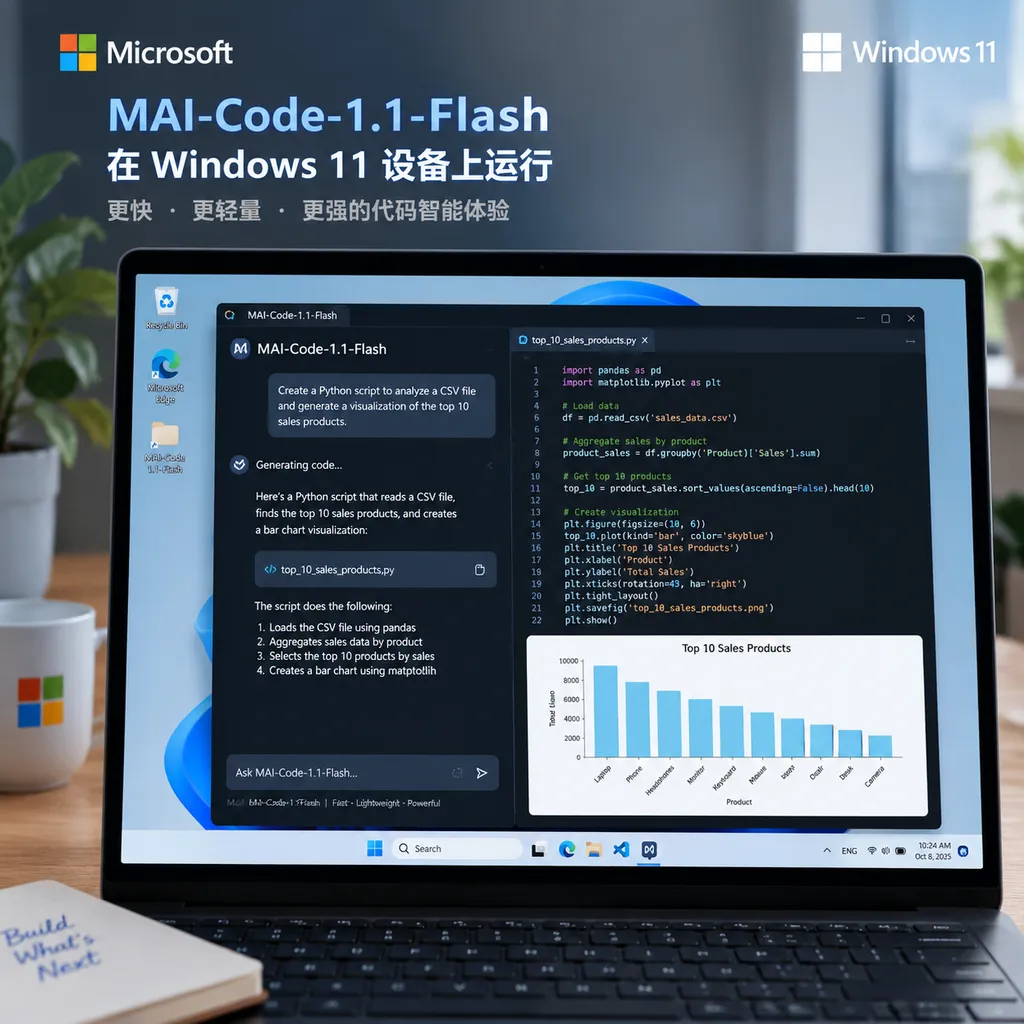
On October 7, Microsoft disclosed an ambitious plan: to further integrate its in-house coding model, MAI-Code-1.1-Flash, into Windows 11, giving tasks such as code generation, repository Q&A, refactoring, and tool use a chance to run directly on local devices instead of being limited to cloud-based Copilot.
Microsoft describes it externally as a model with approximately 130 billion parameters and support for a 256K context window. More precisely, according to the model card released by Microsoft, MAI-Code-1.1-Flash uses a sparse mixture-of-experts architecture, or MoE, with 138B total parameters, while activating only about 5B parameters per inference. These two figures are not contradictory: the former represents the model's overall capacity, while the latter is closer to the actual computational scale of a single run.
This is also the key reason it might be able to run on personal computers.
Not a New Release, but a Move from Copilot to Windows
Strictly speaking, MAI-Code-1.1-Flash did not first appear on October 7. Microsoft already brought it to GitHub Copilot in August this year, making it available through VS Code, Visual Studio, JetBrains IDEs, Copilot CLI, the GitHub website, and mobile clients.
What is genuinely new this time is Microsoft's plan to move the model from being an optional backend in development tools down into Windows 11 devices.
The difference is more than a change of entry point.
When the model exists within GitHub Copilot, developers are still using a cloud service: code and context are organized by the client and sent to a remote server, where the model performs inference before returning the result to the IDE. Once integrated into Windows, Microsoft could turn its inference capabilities into system-level infrastructure that editors, terminals, file systems, automation tools, and even third-party applications can call collectively.
This represents a step from “there is another model in the IDE” toward “the operating system has another layer: a code intelligence runtime.”
However, Microsoft has so far disclosed an integration plan rather than a complete Windows 11 launch announcement. Further details are still needed, including which processors will be supported initially, the minimum memory requirements, whether Copilot+ PCs will be required, which tasks can run fully offline, and whether ordinary developers will be able to call system-level interfaces directly.
Therefore, “support for local execution” is worth watching, but it should not yet be understood as meaning that “every Windows 11 computer can run the full 138B model offline.”
138B Total Parameters: How Can Local Execution Still Be Possible?
If understood as a traditional dense model, 138B parameters would be far beyond the reach of an ordinary PC.
Based on a rough estimate of weight storage alone, FP16 would require approximately 276GB of storage. Even compressed to 3-bit, the theoretical weight size would still be around 50GB. Actual execution also requires quantization metadata, caches, the runtime, and KV cache for long contexts, so one cannot simply convert “3-bit” into the assumption that a mid-range graphics card will be able to hold the model.
MAI-Code-1.1-Flash can be considered for local deployment because of two design choices:
- Sparse MoE architecture: although the model has 138B total parameters, each token calls on only about 5B parameters for computation, making its computational requirements far lower than those of a dense model of the same scale.
- 3-bit quantization: Microsoft says the model is approximately 80% smaller than the original version, significantly reducing memory and bandwidth pressure.
MoE can be understood as an engineering company with many specialized teams. When handling a task, not everyone attends the same meeting. Instead, a router selects a small number of experts based on the problem. The company has a large overall knowledge capacity, but the actual labor involved in any single task is relatively limited.
However, MoE reduces computational requirements; it does not make all the weights disappear. Even if only 5B parameters are activated at a time, the system generally still needs to retain or dynamically load the complete set of expert weights. For local devices, the real bottleneck may not be compute capacity, but memory capacity, memory bandwidth, and expert-weight scheduling.
This means that the first devices to offer a relatively complete experience will most likely be high-memory Copilot+ PCs, workstations, or high-end terminals with large amounts of unified memory, rather than office laptops that commonly have only 16GB of RAM. Microsoft may also adopt a tiered approach: run completion and localized edits locally while falling back to the cloud for complex agent tasks; keep frequently used experts resident in memory while loading the remaining weights on demand; or provide a further-pruned version for specific devices.
Until the hardware requirements are announced, “local execution” is better understood as a technical direction than as a barrier-free promise.
A 256K Context Window Aimed at Absorbing Entire Repositories
MAI-Code-1.1-Flash has a context window of 256K tokens. For coding models, the value of a long context is not to have the model generate hundreds of thousands of tokens at once, but to provide it with more real-world engineering information.
An agentic coding task typically involves more than the file currently open. The model may also need to read:
- The repository structure and dependency relationships;
- Interface definitions, type declarations, and test cases;
- Build logs and terminal errors;
- Project conventions, historical changes, and related documentation;
- Screenshots, architecture diagrams, or UI mockups.
A 256K window gives the model an opportunity to retain more code and operation history during a single task, reducing repeated retrieval and lowering the likelihood that it will forget the constraints imposed by file B while modifying file A. It is especially suited to cross-file refactoring, debugging legacy projects, and agents that continuously call tools.
However, a longer context does not necessarily mean better repository understanding. A medium-to-large monolithic repository can easily exceed 256K tokens, and mechanically stuffing every file into the context also introduces substantial noise. The factors that truly determine performance remain code indexing, retrieval ranking, context compression, and dependency analysis.
In other words, 256K is a larger workbench, not a workbench that has been organized automatically. Microsoft's advantage is that it controls GitHub, VS Code, Visual Studio, Copilot CLI, and the Windows file system at the same time, making it easier to obtain structured engineering context than for vendors that merely provide a model API.
The Performance Gains Matter Less as Leaderboard Results Than as Small Savings on Every Task
Microsoft's comparative figures show that, relative to the MAI-Code-1-Flash released in June, the new version improves performance by approximately 22% on Terminal-Bench 2.1 in GitHub Copilot CLI and by approximately 15% on .NET tasks. Streaming output speed improves by approximately 25%, while the number of tokens required to complete a task falls by approximately 25%.
The latter two metrics are more relevant to developers than any single benchmark score.
The cost of a coding agent depends on more than the model's price. If a task requires repeatedly reading files, calling the terminal, checking results, revising the plan, and executing again, token consumption and the number of tool calls can quickly accumulate. Having the model avoid one unnecessary detour is often more valuable than making each million tokens slightly cheaper.
Suppose an old model requires four rounds of searching, three modifications, and two test rollbacks to complete a repository-level fix, while the new model can finish it with less context and a shorter path. The result is not only a lower bill, but also shorter IDE wait times and a lower probability of the agent running out of control.
This also explains the true positioning of “Flash.” It is not aimed at winning the most complex or difficult reasoning challenges. Instead, it is intended to become the default execution layer frequently called by Copilot: low latency, controllable costs, tool-capable, and sufficiently stable.
Compared with larger flagship models that reason more slowly, this type of model is more like a permanent operator on an engineering production line. Developers can switch to a more powerful model for difficult architectural design, but there is no need to invoke the most expensive reasoning capabilities for every routine task involving test changes, type completion, log inspection, or standard refactoring.
Native Vision Completes the Link from Design to Code
Compared with the June version, MAI-Code-1.1-Flash also adds native image-understanding capabilities, allowing it to accept inputs such as screenshots, architecture diagrams, and UI mockups.
This capability is not merely decorative for a coding model. In real development workflows, many requirements do not originally appear as structured text: a designer provides a screen mockup, a tester pastes an error screenshot, an operations engineer supplies a monitoring dashboard, or an architecture review uses a flowchart to describe service relationships.
Previously, developers had to translate image content into text before asking the model to generate code. Now the model can directly identify page hierarchies, component relationships, error messages, and annotations in an image. It may not produce production-ready implementation in one attempt, but it can reduce the translation overhead involved in repeatedly converting requirements between different forms of expression.
For Windows-level integration, visual input opens up even more possibilities. The system could provide the current window, an error dialog, or an application interface as context for the model, then combine that with local project files to identify the problem. However, this would also directly touch on authorization for screen content, enterprise data boundaries, and sensitive-information filtering. If Microsoft wants to expose these capabilities at the system level, permission prompts and audit mechanisms will be no less important than the model itself.
What Microsoft Is Really Competing for Is the Default Entry Point
Judging solely by model capabilities, MAI-Code-1.1-Flash faces an already crowded market. GPT, Claude, Gemini, and multiple models emphasizing agentic programming are all competing for usage within IDEs and terminals.
Microsoft's advantage is not simply building another code model. It controls the distribution chain for Windows, GitHub, VS Code, Visual Studio, and Copilot at the same time. Even if the model is not ranked first on every leaderboard, sufficiently low latency and cost, combined with direct access to repositories, terminals, and system tools, could make it the default choice for a large number of everyday tasks.
This is why the Windows 11 integration matters more than the parameter count.
Competition among cloud-based coding models primarily revolves around performance, price, and context. Once local models enter the operating system, the dimensions of competition will expand to include privacy, offline availability, system permissions, hardware compatibility, and scheduling efficiency. Microsoft could have a small local model handle immediate tasks, a cloud model handle complex reasoning, and Copilot perform the routing behind the scenes. From the user's perspective, the model's name may gradually become less important.
From a developer's perspective, this approach is genuinely useful, especially for enterprise intranet code, low-latency completion, and frequent tool calls. But it is still too early to call it a “local 130B powerhouse” on Windows. 3-bit quantization and 5B active parameters solve part of the computational problem, but they do not completely solve the issue of keeping the full set of weights in memory. A 256K context window also continues to increase cache requirements.
At this stage, the more reasonable judgment is that MAI-Code-1.1-Flash has already proven itself to be an efficiency model designed for high-frequency engineering tasks, while its integration into Windows 11 will determine whether it can evolve from one option in Copilot into the default foundation of Microsoft's developer ecosystem.
Sources
- ITHome: MAI Code 1.1 Flash Model to Be Integrated into Microsoft's Win11 - Reports on the Windows 11 integration plan, 3-bit quantization, and performance data disclosed by Microsoft at an event in San Francisco.
- GitHub Changelog: MAI-Code-1.1-Flash available in GitHub Copilot - Introduces the model's availability across GitHub Copilot, its vision capabilities, and the development tools it supports.