Google and Unity Turn a Single Sentence into a Game

Google and Unity launched the experimental AI gaming platform Playground on October 7, allowing users to generate, modify, and share 2D/3D games using natural language. It lowers the barrier to prototyping, but remains a significant distance from truly replacing professional game development.
Google and Unity Turn a Single Sentence into a Game
Google and Unity announced a partnership today to launch the experimental AI gaming platform Playground. Users do not need to first learn a programming language, game engine, or 3D modeling. They only need to describe what they want to create in natural language, and the platform can generate a playable game in the browser.
This is not a development tool that replaces a code-completion window with a chat box. Instead, Google is trying to make “creating a game” an interaction closer to product creation: describe an idea first, playtest the result, and then continue modifying the rules, physics, and characters through conversation. For ordinary users, the barrier to entry is indeed lower. For professional developers, it is more like an experimental space for rapidly building prototypes, validating gameplay, and generating assets.
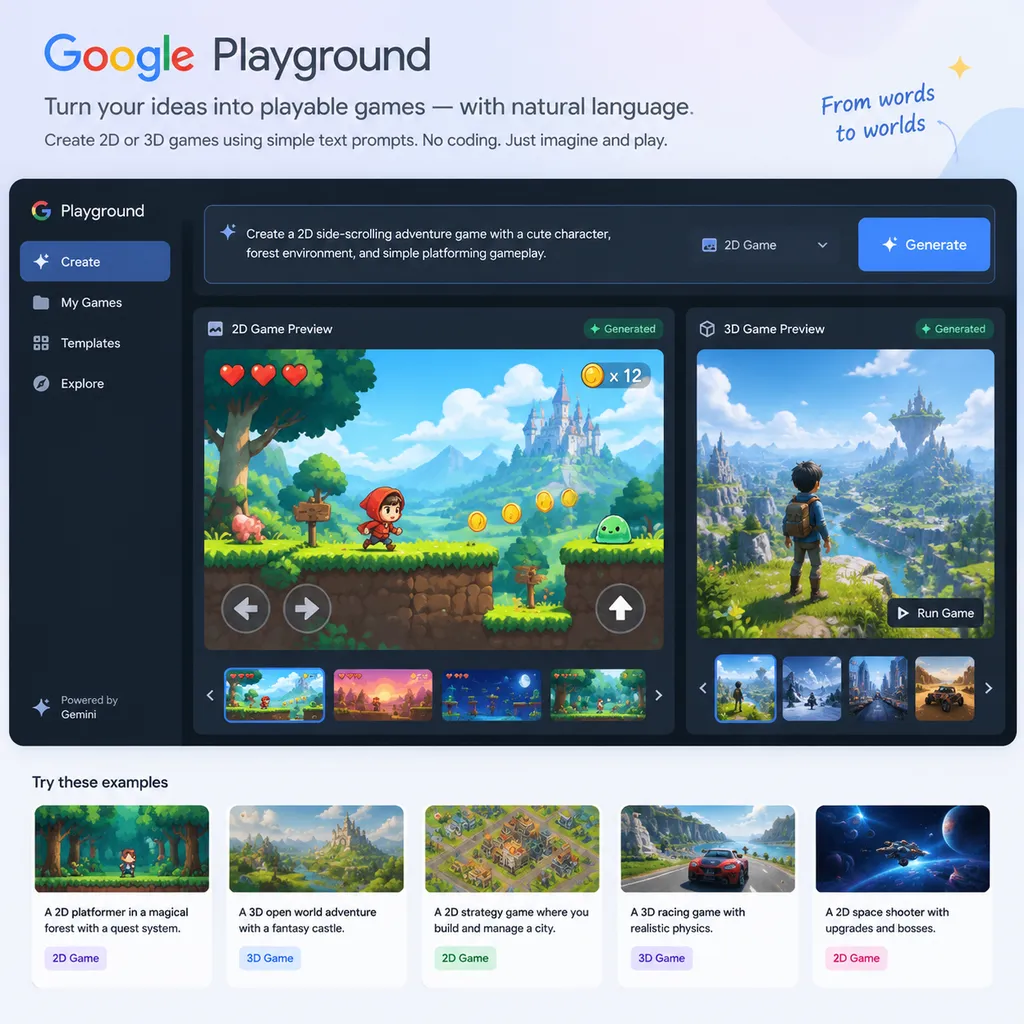
Build the Game First, Then Discuss How to Modify It
Playground uses a conversational interface. Users can enter a description such as, “Create a side-scrolling platform game in which the character must avoid moving obstacles and collect three energy crystals to open the exit,” after which the platform generates a playable version.
The generated result does not mean the game is finished in one pass. Users can continue making more specific requests, such as:
- Double the character's jump height;
- Make the obstacles move at a fixed rhythm;
- Add a countdown timer and health points;
- Change the setting from a forest to a space station;
- Change the enemies' movement so that they track the player;
- Add a second level and new victory conditions.
The key to this type of interaction is not whether the model can generate a piece of code, but whether it can understand a continuously changing game state. Traditional game development usually requires switching back and forth among a scene editor, scripts, physics systems, and asset managers. Playground attempts to compress these modifications into a single sentence, with the AI handling the corresponding adjustments behind the scenes.
Of course, what the user sees as “changing one sentence” still involves complex engineering problems for the system: collision detection, character states, camera tracking, input response, level logic, and asset loading must all remain consistent. If any one of these fails to stay synchronized, the game may exhibit issues such as characters clipping through objects, objectives becoming impossible to complete, or old rules ceasing to work after a modification.
As a result, Playground is currently better suited to generating small-scale, playable prototypes with relatively clear rules. It can help users quickly answer the question, “Is this gameplay idea interesting?” But it cannot yet automatically solve problems involving performance, multiplayer synchronization, save systems, payments, and version management in large-scale projects.
2D Is Only the Starting Point; 3D Is the Focus of the Partnership
Based on the information currently available, Playground supports both 2D and 3D creation. 2D games in the browser are relatively easy to control: scenes are smaller and asset structures are simpler, so the model only needs to handle a limited set of interactions and rules. In a 3D environment, complexity increases substantially.
A seemingly simple 3D game involves, at a minimum, spatial layout, lighting, materials, cameras, animation, physics collisions, and interaction feedback. When a user says, “Create an explorable city environment,” that does not mean the model already knows how the roads should connect, whether buildings can be entered, how non-player characters should behave, or what the player should see at the boundaries of the scene.
The path outlined by Google and Unity is to eventually integrate Playground with Unity Spark. According to the two companies, Unity Spark will provide more powerful editing capabilities, higher-fidelity 3D development capabilities, and greater flexibility through the Unity runtime.
This suggests that Playground may be designed as a gradually escalating creative workflow:
- The user starts with a natural-language prompt and generates a simple 2D or 3D gameplay concept;
- The user modifies the levels, characters, and game rules through conversation;
- When higher visual quality and more complex mechanics are needed, the user moves into Unity Spark;
- The user ultimately continues development with Unity's more complete runtime and professional tools.
This design is more realistic than the idea that “AI can generate a complete commercial game in one shot.” Generative models are good at rapidly producing a first version from vague intentions, while Unity is good at turning that content into a maintainable, publishable, and extensible project. Combined, Google lowers the barrier to entry, while Unity takes on the complexity.
However, whether this workflow can succeed depends on whether projects generated by Playground can be migrated smoothly into the Unity ecosystem. If users can only playtest inside Playground and cannot carry scenes, logic, assets, and versions into a professional workflow, it will be closer to a creative toy. If generated results can be exported in a structured form and developers are allowed to continue debugging them, it may have a chance to become a genuine prototyping tool.
Google Wants More Than an AI Editor
Playground runs in the browser and supports devices including computers and mobile phones. Once a game is completed, users can share it with family and friends or publish it to the Explore showcase page to interact with other members of the community.
The key point here is that “generation” and “distribution” are being combined. In the past, users had to find a game first and then decide whether to play it. Playground attempts to let users participate in creation first and then share what they make. For Google, this could become a new content-distribution entry point: the more works a platform hosts, the more opportunities there are for users to stay and interact; the more users are willing to try generating games, the richer the platform's accumulated creative data and gameplay feedback become.
This model clearly overlaps with Roblox, Fortnite Creative, and various UGC gaming platforms, but its entry point is different. Roblox's core is a mature social and creative ecosystem, and users generally need to learn the platform's tools or scripting. Fortnite Creative relies on existing game content and map-editing capabilities. Playground, by contrast, changes the first step to a natural-language description.
Its advantage is that it is faster to pick up and is suitable for people who have ideas but no development experience. Its shortcomings are equally clear: content generated through natural language is often unstable, quality varies widely, and community-content moderation, copyright ownership, and safety risks are more difficult to manage than in traditional template-based creation.
In particular, copyright issues do not disappear simply because natural language is used in the game-development process. Users may request characters from “a famous game,” recreate the map of a popular game, or use an art style highly similar to an existing IP. The platform needs to establish a complete system covering prompt filtering, asset sources, output review, and infringement appeals. Simply demonstrating “what can be generated” without explaining “what was generated and where the assets came from” will make it difficult to support a long-term ecosystem.
For Developers, the Value Lies in Prototyping Rather Than Replacement
For professional game teams, the most important question about Playground is not whether it can help non-developers create small games, but whether it can reduce the cost of early-stage validation.
One of the most expensive parts of a game project is investing heavily in art, programming, and level-design resources before the gameplay direction has been determined. A team may need several days or even weeks to turn a gameplay concept into a testable version. If Playground can generate an interactive prototype sufficiently close to the target in a relatively short time, designers can validate pacing more quickly, producers can identify directional problems earlier, and programmers can focus their efforts on the parts that genuinely require engineering.
But developers will not evaluate the tool based solely on its demonstrations. They will care about several specific questions: Is the generated logic readable? Are modifications traceable? Can assets be replaced? Can the project be exported? Does it support version control? Will the AI break existing functionality after a series of consecutive modifications?
If the platform only returns an encapsulated black-box result, developers will quickly hit a ceiling. Game development is not one-time content generation; it is a long-term iterative process. A useful AI tool must allow people to inspect, roll back, and take over generated results. Ideally, it should also map natural-language instructions to specific changes in scenes, scripts, and assets.
In other words, AI can turn an “idea” into a “first version,” but engineers still need to turn that “first version” into a “shippable product.” That boundary will not disappear in the short term.
The Real Competition Is the Platform Loop
The partnership between Google and Unity has a clear strategic intent: Google has models, a browser, and the ability to reach users at scale, while Unity has a game engine, development tools, and a creator ecosystem. Playground is responsible for attracting new users, while Unity Spark handles the upgrade path from lightweight creation to professional production.
This is also what distinguishes it from a simple AI code generator. Code tools solve the question of “how to implement something.” Playground is trying to address “what do I want to play?” The former primarily serves existing developers, while the latter attempts to bring players, content creators, and developers into the same production chain.
However, whether this platform loop can work depends on several variables:
- Generation quality: Whether games are genuinely playable rather than limited to screenshots or brief interactions;
- Continuous editing capabilities: Whether existing rules remain stable after users make multiple modifications;
- Unity migration capabilities: Whether Playground creations can enter Unity Spark and professional toolchains;
- Content ecosystem: Whether Explore can develop effective discovery, recommendation, and social mechanisms;
- Monetization model: How the platform will handle asset licensing, developer revenue, and third-party content;
- Safety and moderation: How AI-generated violence, fraud, infringement, and inappropriate content will be controlled.
If these issues are not handled well, Playground may remain at the demonstration stage of “enter one sentence and play for a few minutes.” Conversely, if it can truly connect natural-language instructions with Unity's scene, script, and asset systems, the entry point to game development will indeed change: many projects will no longer begin with a blank editor, but with a runnable draft.
Conclusion: The Barrier Is Lower, but the Standards Are Not
The release of Playground shows that AI-generated games are moving beyond simple code experiments toward more complete creative products. Google has lowered the barrier to entering game development, while Unity is attempting to prepare a path for these new creators to reach professional tools.
Its most realistic value is enabling more people to quickly create playable prototypes and helping professional teams validate ideas faster. As for the claim that “ordinary people can create a commercial-quality 3D game with one sentence,” that remains a marketing statement rather than an engineering reality. The fun in a game comes from its rules, feedback, and continued refinement, not from the number of assets a model can generate.
For developers, the question worth watching is not whether Playground can replace Unity, but whether it can become an entry point into Unity workflows. If the answer is yes, the change brought by AI will not simply be the addition of another chat interface. It will mean that the path from game concept to prototype and then to formal development has been significantly compressed.
References
- ITHome: Google Partners with Unity to Launch AI Gaming Platform Playground — An overview of Playground's launch, natural-language creation, browser-based operation, sharing features, and future integration plans with Unity Spark.