
DeepSeek V4 to Launch Next Week, Three Major Architecture Components Revealed
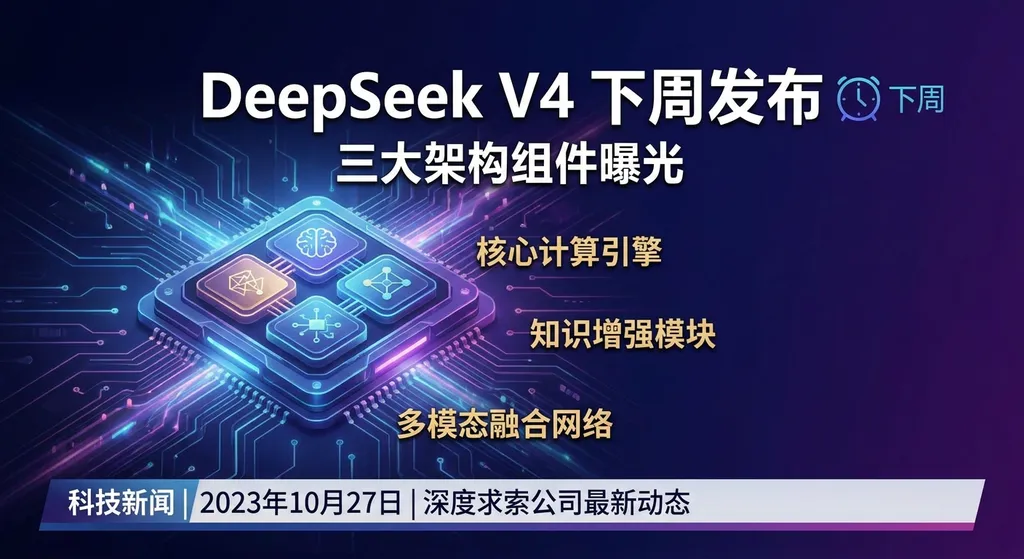
DeepSeek founder Liang Wenfeng has confirmed that V4 will be released in late April. With a trillion parameters and a million-context window, its core features include three major technological breakthroughs: the Engram conditional memory architecture, manifold-constrained hyperconnectivity, and the DualPath dual-path system.
DeepSeek V4 to Launch Next Week: Three Major Architectural Components Revealed
On April 10, DeepSeek founder Liang Wenfeng confirmed in an internal meeting that the next-generation flagship model, DeepSeek V4, will officially launch in late April. Following the R1 reasoning model, this will be DeepSeek’s most significant product update of the year.
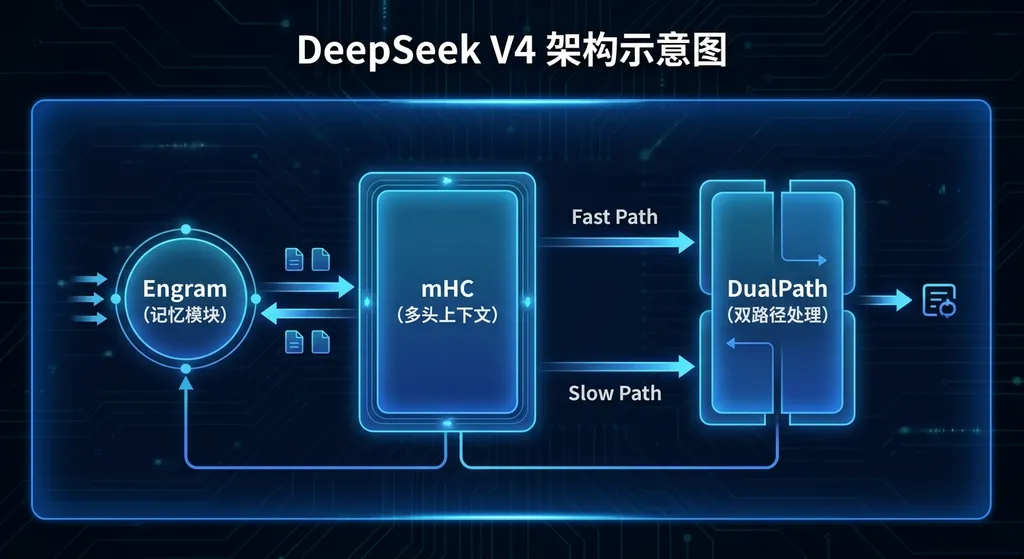
More importantly, Princeton PhD student Yifan Zhang revealed three core architectural components of V4 in the community: Engram Conditional Memory Architecture, Manifold-Constrained HyperConnection (mHC), and DualPath Dual-Stream Reasoning System. These three technologies are not mere parameter stacks — they fundamentally reconstruct large-model memory, training, and reasoning mechanisms from the ground up.
From last year’s V3, which disrupted industry perceptions with “low cost and high performance,” to V4’s architecture-level innovations, DeepSeek’s strategy is increasingly clear: it’s not competing with OpenAI on compute power, but on efficiency and engineering excellence.
Engram: Separating “Memory” and “Computation”
The traditional Transformer architecture has a fundamental flaw: knowledge storage and logical reasoning are entangled. The model has to both memorize static knowledge like “Paris is the capital of France” and handle dynamic reasoning like “If A > B and B > C, what’s the relationship between A and C?” Doing both with the same set of parameters is inefficient and costly.
Engram’s approach is to separate static knowledge memory from dynamic logic computation. DeepSeek hasn’t disclosed detailed implementation yet, but the name (Engram, which refers to a “memory trace” in neuroscience) suggests it likely introduces an external knowledge-base mechanism, allowing the model to fetch information on demand rather than packing everything into parameters.
The advantages of this design include:
- Higher parameter efficiency: Handles more complex tasks with the same parameter count
- Flexible knowledge updates: No need to retrain the whole model each time
- Stable long-context processing: V4’s million-token context window likely relies on Engram
By analogy, traditional models are like memorizing the entire encyclopedia, while Engram is like remembering the library’s index system — retrieve knowledge only when needed.
mHC: Keeping Ultra-Large Model Training Stable
How hard is it to train a trillion-parameter model? Gradient explosion, vanishing, or failure to converge — occasional issues in small models become the norm in massive ones.
Manifold-Constrained HyperConnection (mHC) is DeepSeek’s stability technology tailored to this problem. The “manifold constraint” likely refers to geometric constraints on model topology, and “hyperconnection” may mean improved cross-layer residual links or attention mechanisms.
Official data shows that mHC boosts training efficiency by about 30%. That’s a meaningful figure — for models costing tens of millions of dollars to train, a 30% improvement saves weeks of time and millions in expenses.
Even more crucially, mHC enables DeepSeek to train ultra-large models on domestic compute power. Huawei Ascend and Cambricon chips aren’t as powerful as Nvidia’s H100, but through algorithm-level optimization, DeepSeek is proving that “world-class models can be trained without top-tier U.S. chips.”
DualPath: Putting Idle Network Cards to Use
Where’s the bottleneck in inference? The KV-Cache.
During inference, each token’s attention computation needs access to all previous tokens’ Key and Value, stored in the KV-Cache. The longer the context, the bigger the KV-Cache, increasing VRAM pressure and slowing inference.
The DualPath System aims to offload KV-Cache loading onto idle network card resources. This likely involves storing part of the KV-Cache on remote nodes and fetching them via high-speed networks when needed. Combined with intelligent agent frameworks from Peking University and Tsinghua, online service throughput reportedly doubled.
It’s a highly engineering-driven but practical optimization. For enterprise deployments, doubling throughput means the same hardware can serve twice as many users — or handle the same user base with half the machines.
Million-Token Context + Long-Term Memory: More Than a Bigger Window
V4’s context window expands to one million tokens, which isn’t groundbreaking — Gemini 1.5 Pro already hits two million — but the key is how DeepSeek uses that window.
Traditional models treat context as “single-use”: once the chat ends, the memory resets. V4 introduces a Long-Term Memory (LTM) mechanism, allowing the model to accumulate and recall information across sessions.
This capability is critical for enterprise applications; for example:
- Code review: Remembers coding conventions and past PR discussions to offer team-specific advice
- Document QA: Remembers prior user questions and feedback, avoiding repeated explanations
- Customer service: Remembers user preferences and ticket history, enabling more personalized support
The details of LTM remain undisclosed, but given Engram’s structure, it’s likely implemented through external memory and retrieval-augmented methods. DeepSeek isn’t the first to attempt this, but achieving stability at trillion-parameter scale would demonstrate its engineering strength.
Native Multimodality: True Fusion, Not Stitching
V4 adopts a native multimodal fusion architecture, integrating image, video, and text processing during pretraining — not post hoc stitching like GPT-4V’s vision encoder + language model setup.
Advantages of native multimodality:
- Deeper cross-modal understanding: Learns intrinsic links between images and text during pretraining
- Higher inference efficiency: Avoids costly modality conversions
- More stable training: Unified loss function eliminates complex alignment issues
While Google’s Gemini leads this direction, DeepSeek is catching up fast. Considering V4’s open-source nature, if it achieves Gemini-level multimodal performance, the impact on the open-source community will be significant.
Domestic Compute Adaptation: Strategic More Than Technical
One defining feature of V4 is its deep adaptation to domestic AI platforms like Huawei Ascend. This isn’t just a simple port — it’s a system-level refactoring from operator optimization to inference engine and distributed training framework.
According to Liang Wenfeng, this is one reason for V4’s delay. Technically, Chinese chips lag behind Nvidia in compute density, interconnect bandwidth, and software ecosystems — high adaptation cost, low immediate reward. But strategically, it’s essential: if Chinese AI firms remain dependent on U.S. chips, even the most advanced tech is just “a castle built on sand.”
Reportedly, Alibaba, ByteDance, and Tencent have preordered hundreds of thousands of next-gen AI chips to deliver V4 through their cloud platforms. As a result, AI chip prices have risen about 20% recently — evidence that the industry is gearing up for V4’s large-scale rollout.
Open Source + Commercialization: DeepSeek’s New Phase
V4 will remain open-sourced under the Apache 2.0 license, allowing businesses to deploy and commercialize freely — a long-standing DeepSeek principle and major contrast with OpenAI.
But open-source doesn’t mean non-profit. Liang Wenfeng revealed that DeepSeek is building a product team and hiring a “Model Strategy Product Manager,” signaling a shift from “technical demos” to productization and commercialization.
Potential business models include:
- API Services: Hosted V4 APIs with usage-based billing
- Enterprise Deployment: Tailored on-premise setup and optimization
- Industry Solutions: Fine-tuned applications for verticals like finance, healthcare, and law
This transition matters for DeepSeek’s long-term competitiveness. Even the best technology won’t survive against OpenAI or Google without a sustainable business model.
V4 vs GPT-6: A Head-On Showdown of Two Strategies
Around V4’s release window, OpenAI’s GPT-6 (codename “Spud”) is also rumored to be launching soon, with performance allegedly improving over 40% and supporting 2 million tokens.
Two world-leading large models debuting simultaneously — a rare “dual-giant showdown” for the AI industry. In terms of approach:
GPT-6:
- Heavy compute stack (rumored $1B training cost)
- Commercial closed source, monetized via API
- Relies on top-tier Nvidia chips
- Focuses on general capabilities and ecosystem
DeepSeek V4:
- Efficiency-first, training cost in tens of millions
- Open-source under Apache 2.0
- Adapts to domestic compute, lowering deployment barriers
- Emphasizes architectural innovation and engineering
Their contrast is symbolic: GPT-6’s strength lies in capital and ecosystem; V4’s in accessibility and self-reliant innovation. The former is a “walled garden,” the latter an “open plain.”
Realistically, V4 won’t shake GPT-6’s market dominance overnight — OpenAI’s brand, ecosystem, and capital are formidable. But V4’s true significance lies in this: China’s AI teams now have the technical capability to compete head-to-head with the global first tier, not as “low-cost alternatives,” but as genuine innovators.
Impact on Developers
After release, developers can access DeepSeek via its official API or aggregator platforms like OpenAI Hub. If you already use the OpenAI SDK, switching to V4 will require almost no code changes:
from openai import OpenAI

# Call DeepSeek V4 through OpenAI Hub
client = OpenAI(
    api_key="your-openai-hub-key",
    base_url="https://api.openai-hub.net/v1"
)

response = client.chat.completions.create(
    model="deepseek-v4",
    messages=[
        {"role": "system", "content": "You are a code review assistant familiar with Python and Go best practices."},
        {"role": "user", "content": "Help me review this code:\
\
```python\
def process_data(data):\
    result = []\
    for item in data:\
        if item > 0:\
            result.append(item * 2)\
    return result\
```"}
    ],
    max_tokens=2000
)

print(response.choices[0].message.content)
To use V4’s long-term memory capability, you may need extra API parameters (details to follow official docs):
response = client.chat.completions.create(
    model="deepseek-v4",
    messages=[...],
    # Enable long-term memory linked to a specific user or session
    user="user-123",
    session_id="session-456",
    # Allow model access to historical dialogue
    enable_long_term_memory=True
)
For tasks involving ultra-long documents (e.g., analyzing full codebases or lengthy contracts), V4’s million-token window lets you feed them all at once — no chunking or summarization needed:
# Read entire code repository
repo_content = ""
for file in repo_files:
    with open(file, 'r') as f:
        repo_content += f"\
\
# File: {file}\
{f.read()}"

response = client.chat.completions.create(
    model="deepseek-v4",
    messages=[
        {"role": "system", "content": "You are a code architecture analyst."},
        {"role": "user", "content": f"Analyze the design of this codebase and point out potential issues:\
\
{repo_content}"}
    ],
    max_tokens=5000
)
Key Points to Watch
- V4’s Actual Performance: Architectural innovation sounds impressive, but benchmarks and real usage will be the true test. V3 already proved DeepSeek’s engineering prowess — V4 likely won’t disappoint.
- Maturity of Domestic Compute: By deeply adapting to Huawei Ascend, V4 effectively “endorses” Chinese AI hardware. If it runs smoothly and fast, it will boost domestic confidence significantly.
- Open-Source Community Reaction: Will V4 trigger a wave of fine-tuned derivatives and applications like LLaMA did? That depends on usability and documentation quality.
- Progress on Commercialization: Can DeepSeek build a sustainable business model alongside open-source? That will determine its long-term survival.
In Closing
The release of DeepSeek V4 marks a new stage for Chinese AI — not just catching up or imitating, but articulating original solutions to fundamental technical problems. Engram, mHC, and DualPath aren’t mere engineering tweaks; they represent a fresh rethink of large-model design.
From V3’s “low-cost, high-performance” to V4’s “architecture-level innovation,” DeepSeek’s approach is clearer than ever: don’t compete with OpenAI on compute or capital — compete on efficiency, engineering strength, and understanding of developers. How far this path can go — V4 will tell.
See you next week.
References
- DeepSeek V4 is Coming Soon (Rumored to Launch This Week) — Expectations? - Linux.do — Community discussion, includes Princeton PhD Yifan Zhang’s architecture leak
- DeepSeek V4 Is Coming: 1 Trillion Parameters, 1 Million Context - Zhihu — Technical analysis of the Engram architecture
OpenAI Hub already supports DeepSeek V3 and will integrate V4 immediately after release.


