Grok Bot starts calling the opponent model
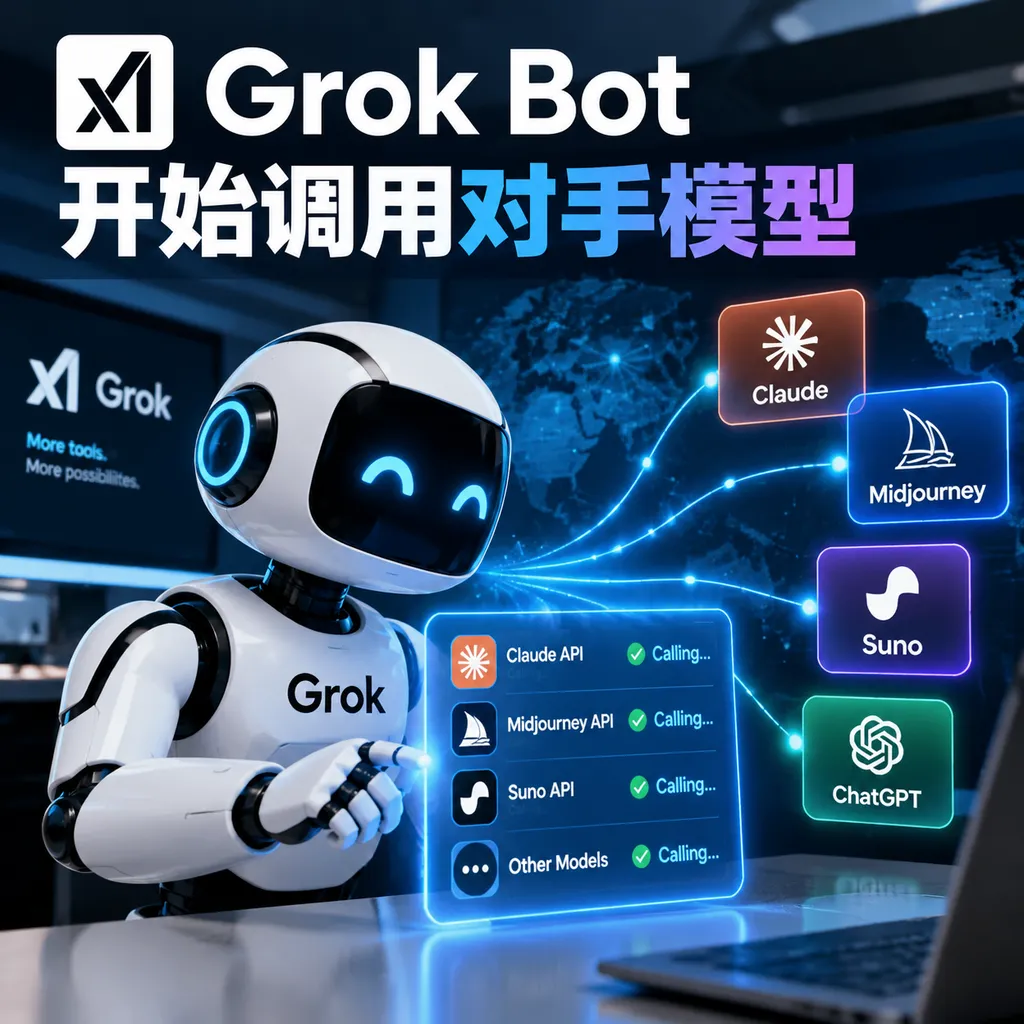
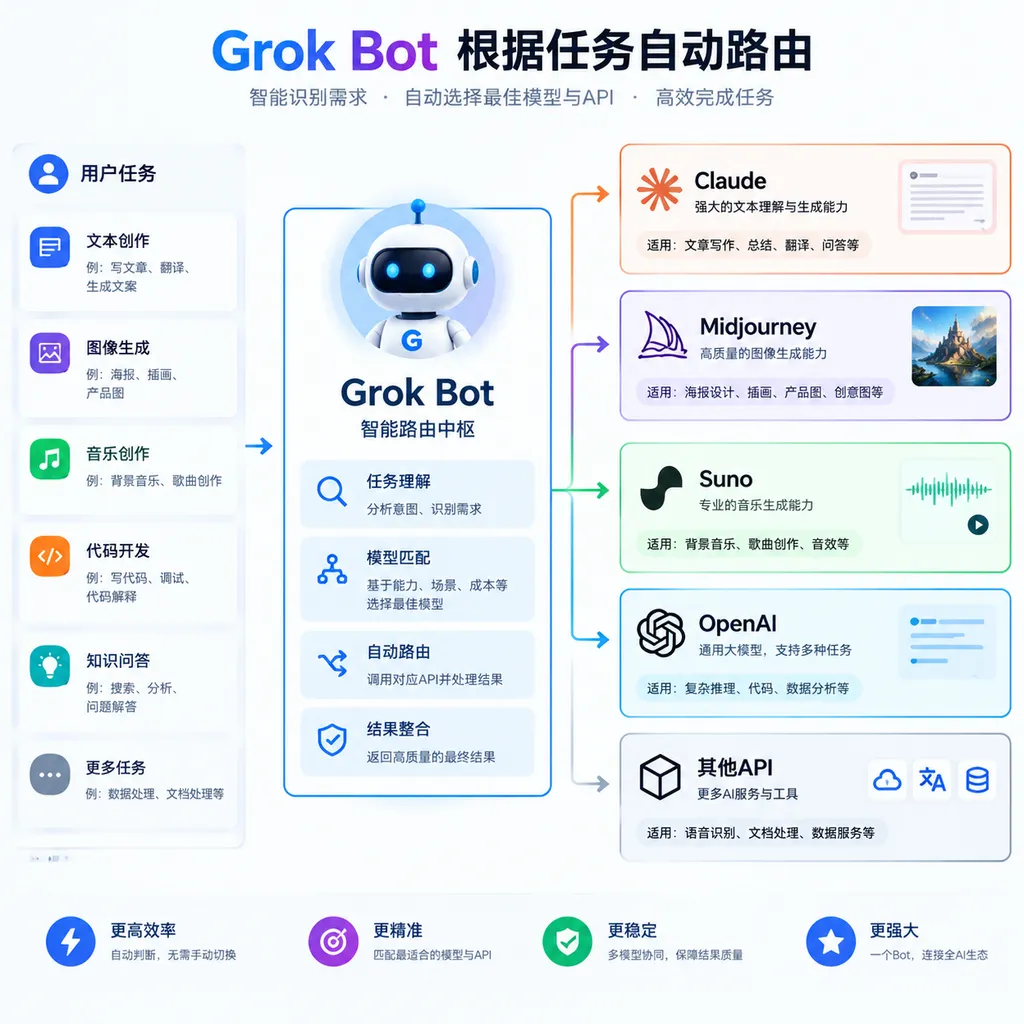
Musk announced that Grok Bot will automatically select the appropriate backend model based on the task in the future, potentially calling third-party services such as Claude Opus 5.5, Midjourney, and Suno. Grok is shifting from a single-model assistant to a multi-model agent gateway.
Grok Bot Begins Using Rival Models
Grok Bot is about to start using models from its competitors.
On October 7, Elon Musk revealed on X that Grok Bot will no longer rely exclusively on xAI's own Grok family of models. Instead, it will automatically select the "best backend model" based on the specific task submitted by the user. He specifically named Anthropic's Claude Opus 5.5, the image-generation tool Midjourney, the music-generation service Suno, and other leading models and APIs as potential services.
This marks a shift in Grok Bot's product positioning: it is no longer merely a chatbot powered by Grok, but is instead trying to become a multi-model agent capable of breaking down tasks, selecting tools, and executing them on the user's behalf.
Grok Is No Longer Insisting on Doing Everything Itself
In the past, the standard product strategy for large-model companies was to train their own foundation models and then build chat, search, coding, and agent products around them. The stronger the model, the more competitive the product; the more widely the product was used, the more data and feedback the company could accumulate in return.
The signal Grok Bot is now sending points to a different, more pragmatic approach: the model does not have to be its own, but the task must be completed better.
According to Musk, the system will select the backend most likely to produce the best result for the user's task. For example:
- For long-form text analysis, complex reasoning, or code review, it might use a model such as Claude;
- For image generation, it might hand the task off to a specialized image model such as Midjourney;
- For creating songs, soundtracks, or audio content, it might use Suno;
- For browsing the web, operating desktop software, or executing multi-step processes, Grok Bot would handle the overall orchestration and call different services at different stages.
This is not the same as simply "switching models." Model switching usually means the user manually selects GPT, Claude, or Grok in the settings. Task routing, by contrast, gives the system control over model selection. The user only needs to state the goal; the system determines which model to use, when to invoke it, whether additional processing is required, and how to deliver the final result.
Grok Bot's Focus Is Execution, Not Conversation
Grok Bot was released in beta in August this year. Its product design is closer to that of an always-on cloud-based colleague than a conventional question-and-answer window.
Each Bot can have its own name, responsibilities, and continuously accumulated context. Users can assign tasks through text, voice, or even voice calls. It runs on a cloud computer with access to a browser, file system, and terminal, allowing it to log in to commonly used websites and applications, perform scheduled tasks, and carry out continuous multi-step operations.
Background tasks can continue running even after the user turns off their computer. The Bot only returns to request approval when it reaches a step requiring human confirmation, such as making a payment, sending an important email, or publishing content.
In this product model, the underlying model is not the only critical variable. What truly determines the outcome is an entire "task execution system":
- Understand what the user actually wants to accomplish;
- Break the objective down into executable steps;
- Match each step with the appropriate model, tool, or external API;
- Preserve intermediate results and context;
- Determine whether the task has been completed, retrying or switching services when necessary;
- Request authorization from the user before performing risky actions.
If Grok Bot merely treats Claude as another chat window, its value will not increase significantly. Users will only experience the real benefits of a "multi-model" system if Grok Bot can organize Claude, Midjourney, Suno, and browser tools into a complete workflow.
This Move Makes Practical Sense for xAI
From a model-capability perspective, it is difficult for any single company to remain a leader in every area. Text reasoning, code generation, images, video, music, speech, and computer operation are fundamentally different engineering problems, each involving different training data, model architectures, evaluation criteria, and product interfaces.
Even if xAI continues investing in computing resources and data, it does not need to retrain the strongest model in every vertical. What Grok Bot users ultimately care about is not whether a particular answer was generated by Grok, but whether the report was completed, the image was generated, the video script could be put into production, or the web operation was successfully performed.
From this perspective, using third-party models does not necessarily mean Grok is backing down. Instead, it may be a sign that agent products are maturing. Grok is responsible for the entry point, context, task planning, and end-to-end execution, while other models serve as interchangeable capability modules.
This also explains why Musk mentioned Claude, Midjourney, and Suno together. They are not the same type of model and cannot easily be placed on a single "which is stronger" leaderboard. What Grok Bot really wants to evaluate is not single-turn question-answering scores, but whether the entire system can deliver better results when completing real work.
"Automatically Selecting the Best" Is Not as Simple as It Sounds
However, "automatically selecting the best model" is an appealing product message, but it is highly complex to implement.
The first challenge is task identification. A single user request often contains multiple objectives, such as, "Help me create a product launch plan, add several visuals, and generate a promotional music track." This is not a single model call, but a composite workflow involving copywriting, research, image generation, and audio generation. The system must accurately identify task boundaries and determine which stages should run sequentially and which can run in parallel.
The second challenge is quality evaluation. "Best" does not simply mean the most capable model. The system must also consider input formats, context length, output consistency, latency, pricing, regional availability, and service limits. A model that is theoretically stronger may perform worse in practice if it has a long queue, cannot process the current file, or produces an output format that cannot be used by the next stage of the workflow.
The third challenge is failure handling. Third-party APIs can time out, impose rate limits, return incomplete results, or change their interface rules. An agent cannot simply pass a failure on to the user; it needs retry, fallback, and alternative-routing capabilities. For example, if an image service is unavailable, should the system switch to another provider? If audio generation fails, should it return only the lyrics and arrangement instructions? These behaviors must be defined in advance at the product level.
The final challenge concerns permissions and data boundaries. Grok Bot can log in to websites and access files, and it may send users' emails, code, contracts, and internal materials to different model providers. The more models it uses, the greater its capabilities, but also the longer and more complex the data flow becomes. At a minimum, users should know which service was used for each task, what content was sent, whether the data was retained, and whether certain models or regions can be restricted.
For developers, these issues matter more than the number of supported models. The core competitive advantage of a multi-model system will ultimately lie in observability and control, not in having a long list of models.
Will Multi-Model Routing Become Standard for Agents?
Most likely, but it will not immediately become a completely opaque, automated decision-making process.
For simple tasks, the system can select models automatically. Tasks such as text summarization, format conversion, and batch classification are relatively easy to evaluate, while their costs and latency are also reasonably predictable. In high-risk scenarios, however, enterprises will not want to hand routing entirely over to an unexplainable system. Financial analysis, code merging, legal document processing, and external publishing all require explicit model allowlists, human approval, and audit logs.
A more common model in the future may be "automatic routing with policy controls":
- By default, the system automatically selects models based on quality, price, and latency;
- Users can specify model preferences or prohibit certain providers;
- Enterprises can define data-isolation and compliance rules for each project;
- Every call records the model, version, input summary, cost, and result status;
- Human confirmation is retained for critical tasks to prevent agents from acting beyond their authority.
This is also where model aggregation platforms provide value. OpenAI-compatible API aggregation services such as OpenAI Hub essentially solve the problems of integrating multiple models, providing a unified interface, and switching between providers. For developers who need to test GPT, Claude, Gemini, DeepSeek, and other models, a unified interface can reduce integration costs. However, deploying such systems in production still requires independent model evaluation, routing strategies, cost controls, and data governance.
In other words, a unified API solves the question of "how to integrate," while Grok Bot must solve the question of "how this task should actually be completed." The two operate at different layers, but they will gradually converge.
Will This Make Grok Bot More Capable?
It will make Grok Bot more useful, but not necessarily more reliable right away.
If Grok Bot merely forwards user requests unchanged to third-party models, the added value will be limited. The system could even become more complex because of lost context, inconsistent permissions, and incompatible output formats. What it truly needs is a stable orchestration layer capable of understanding tasks, selecting models, passing context, validating results, and taking responsibility for errors.
From a competitive product perspective, this update will also blur the boundaries between Grok Bot, Claude Cowork, Claude Code, and other cloud-based agents. Claude Code focuses more on code repositories, terminals, IDEs, and CI workflows, while Grok Bot emphasizes a shared cloud computer, browser access, and cross-application operations. In the future, if Grok Bot can freely use different models in these scenarios, it will be better positioned than a single-model agent to handle complex workflows.
The trade-offs are equally clear: the product will become harder to explain, pricing will become less predictable, and troubleshooting will evolve from asking "Which model gave the wrong answer?" to asking whether the failure occurred in task planning, routing, an API, permissions, or the execution environment. For developers, debugging such a system will increasingly resemble debugging distributed services rather than a single model interface.
For now, Musk has announced only the overall direction. He has not disclosed a specific launch date, the range of supported models, the pricing model, whether users will be able to select backends manually, or details regarding authorization and data processing by third-party services. It therefore remains to be seen whether Claude Opus 5.5, Midjourney, and Suno will all be fully supported in the initial release.
But the direction is already clear: competition among the next generation of AI assistants will no longer be solely about "who has the strongest foundation model," but about "who can organize the entire model ecosystem and get work done for users." Grok Bot has chosen to open up its model boundaries first. Whether it can turn that strategy into a stable product capability will determine whether it becomes merely a multi-model gateway or a genuinely useful AI colleague.
References
- ITHome: Musk Says Grok Bot Will Select Backend Models Such as Claude, Midjourney, and Suno Based on the Task — Covers the plans Musk announced on X on October 7 and Grok Bot's product model.