PLaMo 3 Translation Model Expands to 53 Languages
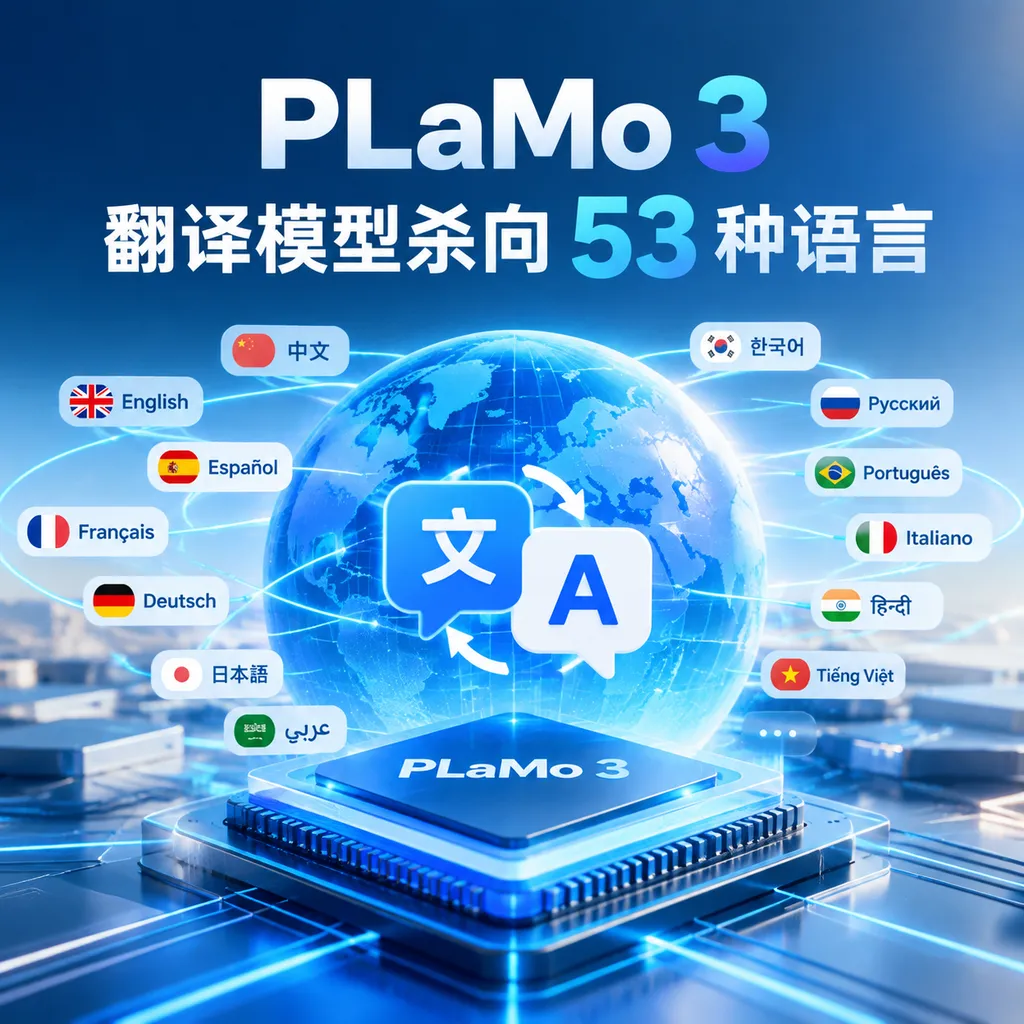
PFN has released PLaMo 3 Translate 31B, expanding translation coverage to 53 languages and launching meeting translation support for 15 languages. Its Japanese capabilities and cost are highly competitive, but a public API, independent evaluations, and deployment options remain key gaps.
PFN Expands Its Japanese Translation Model to 53 Languages
Japanese AI company Preferred Networks (PFN) released PLaMo 3 Translate 31B on October 7, while also rolling out a major upgrade to its PLaMo translation service.
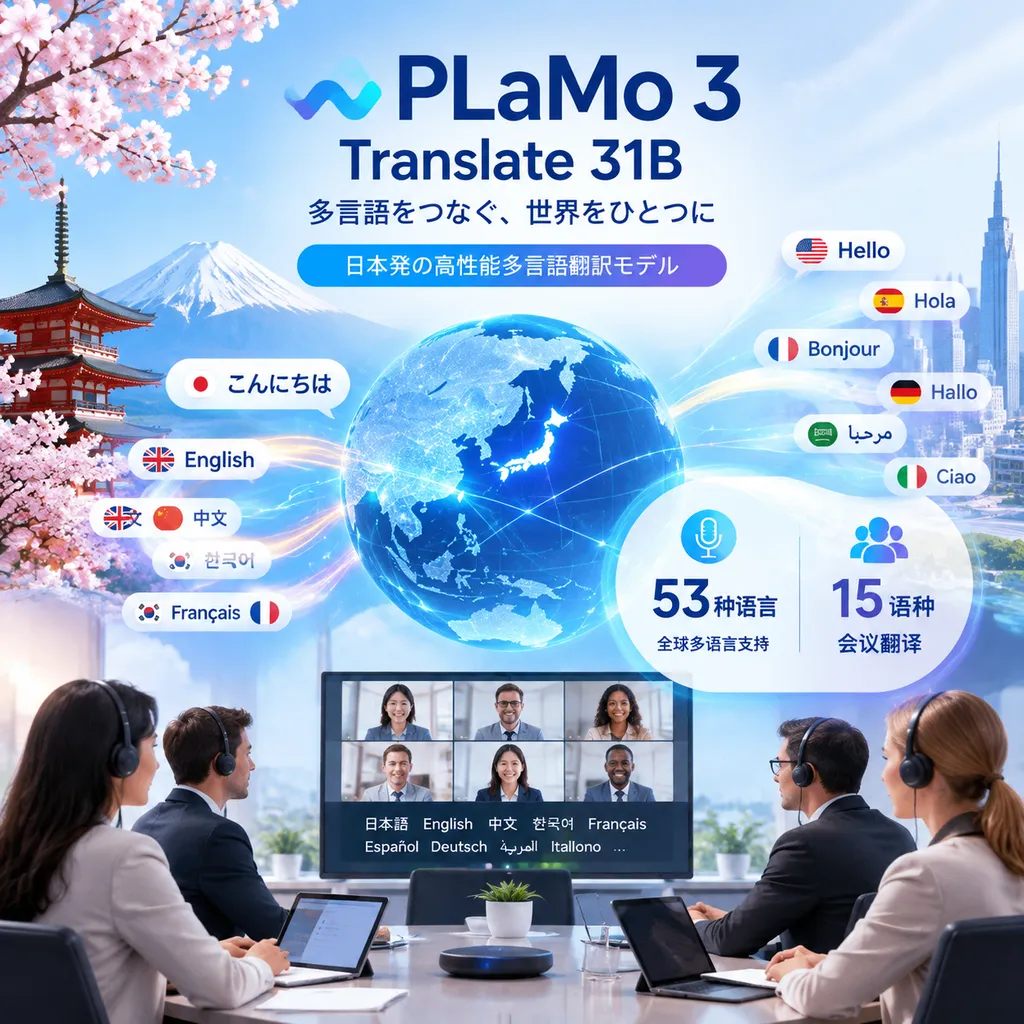
The most visible change in this update is that supported languages have expanded from the previous two, Japanese and English, to 53 all at once. At the same time, PFN officially launched an online meeting translation mode that can handle 15 languages and supports bilingual and trilingual meetings, including Japanese.
The model has 31 billion parameters and was developed on the basis of the PLaMo 3 series foundation model. According to data released by PFN, its overall performance across multiple Japanese-English and multilingual translation tests has entered the same range as frontier models such as GPT-6.1 Sol, GPT-6 Astra, and Claude Fable 5.1. It also outperformed DeepL and Google Translate in comparative evaluations.
What is truly worth noting is not that “yet another model beat GPT,” but that PFN is trying to prove something more practical: for a clearly bounded task like translation, a specialized 31B model can be cheaper than general-purpose frontier models without necessarily performing worse.
Why a 31B Model Dares to Compare Itself with Frontier Models
The foundation of PLaMo 3 Translate 31B is not a simple adaptation of Llama, Qwen, or Mistral, but PFN’s self-developed PLaMo 3 series.
The publicly available model card for the PLaMo 3 NICT 31B Base model shows that it has approximately 31B parameters, was pretrained on 3 trillion tokens, and uses an architecture combining Sliding Window Attention with conventional global Attention. Japanese accounts for nearly 30% of the training data, English for more than 40%, with code and data in other languages making up the remainder.
What does 30% Japanese-language data mean in practice?
For a globally oriented general-purpose model, Japanese is usually just one part of a multilingual corpus. For PLaMo, Japanese is a core language on equal footing with English. The difference is somewhat like that between “an international journalist who has studied Japanese” and “a journalist who has spent years covering local news in Japan.” Both can translate, but the latter is more familiar with levels of honorific speech, omitted subjects, implied tone, and the expressions in business writing that cannot be translated word for word.
PFN also says that the amount of training tokens and data-synthesis compute devoted to translation tasks in this generation is several hundred times that of the previous generation. The key is not simply adding more data, but rebuilding high-quality translation corpora and using LLMs for synthesis and filtering.
This is also where specialized models show their advantage: a general-purpose model must learn to write code, reason, retrieve information, chat, and generate long-form text at the same time, while a translation model can concentrate its limited parameters on semantic alignment, register control, proper nouns, and naturalness in the target language. 31B is not small, but compared with frontier general-purpose models, it remains a size at which inference costs are easier to control.
PFN’s Results Look Good, but Don’t Rush to Believe It Has “Surpassed Everything”
According to results released by PFN, PLaMo 3 Translate 31B outperformed GPT-6.1 Sol and GPT-6 Astra on the average scores of four translation benchmarks. In Japanese-focused tests, it also achieved relatively high win rates against DeepL and Google Translate.
Some of the comparative results provided by PFN include:
- On the PFTB English-to-Japanese task, an 87% win rate against DeepL;
- On the PFTB English-to-Japanese task, an 86% win rate against Google Translate;
- On the SaaS English-to-Japanese dataset, a 73.82% win rate against DeepL;
- On the same dataset, a 91.47% win rate against Google Translate;
- On the WMT24++ English-to-Japanese task, win rates of 59.17% against DeepL and 70.62% against Google Translate.
These results show that PLaMo 3 Translate’s Japanese output is not merely benefiting from “local-model goodwill.” Particularly in scenarios such as business emails, it tends to directly generate expressions that fit Japanese workplace conventions rather than preserving English syntax and replacing the words sentence by sentence.
For example, the English sentence “I realize this adds another step for you” can easily become “I know this will add another step for you” under a mechanical translation. The meaning is not wrong, but it does not sound like natural Japanese business correspondence. A specialized model is more likely to render it as an expression equivalent to “I apologize for the inconvenience,” which better fits the conventions of the target language.
However, these numbers still need to be viewed calmly.
First, the main results come from evaluations designed or compiled by PFN itself, including proprietary benchmarks. Second, the translations were compared by another large model acting as the judge. PFN used Gemini 3.1 Pro to evaluate the two candidate translations twice, switching their order. An LLM Judge can assess naturalness better than character-matching metrics such as BLEU, but it can also be affected by language preferences and evaluation drift.
Third, there is no single score that applies to every translation scenario. Legal contracts prioritize terminology consistency, game localization emphasizes character voice, customer-service dialogues require concise sentences and contextual continuity, while technical documentation must not make function names and error codes “more natural” through translation. A model that wins on general Japanese-English tests cannot necessarily take over a production environment directly.
Therefore, the more accurate judgment is: PFN has produced results strong enough to put it on the shortlist, but the claim that it is “better than GPT and DeepL” is still vendor-led and requires independent verification.
Approximately 14 Yen per 100,000 Characters: The Low Price Comes from Two Layers of Optimization
PFN claims that PLaMo 3 Translate costs approximately 14 yen to process 100,000 source characters, equivalent to about RMB 0.59. At that rate, 1 million characters would cost around 140 yen, or approximately RMB 5.9 at the current reference exchange rate.
That figure is indeed aggressive.
The first source of its cost advantage is model size. A 31B specialized model does not need to activate the full reasoning capabilities of a massive general-purpose model for every translation, nor does it need to generate lengthy chains of thought. For relatively stable translation tasks, the more specialized the model, the less compute is wasted on irrelevant capabilities.
The second advantage comes from the tokenizer. PFN’s tests show that when generating 1,000 Japanese characters, PLaMo 3 Translate uses approximately 447 tokens on average, compared with about 893 for Claude Fable 5.1 and 744 for GPT-6 Astra.
This means that when generating the same amount of Japanese, PLaMo may use only around half as many tokens as some competing models. A tokenizer is like a text “packing algorithm”: if a model splits common Japanese phrases into many fragments, it will not only cost more to run, but will also require more inference steps. If the same content can be expressed with fewer tokens, both cost and latency will fall.
But there is an easily overlooked caveat: PLaMo Translate does not currently offer a public API.
The 14-yen figure provided by PFN is not an actual API bill that developers can already receive. It is an estimate based on the input and output token prices of the same-generation PLaMo API, combined with token usage measured in the evaluation. The public calculation uses reference prices of 60 yen per million input tokens and 250 yen per million output tokens.
Therefore, this figure is closer to the model’s theoretical invocation cost than to a standardized service price that has already been implemented. It shows that the technical approach may be inexpensive, but it does not prove that enterprises will ultimately be able to purchase it at that price.
Meeting Translation Is Not Just Giving the Model a Microphone
Among the updates this time, the meeting translation feature supporting 15 languages may have more product value than text translation in 53 languages.
Users can add a PLaMo translation bot to Zoom, Google Meet, or Microsoft Teams meetings. The system identifies different speakers, transcribes the audio in real time, and displays the original text and translation in a browser interface. In addition to bilingual meetings, it supports trilingual meetings and terminology lists for constraining the translation of names, product names, and industry terms.
Meeting translation is much harder than text translation because it is effectively a chained pipeline:
- Determine who is speaking in multi-person audio;
- Convert speech containing accents, pauses, and self-corrections into text;
- Recover omitted subjects and objects from the surrounding context;
- Identify company names, product names, and abbreviations;
- Complete the translation with the lowest possible latency;
- Correctly associate the translation with the corresponding speaker.
An error at any stage will degrade the final result. Once speech recognition mishears a proper noun, even a highly capable translation model cannot fully recover from it. PFN allows users to configure terminology lists precisely to address this kind of error propagation.
Its practical value is also clear: for cross-border engineering teams’ requirements reviews, weekly meetings between Japanese headquarters and overseas subsidiaries, and presales communications with Japanese customers, broadcast-interpreter-level voice synthesis is often unnecessary. Simply enabling everyone to promptly understand what the others are saying can already significantly reduce communication costs.
Of course, subtitle-style translation cannot completely replace human interpreters. In negotiations, matters involving legal responsibility, or high-context communication, humans are still better at recognizing irony, hesitation, and positions that have not been stated explicitly. PLaMo is better suited to frequent, routine meetings with room for error than to taking a seat as the interpreter at a board meeting.
For Developers, This Currently Looks More Like a Product Launch than a Model Release
The name PLaMo 3 Translate 31B can easily give the impression that PFN has already uploaded the translation weights to Hugging Face. At present, however, the main publicly visible release is the PLaMo 3 NICT 31B Base foundation model. That model has not been instruction-tuned for chat or translation and cannot be treated as equivalent to the translation product announced this time.
PFN’s open-source CLI project currently focuses mainly on the previous-generation plamo-2-translate. It can run on Apple Silicon with the help of MLX and also provides a server mode and MCP integration. It can help developers understand how PLaMo translation models are run locally, but it does not mean that PLaMo 3 Translate 31B is already available for download.
This distinction matters:
- PLaMo 3 NICT 31B Base: Public base weights suitable for research, fine-tuning, and self-hosted inference;
- PLaMo 3 Translate 31B: The specialized translation model announced this time, serving as the core capability behind the PLaMo translation service;
- PLaMo translation service: A text, file, and meeting translation product for end users and enterprises;
- Public API: As of this release, PFN has explicitly stated that one is not yet available.
As a result, developers currently cannot integrate PLaMo 3 Translate directly into existing OpenAI-compatible clients in the same way they can call GPT, Claude, or Gemini. It is also difficult to run automated A/B tests on the same request set. For teams already using OpenAI Hub to call multiple models through a unified interface, PLaMo must currently be treated as an independent translation product rather than an API model that can be directly added to a routing strategy.
This is the biggest disappointment of the release. Whether a translation service is truly suitable for developers depends not only on model scores, but also on API stability, batch processing, terminology lists, concurrency limits, data-retention policies, and error-retry mechanisms. The model has moved ahead, but the developer interface has not caught up.
Japanese Domestic Models Are Shifting from “Speaking Japanese” to “Solving Japanese Business Problems”
The significance of PLaMo 3 Translate is not that Japan has gained yet another large model, but that domestic models are beginning to build product advantages around clearly defined workflows.
Japanese has never been entirely unfamiliar to general-purpose models, but “can generate Japanese” and “can be used reliably in Japanese enterprises” are two different things. Government documents, manufacturing terminology, honorific systems, internal company abbreviations, and the subject omission characteristic of Japanese all require data and evaluations that are closer to the local context.
PLaMo Translate, which PFN launched earlier, was selected by Japan’s Digital Agency for inclusion in the government’s generative AI environment, where it is used to process text containing administrative expressions and government terminology. Such scenarios emphasize not only linguistic fluency, but also data governance, local deployment, supply-chain controllability, and long-term service capabilities.
This also explains why PFN continues to emphasize that it developed a domestic model “from scratch.” For ordinary consumers, where a model comes from may not matter. For governments, financial institutions, manufacturers, and large enterprises, however, model weights, inference environments, and whether data leaves the country can directly affect procurement decisions.
Final Assessment: The Model Is Worth Watching, but the Ecosystem Is Still One Mile Short
PLaMo 3 Translate 31B is a substantive upgrade: support for 53 text languages expands the product’s boundaries, meeting translation in 15 languages brings the capability into real workflows, and the 31B scale combined with a Japanese-optimized tokenizer provides a clear cost rationale.
Its most convincing aspect is not that it surpassed GPT on a particular leaderboard, but that it demonstrates specialized models still have room to survive. As foundation models continue to grow, narrowing the task, deepening the training data, and optimizing the tokenizer for the target language may be more effective than simply adding parameters.
However, it cannot yet be considered a complete developer-friendly release. The translation model weights have not been released, the API is not yet public, the cost figures are estimates, and the benchmark testing was conducted mainly by PFN itself. For technical teams, it can now be added to the evaluation list, but it cannot yet be integrated seamlessly into a production architecture.
If PFN next provides a stable API along with terminology lists, batch file translation, structured output, data-retention opt-out options, and an enterprise-grade SLA, PLaMo 3 Translate will have a real chance to evolve from “a powerful Japanese domestic model” into a third option alongside DeepL and general-purpose large models.
References
- IT Home: PFN Releases the PLaMo 3 Translate 31B Model — Summarizes the model size, number of supported languages, benchmark results, and cost information from this release.
- Hugging Face: PLaMo 3 NICT 31B Base — Describes the architecture, training-data proportions, license, and operating methods of the PLaMo 3 foundation model.
- GitHub: pfnet/plamo-translate-cli — PFN’s local translation CLI, MLX backend, and MCP integration project, currently focused mainly on the previous-generation translation model.
- Reddit: Community Discussion of PLaMo Translate — Discussion in the LocalLLaMA community about the architecture and local-running ecosystem of the PLaMo translation model.