Ecosia Abandons Mistral for Chinese Models

Just five months after launch, Ecosia abandoned Mistral due to issues with quality, stability, and cost, switching to Qwen, GLM, and Kimi. Europe’s AI sovereignty narrative is losing to the engineering realities of open-source models.
Five Months Later, Ecosia Changes AI Providers Again
German search engine Ecosia has just poured cold water on European AI.
According to news disclosed on October 6, Ecosia is dropping French AI company Mistral and switching to models from Chinese providers Qwen, GLM, and Kimi through the AI platform Melious. Ecosia founder and CEO Christian Kroll offered a blunt assessment: the company was disappointed with Mistral’s quality, and its models were already a year behind the competition. (ithome.com)
The switch comes only about five months after the two companies announced their partnership. In May, Ecosia had announced that it was moving from OpenAI to Mistral, hoping to reduce its reliance on closed-source American models and build AI-powered search around a provider more aligned with the idea of “European digital sovereignty.” At the time, it was seen as a typical example of a European internet company supporting homegrown AI, and the move sparked discussion in the community. (reddit.com)
Now Ecosia has changed course again, and this time its choice is not another European model company, but Chinese open-weight models.
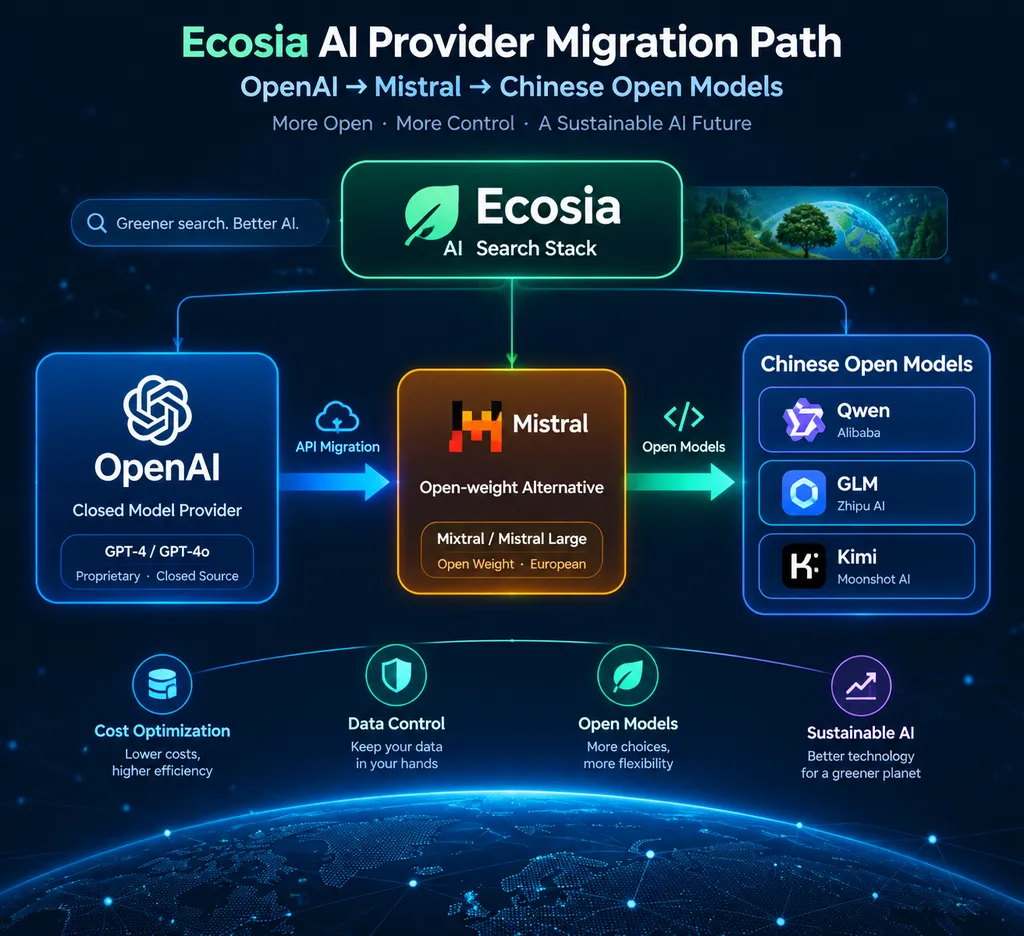
Viewed only through the lens of company nationality, this looks like a dramatic journey: from American models to French models, and finally to Chinese models. But from the perspective of technology procurement, it is quite pragmatic. Companies are ultimately not buying “models with the right values”; they are buying inference capabilities that can reliably return results in production, at a manageable cost, and with the flexibility to switch providers.
Mistral Lost on Production, Not a Benchmark
Kroll’s dissatisfaction with Mistral centers on three areas: model quality, service reliability, and whether the provider truly aligns with Ecosia’s definition of sovereignty and environmental responsibility.
The first two are clearly the most consequential.
Ecosia says it frequently encountered technical problems while using Mistral, including server overloads. For an ordinary chat user, waiting an extra ten seconds now and then may simply make for a poor experience. But for a search engine, model responses are part of the results page: one timeout can mean the entire AI summary module fails to appear.
Search is also more demanding of large models than chatbot use. It is not simply a matter of asking one question and getting one answer. In a short time, the system must interpret search results, summarize web content, remove duplicate information, organize sources, and generate a final response. No matter how capable a model is, frequent rate limits, queues, or timeouts during peak periods make it difficult to use in the core search pipeline.
That is what makes Ecosia’s decision especially notable: its criticism was not merely that Mistral lagged on a particular benchmark. The complete product, combining the model and its inference service, did not meet production requirements.
Model providers often emphasize parameter counts, coding ability, or reasoning leaderboard positions. But companies care about a different set of metrics:
- Are P95 and P99 latencies stable?
- Under high concurrency, does the service frequently return 429 errors, time out, or produce empty responses?
- Do output formats drift after model updates?
- Are tool calls and structured outputs reliable?
- At comparable quality, how many tokens does each request actually consume?
- When an outage occurs, can traffic be switched quickly to a backup model?
Put simply, benchmark performance determines whether a model makes the shortlist; reliability and cost determine whether it stays in production.
Ecosia’s decision provides an answer. According to Kroll, switching to the new setup, which uses Qwen, GLM, and Kimi, improved performance while reducing costs by about half. This figure comes from Ecosia itself. Detailed data on request volume, token consumption, and evaluation sets is not yet available, so it cannot be taken to mean that these Chinese models are half as cheap as Mistral for every task. (ithome.com)
But it does at least show that, for Ecosia’s own search workload, a multi-model open-weight setup has passed real-world business testing.
The Key Shift Is From a Single Model to a “Model Pool”
It is easy to summarize the news as “Chinese models replacing a French model,” but that is incomplete.
Ecosia has not announced that it will route every request to a single Chinese model. Instead, it is working with Melious and using Qwen, GLM, and Kimi in parallel. This looks more like a move from buying from a single provider to using a pool of models that can be assigned to tasks as needed.
The advantages of this architecture are straightforward: search summaries can use models that are fast and inexpensive; complex reasoning can go to more capable models; and long-document processing, coding, or multilingual tasks can each be routed to a better fit. If one model runs into capacity issues, traffic can be routed to another instead of taking the entire product down.
For developers, this is much like separating database reads and writes or deploying cloud services across multiple availability zones. A mature AI application should not assume that one model will always be the best, nor should it hardwire business logic to a single provider’s proprietary interface.
This is also why OpenAI-compatible formats have spread so quickly across the industry. They are evolving from one company’s API design into a de facto abstraction layer for large-model inference. As long as request formats, tool calls, and streaming outputs are sufficiently compatible, applications can switch models without rewriting their entire business logic.
Ecosia’s migration further shows that companies are shifting from “betting on a champion” to “building the ability to switch.” Qwen, GLM, or Kimi may perform best today; tomorrow it could be Mistral, DeepSeek, or a model that has not yet been released. The real assets are not model names, but a company’s own evaluation sets, routing rules, caching systems, observability, and fallback strategies.
Mistral Just Released a New Flagship, but the Timing Is Awkward
More awkwardly, around the time news of Ecosia’s provider switch emerged, Mistral released a public preview of Mistral Large 4, code-named le Chonk, on October 6.
Mistral describes it as one of the strongest open-weight models in Europe and the United States. The model has about one trillion total parameters, with roughly 49 billion activated for each inference, and is designed for tasks including coding, agents, multimodal understanding, cybersecurity, manufacturing, and finance. A preview API is available first, with model weights planned for release later in October. (ithome.com)
The timing makes it clear that Mistral knows it needs to catch up quickly with Chinese open-weight models. The problem is that releasing a stronger new model cannot immediately resolve the service capacity and reliability issues Ecosia has already encountered.
Production migrations are rarely decided by a CEO after watching a single launch event. Companies need to rebuild evaluation sets, test latency and throughput, and adjust prompts, caching, content-safety policies, and failure-handling strategies. Ecosia has already gone as far as publicly announcing a provider switch, which suggests the dissatisfaction had likely been building for some time. The release of Mistral Large 4 is unlikely to make the company reverse course immediately.
For Mistral, ML4 is a necessary technical counterattack, but it is not yet a commercial comeback. It must prove not only that the model can catch up with Qwen, GLM, and Kimi on leaderboards, but also that its inference platform can handle high-concurrency customers such as search engines.
The Definition of “European Sovereign Models” Is Shifting
Ecosia’s other criticism of Mistral centers on the word “sovereignty.”
Kroll believes that Mistral’s reliance on international investors means it cannot be considered truly sovereign. Ecosia has also questioned whether Mistral meets its environmental goals, citing the high share of nuclear power in France’s energy mix. (ithome.com)
These claims are more contentious than the concerns about model quality.
First, equating a European company’s acceptance of international capital with a loss of technological sovereignty sets an excessively strict standard. By that definition, most European AI startups that need to buy Nvidia GPUs, use global cloud infrastructure, and accept cross-border financing would struggle to qualify as fully independent.
Second, treating a high share of nuclear power as inherently inconsistent with environmental goals is not a sufficiently rigorous argument. For AI inference, it would be more useful to compare the actual energy sources of data centers, carbon intensity, GPU utilization, and energy consumption per token, rather than looking only at the energy profile of the country where a company is headquartered.
Still, Ecosia’s choice raises a more useful question: is model sovereignty determined by the nationality of the model developer, or by a company’s control over deployment, data, and supply chains?
If a European company uses an open-weight model released by a Chinese team, deploys it on European infrastructure, keeps data within a designated region, and can move to other inference providers at any time, that arrangement may offer more sovereignty in terms of engineering control than calling a closed, hosted API from a European company.
In other words, sovereignty does not necessarily mean doing everything in-house, starting with pretraining. It can also mean that model weights are available, deployment locations are selectable, interfaces are replaceable, and data flows are auditable.
This is both an opportunity and a challenge that Chinese open-weight models bring to Europe. Europe does not need to spend tens of billions of dollars retraining every foundation model. But if it only consumes other companies’ open weights without building its own inference platforms, application ecosystem, and engineering talent, it will simply be replacing one kind of dependence with another.
Chinese Open-Weight Models Are Becoming Global AI Infrastructure
Qwen, GLM, and Kimi entering Ecosia does not mean they have comprehensively beaten American and European models. It does show that they are no longer just “alternatives for the Chinese market.”
In the past, teams outside China often adopted Chinese models because they were inexpensive or offered better Chinese-language capabilities. Now, code generation, agent tasks, long-context processing, and multimodal capabilities are becoming the main selling points that bring these models into global competition.
More importantly, Chinese providers continue to release open-weight models. Companies can deploy, quantize, or fine-tune them themselves, and can migrate between different hosted platforms. This is turning models into underlying components, much like Linux distributions or database engines, that global infrastructure providers can repackage and deliver.
Of course, the industry needs to distinguish more carefully between “open-source models” and other offerings. Many models are more accurately described as open-weight: users can download the weights, but the training data, complete training code, and license permissions may not be fully open. Different versions of Qwen, GLM, and Kimi may also use different licenses. Companies should not assume they can use a model without restrictions just because a download button appears on GitHub or Hugging Face.
In addition, using Chinese models still requires addressing data compliance, licensing, content filtering, and supply-chain risks. Especially for political, news, or public-information search, refusal behavior and output bias on sensitive topics must be validated through local evaluations. Deploying a model in Europe does not automatically make its behavior neutral.
What Developers Should Learn From Ecosia’s Migration
The biggest lesson for development teams is not to rush to replace Mistral with Qwen, but to avoid treating any model as irreplaceable infrastructure.
1. Build Your Own Evaluation Set First
Generic leaderboards cannot represent real business needs. Search summaries, customer support, code review, and contract analysis all require different capabilities. At a minimum, evaluations should cover accuracy, latency, token consumption, structured-output success rates, and refusal rates, and should continuously replay real production requests.
2. Isolate Model Providers at the Interface Layer
Business code should not depend directly on request fields unique to one provider. A unified gateway can centralize prompt templates, model names, retry policies, and response-format conversion. Switching models should require more configuration changes than business-code changes.
3. Design Fallbacks for Overload and Rate Limits
A model API returning a 429 error or timing out is normal, not exceptional. Production systems should have exponential backoff, circuit breakers, backup models, cached results, and a non-AI fallback page at a minimum. The server overload Ecosia encountered is fundamentally a capacity-planning and provider-redundancy problem as well.
4. Distinguish Model Origin From Data Flow
A model trained by a Chinese company does not mean requests are necessarily sent to China; a model developed by a European company does not mean data necessarily stays in Europe. Compliance reviews should track the actual inference location, log-retention policies, subprocessors, and terms governing the use of training data.
5. Don’t Treat “Open Source” as a Substitute for Supply-Chain Audits
Open weights are only the first step. Companies also need to check licenses, model versions, quantization methods, inference frameworks, image sources, and update mechanisms. Open weights increase controllability, but do not automatically eliminate risk.
This Is Not a Simple China-versus-Europe Model Showdown
Ecosia’s decision is better understood as a procurement vote cast by a real production environment.
It shows that Mistral’s core challenge is no longer just whether it can build a model close to the frontier. It must also deliver that model reliably to large customers. For a company expected to become “Europe’s OpenAI,” that is more dangerous than falling behind on any single benchmark.
With rapid iteration, lower prices, and replaceability, Chinese open-weight models are becoming a shortcut for European companies that want to avoid the high cost of training. The ultimate beneficiaries may not be limited to Qwen, GLM, and Kimi. They may also include platform companies that control inference infrastructure, model routing, and unified APIs.
Our view is that Ecosia’s migration does not prove that Mistral is out of the race, nor that Chinese models are a year ahead in every dimension. But it clearly exposes Europe’s AI dilemma: politically, it wants homegrown models; in engineering practice, it has to choose solutions that are cheaper, more reliable, and easier to replace.
As model capabilities become increasingly commoditized, customers will not pay a reliability premium for “Made in Europe” indefinitely.
Mistral Large 4 still has a chance to prove itself, but first it needs to do something more basic than release a trillion-parameter model: make sure customers can get results during peak traffic.
Sources
- IT Home: Disappointed with Mistral, German search engine Ecosia bets on Chinese open-source AI models — The primary Chinese-language source for this article, including Ecosia’s CEO’s comments on quality, reliability, cost, and sovereignty.
- IT Home: Mistral AI releases public preview of Mistral Large 4 — Additional details on the parameter count, positioning, and release date of Mistral’s latest flagship model.
- Reddit: Community discussion of Ecosia’s switch from OpenAI to Mistral — User feedback and community context following Ecosia’s move to Mistral in May.