Lingguang 2.0: Moving from Chatting to Getting Things Done
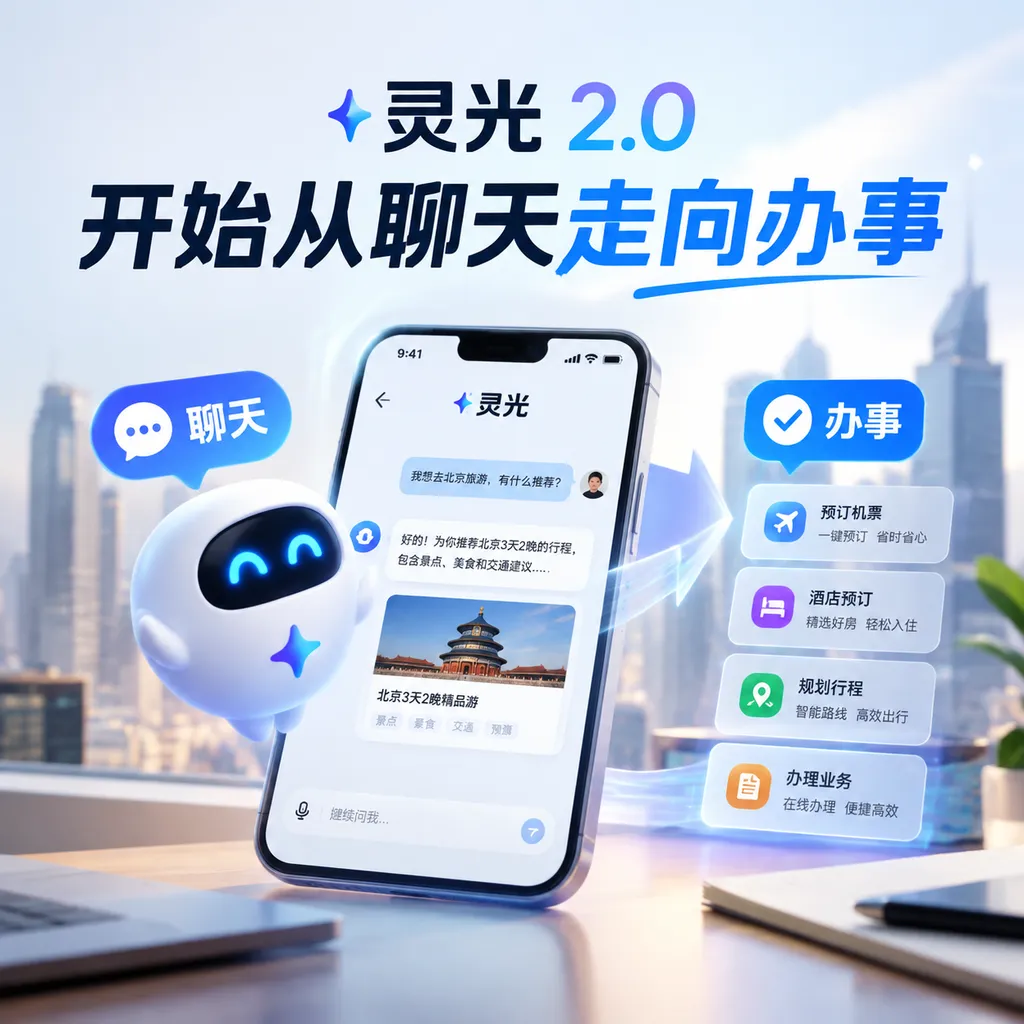
Ant Group’s AI product, LingGuang, recently began a limited beta test. Key upgrades include long-term memory, proactive task execution, and the ability to call external tools through Skills and MCP. It is not positioned as a standard chatbot, but as a personal agent capable of continuously engaging with real life.
Lingguang 2.0 Begins Moving from Chat to Getting Things Done
Lingguang, an AI product from Ant Group, recently began limited internal testing of a new version. According to people familiar with the project, the new Lingguang is positioned as a competitor to Meta’s personal agent Muse, launched this September, and is planned for full availability in October 2026.
The focus of this upgrade is neither to add another chat entry point nor to make generated applications more complex. Instead, it aims to transform Lingguang from an AI assistant that can answer questions and generate small applications into a personal agent that can remember users over the long term, continuously follow up on tasks, and call external tools to complete tasks when necessary.
In other words, Lingguang is no longer focused solely on what users are asking at a given moment. It aims to address what users may need to keep track of, assess, and move forward over the next few days, weeks, or even longer.
From One-Off Q&A to Continuously Completing Tasks
In the past, most AI assistants revolved around a single conversation: the user asked a question, and the model generated an answer; the user asked a follow-up, and the model supplemented its response based on the context. Even when models had tool-calling capabilities, many tasks still had to be actively triggered by users, with the model responsible for executing them one round at a time.
The advantages of this type of product are controllability, simplicity, and ease of understanding. But its shortcomings are also obvious: such products generally do not proactively remember what users asked them to do the previous week, much less return automatically to remind users after external circumstances change. Users have to save the context themselves, repeatedly explain the background, and constantly check whether a task has progressed.
Lingguang 2.0 is attempting to change this interaction model.
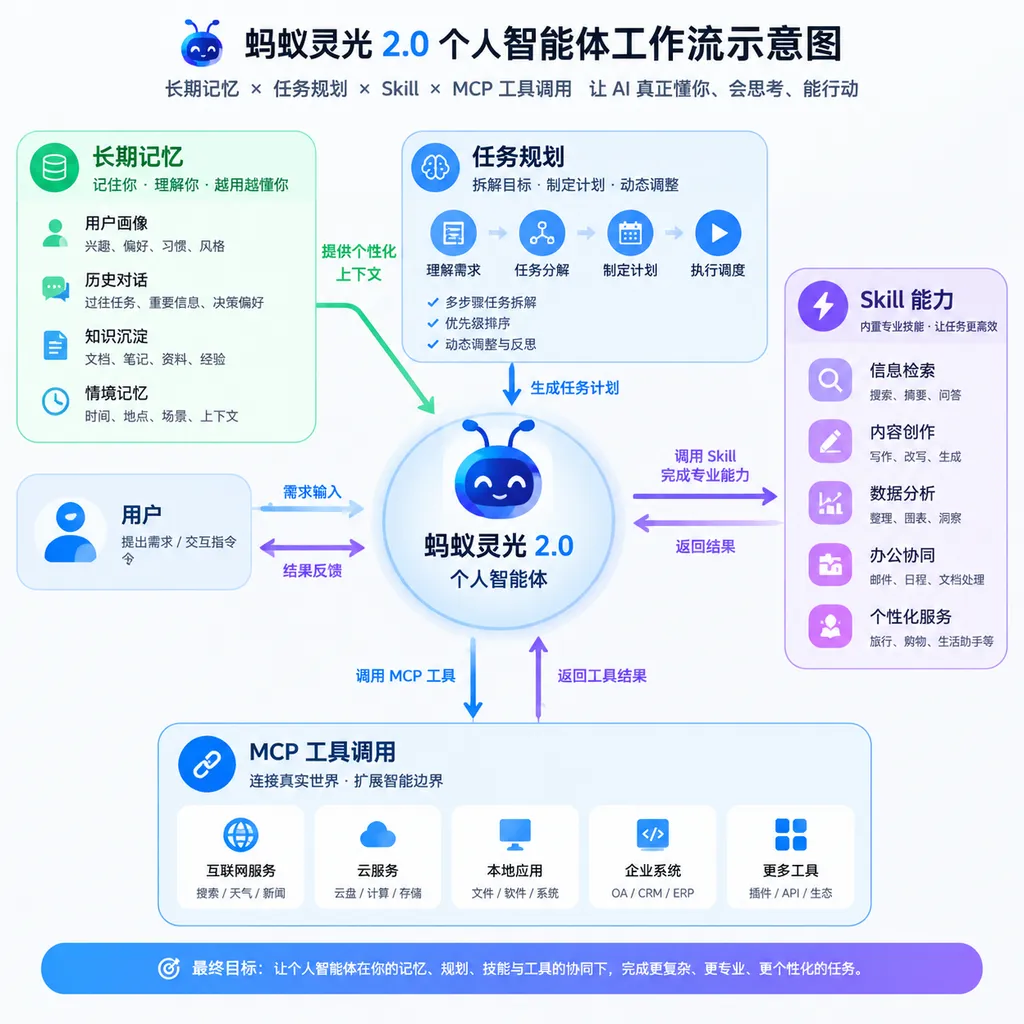
Based on the information disclosed in reference materials, the new Lingguang includes at least three major changes:
- Long-term memory: It will not only retain the context of the current session, but also remember users’ preferences, long-term goals, and ongoing tasks.
- Proactive task execution: For matters that require multiple steps, waiting for external changes, or periodic attention, the system can continue tracking them instead of waiting for users to issue the same instructions again.
- Skill and MCP calls: Through standardized tool interfaces, it can connect to external services such as DingTalk and smart-home systems, allowing AI not only to provide suggestions but also to perform actions within the scope of authorization.
Together, these three capabilities form the basic shape of a personal agent. Viewed individually, long-term memory is no longer new, and tool calling is not a new concept either. But only when a model can formulate plans based on memory, continuously observe its environment, and call tools when necessary does a product truly begin moving from a chatbot toward a task-execution system.
Internal-Test Scenarios Target the Things Ordinary People Most Easily Forget
Lingguang 2.0’s current internal-test use cases focus on long-cycle tasks with many variables—tasks that are difficult for ordinary people to monitor continuously.
For example, an office worker could ask it to track a particular type of market movement. The key is not to have the model explain why a certain stock rose today, but to have it continuously monitor a set of conditions: whether relevant companies have issued announcements, whether industry data has changed, whether market prices have broken through a certain range, and whether those changes are worth bringing to the user’s attention.
Similarly, parents could ask it to help manage their children’s DingTalk check-ins. A simple check-in reminder can be handled by a phone’s operating system. But if the task involves different schools’ scheduling rules, temporary leave, remedies for missed check-ins, and synchronizing the results with parents, it becomes a process that requires ongoing contextual understanding.
Travel is an even more typical scenario. A user may plan an itinerary before departure, but encounter flight delays, attraction capacity limits, changes in the weather, or transportation disruptions along the way. The traditional AI approach is usually for the user to ask another question, after which the system generates a new recommendation based on the latest situation. A personal agent, by contrast, should continuously monitor the status of the itinerary and, when variables arise, automatically determine whether it is necessary to change flights, adjust the route, or reschedule attractions, then notify the user of the changes.
These scenarios have one thing in common: the tasks themselves may not be particularly complex, but the changes occur outside the user’s attention. What people really need is not a model that is better at writing answers, but something that can keep an eye on matters for them and bring decisions to their attention at critical moments.
Skill and MCP Will Determine Whether It Can Truly Be Put into Practice
If long-term memory determines whether an agent can understand the user, and proactive execution determines whether it will continue working, then Skill and MCP determine whether it can actually finish the job.
At present, AI products generally follow two paths for tool calling. One is for the product provider to develop dedicated interfaces for each scenario—for example, integrating calendars, weather, maps, or payment functions within the application. This approach offers a controllable user experience, but development costs are high, and the pace of expansion is limited by the platform’s own capabilities.
The other path is to use a more general tool protocol to package external services as capabilities that models can understand and call. The model does not need to know how each system is implemented internally. It only needs to know what a tool can do, what parameters it requires, and what result it will return after execution.
In the context of Lingguang 2.0, Skill can be understood as a capability module designed for a specific task, such as sending a DingTalk message, checking a schedule, or controlling a home device. MCP is more like a means of connecting models to external tools so they can discover and call them. Together, the two address the same problem: moving agents beyond text generation and into workflows composed of real software and devices.
An ideal task-execution process might look like this:
- The user tells Lingguang to monitor an issue that is changing continuously.
- Lingguang breaks the goal down into a number of tracking conditions and review intervals.
- The system periodically calls search, data, or business tools to obtain new information.
- The model determines whether the change is important and whether user confirmation is needed.
- Once authorization has been obtained, Lingguang uses Skill or MCP to send messages, adjust schedules, or control devices.
- The system records the execution results and continues tracking subsequent developments.
This is fundamentally different from the traditional chat process. In traditional chat, the model answers questions. An agent runs a task state machine, with the model handling the judgment, planning, and tool selection within it.
The Real Challenge Is Not Whether It Can Call Tools
However, being able to send DingTalk messages or control smart-home devices does not mean that a personal agent is mature. Tool calling itself has already become an industry consensus. The real difficulty lies in balancing accuracy, proactivity, and security boundaries.
The first question is what to remember. If every chat record is stored permanently, users will soon face problems involving privacy, data leaks, and inaccurate memories. A personal agent needs to distinguish between temporary context, stable preferences, explicit authorization, and sensitive information. It must also allow users to view, modify, or delete memories. Remembering what pace of travel a user prefers and remembering their home address or financial information clearly cannot be handled in the same way.
The second question is when to act proactively. An overly passive assistant has little value, but an overly proactive one creates noise. Is a small fluctuation in market prices worth notifying the user about? Does a 20-minute flight delay require the route to be rearranged? An agent must understand task priorities, the user’s tolerance, and the frequency of reminders. Otherwise, proactivity can easily become a nuisance.
The third question is which actions can be performed automatically. Checking the weather, organizing information, and generating alternative plans can generally be automated. Sending external messages, modifying orders, making payments, or controlling door locks, however, should involve clear authorization and secondary confirmation. For a personal agent, the most dangerous outcome is not being unable to act at all, but confidently doing the wrong thing.
Therefore, whether Lingguang 2.0 can ultimately earn users’ trust cannot be judged solely by its success rate in demonstrations. It will also depend on how it handles failure, conflicts, and uncertainty. For example, when multiple tools return inconsistent data, will it pause execution? When the original task is no longer valid, will it proactively explain why? When the user does not respond for an extended period, will it continue moving forward or stop automatically?
Benchmarking Muse, but with Its Own Variables in the Chinese Market
The fact that Lingguang’s upgrade directly targets Meta Muse shows that personal agents are becoming a core area of competition in the next phase of AI assistants.
Muse represents a more complete product vision: AI is no longer merely an independent application, but is authorized to access personal data such as email, calendars, shopping, health, payments, and smart-home systems, and to handle some real-world matters on behalf of users. Its value lies not in how polished any single answer is, but in whether it can become an intermediary layer in users’ daily lives.
Lingguang’s advantages may lie in localized services and China’s domestic internet ecosystem. Workplace tools such as DingTalk, smart-home devices, and local lifestyle services are all high-frequency use cases for Chinese users. If these capabilities can be connected through a unified Skill or MCP framework, Lingguang may not need to replicate Muse’s entire approach when carrying out specific tasks.
But this also means it will face more complex systems-related problems. China’s application ecosystem is highly fragmented, and different platforms do not use unified approaches to login, permissions, messaging, or data formats. Many key services also lack stable, public, and sustainable interfaces. Even if an agent can plan tasks at the model layer, an unstable tool layer will ultimately reduce the experience to “provide suggestions and let the user do the work themselves.”
Therefore, Lingguang 2.0’s competitiveness will not be determined solely by model capabilities. It will depend on three factors working together:
- Whether the model can understand long-term goals and plan reliably;
- Whether the memory system can store user information accurately and controllably;
- Whether the tool ecosystem can provide stable, secure, and auditable execution capabilities.
The last of these is often the easiest to underestimate. For a personal agent, connecting a new tool is not difficult. The challenge is properly handling permissions, failure retries, state synchronization, and accountability boundaries after the tool has been connected.
What This Update Means for Developers
If Lingguang 2.0 becomes available in line with the direction disclosed so far, developers will need to focus on more than just model APIs. They will also need to consider how to package their services as capabilities that agents can call.
A tool designed for agents cannot simply expose a complex interface. It needs to clearly tell the model what problem the tool solves, when it should be called, which parameters it requires, which parameters must be confirmed by the user, and how failures should be handled after a call.
In other words, the entry point for future applications may no longer be for users to open an app and click a button. Instead, users may express a goal to a personal agent, which then orchestrates multiple services to accomplish it. For developers, this will create new product opportunities and change how traffic is distributed.
That does not mean, however, that every application should immediately connect its functions to MCP. The more tools there are, the more likely the model is to choose incorrectly; the greater the permissions, the higher the risks. Developers should prioritize capabilities with clear boundaries, verifiable results, and limited consequences in the event of failure—for example, querying, retrieval, status synchronization, and draft generation—before gradually expanding into writing and execution.
Ant’s Move Is Useful, but It Is Still Too Early to Draw Conclusions
From a product-direction perspective, Lingguang 2.0’s upgrade is valuable. It does not remain stuck in the old paradigm of “chat plus app generation,” but instead focuses on long-term tasks, external tools, and real-world execution. This is a necessary step for personal AI assistants to move from demonstrations toward practical use.
However, limited internal testing is still a long way from a mature product. Whether long-term memory is accurate, whether proactive reminders are appropriately restrained, whether Skill and MCP calls are stable, and whether critical actions have sufficient confirmation mechanisms all require repeated validation by real users in complex scenarios.
More importantly, the value of a personal agent is difficult to judge through a single experience. With an ordinary chat product, users can tell within a few minutes whether it is useful. An agent, by contrast, needs to run for days or even weeks before users can determine whether it truly reduces their management burden.
The significance of Lingguang 2.0 may not be that it has already created a perfect personal agent, but that Ant is beginning to shift product competition from “whose model is better at answering questions” to “who can more reliably get things done on behalf of users.” If its stability reaches a usable level after the full rollout in October, it will become a product update worth continuing to watch in China’s personal-agent sector. If it merely combines memory, reminders, and tool calling in a superficial way, it may ultimately remain a more complicated chatbot.
Lingguang 2.0 has currently begun limited internal testing, with full availability tentatively scheduled for this month. What is truly worth watching next is not how many tools it can connect to, but whether it can continuously and accurately complete—without excessive interruption and within the scope of user authorization—the things people are most likely to forget but cannot afford to get wrong.
Sources
- ITHome: Ant’s “Lingguang” Begins Limited Internal Testing, with the New Version Targeting “Meta Muse”: Discloses information about Lingguang’s new-version internal testing, long-term memory, proactive task execution, and Skill/MCP calls.
Note: This article was compiled based on publicly available reports. The specific feature set, rollout schedule, and final product form of Lingguang 2.0 are subject to subsequent official announcements from Ant Group.