
Claude Opus 5.5 Max Tops the Agent Leaderboard
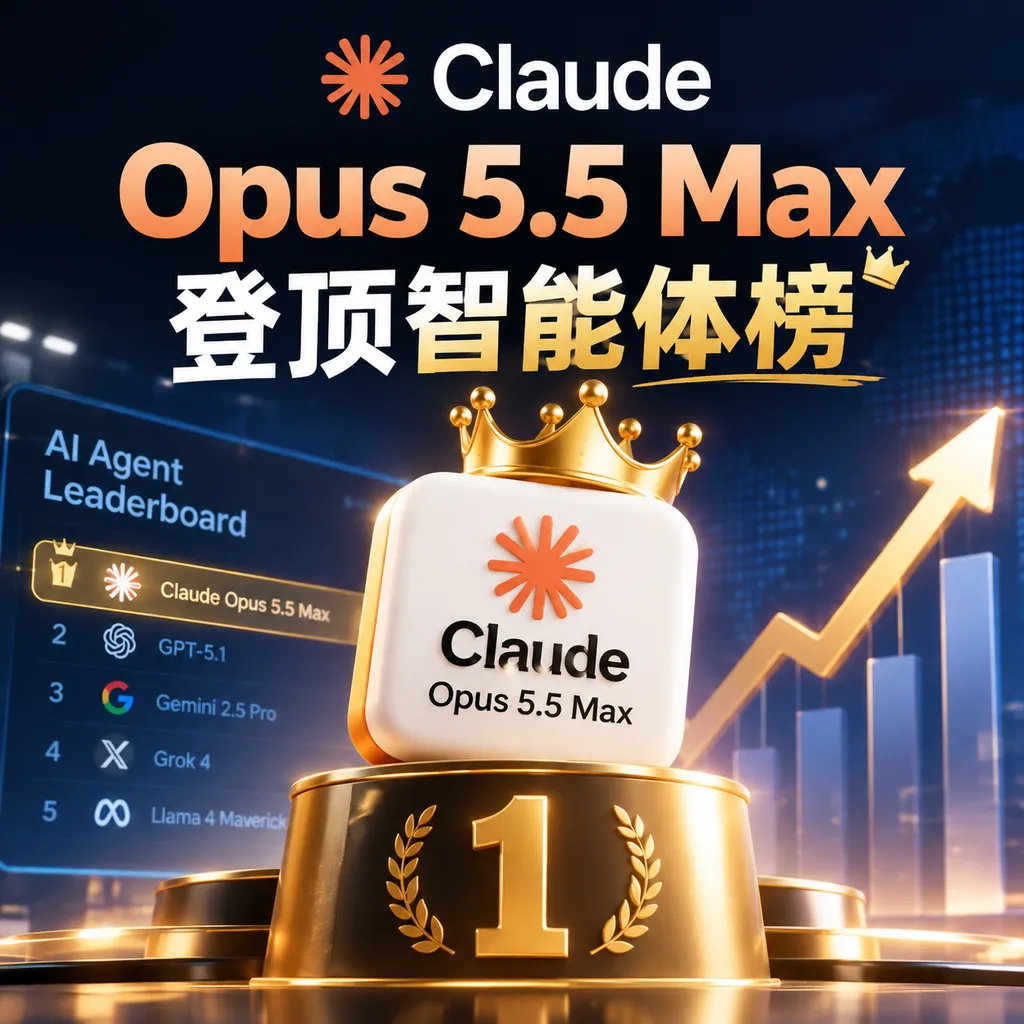
Arena released its rankings for Week 41 of 2026, with Anthropic’s new Claude Opus 5.5 Max taking first place upon its debut on the agent leaderboard. Gemini 4 Argon High continues to lead the overall rankings, while Chinese-developed models remain generally stable in the upper-middle tier.
Claude Opus 5.5 Max Takes First Place in Its First Appearance on the Rankings
Anthropic has once again pushed model competition further toward getting actual work done.
On October 12, Arena released its Week 41, 2026 AI model rankings, covering the period from October 5 to October 11. The newly released Claude Opus 5.5 Max entered Arena’s agent rankings for the first time and immediately took first place, becoming the most notable model development of the week.
This was not an ordinary rise in the overall capability rankings. Arena lists agent tasks separately, focusing on whether a model can continuously execute multiple steps toward a goal: understanding the task, planning steps, calling tools, modifying files, handling exceptions, and actually completing the job through a relatively long workflow. For developers, this type of ranking is closer to real-world usage than the “who is better at writing answers” question posed by single-turn Q&A.
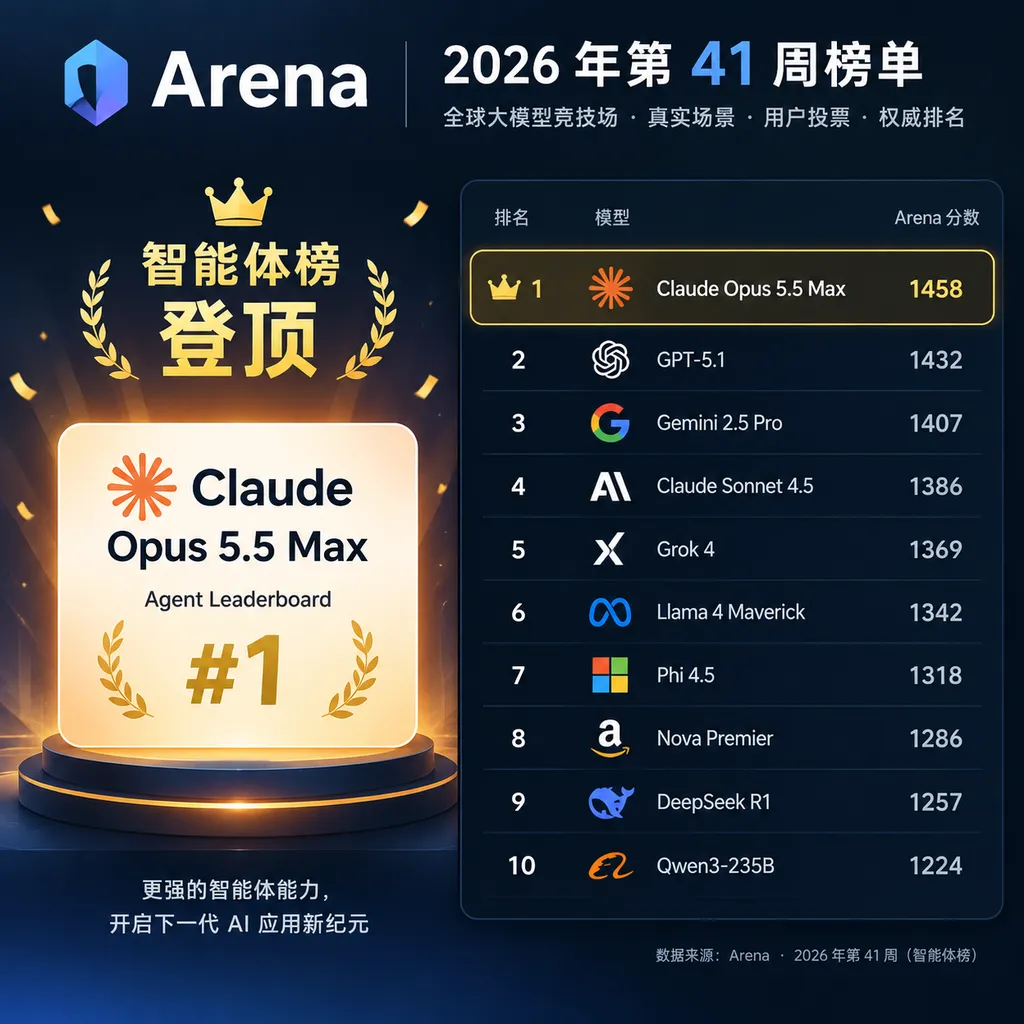
Entering the Rankings for the First Time and Taking the Top Spot Shows That It Wins on the “Execution Chain”
The significance of Claude Opus 5.5 Max lies first in the fact that it did not gradually climb from the middle of the rankings to the top. Instead, it took first place in the agent rankings upon entering them for the first time as a new model.
This usually indicates that the model has made significant improvements in certain key aspects of agent tasks, including:
- Complex task decomposition: When faced with a task whose objective is unclear and whose steps are numerous, it can first establish an execution plan instead of immediately producing an answer that appears complete but cannot actually be implemented;
- Tool-calling stability: It reduces parameter errors and ineffective calls when searching, executing code, reading and writing files, operating browsers, and performing other actions;
- Maintaining state over long workflows: Even after a dozen or more rounds of operations, it can still remember what has been completed, where it is currently stuck, and what needs to be done next;
- Error recovery: After a tool returns an error, code execution fails, or the environment changes, it can reassess the situation instead of becoming trapped in repeated attempts;
- Result verification: After completing an operation, it checks whether the output meets the objective instead of mistaking a “successful call” for a “completed task.”
None of these capabilities is entirely new, but together they determine whether a model is merely a “chatbot” or an execution engine that can be integrated into workflows. Many models perform well in single-turn code generation, knowledge Q&A, or localized reasoning, but their performance drops rapidly once a task requires continuous tool use. The value of the agent rankings lies precisely in exposing this gap.
Of course, Arena has not published enough information to support the conclusion that “Opus 5.5 Max leads across all agent tasks.” The rankings reflect user preferences in anonymous blind tests, not absolute capability tests in the laboratory sense. A more accurate statement would be: among the tasks actually compared by Arena users in this round, Claude Opus 5.5 Max received the highest overall evaluation.
The Overall Rankings Have a New King, but Anthropic Continues to Occupy the Top Tier
If we turn our attention back to the overall rankings, the top-tier structure has not fundamentally changed.
Google’s gemini-4-argon-high remains in first place, with an ELO score of 1525. Anthropic has multiple models in the top four: claude-opus-5.5-high rose two places to second, with a score of 1507; claude-opus-4-6-high ranked third, with a score of 1504.
There is still a gap between the first- and second-place models, but Arena also specifically notes that differences of less than 30 points should be understood in conjunction with confidence intervals and should not be simply interpreted as definitive generational superiority. In other words, the overall rankings are better viewed as a dynamic competition among a group of highly capable models than as an absolutely clear dividing line in capability.
This edition of the overall rankings also added two models:
- gpt-5.5 ranked 29th, with an ELO score of 1477;
- gemini-3.5-flash-medium ranked 30th, with an ELO score of 1476.
When new models first enter the rankings, the number of votes is usually insufficient, so their positions can be easily influenced by the composition of the sample. Therefore, these two rankings are better viewed as their initial positions; changes over the following weeks will be more meaningful.
It is worth noting that Anthropic continues to have a strong presence at the top of the overall rankings, but the most impactful change this time came from the agent rankings. This indicates that competition among model providers is continuing to shift from “answer quality” toward “task completion rates.”
Chinese Models Remain Steady in the Upper Middle Tier but Have Yet to Break into the Front Ranks
Chinese models performed steadily overall this week, with no major fluctuations.
Moonshot AI’s kimi-k3-max remained in 16th place in the overall rankings, with an ELO score of 1488; Alibaba’s qwen3.8-max ranked 22nd, with an ELO score of 1483, up one place from last week; Xiaomi’s mimo-v2.6-pro ranked 26th, with an ELO score of 1480; and Zhipu AI’s glm-5.3-max ranked 27th, with an ELO score of 1478.
This result can be viewed on two levels.
First, Chinese models are no longer marginal participants in the rankings. Multiple models have consistently remained in the top 30, indicating that their stability in comprehensive Q&A, coding, Chinese-language understanding, and general reasoning tasks has received a certain degree of validation. In particular, kimi-k3-max has remained in the top 20 for an extended period, suggesting that its ranking is not the result of a one-time burst of performance but of relatively consistent user feedback.
Second, stability does not equal a breakthrough. Compared with the models at the very top of the rankings, Chinese models currently resemble “reliable upper-middle-tier options,” but they have yet to establish a sufficiently strong leading advantage in complex agent workflows, long-horizon planning, and cross-tool execution. What will truly be worth watching next is not whether a particular model can occasionally enter the top ten, but whether it can remain competitive across different rankings, task types, and longer time periods.
This is also the biggest difference between the Arena rankings and launch-event evaluations: launch events typically showcase a model’s strongest examples, whereas Arena more closely reflects the choices of a large number of anonymous users who do not know the models’ identities in advance. For developers, the latter offers a better indication of what a model may encounter after being integrated into a product.
Are the Agent Rankings More Useful Than the Overall Rankings for Developers?
The answer depends on what you are building.
If a project primarily involves knowledge Q&A, text rewriting, summarization, or ordinary code completion, the overall rankings remain useful. A model’s language quality, knowledge coverage, response speed, and price are often more important than whether it can autonomously operate a dozen tools.
However, if you are building any of the following products, the agent rankings should be given significantly more weight:
- Coding agents: Automatically reading repositories, modifying multiple files, running tests, and submitting patches;
- Research agents: Searching for materials, organizing evidence, generating reports, and conducting additional searches based on gaps;
- Browser automation: Logging into systems, filling out forms, downloading files, and handling exceptional states on webpages;
- Enterprise process automation: Connecting CRMs, ticketing systems, databases, and internal knowledge bases to complete cross-system tasks;
- Multi-step data analysis: Reading data, writing scripts, generating visualizations, and reanalyzing anomalies.
In these scenarios, one additional minor error at each step can cause the overall success rate to drop significantly. A model with 90% accuracy on single-turn responses is not necessarily better suited to serve as the core of an agent than a model with slightly lower single-turn accuracy but the ability to self-correct after failures.
Therefore, the most noteworthy aspect of Claude Opus 5.5 Max taking first place in the agent rankings on its first appearance is not that “there is another number-one model,” but that Anthropic may be further concentrating its capabilities on executing long workflows. For developers who genuinely need tasks to be completed automatically, this direction is more important than a promotional slogan on a leaderboard.
Test Through a Unified Interface—Don’t Look Only at Ranking Positions
Arena’s rankings are suitable for screening candidate models, but they should not directly replace product evaluations. Real-world systems must also consider context length, tool-calling formats, latency, rate limits, pricing, output stability, data compliance, and other factors.
For agent applications in particular, it is recommended to prepare at least three types of internal test sets:
- Success set: Standard tasks that the model should be able to complete in one attempt;
- Interference set: Tasks containing ambiguous instructions, irrelevant information, and tool errors, used to test whether the model will perform incorrect operations;
- Recovery set: Intentionally causing one step to fail and observing whether the model can identify the cause and continue execution.
If you want to quickly compare Claude Opus 5.5 Max with other mainstream models, you can connect through OpenAI Hub’s unified OpenAI-compatible API and switch models without changing your business code. An example configuration is shown below:
from openai import OpenAI

client = OpenAI(
    api_key="YOUR_OPENAI_HUB_KEY",
    base_url="https://openai-hub.com/v1"
)

response = client.chat.completions.create(
    model="claude-opus-5.5-max",
    messages=[
        {
            "role": "user",
            "content": "Please analyze the causes of the current project's test failures, provide a remediation plan, and explain how each step should be validated."
        }
    ],
    temperature=0.2
)

print(response.choices[0].message.content)
When integrating in practice, developers should still refer to the platform’s currently available model names, context limits, and billing rules. For agent tasks, it is recommended to log tool calls, final results, and intermediate states, then conduct horizontal comparisons using success rate, average number of steps, failure recovery rate, and cost per task, rather than judging solely by the impression created by a single conversation.
Beyond the Rankings, the Real Competition Is Just Beginning
The signal released by this week’s Arena rankings is clear: the gap between leading comprehensive models is becoming increasingly difficult to explain through a simple ranking position, and competition is shifting toward more specific workflow capabilities.
Gemini 4 Argon High continues to hold first place in the overall rankings, while multiple Anthropic models remain strong in both the overall and agent rankings. Claude Opus 5.5 Max taking first place in the agent rankings on its first appearance at least indicates that it has earned user recognition in the effort to “keep models working continuously.” Chinese models have maintained their upper-middle-tier positions. In the short term, the priority is not a dramatic rise in the rankings, but continued improvement in stability and controllability during long-workflow tasks.
However, it is also important to note that Arena is a dynamic leaderboard. It is based on anonymous blind-test voting, the agent rankings use percentage-based signals, and results from different sub-rankings cannot be directly compared horizontally. New models also need to accumulate enough votes before their positions become more stable. Being number one today does not make a model the final answer for every scenario.
For developers, the more practical conclusion is this: add Claude Opus 5.5 Max to your pool of candidate agent models, with a particular focus on testing its completion rate and recovery capabilities in real toolchains. At the same time, retain multiple models as alternatives, using routing, fallback mechanisms, and task allocation to hedge against the uncertainty of relying on a single model. Model leaderboards can tell you where to start, but whether a model is worth deploying is ultimately determined by your task data and production metrics.
References
- IT Home: Arena Releases a New Round of Weekly AI Model Rankings — Provides information on the Arena Week 41, 2026 rankings, model positions, and evaluation methodology.